
Your denials are creeping up, your A/R is aging, and your billing team is spending more time chasing problems than preventing them. That's usually the point where a CFO or practice owner starts asking the right question, not “Do we need more billing help?” but “Which part of the revenue cycle is leaking cash, and what should we fix first?” Revenue cycle consulting exists for that moment, when the operation has outgrown the people, process, and systems currently carrying it.
The mistake most organizations make is treating this like a back-office cleanup project. It isn't. The strongest consulting work looks at the full operating model, from scheduling and eligibility to claims, denials, patient liability, and final reconciliation, because leakage upstream is what keeps showing up downstream.
Table of Contents
- Where Revenue Cycle Consulting Fits in a Struggling Practice
- What Revenue Cycle Consulting Is
- Core Services Inside a Revenue Cycle Consulting Engagement
- The KPIs That Prove Consulting Is Working
- Engagement Models and How Pricing Works
- How to Choose the Right Revenue Cycle Consulting Partner
- Real-World Examples of What Consulting Changes
- Your Next Step and How to Start a Complimentary Review
Where Revenue Cycle Consulting Fits in a Struggling Practice
A practice usually doesn't wake up one morning and decide to bring in a consultant. The trigger is more like this. Denials that used to be manageable start piling up, claims sit in queues longer than they should, and the in-house biller is now doing follow-up work that belongs to a team, not one exhausted person. Leadership can feel the cash pressure, but can't tell whether the problem is weak front-end capture, sloppy billing, or a tech stack that's getting in the way.
That uncertainty is exactly where revenue cycle consulting fits. It gives you a structured diagnosis instead of another opinion from inside the same broken workflow. Industry evidence has long linked consulting engagements to financial gains, and the most commonly cited wins are improved cash receipts and reduced A/R days, each reported by 61% of respondents in a published analysis of revenue cycle transformations PubMed analysis of revenue cycle transformations.
The real warning signs show up early
If you're seeing errors at registration, eligibility misses, slow claim submission, or a backlog of patient balances, the issue is not isolated. Those front-end failures travel through the whole cycle and surface later as denials, rework, and write-offs. In that sense, consulting is not a luxury add-on. It's a reset when the current operating model is no longer protecting cash.
Practical rule: If your team keeps asking, “Why did this claim fail?” instead of “How do we stop this class of failure?” you've already crossed into consulting territory.
The other reason consulting becomes relevant is scale. Once a practice grows, the old habit of having one strong billing person hold everything together stops working. At that point, the right move is not more heroics. It's redesign.
What Revenue Cycle Consulting Is
Revenue cycle consulting is the diagnosis and redesign of a healthcare organization's financial workflow. It is not billing support, and it is not software. A real engagement examines how money moves from the first patient touchpoint through final payment, then identifies where avoidable leakage is happening and what needs to change in process, staffing, controls, and tooling.
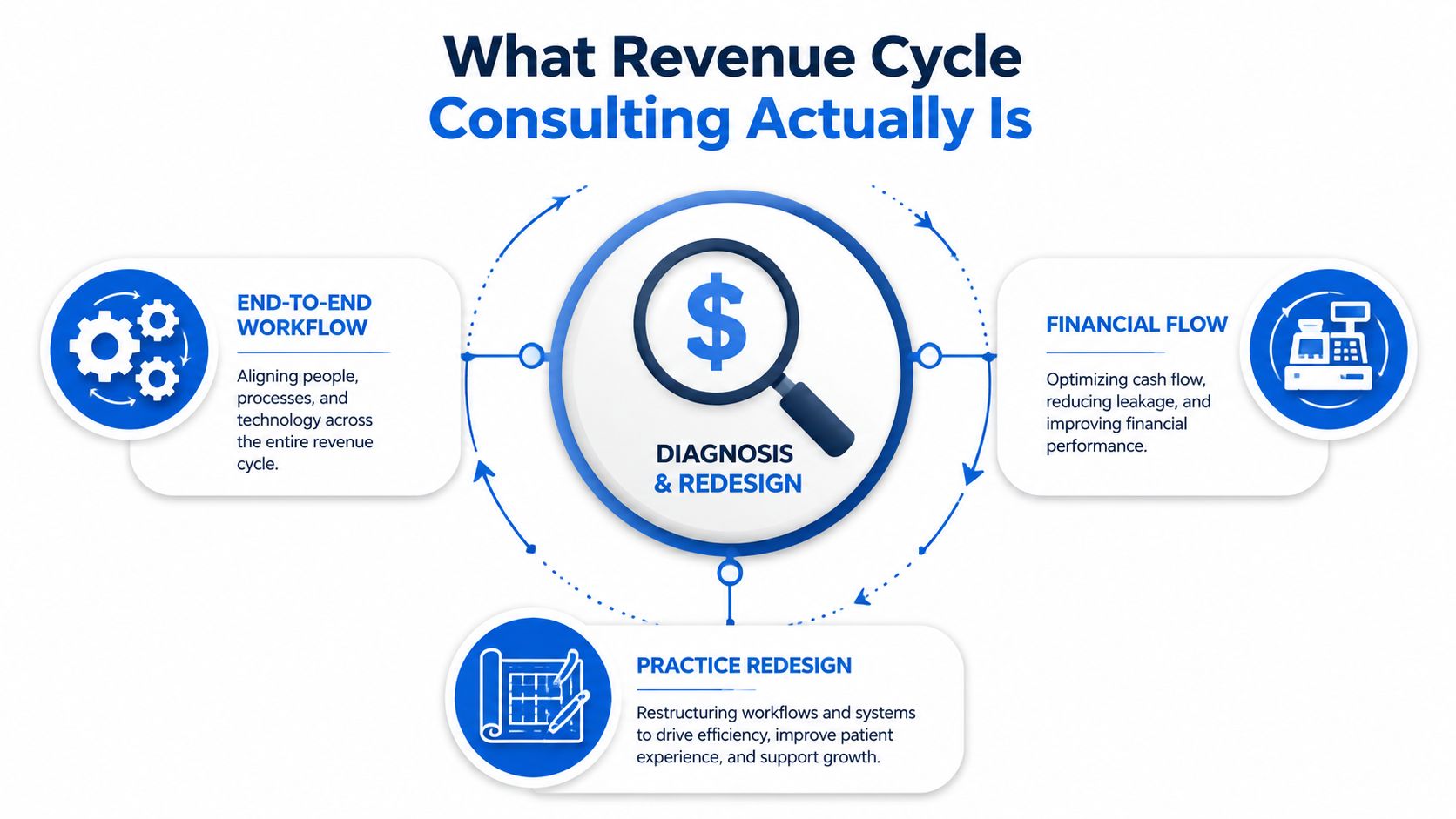
The cleanest way to separate consulting from other RCM services is to ask what problem is being solved. Consulting solves design problems. Outsourced RCM solves execution problems. Software solves visibility and speed problems. A consulting engagement should tell you what to change, why it is failing now, and how to run the operation better after the redesign.
The full workflow matters because revenue cycle work does not fail in one place. It starts with scheduling, eligibility verification, demographic capture, and authorization, then moves into charge capture, coding, claim creation, denial handling, patient billing, and reconciliation. When one step is weak, the rest of the chain pays for it. Industry KPI frameworks treat those early steps as leading indicators because they shape clean claim rate, denial volume, days in A/R, and net collection rate, rather than acting as isolated admin tasks revenue cycle KPI framework.
Plain truth: If a vendor only talks about downstream follow-up, they are selling half a solution.
A good screen for buyers is simple. Ask whether the engagement includes process assessment, redesign recommendations, performance measurement, and operational follow-through. If the answer is only “we'll handle billing,” that is staffing, not consulting. If you want a clearer view of the broader operating model behind those steps, the overview of revenue cycle management is the right starting point.
The strongest consulting teams do not stop at identifying defects. They help leadership decide what gets fixed first, what gets automated, and what must stay manual because the risk is too high. That distinction is where the core value lives.
Core Services Inside a Revenue Cycle Consulting Engagement
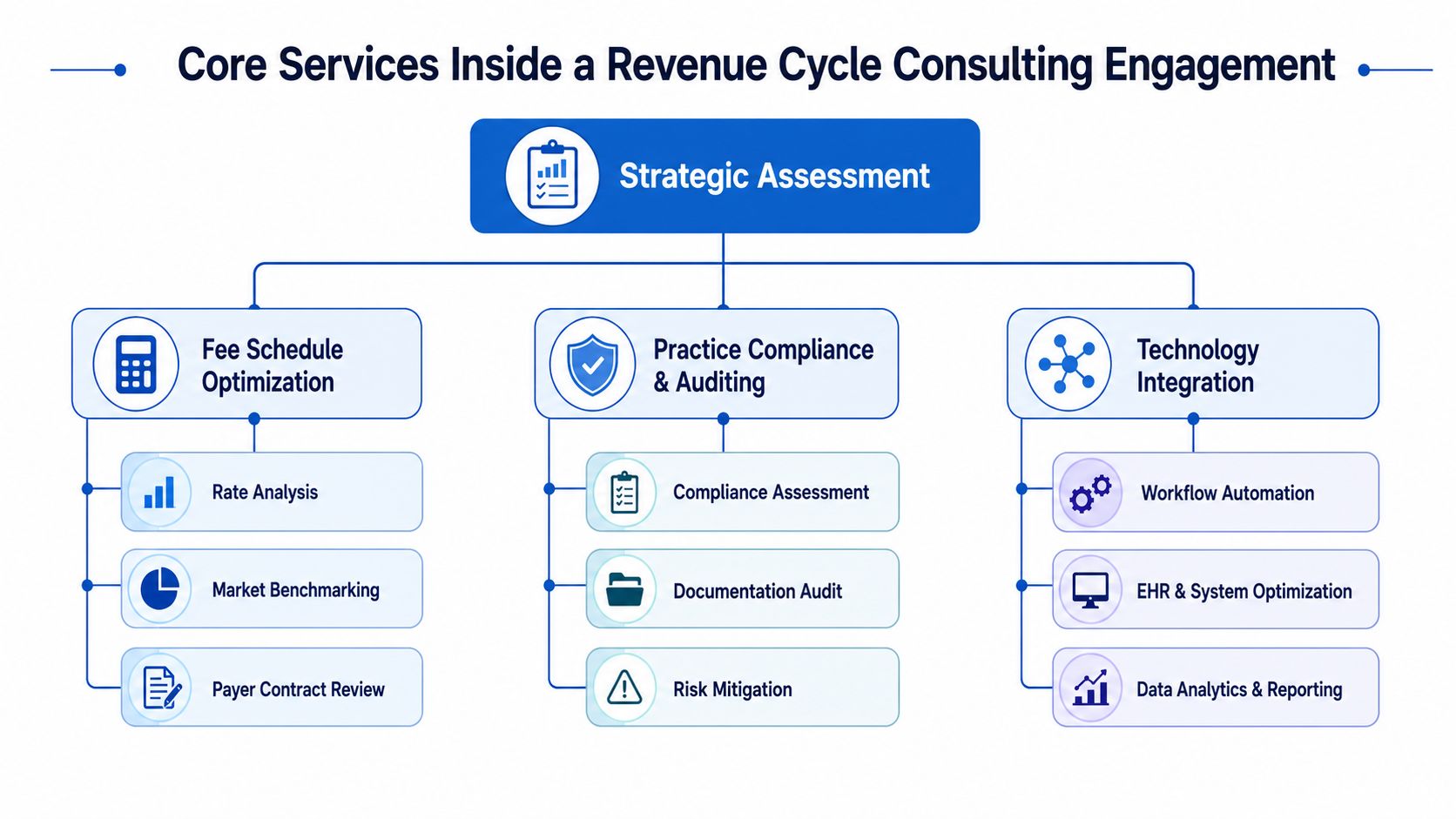
A serious engagement starts with a strategic assessment, then moves into the work that changes cash performance. A consultant should be looking at fee schedule setup, billing operations support, benefit verification, claim status follow-up, payment posting, denial management, and patient responsibility workflows. The job is not to check boxes. It is to remove failure points that keep revenue trapped.
Each service should map to an operational result
Fee schedule and practice management setup determines whether your charge master and system rules support correct billing from the start. If that foundation is off, every downstream step gets distorted.
Insurance benefit verification is more than confirming coverage. It lowers front-end denials and cuts the number of claims that fail because the team did not verify eligibility or patient responsibility correctly.
Claim status and payment posting matter because a clean remittance process shows what got paid, what did not, and what needs appeal or correction. Treating posting as a mechanical task leaves systemic errors in place. That is also why teams should tie posting and follow-up to revenue cycle analytics that show where breaks are occurring.
Denial management is where many providers feel the pain, but it should not be the first place the consultant looks. It is the repair zone, not the origin point.
The scope is heavily concentrated in claims and denials
Claims and denial management alone accounted for 33.40% of 2025 revenue across the global revenue cycle management market, which shows how much of the work still sits in verification, claim follow-up, and payer response handling Grand View Research market analysis. That concentration matters because it tells you where vendors spend time and where buyers should expect the highest operational payoff.
The right engagement does not overload your team with a giant punch list. It isolates the few workflow failures causing most of the leakage, then fixes those first. A good consultant should tell you whether your problem is front-end, middle-cycle, or post-service. If they cannot separate those layers, they are guessing.
The KPIs That Prove Consulting Is Working
A consulting engagement should change the operating rhythm of the practice, not just the slide deck. If the work is real, you see cleaner claims, faster cash movement, fewer avoidable denials, and tighter control over the steps that create rework. Measure the consultant against those outcomes, and keep the scoreboard tied to the exact workflow they touched.
| KPI | What It Measures | Target Range | Where Consulting Acts |
|---|---|---|---|
| Clean Claim Rate | How many claims go out without errors | Higher is better, usually above common industry expectations | Front-end verification, coding review, claim edits |
| Days in A/R | How long money sits uncollected | Lower is better, with most teams trying to keep it under control | Follow-up cadence, denial work queues, posting discipline |
| Denial Rate | How often payers reject or deny claims | Lower is better, with leaders trying to keep it tight | Eligibility, prior auth, documentation, payer rule handling |
| Net Collection Rate | How much collectible revenue is actually realized | Higher is better | Entire workflow, from capture to final reconciliation |
Use leading indicators before you wait for lagging results
The best consultant dashboards do not wait for month-end reports to tell the story. They track eligibility verification accuracy, charge lag, and time to first claim submission, because those are the early signals that show whether the workflow is healthy before cash numbers catch up. If you want a practical benchmark, claim submission should happen in under 2 days from date of service, and claims that sit in submitted or accepted status beyond 30 days deserve immediate review, as outlined in claim turnaround guidance.
That timing matters because delays create preventable friction at every stage. A slower front end gives denials more room to surface, extends the cash cycle, and pushes work into a deeper follow-up queue that costs more to clear. A consultant who understands operations should remove the delay at the source, not just chase aged accounts after the damage is visible.
Denials are still under pressure across the market, and that is exactly why many practices bring in outside help. Guidehouse survey data summarized in industry reporting shows that a meaningful share of healthcare leaders report denial rates above common thresholds, and the share reporting higher denial levels has grown enough to force attention Guidehouse survey data summarized in industry reporting.
A useful consulting engagement should make those metrics move in the right direction, but it should also show why they moved. If clean claims improve while denial patterns stay flat, the consultant fixed only part of the process. If days in A/R falls without better front-end controls, the practice may just be working down old inventory. The stronger read comes from pairing the financial KPIs with the workflow drivers behind them, which is why teams should review healthcare revenue cycle analytics alongside the core revenue numbers.
Bottom line: if a consultant cannot show improvement in both the workflow drivers and the financial KPIs, the engagement is cosmetic.
Engagement Models and How Pricing Works
A practice with broad leakage across intake, claims, denials, and collections needs a different engagement than one with a single bottleneck. That is the first decision point, because the wrong model wastes time and hides the essential fix.
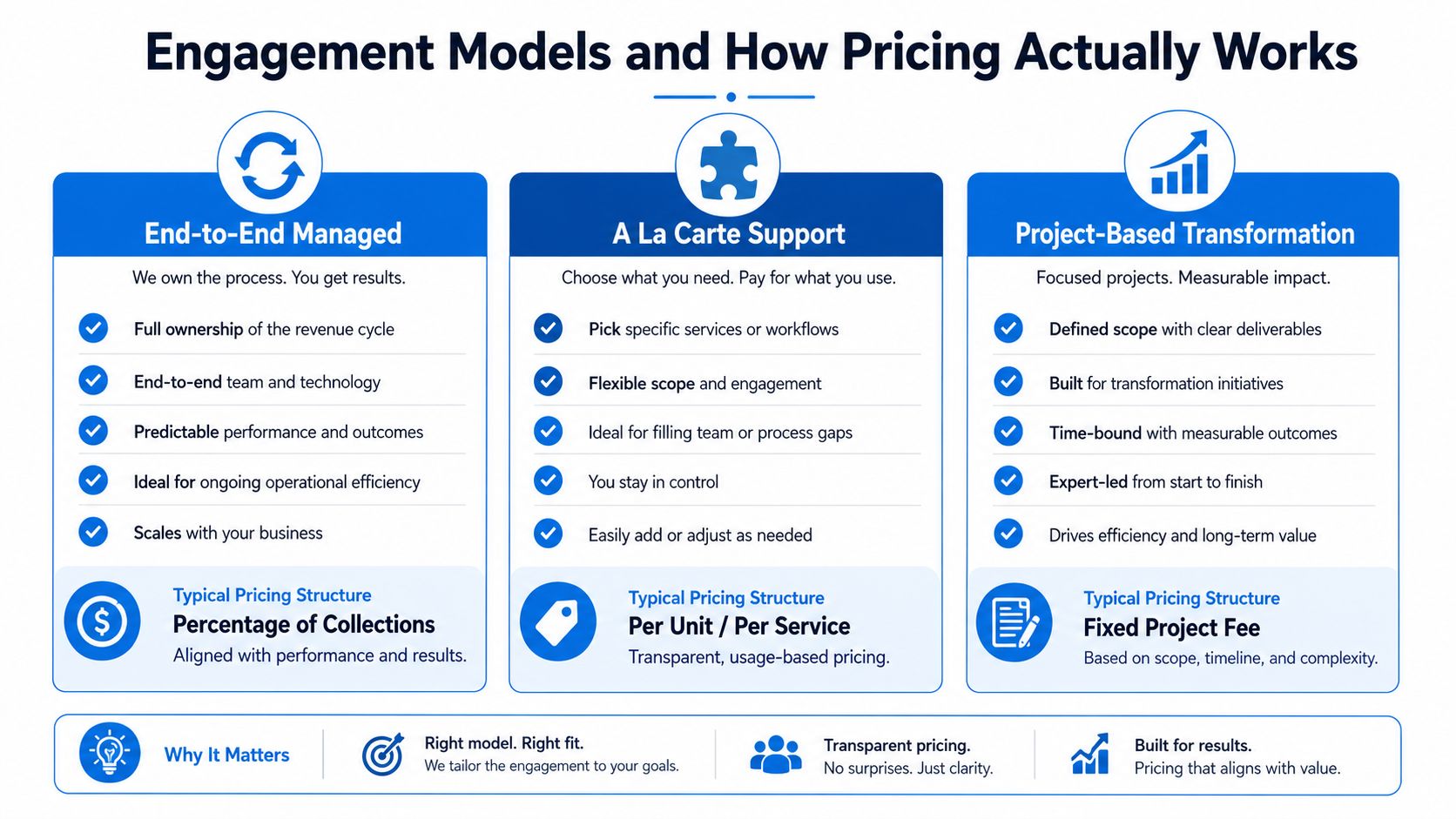
Consulting usually comes in three shapes. End-to-end managed revenue cycle gives the partner control over a broad slice of the operation. A la carte support covers one or two functions, such as denial work or benefit verification. Project-based transformation focuses on assessment, redesign, and implementation rather than ongoing operations.
Match the model to the problem
If the whole cycle is underperforming, a broad managed model usually earns its keep. If one workflow is dragging the rest down, a targeted engagement is cleaner and cheaper. If the operation mostly works but needs redesign, a project model is the right fit.
Pricing should follow scope, not marketing language. Percentage-of-collections pricing is common in outsourced arrangements because it scales with performance and volume. Fixed-fee pricing works better for defined projects because it gives you a clear scope and tighter budget control. Per-claim or per-encounter pricing can work, but only when volume and workflow stay stable enough for both sides to understand the economics.
PwC-referenced market summaries point to end-to-end revenue cycle transformation as a path to higher net revenue PwC-referenced market summary. That is the opportunity you are trying to recover, so the fee only makes sense if the work is aimed at real leakage.
Read the proposal like a CFO, not a shopper
Look for assumptions. Volume assumptions, payer mix assumptions, turnaround assumptions, and what counts as out of scope. If the proposal does not make those explicit, the price is not really the price. It is a starting point for change orders.
Use a straight comparison of engagement models, pricing structures, and business benefits before you sign anything. The clearest view is often a simple side-by-side review, and the right partner should be willing to walk through it without hiding behind jargon.
The video below is useful if you want a quick visual on how the engagement shapes the economics.
The key is fit. A firm paid only to process volume may move quickly but miss root-cause fixes. A project consultant may deliver a cleaner design but leave execution to a team that is already stretched. Pick the model that matches the problem you are trying to solve.
How to Choose the Right Revenue Cycle Consulting Partner
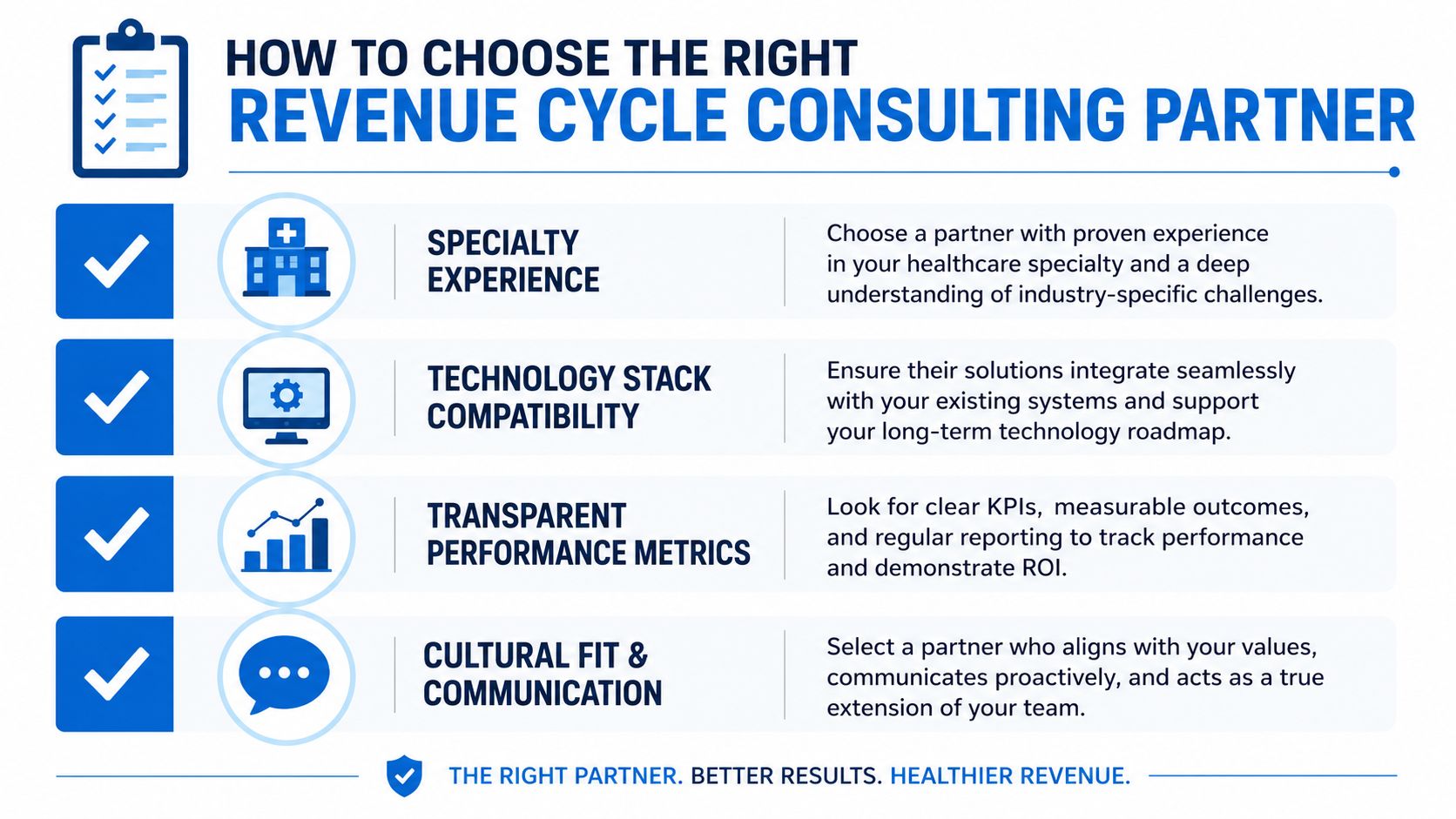
Don't buy a pitch deck. Buy operating discipline. The right partner should show specialty experience, technology compatibility, transparent metrics, and the ability to work without creating chaos inside your team. If they can't do that, the rest doesn't matter.
Ask questions that expose weak operators
Specialty experience. Ask which specialties they've worked in, not just which healthcare categories they claim. Payer rules and workflow friction vary too much to assume one model fits all. If they can't talk specifically about your specialty, move on.
Technology stack compatibility. Ask how they handle your practice management system, clearinghouse, and analytics tools. A partner who can't work cleanly with your existing environment will slow you down.
Transparent performance metrics. Ask what they report weekly, how they define success, and what happens if metrics stall. That question matters more than any polished proposal language. If they won't show the measurement model, they're hiding something.
Cultural fit and communication. Ask who your day-to-day contact is and how issues get escalated. Revenue cycle work breaks when communication gets vague.
A useful vendor filter is operational cadence. Industry guidance targets claim submission in under 2 days from date of service and flags claims stuck in submitted or accepted status beyond 30 days as requiring investigation claim cadence guidance. If a vendor can't run to that rhythm, they're not ready for your environment.
You can also use this overview of healthcare RCM companies to compare how different firms frame scope and delivery. Just don't let branding decide the deal. Let operating clarity decide it.
Red flag: If a prospective partner talks mostly about staffing relief and barely mentions workflow redesign, they're selling labor, not consulting.
The fear of losing control is real, and it's valid. The fix is a defined scope, clear reporting, and a contract that lets you see the work queue instead of just the monthly invoice. That's how you avoid getting trapped in a bad arrangement.
Real-World Examples of What Consulting Changes
A small primary care practice usually feels the pain first at the front desk and in claim rejections. One familiar pattern is an overwhelmed in-house biller struggling with eligibility misses and coding inconsistency. In that setup, consulting typically changes the intake script, the verification workflow, and the review process before claims go out. The result is less rework and a cleaner path to payment.
A mid-size behavioral health group often has a different problem. Credentialing and payer enrollment lag behind growth, so claims go out under the wrong setup or not at all. When consulting tightens those functions, the revenue lift comes from stopping preventable leakage, not from squeezing the same claims harder.
A multi-site specialty group usually has the hardest coordination problem. Billing is fragmented across locations, each site works its own way, and leadership has no clean line of sight into cash performance. A consulting engagement often centralizes RCM, standardizes rules, and creates one operating rhythm, which is how organizations get out of local inconsistency and into a controlled workflow.
The important caveat is that results depend on the starting point, payer mix, and scope of change. A practice with a broken front end needs a different fix than a group with a decent process but weak follow-up. Consulting pays when it removes structural leakage. It falls short when leadership wants a report but won't change the operation.
Your Next Step and How to Start a Complimentary Review
Start with your own numbers. Pull 90 days of denials by reason code, review A/R aging by payer, and check clean claim rate before you talk to anyone. HFMA guidance recommends building a data hub and integrating analytics before scaling automation, which is why measurement should come first HFMA guidance on analytics and automation.
From there, a complimentary review should tell you where the leakage is, what to fix first, and whether you need full-service support, a targeted engagement, or a focused project. That conversation should feel diagnostic, not pushy, and it should leave you with a concrete path forward.
Clarity offers a complimentary review of your current revenue cycle, then maps the fixes that matter most for efficiency, accuracy, and profitability. If you want a candid diagnosis of where cash is leaking and what to automate first, visit Clarity and start there.
No responses yet