
CMS's own outpatient psychiatric care compliance data show that insufficient documentation accounted for 78.3% of improper payments in the 2024 reporting period. The practical answer is simple, most behavioral health CPT denials are not really coding problems, they're documentation failures dressed up as claim errors.
Table of Contents
- Why CMS Behavioral Health CPT Denials Keep Multiplying
- The Four Denial Categories CMS Tracks
- Rewriting the Behavioral Health Progress Note to Support Medical Necessity
- Front-Door Controls That Stop Denials Before the Claim Is Built
- Cleaning Up the Claim Before It Leaves the Building
- Running the Denial Backlog and Writing Appeals That Win
- The 30-60-90 Day Plan to Keep CMS Behavioral Health CPT Denials From Returning
Why CMS Behavioral Health CPT Denials Keep Multiplying
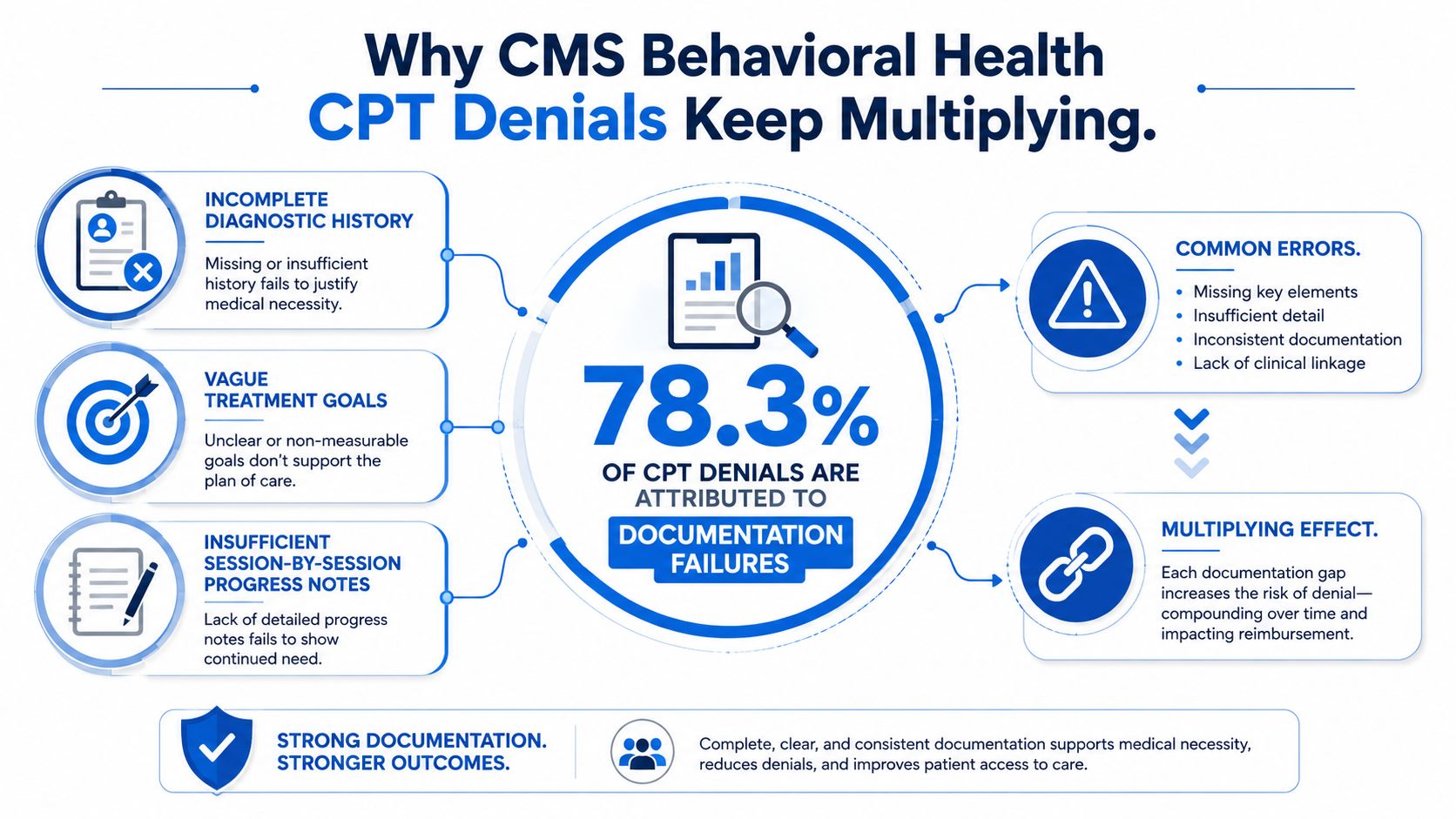
CMS behavioral health CPT denials keep multiplying because the service is often clinically real but administratively under-documented. In the 2024 reporting period, CMS said insufficient documentation made up 78.3% of improper payments for outpatient psychiatric care, while no documentation accounted for 17%, incorrect coding 2.6%, and other errors 2% CMS outpatient psychiatric care compliance data. That split matters because it tells you where the leak starts.
The real failure is usually in the note
A lot of teams still chase denials as if the CPT itself is the culprit. In practice, the billed code often reflects the service that happened, but the chart doesn't prove it cleanly enough for Medicare review, payer utilization management, or post-payment audit.
That's why behavioral health gets more scrutiny than many other specialties. The note has to connect the diagnosis, the intervention, the treatment plan, and the continued need for care in a way that survives review, not just internal billing rules. If the documentation looks thin, payers don't have to argue about the session, they can deny the support for the session.
Practical rule: if the note would not convince an outside reviewer in under two minutes, it is not ready to bill.
The operational mistake I see most often is treating denial work as an appeals problem instead of a documentation control problem. Appeals matter, but they're downstream. The first fix is making sure the clinician's record explains why the visit was necessary, why the selected code fits, and why the care continued.
Where the energy should go first
Before anyone writes another appeal, the team should sort denials by root cause and ask a blunt question, did the record support the service or not? If the answer is no, the fastest win is not a better appeal letter, it's a better note template and better clinician training.
That reframes the entire workflow. Coding still matters, authorization still matters, and payer rules still matter, but none of those will save a chart that cannot stand on its own. For a useful coding-specific cross-check on longer psychotherapy visits, see the internal guide on how to bill 90837.
The Four Denial Categories CMS Tracks
CMS's psychiatric compliance data are useful because they compress the mess into four buckets. Once the denials are sorted that way, each pattern points to a different control, and the backlog becomes manageable instead of vague.
| CMS Behavioral Health Denial Categories and the Control That Stops Each | ||
|---|---|---|
| Denial Category | Share of Improper Payments | Primary Operational Control |
| Insufficient documentation | 78.3% | Note template, clinician training, pre-bill documentation audit |
| No documentation | 17% | Hard stop before charge entry, missing-note queue, same-day completion rule |
| Incorrect coding | 2.6% | EHR charge scrubber, coding review, CPT-to-service crosswalk |
| Other errors | 2% | Exception log, payer-specific follow-up, escalation review |
The table is not just a way to label denials. It tells you where the control failed and which team should own the fix. A missing note calls for a workflow control that blocks billing entirely. An incorrect code needs coding logic. A documentation gap needs clinical documentation redesign.
Build the control around the bucket
A denial dashboard should never say only “behavioral health denial.” That is too broad to act on. It should show which bucket the denial fell into, who owned the fix, and whether the claim was stopped before submission or denied after payment review.
If the category is no documentation, the team needs a stop-gap before charge entry. If the category is insufficient documentation, the fix belongs in clinician templates, audits, and education. If the category is incorrect coding, the billing team should review unit logic, code selection, modifiers, and service-to-code matching in the EHR.
The fastest way to reduce rework is to stop using one denial playbook for four different failure modes.
Generic denial reports from the practice management system often hide the pattern you need to see. They can blend unrelated payer behaviors and make the problem look smaller than it is. Segment by payer and service line, then review plan-service combinations instead of one blended denial rate. For a practical coding cross-check on longer psychotherapy visits, use the internal guide on how to bill 90837.
Rewriting the Behavioral Health Progress Note to Support Medical Necessity
The cleanest way to cut cms behavioral health cpt denials is to make the note prove medical necessity without forcing the reviewer to infer anything. That means the chart has to show the symptom burden, the intervention, the reason the selected CPT fits the time or service type, and the continued need for treatment.
Start with the clinical story, not the code
For 90791, the initial assessment has to show why a diagnostic evaluation was needed and what clinical questions the clinician was answering. For 90837 and 90853, the progress note needs to connect today's symptoms to the treatment plan and show why the visit still belongs in active care rather than discharge planning. For family therapy, the note should explain the family context, the therapeutic objective, and how the session ties back to the patient's plan of care.
A note that lists interventions without clinical linkage is weak. So is a note that says the patient was seen for therapy but never explains what changed, what was addressed, or why more care is necessary. Payers can accept a tidy note that is clinically thin on first read, then deny it later when the chart doesn't support the continued service.
A useful structure is simple and repeatable:
- Presenting problem and symptom change. State what the patient reported, what the clinician observed, and what changed since the last session.
- Intervention and response. Name the modality or technique used, then show how the patient responded.
- Medical necessity and next step. Tie the visit to treatment goals and explain why care continues.
Use wording that survives audit
The safest language is specific and plain. Say what the patient could not do, what the session focused on, and how that relates to the plan. Avoid broad phrases like “doing well” or “stable” unless the note also explains why that still supports ongoing treatment.
Checklist items help clinicians self-audit before sign-off:
- Diagnosis specificity: Does the note match the recorded diagnosis and the actual treatment focus?
- Session duration: If the code is time-based, does the note support the time billed?
- Treatment-plan linkage: Does the note connect today's work to an existing goal?
- Medical necessity: Does the record explain why the patient still needs this level of care?
- Clinical response: Does the note show how the patient responded to intervention?
If the progress note can't answer “why now, why this code, why continued care,” the claim is exposed.
The most common miss is not the CPT itself, it's the failure to connect symptoms, goals, and continued need in one coherent record. That is where many denials start, even when the session happened exactly as billed.
Front-Door Controls That Stop Denials Before the Claim Is Built
Most denial work gets easier when intake catches the problem first. If eligibility, authorization, and service-level benefits are wrong before the appointment, the billing team is trying to recover from a mistake that should have been blocked at scheduling.
Verify the right benefit, not just any benefit
Behavioral health coverage is not one bucket. A plan may cover outpatient therapy while treating PHP, IOP, or residential benefits very differently. The front-desk team has to verify the exact level of care, the diagnosis alignment, the planned service type, and any session limits before the patient arrives.
That is also where Medicare Advantage prior authorization issues show up. A practical CMS-aligned denial reduction workflow starts by splitting denial reports by payer and service line, then calculating denial rate by plan-service combination and flagging any combination above 15% for intervention CMS-aligned denial reduction workflow. The same workflow calls for estimating the revenue hit by multiplying denied authorizations by expected reimbursement, then using standardized appeal templates for repeat patterns such as PHP step-down, IOP concurrent review, residential extension, therapy session-limit, and medication-management denials.
A front-desk script should sound like this:
- Benefit scope: “I'm verifying outpatient behavioral health benefits, and checking whether a higher level of care needs separate authorization.”
- Medical necessity link: “Which diagnosis and service level are approved for this plan?”
- Limit check: “Are there session caps, concurrent review requirements, or date-specific authorizations?”
- Payer rule check: “Does this plan require notification before the first visit, or authorization before each level of care change?”
The goal is to avoid building a claim that was never payable on the front end. Once the wrong service lands in the schedule, the rest of the workflow is cleanup.
Tie intake to the exact service that will be billed
The charge capture process should start before the visit, not after it. That means scheduling, eligibility, authorization, and planned CPT need to line up with the place of service and the expected documentation pattern, otherwise the billing team is left guessing. A clear reference on what charge capture is helps staff see where intake stops and billing responsibility begins.
A good intake checklist is short enough to be used every time and strict enough to matter. It should capture the payer, authorization status, approved level of care, service date window, diagnosis alignment, and any visit limits. If those fields are complete before the encounter starts, the claim has a defensible path from scheduling to charge entry.
Cleaning Up the Claim Before It Leaves the Building
Once the note and the front-door checks are done, the claim still needs a final scrub. Avoidable denials often happen, not because the clinical work was wrong, but because the billing file and the session record don't line up cleanly.
Match the code to the visit details
Behavioral health claims should be checked against the actual session duration, the service type, and the note content. A longer psychotherapy code should not go out if the documentation doesn't support the time and intensity. A group session should not be billed like individual therapy, and a family session should not be submitted without the family-therapy context that supports it.
Interactive complexity, when present, also needs to be handled consistently. If the EHR or charge router expects a specific add-on logic, the team should review that rule before submission rather than after a denial lands. Secondary diagnosis sequencing matters too, because the primary reason for treatment should be obvious in the claim file and mirrored in the note.
Use the scrubber instead of memory
No one should rely on memory for the last mile. The EHR should flag missing modifiers, unit mismatches, place-of-service problems, and incompatible code combinations before the claim hits clearinghouse edits. That catches routine mistakes, but only if the practice has configured the rules and trained staff to respect the alerts.
A practical claim-scrub checklist looks like this:
- Code-to-duration match: Does the recorded time support the CPT selected?
- Diagnosis alignment: Does the claim diagnosis match the note and authorization?
- Place of service accuracy: Is the service location entered correctly?
- Modifier review: Are required modifiers present and used consistently?
- Unit logic: Do the units reflect the service delivered, not the default template?
- Add-on review: If an add-on is used, is the supporting condition clearly documented?
The goal is not to make billing slower. It's to stop the claim from becoming a rework item. A clean claim is the result of three things working together, the clinician note, the intake verification, and the final billing scrub.
Running the Denial Backlog and Writing Appeals That Win
A live backlog needs triage, not optimism. When every denial gets the same attention on the same day, the team spends time on low-value work and misses the deadlines that protect appeal rights.
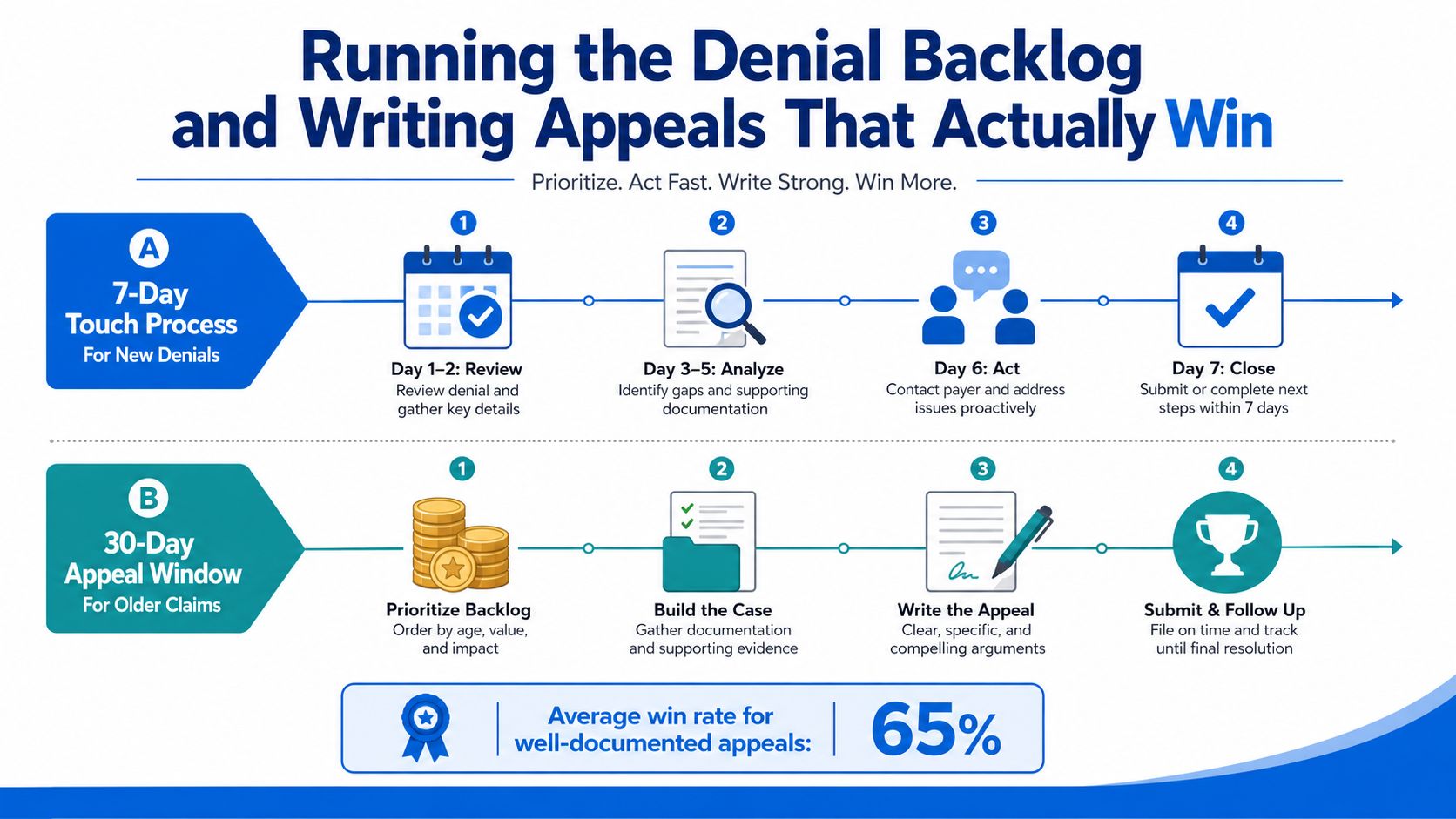
The operating rule is simple. Touch every denial within 7 days, then file the appeal within 30 days. That timing helps protect overturn opportunities and limit A/R leakage behavioral health denial benchmarks. Benchmark data from the same source also frames a 5 to 10% initial denial rate and a 92 to 95% first-pass clean-claim rate as practical targets, with hard denials kept under 2 to 3% of billed charges. Those figures are useful as operating targets, not excuses, because the key question is whether the team responds fast enough to protect cash.
A realistic 90837 denial workflow
A therapist bills 90837 for a long individual session. The claim comes back denied for insufficient documentation. The denial lands in the queue on Monday, and the billing lead reviews it the same day. By Wednesday, the coder or auditor has pulled the note, confirmed the service was clinically real, and identified that the progress note did not clearly tie symptom burden to continued medical necessity.
From there, the appeal packet needs to be tight. The reviewer should see the denial letter, the original claim, the corrected note or addendum if allowed, and a one-page appeal letter that names the service, explains the documentation gap, and points directly to the clinical record that supports the billed session. Do not bury the evidence in a long narrative paragraph that forces the reviewer to hunt for it.
The appeal language should stay direct:
- Documentation insufficiency: “The original record did not fully express the clinical linkage required for review. The attached documentation shows the symptom burden, the intervention delivered, and the continued need for care.”
- Medical necessity not established: “The session addressed active symptoms and treatment-plan goals that support the level of service billed.”
- Session limit exceeded: “The service was delivered under the approved plan, and the attached authorization or review record confirms the billed date falls within the covered period.”
- Authorization issue: “The patient was verified and the service was rendered consistent with the approved benefit structure. The attached intake record and payer correspondence support reconsideration.”
For peer-to-peer escalation, the clinician should lead with diagnosis severity, current functional impairment, what changed since the last visit, and why a lower level of care would not have fit the case. A standardized denial library built from behavioral health CPT billing denials helps the team keep wording consistent, but the operating rule stays the same, make the reviewer's job easy.
Good appeals do not argue harder. They organize the evidence faster than the payer can dismiss it.
The 30-60-90 Day Plan to Keep CMS Behavioral Health CPT Denials From Returning
A durable fix does not require a giant rebuild on day one. It requires a sequence that locks in the basics, then hardens the workflow, then measures whether the changes are sticking.
Days 1 to 30, baseline and stabilize
Start by separating denials into the four CMS categories and sorting them by payer and service line. That tells you whether your biggest problem is documentation, missing notes, coding, or something else entirely. At the same time, tighten the note templates for the highest-volume behavioral health CPTs and require same-day completion for the most denial-prone services.
Days 31 to 60, add front-door and scrubber controls
Roll out the eligibility and authorization script at intake. Then turn on the EHR claim-scrubber rules that catch unit mismatches, missing modifiers, and basic CPT-to-service errors before submission. This is also the point where payer-service combinations that keep recurring should get a separate worklist and owner.
Days 61 to 90, lock in appeals and reporting
Put the denial backlog on a cadence. New denials get touched within 7 days, appeals go out within 30 days, and the results are reviewed weekly so the same denial doesn't return in a new form behavioral health denial benchmarks. The dashboard should show denial reason, payer, service line, appeal status, overturn status, and days outstanding.
A useful monthly review agenda is simple:
- Denial mix: Which category is still dominating?
- Payer drift: Which plan is tightening documentation or authorization rules?
- Template compliance: Are clinicians using the revised note structure?
- Appeal yield: Are the packets complete and getting reviewed quickly?
- Backlog aging: Are old denials being worked before deadlines?
The early warning sign is always the same, one payer or one service line starts to drift, and the team keeps treating it like a one-off. That's how avoidable denials become normal operating noise. The fix is to make the denial data visible, actionable, and owned by the people who can change the workflow.
If your team is still fighting the same behavioral health denials month after month, Clarity can help you rebuild the workflow behind the claim, from eligibility checks and charge capture to billing follow-up and appeals. Visit Clarity to talk through your current denial pattern and map out a cleaner revenue cycle for your practice.
No responses yet