
You're staring at another denial report, a payer audit letter, and a margin that keeps shrinking even though patient volume hasn't. The problem usually isn't that your team works harder. It's that the work is scattered across spreadsheets, inboxes, and disconnected checks, so nobody can see risk early enough to stop it from hitting cash.
Risk compliance performance solutions fix that by treating governance, controls, and revenue cycle execution as one operating model. For healthcare leaders, that means fewer blind spots, faster issue resolution, and a tighter link between compliance work and financial outcomes. The market is moving in that direction fast, because enterprise GRC demand is projected to rise from USD 23.62 billion in 2026 to USD 42.19 billion by 2031 at a 12.3% CAGR (Mordor Intelligence market outlook), and the pressure on compliance teams is still real, with 80.9% relying mainly on manual workflows and spreadsheets (RiskWatch compliance statistics).
A smarter way to think about this is simple. If a control can't help you reduce denials, shorten audit cycles, or speed up resolution of revenue-impacting issues, it's not doing enough. That's why the best programs now look less like a document archive and more like an execution layer for billing, compliance, and finance. One practical resource for payer-side coordination is vendor matching for payers, because vendor and payer alignment problems often sit underneath avoidable claim friction.
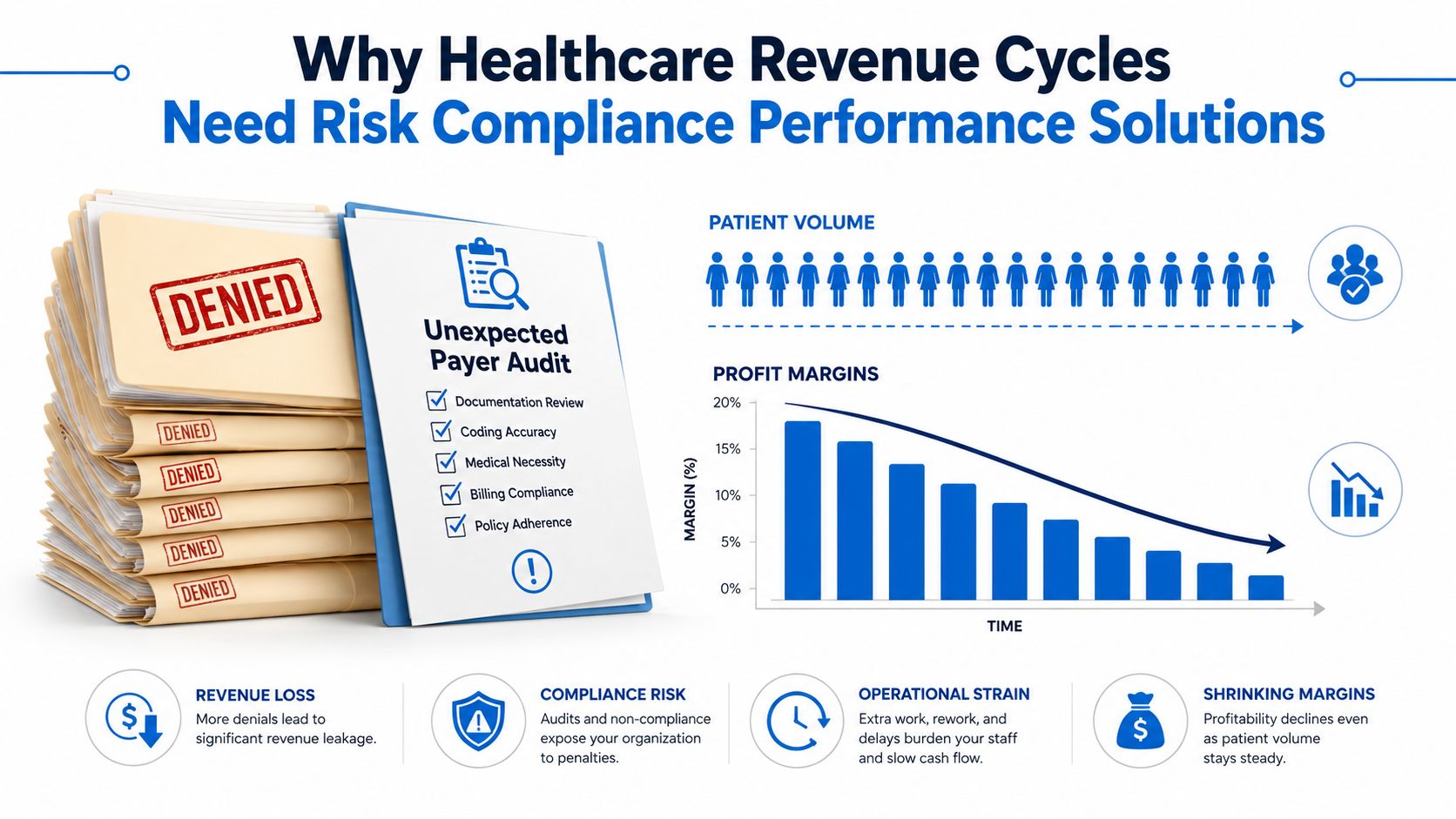
Table of Contents
- Why Healthcare Revenue Cycles Need Risk Compliance Performance Solutions
- What Risk Compliance Performance Solutions Mean
- Regulatory and Financial Drivers Behind the Shift
- Core Components of a Modern Solution
- How to Choose the Right Vendor for Your Practice
- KPIs and ROI You Should Expect
- Where Clarity Fits and an Implementation Roadmap
- Frequently Asked Questions for Healthcare Leaders
Why Healthcare Revenue Cycles Need Risk Compliance Performance Solutions
A denial pile grows. An audit notice lands. Billing starts pulling records from three different places, and cash keeps slipping while the work gets messier. That is the point where healthcare leaders realize revenue cycle control and compliance control were never separate problems, they were just handled in separate systems.
Healthcare revenue cycles need risk compliance performance solutions because policies sitting in a folder do nothing to stop claim leakage. The operating model has to connect clinical documentation, billing rules, payer requirements, credentialing, and vendor dependencies so teams can catch problems before they become denials, audit findings, or rework. In practice, one control should reduce exposure across multiple workflows instead of living as a one-off checklist.
Market adoption reflects that shift. Enterprise GRC tools are already used at scale, and healthcare remains one of the strongest buyer groups because regulated organizations do not spend on documentation for its own sake, they spend to reduce cash disruption and control audit exposure. That pattern matches what revenue cycle leaders see every day. If a process creates repeated denials or slows audit response, it belongs in a governed workflow, not in a shared drive.
Practical rule: if a recurring issue affects denials, days in A/R, audit cycle time, or posting accuracy, it belongs in a governed workflow, not a shared drive.
The value shows up in revenue cycle metrics. A strong risk compliance performance model shortens the time it takes to detect errors, reduces avoidable back-and-forth with payers, and gives finance a cleaner view of where cash is being delayed. It also helps leaders see whether the problem is front-end eligibility, documentation quality, internal handoffs, or a dependency outside the practice, such as vendor matching for payers.
Healthcare leaders should treat this as an operating decision, not an IT purchase. CFOs, doctor-owners, and practice managers need a way to connect compliance work to measurable revenue cycle outcomes, because that is where margin gets protected. The old patchwork of spreadsheets, reminders, and inbox follow-ups cannot keep pace with audit pressure, payer scrutiny, and the volume of small failures that drag performance down.
What Risk Compliance Performance Solutions Mean
A denied claim on a high-value case, a credentialing gap that delays billing, or a missing proof-of-service record all point to the same problem. Risk compliance performance solutions exist to stop those failures from draining margin and to make the response measurable when they do happen. In revenue cycle terms, the point is simple, control the issues that interrupt cash and create audit exposure.
Risk in revenue cycle work is the chance that a process breaks cash flow or creates a compliance problem. The impact matters as much as the likelihood, because even a low-frequency issue can do serious damage if it stalls high-value claims or forces repeated rework. That is why leaders need a clear view of which failures are isolated and which ones are starting to repeat.
Compliance means following payer rules, HIPAA obligations, and billing regulations without improvising a new process each time. If a front-end registration error creates an eligibility mismatch, or if documentation does not support the billed service, that is a compliance exposure that can become an audit finding. The cost goes beyond one denied claim. It adds staff rework, delayed reimbursement, and a paper trail that someone else may review later.
Performance is the part many revenue cycle teams under-measure
Performance is the measurable speed, accuracy, and yield of the revenue cycle. It shows up in how fast issues are found, how quickly they are resolved, and how cleanly work moves through each stage. The question is not whether a team knows the rules. The question is whether the organization can prove its controls are reducing disruption and improving outcomes.
That is why risk compliance performance solutions should be treated as an operating model, with software behind it. They centralize the rules, automate evidence handling, route exceptions, and track outcomes in one place. The value comes from the link between control and action, not from a document repository that sits untouched after the next review.
A control that does not change behavior is paperwork with a dashboard attached.
Healthcare leaders should judge the category by what it changes in the revenue cycle. It should cut avoidable denials, shorten days in A/R, and reduce audit cycle time while giving finance a clearer view of where cash is getting stuck. That is where Clarity fits as the execution partner, because it helps teams turn policy into a governed workflow instead of a set of disconnected reminders. The right setup also connects day-to-day compliance work to the healthcare IT compliance guide so the operating team and the compliance team stay aligned.
When those pieces are connected, a single issue can be traced from root cause to financial impact, which is how a mature revenue cycle should operate. If the system only produces reports, it is too weak for the pressure healthcare teams face.
Regulatory and Financial Drivers Behind the Shift
The shift away from manual compliance is happening because it no longer matches the pace of healthcare operations. 80.9% of compliance teams still relied primarily on manual workflows and spreadsheets in a 2026 statistics roundup, and that is a poor fit for a setting where documentation, payer policy, and staffing changes keep moving (RiskWatch compliance statistics). A spreadsheet can list tasks, but it cannot prove that a control worked when the same issue keeps showing up in audit review.
The regulatory load keeps stacking
HIPAA enforcement, No Surprises Act obligations, CMS billing rules, and state-level mandates all create separate points of failure. A small billing slip, such as an incomplete authorization or a missed documentation step, can turn into a record request, a refund issue, or a finding if it happens often enough. The more fragmented the workflow, the easier it is for those gaps to stay hidden until reimbursement slows down.
Healthcare leaders should treat compliance as part of the revenue cycle operating model, not a side task. Controls need to sit close to intake, coding, billing, follow-up, and audit response so teams can see where work breaks down and fix it before cash gets stuck. The same discipline that reduces policy misses also shortens audit cycle time and gives finance a clearer picture of where denials start.
The financial penalty shows up in operations
Denied claims are the obvious pain point, but they are not the only one. Manual reconciliation creates hidden labor, delayed follow-up, and uneven escalation across teams. That is why many senior executives still rank risk and compliance among the top two risk categories they feel least prepared to address, and why only 36% of organizations had a formal enterprise risk management program in the benchmark cited above (RiskWatch compliance statistics). Weak governance creates both risk and operational drag.
The market shift also reflects how regulated organizations are handling this pressure. As noted earlier in the market outlook, highly exposed sectors are moving toward software-supported governance, and healthcare has the same need because compliance and cash collection touch the same work. A program built on disconnected trackers cannot keep pace with denial management, audit readiness, and vendor oversight at the same time.
For a practical healthcare IT lens on how controls, policy, and implementation discipline fit together, the healthcare IT compliance guide is a useful companion read. The right setup uses a revenue cycle workflow and compliance monitoring for healthcare teams to keep issues visible, route them to the right owner, and connect control failures to financial impact.
Core Components of a Modern Solution
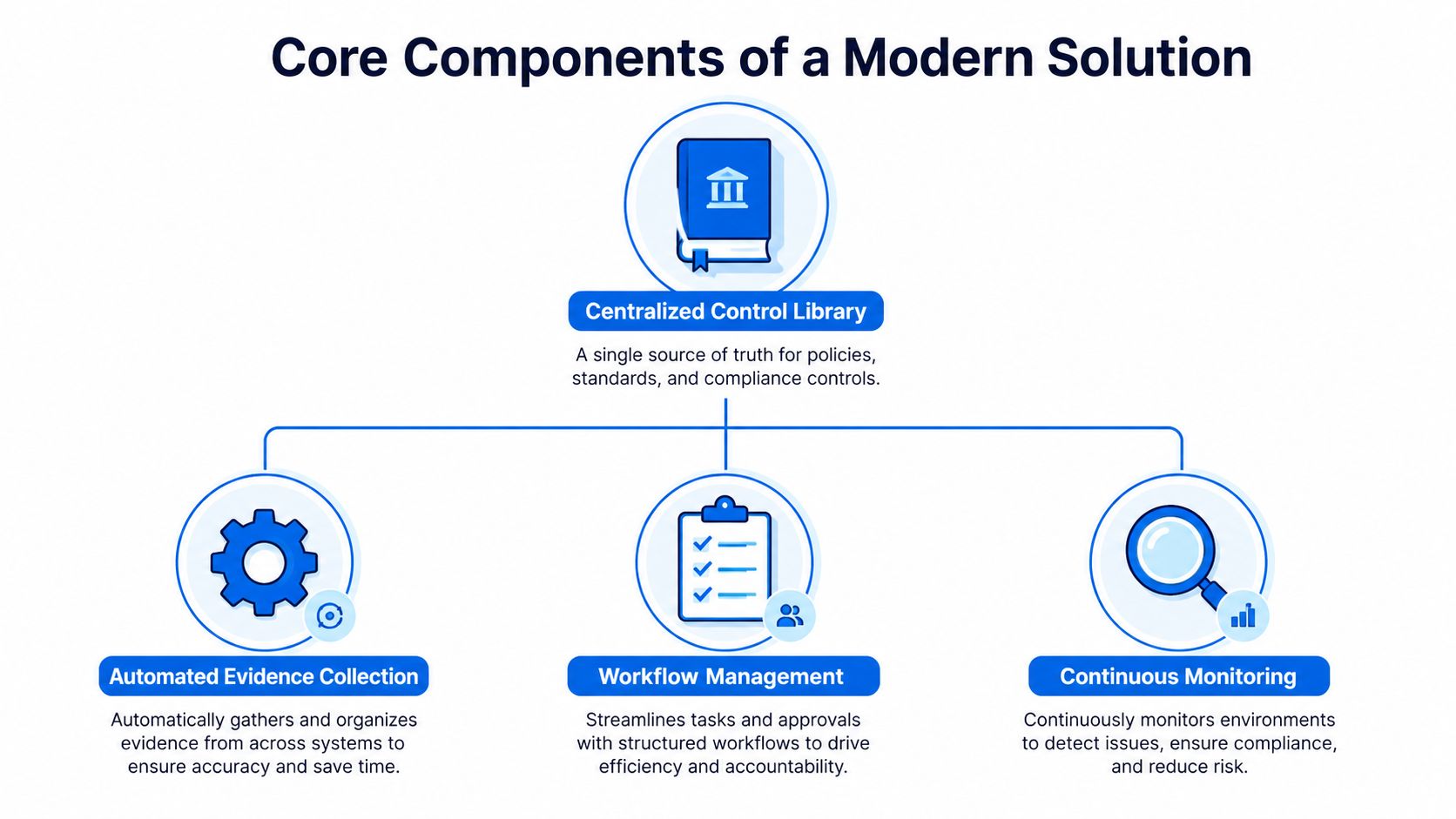
A credible platform starts with a centralized control library. One control should map to multiple obligations, including HIPAA, payer policy, and internal review standards, instead of living in separate files that teams have to reconcile by hand. In healthcare revenue cycle work, that matters when a single charge-capture control has to satisfy documentation rules and billing integrity checks at the same time.
The five capabilities that matter
- Centralized control library. Frameworks, obligations, and controls live in one place. That prevents the policy binder problem and keeps teams from maintaining shadow versions in spreadsheets.
- Automated evidence collection and workflow routing. The system should assign requests, track attestations, and move evidence to the right reviewer. If staff still have to chase every file manually, the platform is adding work, not removing it.
- Real-time dashboards and AI-driven anomaly detection. Real-time dashboards and AI-driven anomaly detection surface outliers in policy, control, incident, or vendor data before they become findings.
- Vendor and third-party risk management. Healthcare depends on clearinghouses, billing partners, software vendors, and service providers, so the platform must track outside exposure too. Self-reported assurances do not tell you where the exposure is.
- Configurable audit reporting. Teams need reporting that can be adapted for internal reviews, payer questions, and external audits. If every report still requires a custom export and manual cleanup, the system is slowing down audit response instead of speeding it up.
One enterprise example shows where the market is headed. A mature platform can support 55+ ready-to-action frameworks, 300 jurisdictions, and a shared evidence framework that lets teams collect once and comply across multiple frameworks (OneTrust tech risk and compliance). That is not a healthcare-specific number, but the operating logic fits healthcare well when one control has to satisfy several requirements without creating duplicate work.
The deeper advantage is orchestration. In one enterprise platform, AI and automation features such as outlier detection, predictive modeling, and NLP-based document analysis are designed to cut administrative overhead and expose hidden risk earlier in the lifecycle (Mitratech risk and compliance). For healthcare, that only matters if the output feeds revenue cycle action, not another alert queue that nobody has time to work.
Buy for workflow, not for storage. If the product cannot connect controls, evidence, and escalation, it is a repository wearing a performance label.
For a closer look at how monitoring fits into a broader operating model, see Clarity's compliance monitoring overview.
How to Choose the Right Vendor for Your Practice
The wrong vendor will look polished in the demo and disappear when the first integration issue hits. The right one will map cleanly to your workflows, adapt to your team's size, and give you evidence you can trust during an audit. Don't ask for generic “compliance automation.” Ask how the platform will support your actual revenue cycle.
Vendor evaluation criteria for healthcare-focused risk compliance performance solutions
| Criterion | Key Buyer Question | Red Flag |
|---|---|---|
| Framework coverage | Does the platform map the controls you actually use across payer, privacy, and internal review requirements? | The vendor talks about “broad coverage” but can't show how one control links to multiple obligations. |
| Healthcare-specific content | Is the content built for claims, billing, credentialing, or vendor oversight? | The demo stays generic and never touches revenue cycle workflows. |
| Integration with EHR and practice management systems | How does data move from your operational systems into the control and evidence workflow? | Manual exports are presented as a normal implementation step. |
| Automation depth | What gets routed, validated, or escalated without human follow-up? | Automation is limited to email reminders and basic task lists. |
| Audit-readiness | Can the system produce clean evidence trails fast enough for payer or internal review? | Reports require heavy spreadsheet cleanup before they're usable. |
| Total cost of ownership | What breaks, customizes, or needs ongoing consulting after go-live? | The quote looks low, then implementation, support, and change requests pile up. |
The most important demo question is this. “Show me how a control, an exception, and an evidence item move from discovery to closure without manual rework.” If the vendor can't answer that plainly, the platform probably won't help your staff under pressure. For a more operational view of platform selection, this revenue cycle management software overview is useful as a reference point for how systems should connect to finance and billing work.
What to pressure-test in the room
- Ask for a live workflow. A real example beats a slide deck every time.
- Ask where healthcare-specific logic lives. If it lives in customization only, expect long-term friction.
- Ask what your team still has to do manually. Every manual step is future leakage.
- Ask how exceptions are escalated. If escalation depends on someone remembering, the control isn't mature.
The buyer who scores vendors this way usually finds the answer quickly. Good platforms reduce operational noise. Weak ones shift the burden back onto the team.
KPIs and ROI You Should Expect
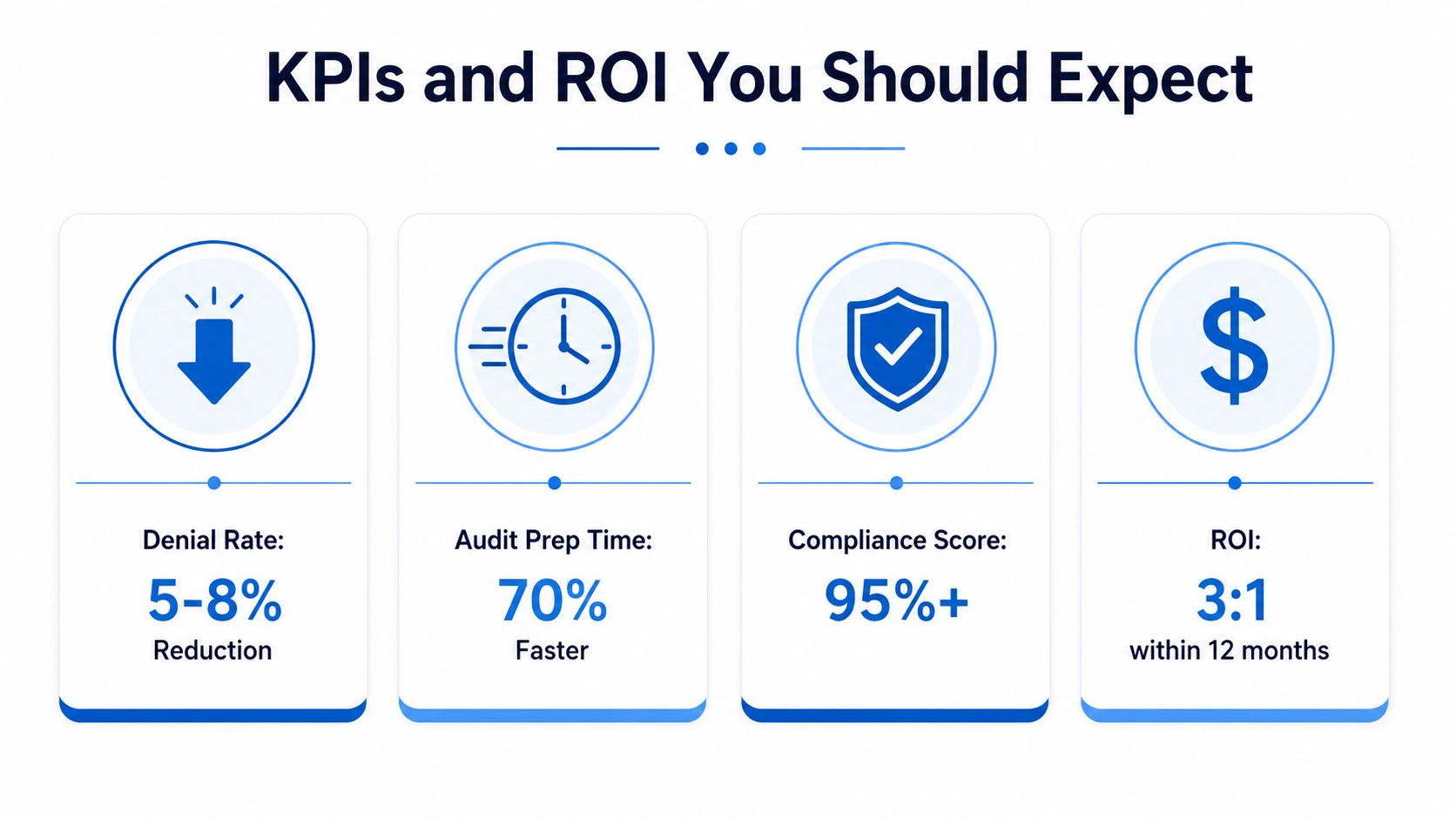
The KPI stack should be short enough to manage and strong enough to matter. Start with denial rate, first-pass yield, days in accounts receivable, cost to collect, mean time to issue discovery, mean time to resolution, and audit cycle time. If a vendor can't connect the solution to those metrics, it's not a performance solution, it's a documentation tool.
What a disciplined program should move
- Denial rate. The goal is fewer preventable denials tied to documentation, eligibility, or policy misses.
- First-pass yield. Claims should get through cleanly the first time more often because upstream controls are tighter.
- Days in A/R. Faster issue discovery and cleaner routing should reduce cash drag.
- Audit cycle time. Evidence assembly should happen faster because the data is already organized.
- Mean time to issue discovery and resolution. Control quality becomes visible here.
A practical way to think about ROI is to compare what you're spending on rework, audit prep, and preventable denials against the cost of a disciplined operating model. For a 200-provider group, a six-figure annual investment can make sense if the program removes repeated denial work, shortens audit preparation, and stops revenue leakage from recurring control gaps. If you want a framework for proving the value of team enablement work, the guide to proving training value is a good companion because the same logic applies to compliance process training.
For broader reporting and trend visibility, this revenue cycle analytics resource is useful. The point isn't to build prettier dashboards. The point is to make sure the dashboard tells you whether controls are improving collection performance.
If the board deck can't tie compliance work to revenue protection, it's not ready for leadership review.
The healthiest ROI story is simple. Less rework. Faster audit response. Better cash discipline. That's the standard.
Where Clarity Fits and an Implementation Roadmap
Software alone won't close the gap if your data, workflows, and ownership are messy. That's where execution matters. Clarity fits as the operating layer that helps turn these concepts into day-to-day revenue cycle discipline, starting with fee schedule and practice management setup, then moving through billing operations support, insurance benefit verification, and claim status and payment posting to keep the loop tight.
A practical rollout path
- First 90 days, assess and instrument. Review denial patterns, audit exposure, eligibility weak points, and posting gaps. Clean up the data foundation and define the controls that matter most.
- By 6 months, operationalize. Put ownership on the recurring issues, tighten front-end verification, and route exceptions into repeatable workflows.
- By 12 months, optimize. Use the trend data to reduce repeat findings, shorten audit cycles, and align staffing to the issues that still cost the most.
That phased approach works because it respects how revenue cycle teams operate. The biggest wins usually come from making sure the front end is clean and the back end closes the loop, not from piling on more reporting. If you need a partner to handle the operational gap between software capability and daily execution, that's the role Clarity is built to fill.
The best version of this model is not “buy software and hope.” It's “define the controls, run the workflow, measure the result, then refine the process.” That's what makes compliance performance real.
Frequently Asked Questions for Healthcare Leaders
How long does it take to see ROI? Most practices should expect early operational improvement before the full financial payback shows up. The fastest gains usually come from cleaner verification, better denial handling, and less audit scramble.
How is this different from an EHR reporting module? An EHR module reports on activity. A true risk compliance performance model connects controls, evidence, routing, and escalation across departments, so the team can act on the issue instead of just seeing it.
What implementation risks matter most? Bad data, weak ownership, and poor system integration. If your practice management data isn't clean, or no one owns exception follow-up, the platform won't save you.
Can a smaller practice use this without enterprise-level spending? Yes, but the scope has to be disciplined. Start with the controls that affect denials and audit risk first, then expand once the operating rhythm is stable.
If you're ready to stop treating compliance as a paperwork burden and start using it as a revenue protection system, Clarity can help you build that operating model. Visit Clarity to start with a complimentary consultation and see how your current workflow can be tightened, measured, and managed with less waste.
No responses yet