

The clearest signal in this category is blunt. In one 2024 comparison, providers collected 90% of balances when payment plans were used, while they collected only 7% without them in 2023, according to industry benchmarking cited in Cedar's analysis of patient AR performance. That makes patient payment plans a revenue-cycle decision, not a courtesy feature, and it is also a reminder to keep payment reconciliation tight once installments start flowing.
Patient payment plans have moved from exception handling to operating model. Major hospital systems are already treating them that way, and the evidence is hard to ignore. A peer-reviewed study of 204 hospitals found that 95.5% offered in-house payment plans, 19.1% offered third-party plans for non-emergency care, 97.0% offered plans to underinsured patients, and 86.7% offered financial assistance. If you still treat installment billing as a back-office courtesy, you are behind how the market works. To operationalize it properly, teams also need to know how to set up subscription billing so scheduled payments post and repeat on time.
That gap matters because the common advice is too generic. The operational decisions that move recovery rates are specific, who gets offered a plan, which balances qualify, how the first payment is collected, how misses are handled, and whether the plan is managed like a product with rules, reporting, and ownership. The Cedar analysis shows the revenue upside when plans are used. The hospital study shows how widely they have already been adopted. The key question is whether your organization runs them with enough discipline to collect what you are owed.
Table of Contents
- Why Patient Payment Plans Now Sit at the Center of Revenue Cycle
- Defining a Patient Payment Plan
- In-House Plans, Third-Party Financing, and Recurring Billing Compared
- Benefits, Risks, and the Compliance Floor
- Designing a Plan Your Practice Can Actually Run
- Script and Policy Templates for Patient Conversations
- Connecting Payment Plans to the Rest of Revenue Cycle
- KPIs, ROI, and a 90-Day Implementation Roadmap
Why Patient Payment Plans Now Sit at the Center of Revenue Cycle
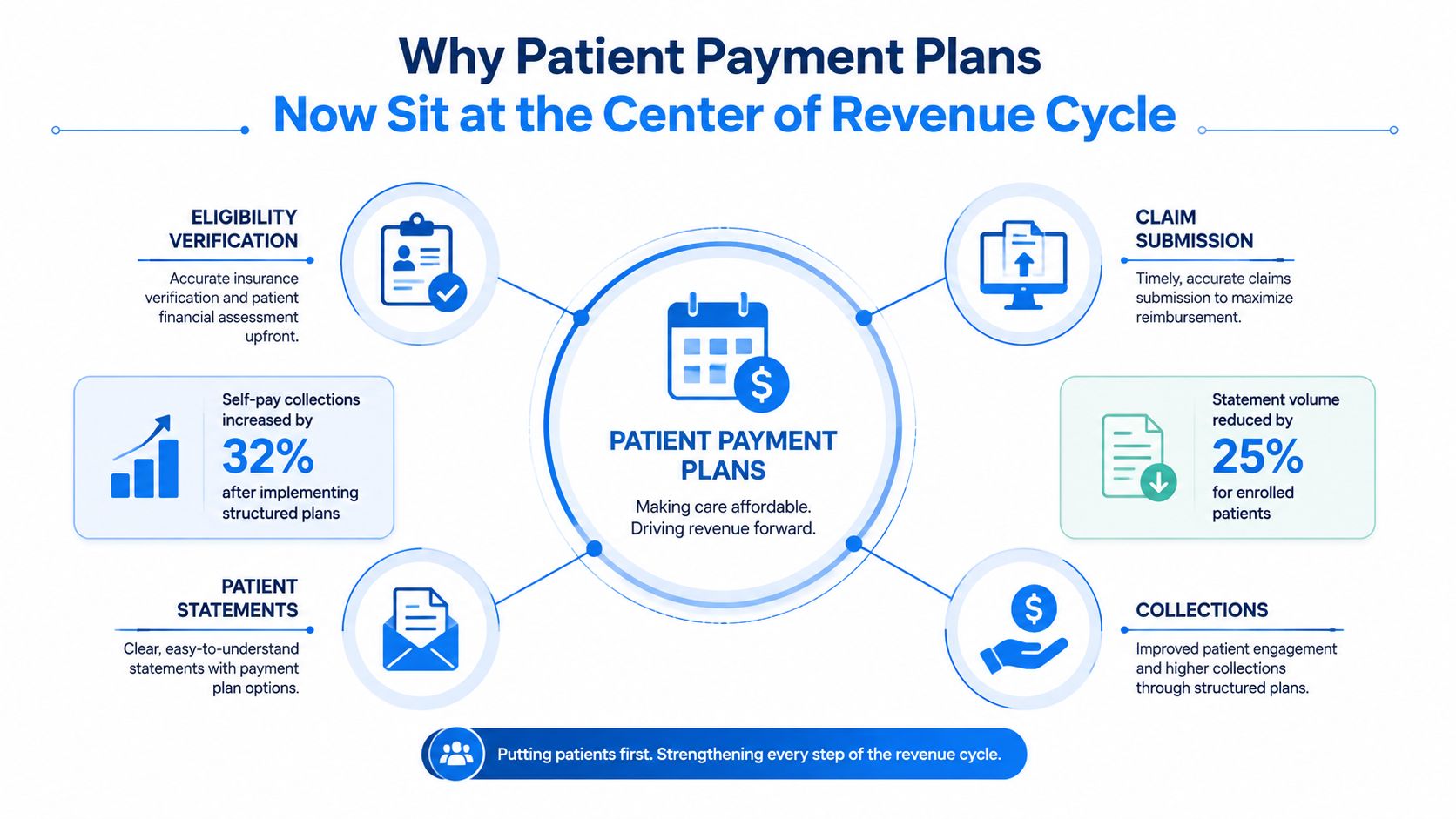
The recovery gap is the core story. Once a balance moves into patient responsibility, every extra step before a payment plan adds friction, slows recovery, and increases the odds that the account drifts into aging and then write-off. CFOs should stop treating patient payment plans as a courtesy at the margins. They are a managed revenue tool, and the operating model decides whether they improve cash or just create another bucket of receivables.
The market has already moved
Hospitals have already made the shift. The peer-reviewed hospital study found that in-house plans were widely available, and relief options for underinsured patients were common. That means payment plans are now part of the standard billing playbook, not an edge case, and patients expect a structured path to pay over time when the bill is larger than they can clear at once.
Consumer behavior points in the same direction. Cedar's analysis found that patients used payment plans more often as out-of-pocket amounts rose, with adoption increasing as balances got larger. Finance leaders should read that as a direct operating signal. Higher patient burden drives higher demand for structured payment, so the question is not whether to offer plans, it is how to design them so they collect.
Practical rule: If your team keeps mailing statements before offering a plan, you are starting with the most expensive workflow first.
A patient payment plan is a formal agreement that breaks a medical balance into scheduled installments under defined terms. It is not charity care, and it is not a vague promise to pay later. It is a controlled billing arrangement with dates, amounts, and escalation rules. If you want the broader operational context, the healthcare revenue cycle optimization guide is a useful reference, and the logic should match the revenue cycle flowchart review so the plan sits in the right place in the workflow.
A CFO should read that definition as a control structure, not a gesture. The plan either reduces friction and keeps balances collectible, or it turns into another unmanaged receivable class. That is the trade-off, and there is no middle ground.
Defining a Patient Payment Plan
A patient payment plan is a billing agreement that lets the patient pay a balance over time instead of all at once. That sounds simple, but the operating model changes everything. The plan can be fully in-house, handled by a third party, or built into recurring billing logic, and each version changes control, compliance, and the patient experience.
Separate the plan from similar tools
A payment plan is different from a prompt-pay discount. A discount changes the balance. A plan changes the timing of the payment. It is also different from charity care, because charity care reduces or eliminates the financial obligation based on policy. It is different from a medical credit card as well, because a lender sits between the provider and the patient.
A good plan preserves the provider's right to collect and the patient's ability to pay without forcing either side into the wrong product.
The practical sequence is straightforward. The patient gets a bill after care, the balance is confirmed, and the practice offers a structured way to pay it. In many organizations, that offer begins at the point of service, at discharge, or when a statement is first generated. The earlier the conversation happens, the less likely the account is to drift into passive aging.
Use the same language your billing team can enforce
The billing system needs a clean definition of plan status, because plan balances should not be confused with active receivables. That is a reconciliation problem, and the team needs a shared vocabulary across patient financial services and posting workflows. For a concrete reference point on payment flow terminology, the payment reconciliation overview is worth keeping handy.
If your team is comparing patient payment plans to recurring consumer billing, the difference is timing and uncertainty. Consumer subscriptions bill a stable amount on a fixed cadence. Patient plans have to account for claim adjudication, patient responsibility, and occasional balance changes. The mechanics in set up subscription billing are useful as a contrast, but healthcare needs tighter consent and more flexibility.
The bottom line is plain. A patient payment plan is a structured promise to collect a known balance over time. It works only when the plan terms, enrollment rules, and payment processing are designed together.
In-House Plans, Third-Party Financing, and Recurring Billing Compared
This is the decision point most leaders need. The right structure depends on balance size, staffing capacity, compliance appetite, and how much control you want to keep over the patient relationship. Don't pick the tool first. Pick the operational outcome first.
Compare the three models on the criteria that matter
| Criterion | In-House Plans | Third-Party Financing | Recurring Billing |
|---|---|---|---|
| Cost to the practice | Usually lower direct vendor cost, but higher internal servicing burden | Often shifts some administrative burden outward, but introduces vendor economics | Can be efficient once set up, but needs payment infrastructure and monitoring |
| Control of the patient relationship | Highest control, the practice owns communication and escalation | Lower control, the financing partner often shapes the patient experience | Moderate control, especially if the practice manages the messaging |
| Implementation effort | Moderate if billing rules are already disciplined | Higher because it requires partner setup, disclosures, and integration | Moderate to high depending on automation maturity |
| Compliance exposure | Directly owned by the practice | Shared, but still visible to the practice | Depends on consent, authorization, and stored-payment handling |
| Collection speed | Strong when enrollment is immediate and rules are tight | Can be strong if underwriting is fast and patients qualify | Strong for predictable balances, weaker if balances fluctuate |
| Patient experience | Best when terms are simple and transparent | Can help for larger balances, but feels like financing | Best for convenience when patients accept automated cadence |
If you're handling a $400 specialist visit, in-house plans or recurring billing usually make more sense than sending the patient to a financing partner. The balance is small enough that a long external application process adds friction you don't need. If you're handling a $2,400 elective procedure, a longer structured arrangement or third-party option may be more defensible, especially if the patient can't absorb the full amount at once.
The decision isn't only about patient tolerance. It's about what your team can service. A small practice with thin front-desk staffing should not build a complex installment policy that requires manual chasing. That's why medical billing services often need to be aligned with plan design, not treated separately.
Pick the model that matches your mix
In-house plans make sense when you want direct control, faster enrollment, and fewer handoffs. Third-party financing makes sense when balances are larger and you want to offload some credit risk. Recurring billing makes sense when you want predictable autopay behavior and can standardize around stored payment methods.
Operational rule: If the plan needs a human to rescue it every month, it's too complicated.
The right answer is usually not one model. It's a tiered policy that uses different structures for different balance bands and different patient scenarios. That's how you avoid overengineering small balances and under-serving large ones.
Benefits, Risks, and the Compliance Floor
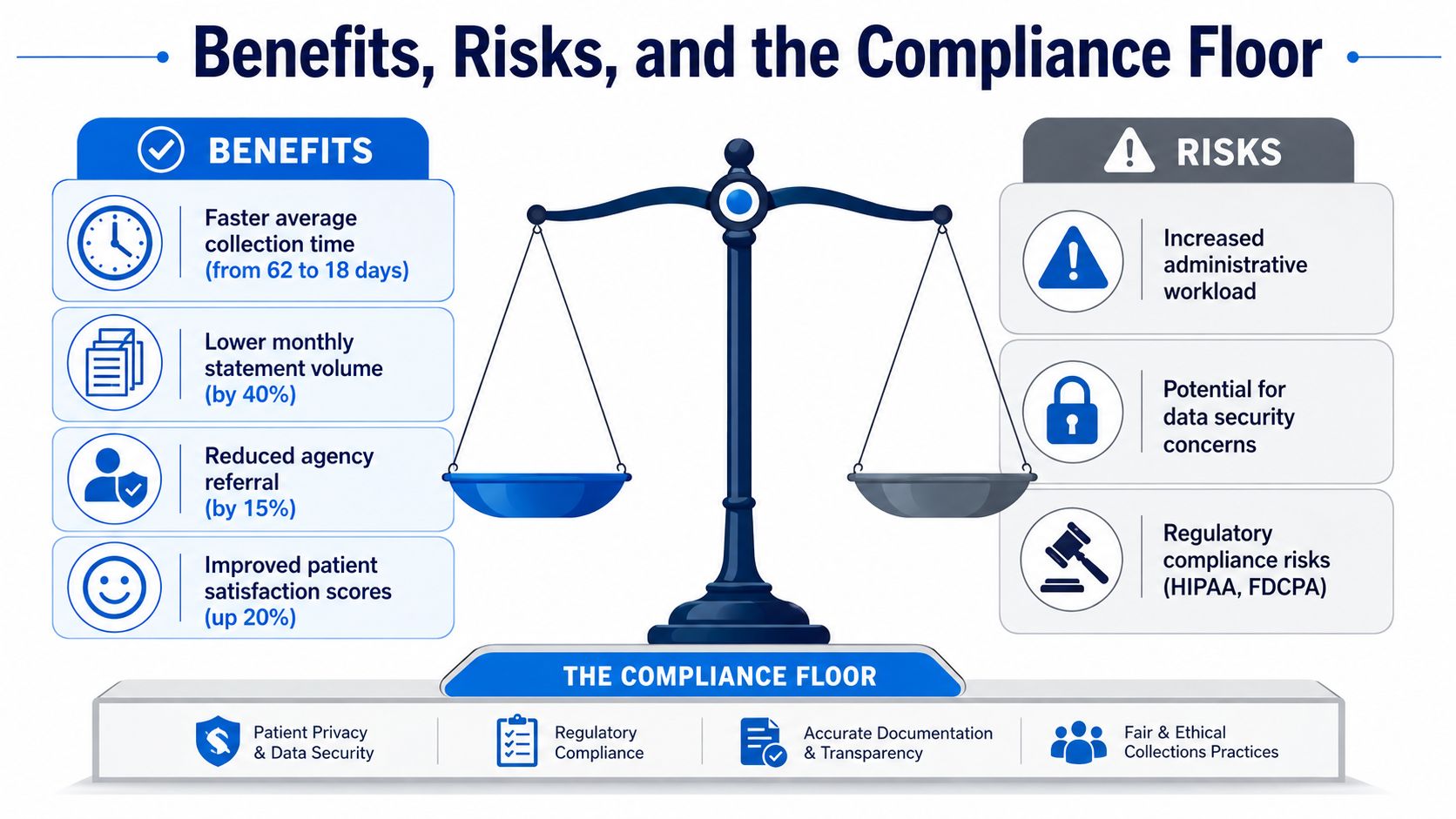
Patient payment plans work only when they reduce friction, improve cash collection, and stay inside the compliance floor. That is the standard. A plan that lifts collections but violates disclosure rules is a liability. A plan that feels friendly but cannot collect is just delayed charity.
The upside is operational, not theoretical
The main benefit is stronger recovery on patient balances. Cedar's patient AR revenue analysis shows that payment plans materially outperform no-plan collection workflows, which is exactly why plan design belongs in revenue-cycle strategy, not in a side conversation (Cedar's patient AR revenue analysis). A second benefit is less administrative churn, because one scheduled plan is easier to manage than repeated statement cycles. A third is patient preference. Patients do choose plans when balances are large enough to strain household cash flow.
The risk side is sharper than many leaders admit. Long terms create servicing work that may not be worth the labor. Weak disclosures invite disputes. Unclear default rules slow collections. If your state limits monthly exposure, the plan has to fit that ceiling.
Maryland's hospital-payment-plan rules show what a compliance floor looks like in practice. Under those rules, total monthly payments under an income-based plan may not exceed 5% of the lesser of the patient's household income, and the hospital must disclose the debt amount, interest rate, payment size, number of payments, payoff date, and missed-payment or default treatment before enrollment (Maryland regulations). That is an operating constraint, not a legal footnote.
Build the controls before you launch
A payment plan only works if the billing system can enforce the basics.
- Clear affordability logic: Set rules that stop plans from overcommitting the patient.
- Documented disclosures: Show debt amount, timing, interest, fees, and default treatment before the patient enrolls.
- Escalation triggers: Define what happens after missed payments, without relying on staff memory.
- Exception handling: Create a route for hardship requests so agents do not improvise.
- Vendor and gateway discipline: Keep the payment path secure and consistent with your integration standards, and use payment gateway API best practices when your team wires autopay or recurring collection logic.
A practice that cannot enforce those controls does not have a payment plan program. It has a loose promise with collection risk attached.
Designing a Plan Your Practice Can Actually Run
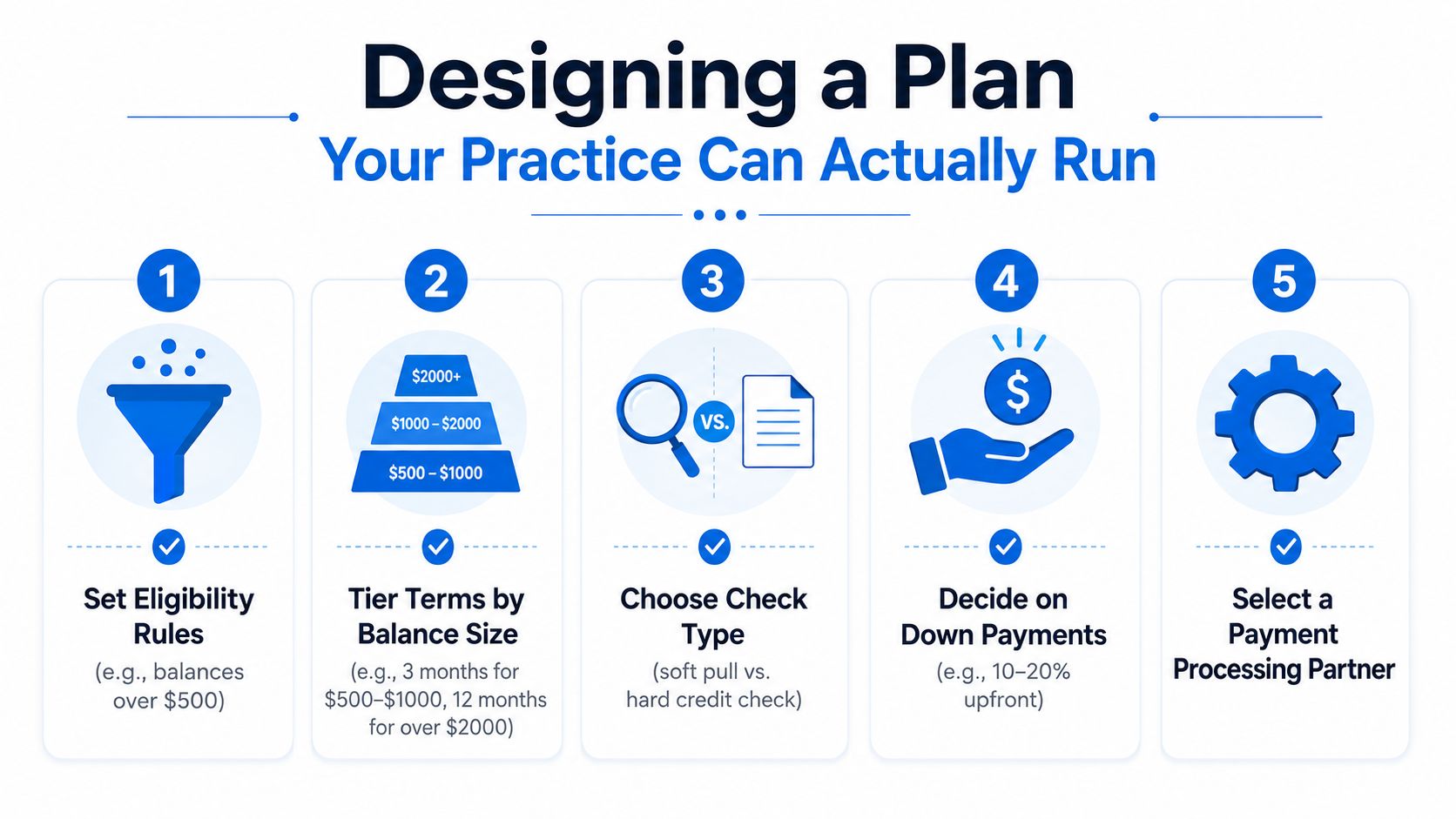
Good plan design starts with balance size, not with optimism. Small balances should move through short, simple terms. Larger balances can justify longer terms, but only if you've built the servicing logic to support them. If your policy ignores that reality, your team will bury itself in manual follow-up.
Start with eligibility and term ladders
Eligibility rules should be explicit. Many practices only offer plans above a minimum balance threshold, because there's no point spreading a tiny receivable over months. Once you cross that threshold, match the term to the balance band. The operational guidance in the source material points toward 3-6 month plans for $500-$1,500 balances, and 12-24 month plans for $1,500-$5,000 balances, with 20-30% down payments used to reduce exposure (Rework healthcare payment plan guidance).
That's a workable ladder because it keeps small balances from becoming servicing debt. It also acknowledges that larger balances need more room. A one-size-fits-all payment policy looks easy on paper and expensive in practice.
Decide how much friction you want at enrollment
Soft credit checks can reduce friction when compared with harder underwriting, but you still need a policy for who qualifies and what happens if the patient can't meet the standard terms. Autopay and card-on-file can improve reliability, but they only work if the patient understands what gets charged and when. The core question is simple. Do you want the plan to be easy enough to adopt, or strict enough to minimize risk? You rarely get both.
Practical rule: The more you ask of the patient at enrollment, the more staff time you'll spend convincing them to finish.
That's why the enrollment packet matters. It should include the balance, payment amount, due dates, payoff date, interest or fee treatment, missed-payment consequences, and any hardship options. If your front desk can't explain the plan clearly in one pass, the policy is too complex.
Use standards that stop avoidable fallout
Don't let agents create custom plans on the fly. Use a defined ladder, a standard deposit rule, and a fixed escalation path for defaults. If a patient requests hardship relief, send it through a documented modification process instead of rewriting terms informally. That's how you protect both collectability and fairness.
Clarity's patient services can support short payment plans for patients facing real financial hardship, with card-on-file used to collect the remaining balance, which is the kind of controlled workflow that belongs in this category. It's one implementation choice, not a universal answer, but it shows how policy can connect to execution without turning into chaos.
Script and Policy Templates for Patient Conversations
Policy only works if staff can say it plainly without sounding stiff or evasive. Patients do not need billing jargon. They need clarity, a fair next step, and proof that the practice has a consistent process. The script has to sound human and still protect the organization.
Use a simple policy excerpt
A workable policy excerpt sounds like this:
“Patients with eligible balances may enroll in a payment plan after the balance is confirmed. The plan will include the payment amount, due date, number of payments, total amount due, and default treatment. The patient will receive a copy of the agreement before enrollment.”
That is short, direct, and specific. It tells staff what must be present and gives patients enough information to decide without confusion.
Front desk conversation that does not create friction
A front-desk script should sound like this:
“Your balance is ready, and we can either take it today or set up a payment plan if that works better for you. If you want to spread it out, I can show you the payment amount and the number of months before you decide.”
That wording matters. It does not pressure the patient, and it does not hide the fact that a balance exists. If the patient says they cannot pay this month, staff should move to a hardship path, not turn it into a debate.
“If the balance will not work today, let's look at the lowest-risk option that still keeps the account in good standing.”
A collections handoff script should be firmer. It should identify the amount due, remind the patient of the approved terms, and give a specific next step for updating the payment method or requesting review. The point is to reduce ambiguity, not to sound punitive.
Hardship modifications need a template
Your hardship template should capture the reason for the request, the modified amount, the new date range, who approved the change, and whether card-on-file or autopay remains active. If you do not document those changes, your plan portfolio gets messy fast. The payment reconciliation workflow should reflect those adjustments cleanly, or your reports will drift away from reality.
Patients remember tone. They also remember whether the practice explained the plan before asking for payment. That is the standard to enforce.
Connecting Payment Plans to the Rest of Revenue Cycle
A payment plan that lives outside the rest of the revenue cycle becomes a data silo. That's the mistake. Plan enrollment should affect statements, aging, reconciliation, and reporting, or leadership won't know what's collectible.
Treat enrollment as a workflow trigger
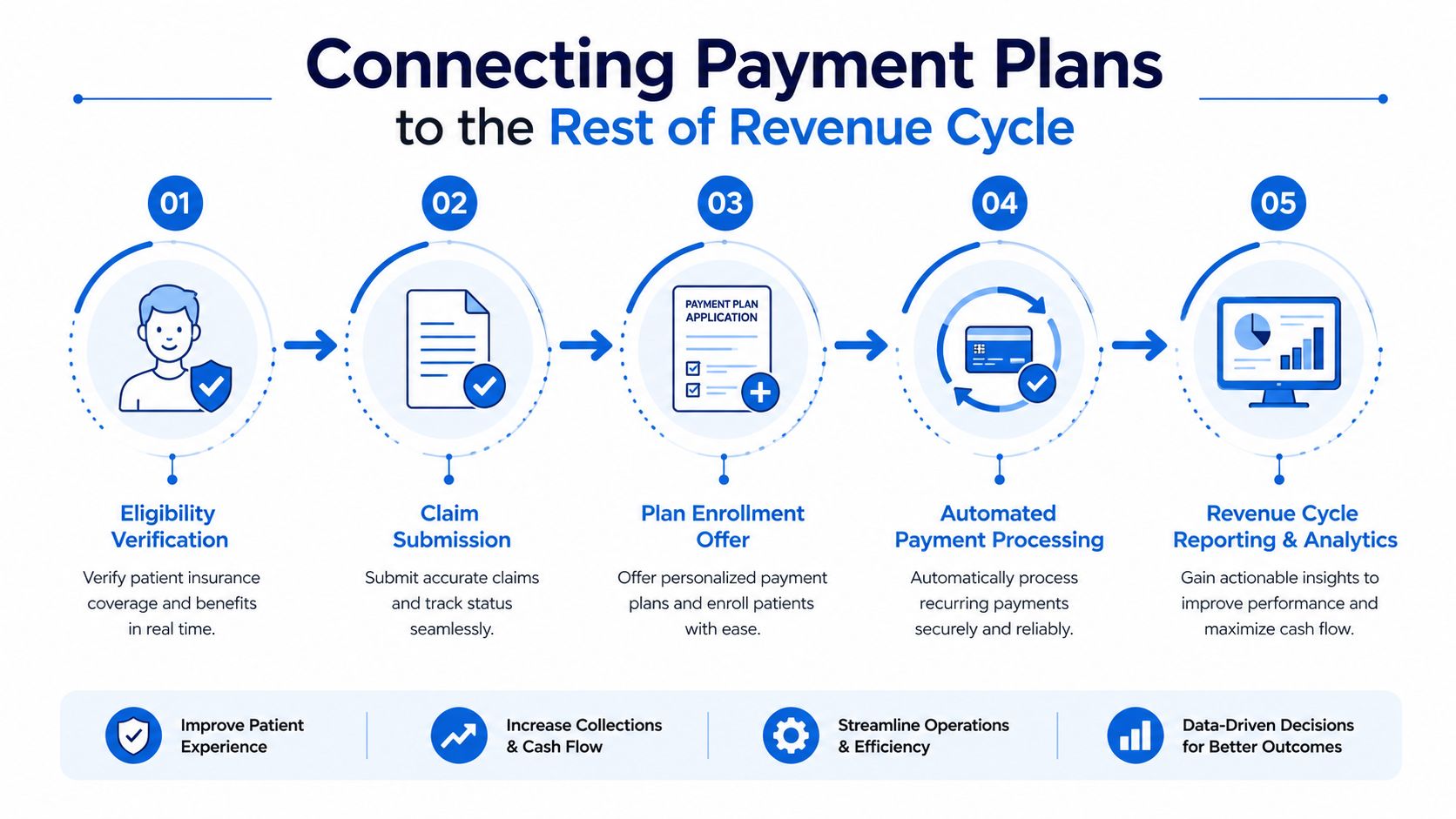
When the plan starts, the balance should move out of the ordinary statement cycle and into plan status. That means the patient statement logic needs to know the difference between a new collectible balance and an active installment account. It also means the plan status has to flow back into AR aging so finance can see plan balances separately from standard receivables.
That separation matters because leadership needs to know whether the issue is collections, adjudication, or installment performance. Without it, a payment plan can look like a bad receivable when it's progressing correctly. The opposite also happens, where a weak plan hides inside a healthy-looking aging bucket.
Tie the plan to eligibility, posting, and reporting
Plan offers should connect to eligibility verification, claim posting, patient statement suppression rules, and recurring payment processing. If the account is still pending adjudication, the team shouldn't guess at a final installment amount. If the balance is final, the plan logic should activate quickly so the patient doesn't drift into another statement cycle.
The most useful operational pattern is simple. Verify coverage, post the claim, calculate responsibility, offer the plan, enroll the patient, then report the status in a separate plan bucket. That keeps every downstream team aligned. It also reduces the number of times staff have to re-explain the same balance.
Use automation, but don't let it get sloppy
Automated reminders and self-service payments are part of the modern model, especially when patients prefer online payment experiences. But automation only helps when the plan data is clean and the rules are enforced consistently. If staff can override everything manually, the workflow becomes a mess.
The plan should follow the patient's approval, then the system should carry it.
A good revenue cycle platform should also reconcile collected installments back to the original account so finance can see how much of the balance was paid, how much remains, and where exceptions occurred. That's how patient payment plans stop being a side process and become part of the financial operating system.
KPIs, ROI, and a 90-Day Implementation Roadmap
Measure the program on three things only. First, recovery rate. Second, days to collect on plan balances. Third, patient satisfaction related to billing. If you track more than that at launch, you are measuring activity, not performance.
Build the ROI case around actual collection behavior
The strongest ROI case comes from the gap between plan-based and non-plan-based collection behavior. As noted earlier, the benchmarking data showed collection on patient balances moving from 7% without payment plans in 2023 to 77% with payment plans, and that is a clear signal that structured plans change recovery outcomes. The value is not abstract. It sits in the gap between passive aging and active recovery, which is exactly where revenue cycle leaders should focus.
Use that comparison carefully. Do not promise every account will perform that way. Use it to justify dedicated workflow design instead of ad hoc handling. If your current process depends on repeated statements and manual calls, a structured plan will usually perform better because it gives the patient a path and gives staff a rule set to follow.
Run a 90-day launch with discipline
The first 30 days should focus on policy and configuration. Finalize plan eligibility, approval authority, disclosure language, and default rules. Choose the payment processor, confirm card-on-file handling, and define how balances move into plan status.
The next 30 days should focus on staff readiness. Train front desk, billing, and collections on the same script. Walk through a few balance scenarios. Test what happens when a patient asks for hardship, when a payment fails, and when a plan ends early. If the team cannot handle those cases the same way every time, the launch is not ready.
The final 30 days should be a controlled go-live. Start with a narrow patient segment and watch enrollments, payment success, and exception volume. If staff are making up terms, if patients are confused, or if reports do not separate plan balances correctly, stop and fix the process before you scale it.
Know when you're ready to expand
You are ready to scale when the plan is explainable in one minute, enforceable in the billing system, and visible in reporting. You are also ready when managers can answer simple questions without digging through notes. How many patients enrolled. How many payments failed. How many plans need modification.
That is the standard. Patient payment plans are a managed financial product, not a courtesy add-on. If your team wants help building a tighter billing workflow around that reality, talk to Clarity. This is operational work that demands clean policy, disciplined execution, and reporting you can trust.
No responses yet