
Payment reconciliation in a medical practice is the process of proving that the money expected from payers and patients is the money that hit the bank, and that every difference has been explained and posted correctly. A morning batch might show an ERA with no matching deposit, a payer portal that says zero, and a bank credit that is short by a few hundred dollars, which is exactly why this work matters.
Table of Contents
- A Day in the Life of a Payment Reconciliation
- Where Reconciliation Fits in the Revenue Cycle
- The Three Data Sources Every Practice Reconciles
- How a Typical Reconciliation Workflow Runs
- Common Pain Points and Hidden Reconciliation Breaks
- Manual vs Automated vs Outsourced RCM Approaches
- Key Reconciliation KPIs Every Practice Should Track
- When Outsourced RCM Makes Sense for Reconciliation
A Day in the Life of a Payment Reconciliation
The day usually starts with a stack of ERAs, a bank report, and one question nobody wants to answer twice, did the money that hit the bank belong to us? In a busy practice, that question shows up as a short deposit, a payer portal that hasn't posted yet, or a check that landed without the expected remittance detail.
A billing lead opens the morning file, scans for the obvious matches, and then starts sorting the exceptions. One deposit may tie cleanly to a batch of claims. Another may need a check number, EFT trace, or payer reference to prove it belongs to the practice.
That daily check is what payment reconciliation really means in healthcare. It's not a month-end bookkeeping ritual, it's the control that confirms revenue is real, posted correctly, and not leaking through underpayments, misapplied patient balances, or timing gaps.
Practical rule: If the deposit exists but the claim doesn't post correctly, reconciliation isn't done yet.
For practice leaders, the value is straightforward. Reconciliation tells you whether collections are flowing into the right accounts, whether adjustments were applied correctly, and whether a deposit is waiting on an ERA or missing altogether. It's also the first place a recoupment, duplicate payment, or payer-side correction usually surfaces.
The scale makes this more than a clerical task. The UK alone processed about £101 trillion in payments between August 2024 and August 2025 across major payment rails, which is a good reminder that even small mismatches can become material at volume, and that reconciliation is a high-volume control, not a side task, according to the payment reconciliation overview from Aurum Solutions.
Where Reconciliation Fits in the Revenue Cycle
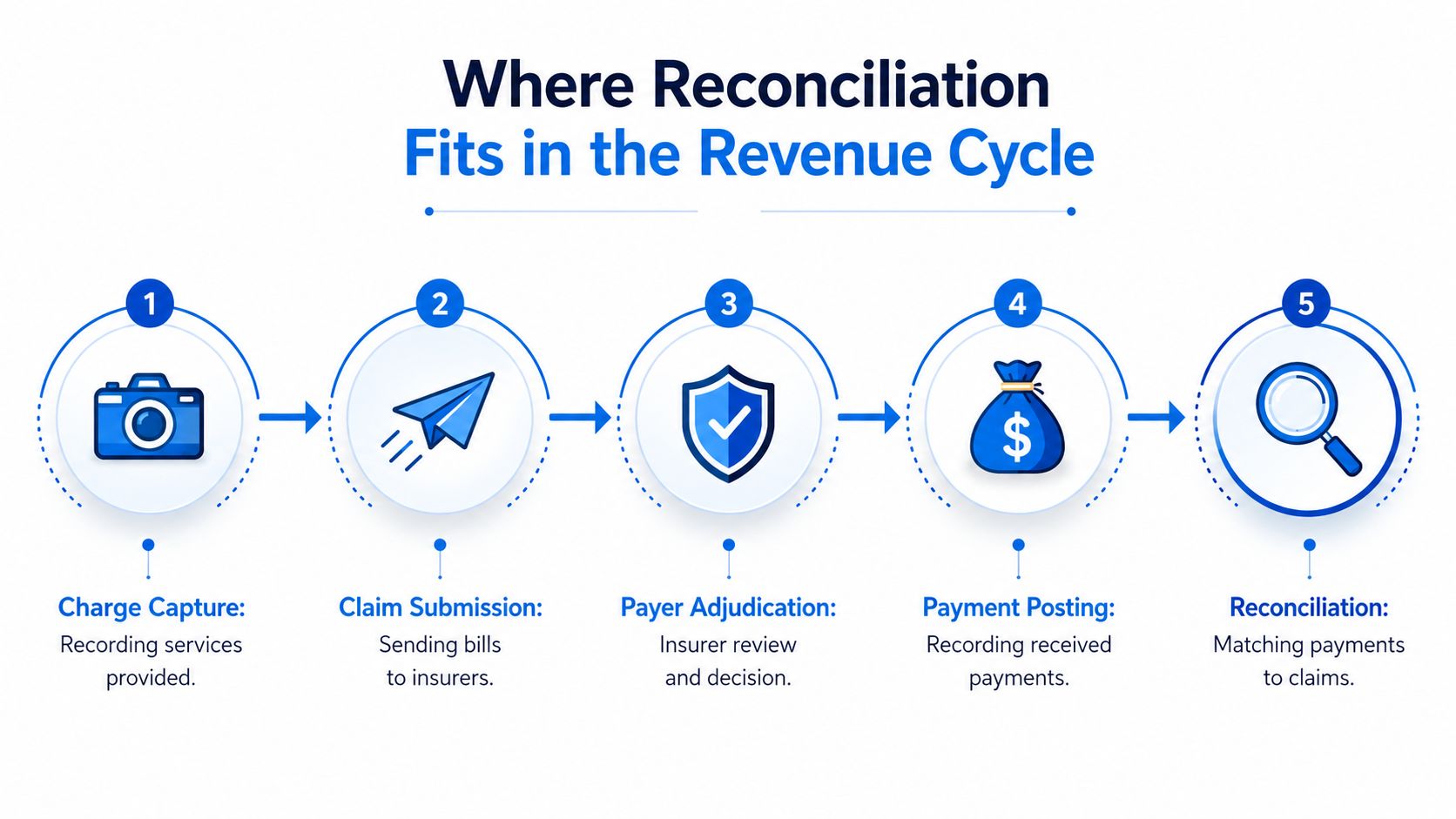
Reconciliation sits after money is expected, and before anyone should trust the numbers. In a healthcare revenue cycle, the flow usually starts with charge capture, moves through claim submission and payer adjudication, then lands in payment posting, reconciliation, and reporting. The posting step records what arrived, but reconciliation proves that it arrived in the right amount and with the right meaning.
That distinction matters because a practice can post a payment and still be wrong. A payment posting entry may record a check or EFT as received, but if the practice management system doesn't agree with the ERA, the bank, and the payer reference, the ledger can still carry a bad balance. Reconciliation is the checkpoint that catches that mismatch before it gets baked into A/R, patient statements, or month-end close.
The practical mistake I see most often is treating posting as proof. Posting only says someone keyed in a receipt. Reconciliation says the receipt, the remittance, and the bank all agree.
Why this step belongs in the middle
The operational control sits between money movement and financial truth. If charge capture is weak, the claim base is wrong. If posting is sloppy, the ledger is wrong. Reconciliation is the layer that catches both before reporting goes out the door.
A clean reconciliation process also supports the rest of the cycle. It sharpens patient balances, reduces noise in aging reports, and makes follow-up work more targeted. That's why the step belongs with finance and revenue cycle leadership, not only with a back-office clerk.
For a useful visual on the upstream and downstream pieces, this healthcare revenue cycle flowchart is a good companion reference.
The Three Data Sources Every Practice Reconciles
Healthcare reconciliation gets messy because the same payment shows up in three different forms, and none of them tells the full story on its own. The ERA, the EOB, and the bank deposit each describe the same event through a different lens, so the job is to line them up and see whether the numbers agree.
The ERA, or Electronic Remittance Advice, ANSI X12 835, is the machine-readable version. It's what tells the practice what was paid, denied, adjusted, or assigned to patient responsibility at the claim level. The EOB is the paper or human-readable version, often attached to a check or mirrored in older payer workflows. The bank deposit or ACH credit is the cash reality. It only shows the net amount that landed in the account.
That difference matters. A claim may post gross on the billing side, then settle net after fees, contractual adjustments, or timing differences, which means the bank will never look exactly like the remittance file without normalization. Reconciliation is the process of making those records comparable, then deciding whether the remaining variance is legitimate or needs research.
| Three Data Sources for Healthcare Payment Reconciliation | | | |
| Source | Format | What it shows | What it does not show |
|---|---|---|---|
| ERA | Electronic X12 835 file | Claim-level payment, adjustments, denials, patient responsibility | Final cash in the bank |
| EOB | Paper or readable remittance | Human-readable explanation of payer decisions | Full bank settlement detail |
| Bank deposit | Bank statement or ACH record | Actual cash received | Why the amount differs |
The second trap is assuming the source with the cleanest layout is the most complete. It usually isn't. The ERA is best for detail, the bank is best for truth of receipt, and the EOB is useful when payer communication is still paper-heavy. None of them replaces the others.
If you want a deeper look at the operational input side, the charge capture process is the first place to check because bad front-end data makes downstream reconciliation harder than it needs to be.
Practical rule: If one source says the payment exists and another source can't explain it, treat that as a real exception, not a rounding issue.
How a Typical Reconciliation Workflow Runs
A good workflow starts before anyone touches the general ledger. The billing team downloads the day's 835 files from the clearinghouse, posts expected payments through the practice management system, then pulls the bank deposit report and starts matching by check number, EFT trace number, payer reference, or other deterministic keys.
The first pass should catch the easy matches. Exact matches are the fastest wins, and they should be posted and cleared without drama. After that, the exception queue should be reviewed for deposits without ERAs, ERAs without deposits, amount mismatches, duplicate items, and claims that were partially paid or adjusted in an unexpected way.
A practical workflow usually looks like this:
- Load the payer files. Bring in the ERA data first so the expected payment detail is available before the bank review begins.
- Post the straightforward items. Let the system handle claims that match on identifier, amount, and settlement timing.
- Match to bank activity. Tie deposits to the right payer file, check, or EFT trace.
- Push mismatches to review. Flag anything with missing detail, different amounts, or a conflicting date.
- Resolve and post only validated changes. Don't force an adjustment until the root cause is understood.
The exception step is where the core value lies. When a deposit has no ERA, it may be waiting on payer processing or missing remittance detail. When an ERA has no deposit, the claim may have been reversed, recouped, or delayed. When amounts differ, the cause is often fee deduction, FX variation, split settlement, or a posting error that needs correction.
A useful control point is the trail left behind. Automated or semi-automated workflows should classify unmatched or duplicated items for investigation and only post validated adjustments after the issue is understood, which is exactly why teams need a solid reconciliation toolset such as a healthcare RCM software workflow that can preserve the audit trail.
Common Pain Points and Hidden Reconciliation Breaks
A matching deposit total doesn't mean the job is finished. That's the mistake that keeps small variances alive long enough to distort A/R, patient statements, and close. In practice, the breakdown usually happens in the exceptions, not the totals.
One of the most common problems is the underpayment that hides inside line-level adjustments. The deposit looks fine, but the claim was short paid and the difference was buried where nobody looked. Another frequent problem is a partial payment that got posted without the correct contractual write-off, which makes the patient balance or remaining insurance balance look wrong.
The breaks that cause the most damage
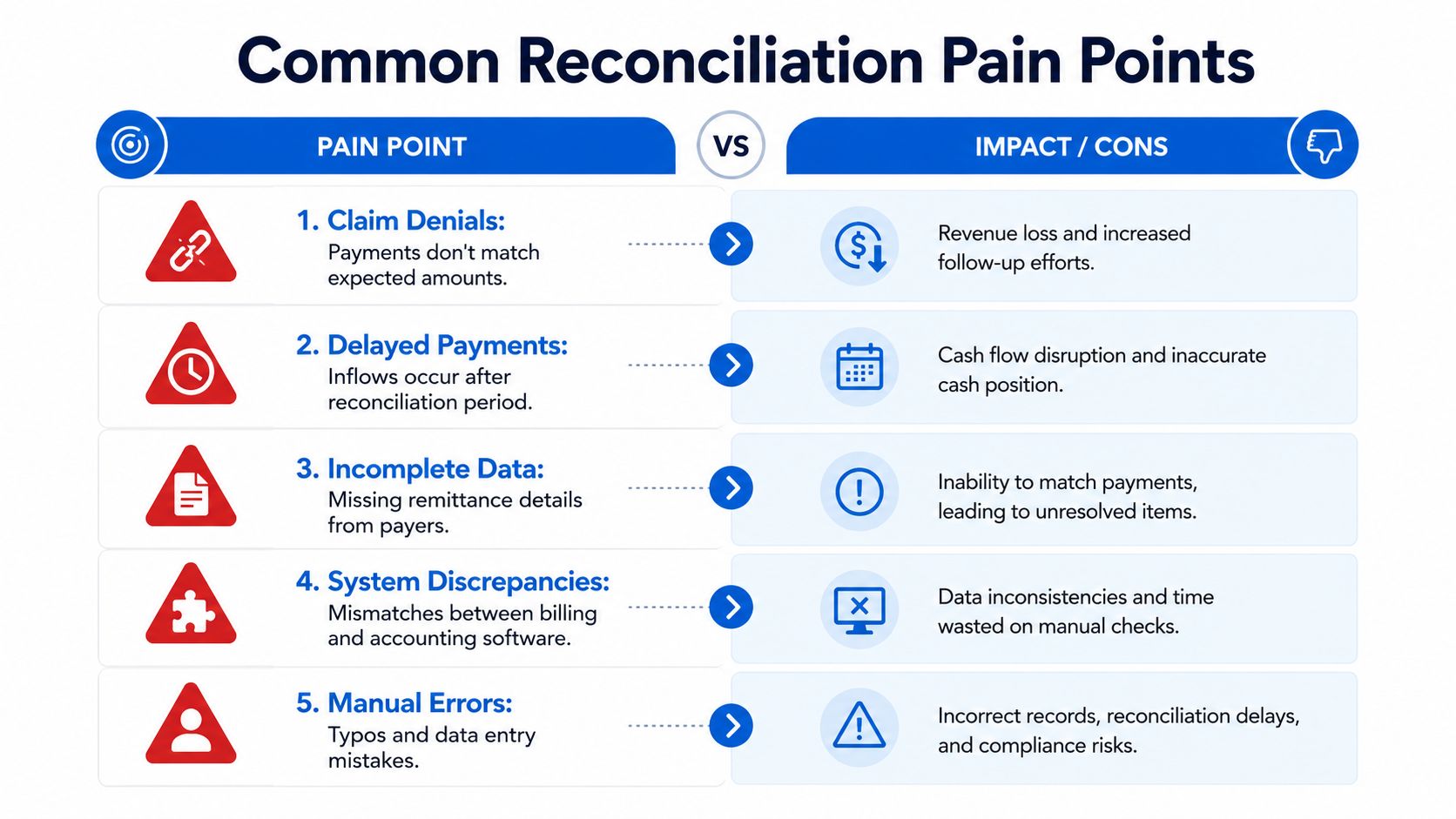
- Underpayments hidden in adjustments: The payer appears to have paid, but the true allowed amount doesn't match the contract.
- Patient payments posted to the wrong account: The balance stays open in one chart while another account gets cleared incorrectly.
- Timing gaps between files and cash: The ERA arrives now, the bank settles later, and staff assume the payment is missing.
- Silent recoupments and reversals: A negative line item reduces revenue without a loud alert.
- Missing remittance detail: The team can see the money, but not the reason behind it.
Each of those issues creates downstream noise. Underpayments inflate receivables. Misposted patient payments trigger bad billing statements. Timing gaps make cash visibility look worse than it is. Silent recoupments can surprise a CFO who thought the month was closed.
The bigger operational issue is that these problems don't always look urgent on day one. A deposit posts, the ledger balances, and everyone moves on. Later, when a secondary claim rejects or a patient complains about a bill, the original mismatch is still sitting there.
That's why reconciliation is exception management. The core work is not comparing two totals and calling it done, it's investigating the cases where the payer, the bank, and the practice management system disagree. In healthcare, that disagreement is often the clue that revenue was lost or delayed.
Manual vs Automated vs Outsourced RCM Approaches
Manual reconciliation is still the default in a lot of practices, especially when the team is living in spreadsheets and copied totals. It works until volume grows, remittance formats multiply, or the same few people start carrying the entire exception load. At that point, the process becomes slower, harder to audit, and more dependent on memory than control.
Automation changes the economics. A 2025 finance benchmark cited manual reconciliation costs of about $8-12 per transaction, versus $2-4 with AI-assisted workflows, which points to a 60-75% cost reduction when automation is mature, according to the benchmark summarized by Stealth Agents. The same source reported 85-95% straight-through match rates in mature deployments, a 70-80% reduction in manual matching time, and books closing an average of 2.4 days faster per period.
| Approach | Cost profile | Accuracy profile | Speed | Visibility |
|---|---|---|---|---|
| Manual | Labor-heavy, spreadsheet-dependent | Highly variable | Slow | Low unless heavily documented |
| Automated | Lower per-transaction effort | Strong on routine matches | Fast on standard cases | Better dashboarding and audit trail |
| Outsourced RCM | Service-based, depends on scope | Strong when payer nuance matters | Faster than internal manual work | Better exception handling and oversight |
The decision is not really about ideology. It's about where your practice feels pain. If the team mostly needs help with routine match logic, automation is often enough. If the team is drowning in payer-specific oddities, staffing gaps, and unresolved exceptions, an outsourced model can absorb the long tail that internal staff keeps revisiting.
Practical rule: Keep manual review for true exceptions, not for the routine work that software can clear safely.
Clarity is one option that combines payment posting support, payment variance analysis, and reconciliation help within a broader RCM service model, so it fits practices that want both process coverage and exception handling without building the whole stack in-house.
Key Reconciliation KPIs Every Practice Should Track
A reconciliation dashboard should tell a CFO whether the process is healthy, not just busy. The first metric that matters is days to reconcile, because delayed exception clearing is usually where leakage shows up first. If open items keep aging, the team is reacting instead of controlling.
The second is straight-through match rate, which shows how much of the flow clears without manual intervention. Mature automation can push that much higher, while a low rate usually means the data is messy, the matching rules are weak, or the payer mix is more complex than the workflow can handle.
The other numbers should be tied to real operating risk:
- Unresolved exception aging: Watch the dollar amount that stays open too long. Older items usually signal staffing strain or a payer-side change.
- Underpayment recovery rate: Track how much identified short payment is collected back. A long list of identified variances means little if nothing gets recovered.
- Reconciliation accuracy: Sample-test the work. If the variance rate keeps rising, the posting rules or source data need attention.
A healthy dashboard makes it hard to ignore drift. Once the aging bucket starts growing, the issue has usually moved beyond simple posting cleanup.
The goal is not to hit a vanity number. It's to spot pattern shifts early enough to stop cash from leaking, patient balances from distorting, and close from slipping. A practice owner doesn't need every transaction on the screen. They need the handful of signals that tell them whether revenue control is tightening or slipping.
When Outsourced RCM Makes Sense for Reconciliation
Outsourced reconciliation starts making sense when the work stops fitting inside the day. If ERA backlogs run past two business days, exception aging keeps crossing the point where items should have been resolved, or the same underpayments keep coming from the same top payers, the process has become strategic.
It also makes sense when billing staff are spending too much time matching deposits instead of handling denials, follow-up, and patient balance work. Another warning sign is the absence of a real reconciliation dashboard. If no one can see what's pending, open, or recovered, the practice is managing blind.
The decision point is simple. If the practice wants cleaner cash visibility, better auditability, and fewer manual loops without hiring more headcount, outsourced RCM is a reasonable next step. If the current setup is still small and the payment flow is stable, tighter automation may be enough for now.
For practices that want a low-friction starting point, a consultation can help map where reconciliation breaks are happening and what should be automated, posted, or handed off.
If reconciliation feels more like daily firefighting than a controlled process, Clarity can review your current payment posting and exception flow, then show where posting support, variance review, or outsourced reconciliation would reduce noise. That kind of assessment is useful when you want cleaner cash visibility without adding more internal headcount.
No responses yet