
Your clinic just got the letter no CFO wants to see. A payer wants records. Compliance wants a response. Operations is saying the claim was clean, billing is saying the edit system never flagged it, and someone is now digging through spreadsheets trying to prove the issue was isolated.
That's the moment teams often learn the same expensive lesson. Compliance monitoring is not a legal decoration on top of revenue cycle work, it's a revenue protection system. If you only look after a problem shows up, you've already let a correctable issue turn into recoupment risk, audit pain, and internal chaos.
What changed is simple, and the numbers tell the story. In a 2025 survey cited by Secureframe, 58% of organizations conducted 4 or more audits, and 35% of enterprises conducted more than 6 audits on average. A 2026 industry roundup reported that 92% of organizations now conduct at least two audits or assessments annually. That's not bureaucracy for its own sake, it's continuous review becoming the operating norm in serious programs. Secureframe's compliance statistics roundup
Table of Contents
- The Compliance Wake-Up Call Every RCM Leader Should Heed
- What Compliance Monitoring Means in RCM
- The Regulatory Drivers Behind the Program
- Core Components of a Working Monitoring Architecture
- Risk-Based Design and the KPIs That Actually Matter
- Technology, Automation, and the Build Versus Buy Decision
- A 90/180/365-Day Implementation Roadmap
- Why More Monitoring Is Not Always Better
The Compliance Wake-Up Call Every RCM Leader Should Heed
The cleanest way to understand the problem is to watch it play out in a real practice. A mid-sized group gets a payer recoupment letter tied to a cluster of claims that should have been caught earlier. Leadership asks for the monitoring file, and there is no real file, only scattered audits, a few email reminders, and a lot of confidence that someone on the team would have noticed. That confidence gets expensive fast.
The false comfort of “we've always done it this way”
In revenue cycle, most failures do not look like fraud. They look like weak eligibility checks, inconsistent claim edits, sloppy documentation follow-through, or a policy that exists but never gets tested against live work. Without a monitoring cadence, the organization learns about the gap from a payer, an auditor, or a regulator, which is the worst possible time to find out.
Practical rule: if the only evidence you have is that a task was assigned, you do not have compliance monitoring yet.
That is why the shift in compliance programs matters to RCM leaders, not just compliance officers. Mature programs separate execution from effectiveness. KPMG recommends distinguishing whether controls were performed on time from whether they reduced residual risk, because a dashboard full of completed tasks can still hide a weak control environment. KPMG's guidance on compliance effectiveness metrics
Why this is a finance issue, not a side project
A payer recoupment is a cash event. An audit inquiry is an operating event. A missed monitoring gap can become both, and then it starts draining staff time, delaying payments, and pulling leadership attention away from revenue work. That is why I treat compliance monitoring as part of RCM performance, not a separate legal lane.
Healthcare leaders also need to stop treating monitoring as a once-a-year ritual. The practical standard in a resource-constrained practice is simple, check the highest-risk controls often enough to catch drift before it turns into bad cash flow or bad headlines. Over-monitoring low-risk work wastes staff time and trains teams to ignore alerts. Under-monitoring the high-risk work leaves the practice exposed and forces you to react on someone else's timeline.
The broader compliance picture points in the same direction. Secureframe's compliance statistics roundup shows that risk and compliance teams are dealing with more than privacy and enforcement alone. That matters in healthcare, because the exposure now includes reputation, employee issues, and control failures that spread well beyond a single claim file. Secureframe's compliance statistics roundup
The executive takeaway is blunt. If you wait for the letter, you have already paid for the monitoring gap. A defensible program catches the issue early, documents what happened, and gives the CFO a chance to fix the problem before someone else prices it for you.
What Compliance Monitoring Means in RCM
A claims team can be busy all week and still miss the warning signs. Eligibility may look clean, coding may move on time, and payments may post without obvious errors. The problem shows up later, when a weak control lets a denial pattern, a documentation gap, or a privacy issue sit unnoticed until it costs cash and staff time.
From billing task to control
In RCM, a control is a repeatable check that reduces risk or catches it early. Eligibility verification before claim submission is a control. Claim edit review is a control. Coding audits are a control. Payment posting reconciliation is a control. HIPAA access log review is a control when someone reviews the results and acts on the exceptions.
The common mistake is treating activity as proof. A staff member can say eligibility was checked, but if the workflow does not preserve what was checked, when it was checked, and how the team handled a failure, that is not monitoring. It is memory, and memory does not hold up in an inquiry.
A definition a CFO can use at the board table
A fire department responds after the problem starts. A smoke detector gives the practice a chance to stop the spread before the loss gets bigger. Compliance monitoring is the set of rules, reviews, evidence trails, and escalation steps that lets the practice catch control failures early enough to fix them while the risk is still manageable.
The test is simple, if a payer, auditor, or regulator asked for proof tomorrow, could your team show what was checked, what failed, who owned the fix, and when it was closed?
That is the line between being busy and being defensible. It also shows why monitoring has to live inside daily workflow, not in a policy binder nobody opens. If the practice does not connect its checks to claims accuracy, eligibility, coding, and payment integrity, the program will not protect cash.
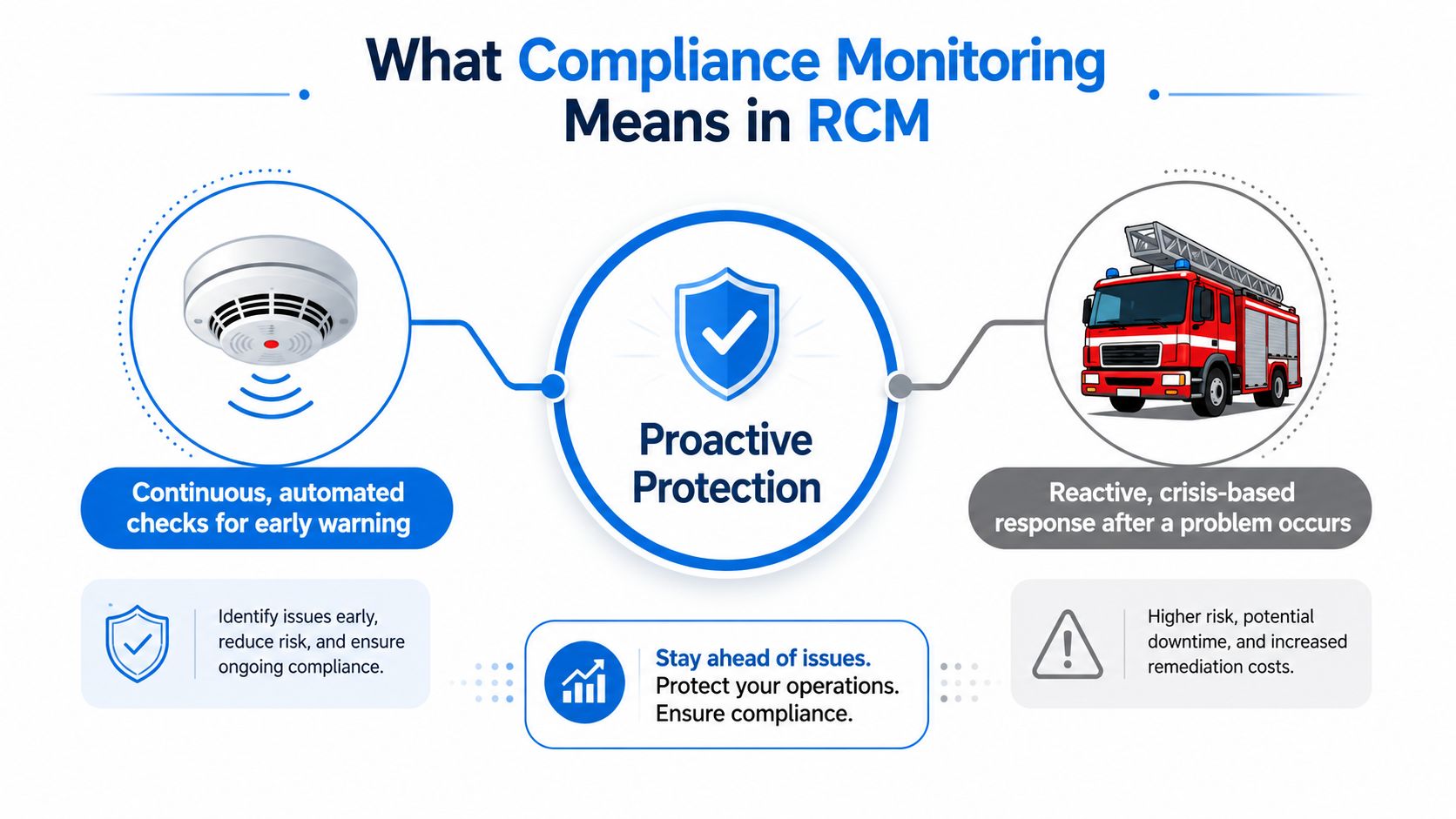
The working definition I would give any partner or board member is simple. Compliance monitoring is the routine, evidence-based testing of revenue cycle controls so the practice can detect failures early, prove what happened, and fix issues before they become recoupments, breaches, or enforcement problems.
A resource-constrained practice does not need to monitor everything with the same intensity. It needs a small set of high-risk checks, clear ownership, and a paper trail that a payer or regulator can follow without a scavenger hunt. That approach protects margin. It also keeps staff from drowning in alerts that do not change behavior.
Over-monitoring low-risk work is expensive theater. It burns time, trains teams to ignore noise, and pushes attention away from the controls that guard revenue. A tighter program that focuses on the highest-risk handoffs, exceptions, and repeat failure points will do more for cash flow and compliance than a bloated checklist ever will.
The Regulatory Drivers Behind the Program
Healthcare RCM doesn't get to pick its compliance pressure. The rules come from multiple directions, and each one creates a different kind of monitoring obligation. HIPAA and HITECH drive how you handle protected health information. The False Claims Act and Anti-Kickback Statute shape billing integrity. CMS and state Medicaid rules govern participation and payment expectations. Payer contracts add another layer because a contract can create takeback risk even when no regulator is in the room.
The obligations are not equal
Some requirements are fixed. If you mishandle PHI, you're in security and privacy territory whether or not a patient complaint arrives. If you submit claims without proper support, you create false claim exposure. If your contracts define documentation or timing requirements, the payer can enforce those terms even if your internal policy says something laxer.
That's why I don't like one-size-fits-all checklists. A checklist says, “Did we do the thing?” A monitoring program asks, “Did the thing reduce risk, and can we prove it?” That difference matters because the financial exposure sits in different places depending on the obligation. Privacy failures can become reportable incidents. Billing failures can become takebacks or scrutiny. Contract failures can become systematic underpayment or overpayment disputes.
Monitoring has to match the obligation
A practical way to think about this is by cadence and evidence. High-risk checks deserve tighter review because delayed discovery makes everything more expensive to unwind. Lower-risk controls can live on a slower cycle, as long as they still get tested and documented.
The same logic shows up in external guidance on continuous monitoring architecture. Industry guidance recommends mapping each obligation to a testable control, then linking obligation registers, control results, audit findings, policy systems, and live operational telemetry into one layer with defined alert thresholds. That structure is what turns compliance from theory into something the organization can act on in real time. AccountableHQ's compliance monitoring and reporting guidance
You also have to remember that regulators expect a cadence, not intentions. A good policy that never gets tested won't protect the practice when someone asks for evidence. If your team can't show a monitoring rhythm, the policy reads like wishful thinking.
Core Components of a Working Monitoring Architecture
A monitoring program falls apart when the pieces live in separate drawers. Policies sit with compliance. Audits sit with quality. Workflow issues sit with operations. Then everybody is shocked when the response is slow and the evidence is incomplete. A working architecture pulls those parts into one operating model.
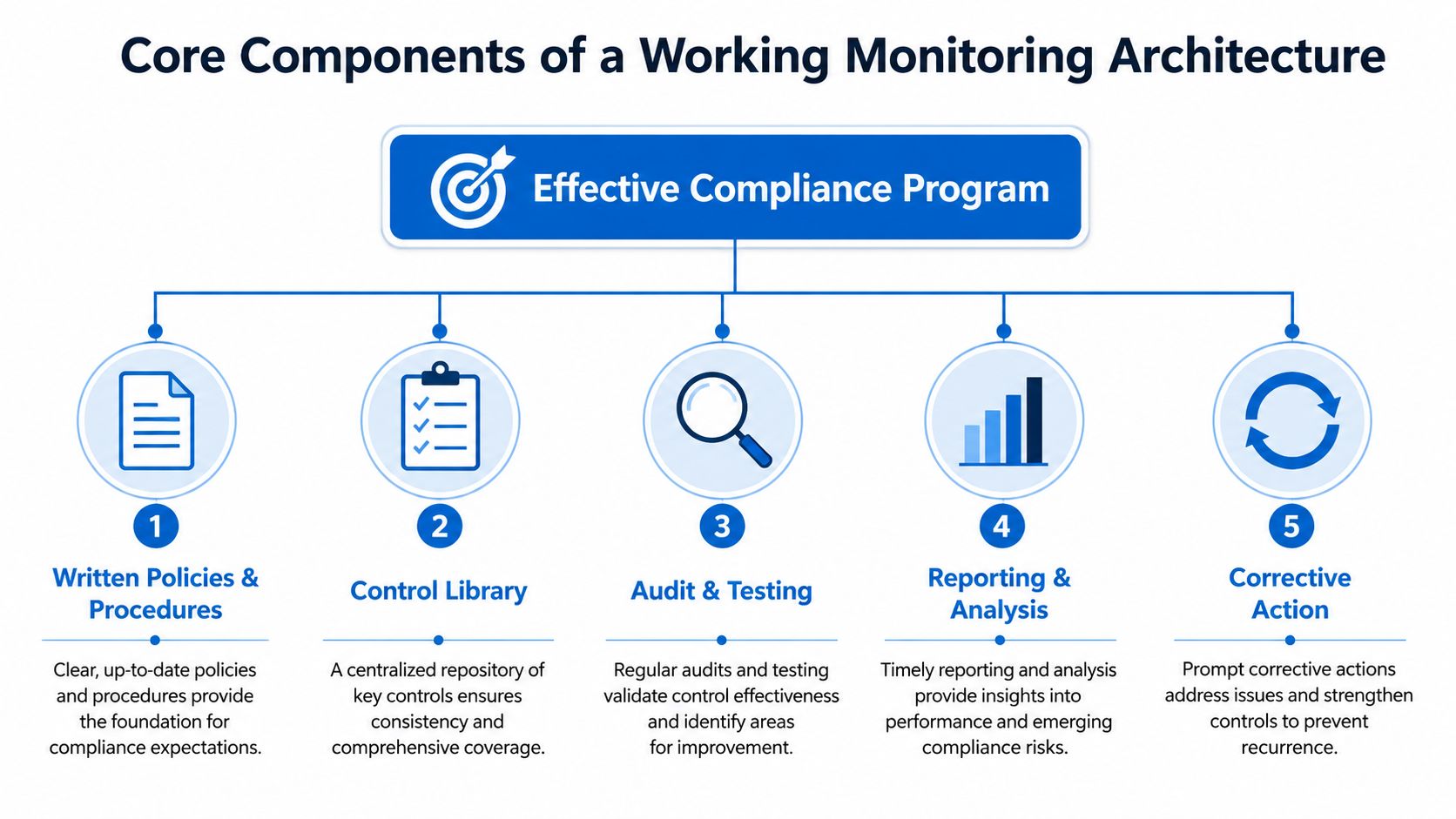
Build the program around five connected layers
Start with written policies and procedures, but treat them as the rulebook, not the finish line. Next, create a control library that maps each obligation to a specific check in revenue cycle work. Then define audit and testing workflows so someone knows how often the control gets reviewed and what evidence counts.
After that, connect reporting and analysis so leaders can see exceptions, trendlines, and repeat problems. Finish with corrective action, because a control that finds nothing to fix isn't monitoring, it's theater.
- Written Policies & Procedures: set the standard, define ownership, and name what “good” looks like.
- Control Library: translate obligations into specific checks, such as eligibility review before submission or coding validation before charge entry.
- Audit & Testing: prove the control works, not just that someone remembers doing it.
- Reporting & Analysis: surface trends, exceptions, and repeat failures in a form leadership can use.
- Corrective Action: assign fixes, deadlines, and follow-up so the same issue doesn't recur.
A concrete example helps. If eligibility verification is the control, the policy states the requirement, the control library specifies which encounters must be checked, testing confirms the team verified coverage, reporting flags missed checks, and corrective action routes failures back to the right supervisor with a documented closure note.
The architecture only counts as monitored when it produces evidence you can defend. If a workflow completes but doesn't leave a trace, it's not enough. That's why I tell teams to think in terms of traceability, not just completion.
For a closer look at how coding failures create downstream monitoring problems, review Clarity's overview of medical coding errors. And if you want a clean operational example of how analytics can support RCM oversight, this embedded training is worth a look.
Risk-Based Design and the KPIs That Actually Matter
A strong monitoring program does not review every control with the same intensity. That's how teams end up bloated, tired, and blind to the issues that matter most. Risk-based design means you spend your attention where the exposure is highest and back off where the impact is lower.
Separate execution from effectiveness
This distinction saves a lot of bad reporting. Execution metrics tell you whether the control happened on time. Effectiveness metrics tell you whether it reduced risk. A training record can show completion. That doesn't mean the team changed behavior. A claim edit can run. That doesn't mean the error was prevented.
KPMG's guidance is useful here because it warns against dashboards that overstate compliance just because tasks were completed. In my view, that's the fastest way to lull executives into false confidence. If the board dashboard is full of green checkmarks, but exceptions are still leaking through, the program is lying to you politely.
What belongs on the CFO dashboard
Use a short set of RCM measures that force action, not decoration. Clean claim rate belongs on the executive view because it reflects upstream quality. Denial overturn rate matters because it shows whether the team is appealing well or just absorbing bad outcomes. Days in A/R over 90 is a cash signal, not just an operational metric. Eligibility verification completion belongs because missed verification creates preventable denials. Coding accuracy from audits is an effectiveness measure. HIPAA training completion is useful, but only if it's paired with behavior checks and access review.
If you want a practical analytics layer that turns these signals into something leadership can use, Clarity's healthcare revenue cycle analytics resource is a good reference point for the kind of reporting structure that makes monitoring actionable instead of decorative.
CFO rule: if a metric doesn't change a decision, it doesn't belong on the top dashboard.
Use two dashboards, not one
The executive view should be narrow, trend-oriented, and tied to risk. The working view should be messier, with exceptions, owners, due dates, and open remediation items. Those are different tools for different jobs. The CFO needs to see whether risk is rising. The manager needs to know which file, which payer, and which staff member needs action today.
That separation keeps the program honest. It also keeps teams from mistaking volume for value.
Technology, Automation, and the Build Versus Buy Decision
Technology helps, but only if you know what job you want it to do. A lot of teams buy software thinking they've bought compliance. They haven't. They've bought detection capacity, maybe reporting, and sometimes workflow. Someone still has to interpret what the signal means and decide what to do next.
Automate the checks that are repeatable
Good candidates for automation are the obvious, repeatable ones. Eligibility checks, claim edits, PHI access log review, and policy exception tracking can all benefit from rules-based screening and centralized reporting. Those are the places where the machine can catch a known pattern faster than a person can.
Human judgment still matters for medical necessity review, root cause analysis, and judgment calls around remediation. Automation can tell you a file was missing a signature. It can't tell you whether the issue came from training, workload, or a broken handoff without human review.
Build only what you can maintain
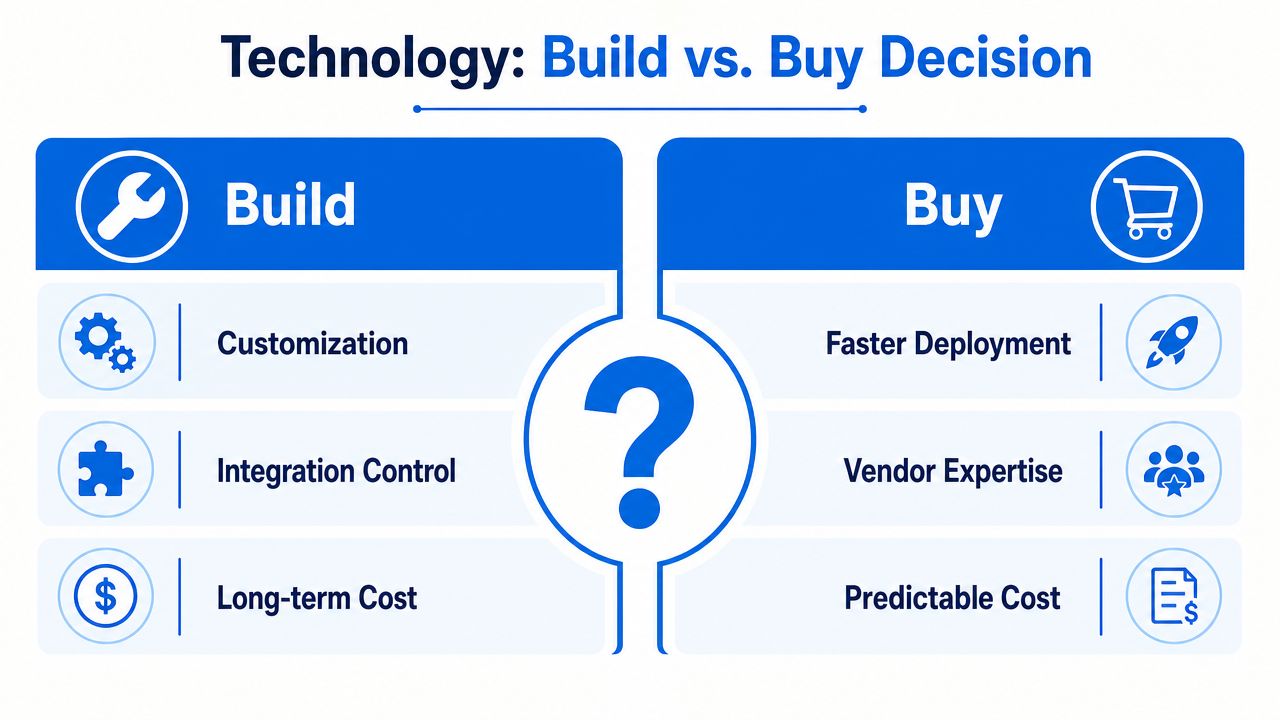
The build-versus-buy question is mostly about speed, integration, and support burden. If your team has the internal data discipline to maintain custom logic and the appetite to keep it tuned, building can make sense. If not, buying usually gets you to a defensible program faster. That's especially true when the practice doesn't have a deep compliance staff or a fully integrated data environment.
A practical path is phased. In the first stretch, get the highest-risk checks visible and documented. In the middle, connect those checks to alerts and remediation. By the end, decide whether the program should keep living inside the practice or whether an outside partner can run the workflow more efficiently.
For teams that want a partner model instead of a full internal build, Clarity's healthcare RCM software page is one place to compare how workflow support can sit alongside monitoring. Use that comparison directly. Software without ownership is just a prettier spreadsheet.
A 90/180/365-Day Implementation Roadmap
The fastest way to fail is to try to launch everything at once. The better move is to build a minimum viable program that addresses the highest-risk workflows first, then expand after the basics are stable. This approach is more realistic for smaller teams and far less exhausting for everyone involved.
Days 1 to 90, establish the floor
Start with scope, ownership, and the core risk areas. Focus on eligibility, coding, claim edits, and PHI access. Refresh policies so they match what the team does, not what the last binder said. Then set up simple evidence capture so every check leaves a trail.
A small team can do this with a lean structure. One leader owns the program. Operations owns workflow execution. Billing or coding owners handle daily follow-through. Compliance or an outside advisor reviews the control design and the evidence trail.
Practical rule: don't instrument the whole organization before you can monitor the five processes that create most of your claims risk.
Days 91 to 180, test and report
Once the floor is in place, add testing and routine reporting. That means reviewing whether the controls are happening, whether exceptions are being closed, and whether the same failure keeps repeating. Monthly or quarterly review cycles make sense for the highest-risk checks in smaller organizations, especially when staff is limited and systems are fragmented. Recent guidance for smaller firms pushes in exactly that direction, with centralized data, primary-source verification, and time-bound exceptions instead of annual manual sweeps. MCO's guidance for smaller firms
Days 181 to 365, harden and simplify
By this point, automation should be doing some of the repetitive work, and leadership should be seeing a stable dashboard with trends and unresolved items. Document exceptions properly. Close the loop on remediation. Decide what deserves monthly review, what can move to quarterly, and what only needs periodic sampling.
The core question isn't how much you can monitor. It's how much you can monitor well. That's the program that survives scrutiny.
Why More Monitoring Is Not Always Better
The most common mistake I see is scope creep. Leaders get nervous, add more checks, more reports, more meetings, and more documentation, then wonder why the team is exhausted and the important issues still aren't getting fixed. A wider net can catch more noise. It doesn't automatically catch more risk.
Minimum viable evidence beats maximum possible paperwork
Recent guidance is moving toward minimum viable evidence for high-risk areas. I agree with that direction. The goal isn't to prove you observed everything. The goal is to prove you observed the right things often enough to catch material failures before they spread. KPMG's recent framing on targeted, decision-useful monitoring points in the same direction, because broad coverage without useful escalation just creates clutter.
That matters for resource-constrained practices. Smaller organizations don't have the luxury of bloated control libraries and endless testing cycles. They need centralized data, primary-source verification, and a cadence that matches risk. If a control fails monthly, review it monthly. If the exposure is lower, quarterly may be enough. If it's stable and low-risk, sample it periodically and keep moving.
What I would do if I were protecting a budget
I'd fund the controls that touch cash and exposure first. I'd stop pretending every policy deserves the same review rhythm. And I'd make sure every exception has an owner, a date, and a documented closeout. That's not minimalist for the sake of being cheap. It's disciplined because it respects staff time and focuses on what changes outcomes.
A monitoring program fails when nobody owns the follow-through. It also fails when technology is treated like a substitute for judgment. The right answer is a narrow, defensible system that lets the practice prove it knows where the risks are and what it's doing about them.
If you're deciding what to do this week, start here. Review the three controls most likely to create denials or recoupment exposure, assign clear owners, and make sure each one leaves evidence you can produce on demand. This quarter, build the dashboard that separates task completion from true risk reduction. If you want a partner to help structure that work, Clarity can support revenue cycle operations, verification, claims follow-up, payment posting, and compliance audit workflows without turning the program into a paperwork contest.
No responses yet