
The cleanest way to understand medical coding compliance is to start with the money. In FY 2024, Medicare Fee-for-Service improper payments were 7.66%, an estimated $31.70 billion. Medicare Part C was 5.61%, about $19.07 billion, and Medicare Part D was 3.70%, about $3.58 billion (Aptarro summary of CMS and HFMA materials). Those numbers aren't an abstract federal problem, they're a reminder that coding controls sit inside the revenue engine, the audit trail, and the organization's ability to defend payment.
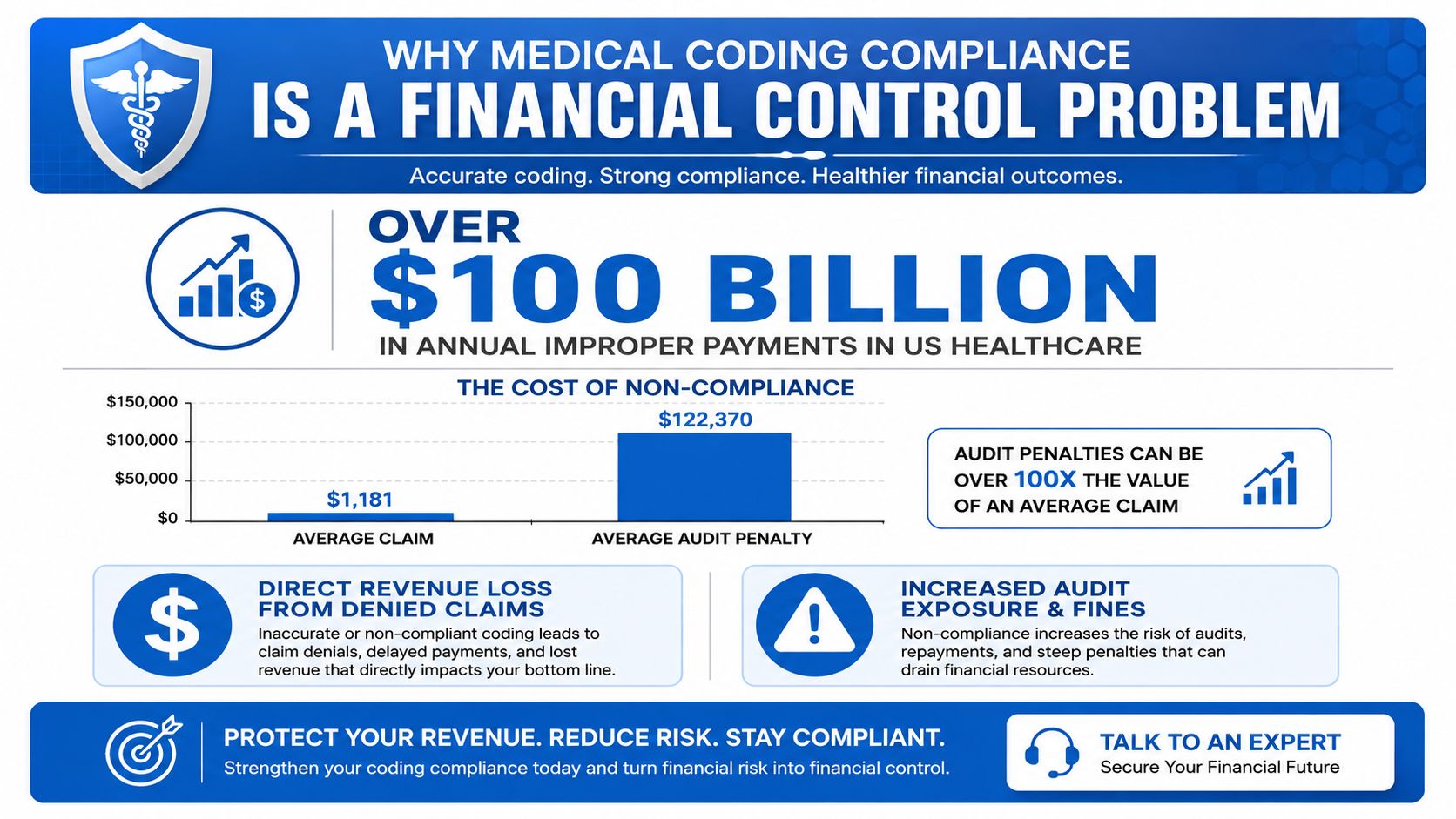
A lot of practices still treat coding as a back-office documentation task. That framing misses the point. Coding choices determine whether a claim is payable, whether the documentation supports medical necessity, whether modifiers survive payer edits, and whether the organization can stand up to a contractor review without scrambling for records. The financial-control lens is the right one because most losses don't come from a single dramatic mistake, they come from small process failures that repeat until they become denial patterns, recoupments, or both.
The oldest warning sign in the compliance literature makes the same point. An Office of Inspector General audit of the Health Care Financing Administration found errors in 30% of all claims paid in fiscal year 1996, with those errors representing about $23.2 billion annually, or 14% of total Medicare fee-for-service payments (AHIMA PDF). Roughly half of the errors were tied to insufficient or absent documentation, and about one-third of documentation errors came from providers who didn't respond to repeated auditor requests for records (AHIMA PDF). That's the key operational lesson. Compliance failures usually start upstream, with weak encounter support, not at the final coding keystroke.
What a real compliance policy has to obey
A useful policy stack starts with the legal floor, not with coder preference. At minimum, a program has to sit inside HIPAA, the False Claims Act, the Anti-Kickback Statute, and current OIG compliance program guidance. After that come the operational rules that govern claim construction, including ICD-10-CM, CPT/HCPCS Level II, Medicare National Coverage Determinations, Local Coverage Determinations, NCCI edits, Medically Unlikely Edits, and payer manuals. If a policy can't point to one of those authorities, it's probably a habit dressed up as a rule.
Practical rule: every internal coding policy should answer one question, “What authority does this rely on?” If the answer is “this is how we've always done it,” the policy isn't ready for audit.
That's why strong programs keep the source material close. A coding lead should have the current CPT and ICD-10-CM guidance, Medicare coverage references, NCCI and MUE resources, payer bulletins, and internal payer-variance logs bookmarked and reviewed routinely. Policy writing can't lag behind the rule changes, because auditors don't accept “our system used the old version” as a defense.
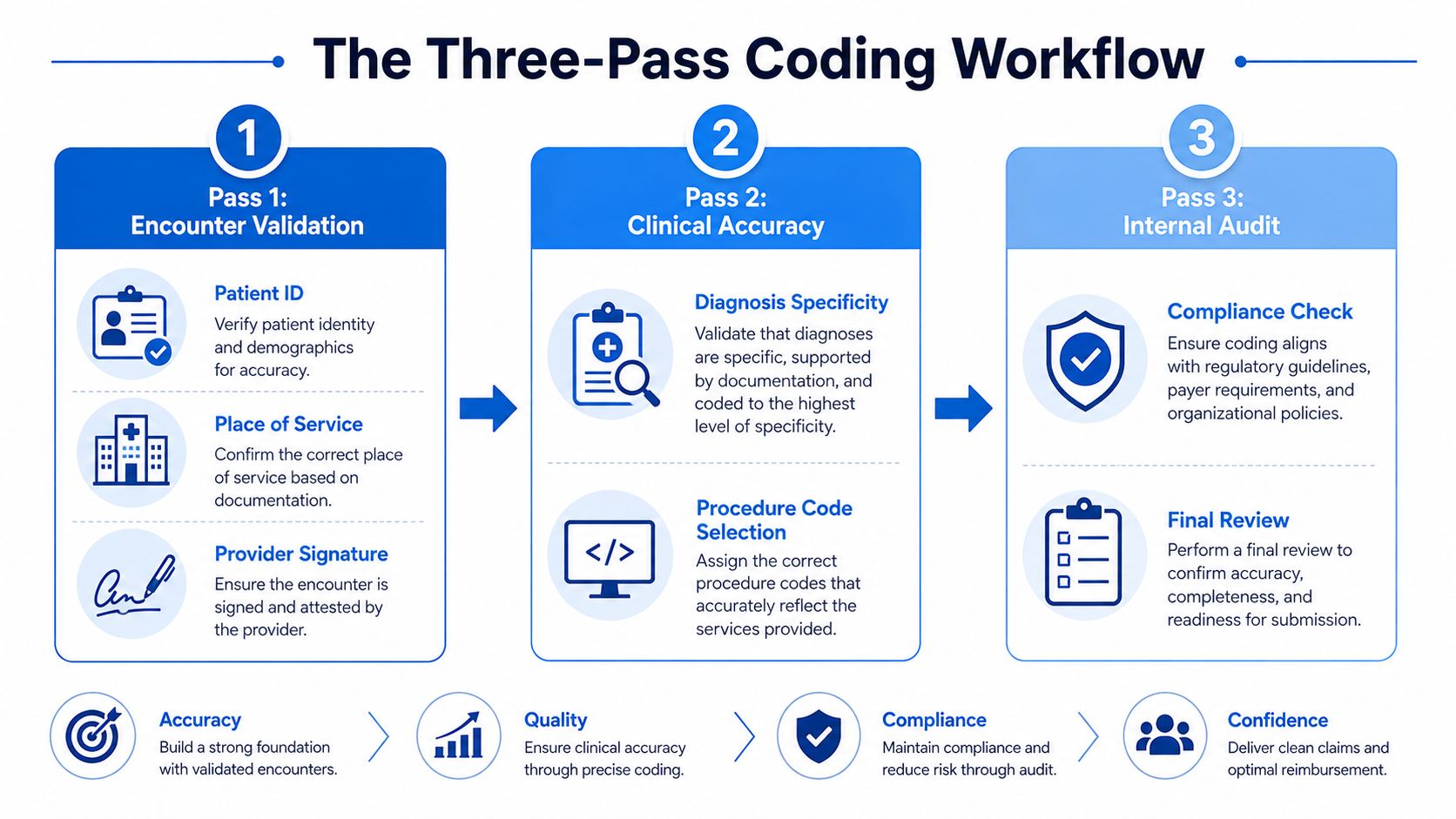
Table of Contents
- What a real compliance policy has to obey
- Why Medical Coding Compliance Is a Financial Control Problem
- The Three-Pass Coding Workflow at the Heart of the Program
- Building the Governance and Policy Stack
- Running Internal Audits That Find Real Risk
- The KPI Dashboard and Monthly Reporting Cadence
- The Compliance Gap Nobody Talks About
- Preparing for External Audits Without Panic
Why Medical Coding Compliance Is a Financial Control Problem
A compliance program that isn't built as a financial control program usually turns into a document chase. That's a problem, because the system-level losses tied to coding and documentation are large enough to affect margins, reserves, and board-level risk conversations. The modern benchmark is blunt. FY 2024 Medicare Fee-for-Service improper payments were 7.66%, or $31.70 billion, with Part C at 5.61% and $19.07 billion, and Part D at 3.70% and $3.58 billion (Aptarro summary of CMS and HFMA materials). Those aren't practice-level numbers, but they show the scale of the environment every provider is operating in.
Why documentation drives most of the risk
The practical lesson from both the older OIG audit and current CMS/HFMA materials is that documentation problems do most of the damage. In the historical audit, roughly half of the errors were tied to insufficient or absent documentation, and about one-third of those documentation errors came from providers who didn't respond to repeated record requests (AHIMA PDF). In the FY 2023 CMS/HFMA materials summarized by Aptarro, insufficient documentation accounted for $19.6 billion, or 60.9% of projected Medicare FFS improper payments, while incorrect coding contributed $3.6 billion, or 11.2% (Aptarro summary of CMS and HFMA materials). That split matters operationally. A coder can only protect revenue that the chart supports.
The control mindset changes the questions leadership asks. Instead of “Did the coder get the code right?” the better questions are, “Did the encounter contain what the code required, did the policy allow it, and can we prove it if asked?” That framing is especially important for CFOs and practice owners because it links coding directly to cash collection, denial prevention, and audit defense.
Compliance starts before coding starts. If the record is thin, unsigned, or internally inconsistent, the downstream claim is already exposed.
A good program therefore treats documentation gating as a control, not a suggestion. The claim should not move forward until the encounter is complete, authenticated, and internally consistent. After that, coding integrity and policy alignment can be tested instead of guessed at.
What the operating model has to include
The rest of the program should be built around a few hard controls, not broad intentions. That means governance, a clear workflow, targeted audits, measurable KPIs, documented corrective action, and readiness for outside review. It also means mapping the rules that govern every line of a claim, because a policy without its authority is just a preference with a logo on it. For a practical downstream view of how coding depends on encounter accuracy, the charge-capture discussion at this Clarity overview fits naturally into the same control mindset.
The Three-Pass Coding Workflow at the Heart of the Program
The cleanest way to reduce rework is to make every coder run the same three passes before a claim leaves the building. The order matters. If the encounter facts are wrong, the rest of the review is wasted effort, and if the policy check comes too late, the claim gets corrected only after it has already introduced denial risk.
Pass one validates the encounter
First, confirm the basics, patient identity, place of service, provider authentication, signature, and the presence of a complete record. A lot of avoidable exposure starts here, because missing signatures and incomplete notes are not minor clerical issues. They can turn a service into a defensibility problem. The chart has to be legible, complete, and signed before code assignment begins, not after.
Pass two checks coding integrity
Second, test the code set itself against the documentation. That means diagnosis specificity, procedure selection, units, bundling logic, and modifier use. The record should support the code line by line, not just in aggregate. Unsupported modifier use, especially when teams default to -25 or -59 without documentation support, creates a predictable audit target, and so do mismatches between the diagnosis and the procedure line. A useful internal review method is to crosswalk the record against the claim exactly as it will be submitted.
Pass three tests policy alignment
Third, verify that the claim meets payer and coverage rules. That includes medical necessity, payer-specific LCD and NCD rules, telehealth place-of-service constraints, and NCCI and MUE edits. A telehealth claim can be clinically sound and still deny if the place-of-service logic is wrong. A procedure can be documented and still fail if the payer's edit logic isn't satisfied.
Documentation gating is the control point. No signed, complete chart, no code assignment. Without that gate, the other two passes are just cleanup.
A simple way to keep the sequence disciplined is to use the same question in each pass, but at a different layer. Is the encounter real? Is the code accurate? Does the policy allow payment? That structure is what keeps speed from overrunning quality.
Building the Governance and Policy Stack
A compliance program survives when ownership is clear. In a mid-sized practice, the committee has to be small enough to act and broad enough to catch risk. The group should include the CFO, a compliance officer, the coding lead, a clinician champion, and a billing operations representative. Their job isn't ceremonial. They approve policy, review audit findings, sign off on corrective action, and decide what education happens next.
What the written plan needs to say
The written compliance plan should cover the code of conduct, scope, roles, training requirements, audit cadence, and disciplinary procedures. It should also name the day-to-day policy stack coders use, including coding guidelines, modifier policy, query policy for physician clarification, and a payer variance log for conflicting instructions. That last piece matters more than most leaders expect, because a binder full of stale policies creates a false sense of control. Short, current, signed policies beat an unread manual every time.
One of the best habits is to make the policy stack usable under pressure. Coders should know exactly where to find the rule for modifier use, where the query template lives, and what to do when payer guidance conflicts with standard coding guidance. If the team has to hunt through old emails to justify a decision, the program is already brittle.
A practical reference point is master compliance with this guide, which is useful because it keeps the governance question tied to ownership, review, and follow-through instead of treating compliance as a document archive. Internal policies should do the same.
How the committee should work
The committee doesn't need a long agenda, but it does need a fixed cadence. Review audit results, denial patterns, high-risk specialties, payer variances, and education needs. Approve updates to policy, and make sure corrective actions get tracked until they're closed. A policy no one monitors becomes a shelf artifact.
The best programs also separate control design from control execution. Coders follow the rules. The committee checks whether the rules are current, whether the workflow is being followed, and whether patterns of error are getting addressed. That separation keeps the process honest and prevents the same mistakes from reappearing under a new memo.
Running Internal Audits That Find Real Risk
Internal audits only work when they're aimed at the right claims. Random review has a place, but a mid-sized practice gets more value from stratified sampling across high-risk specialties and 100% review of unusual or high-dollar claims. E/M-heavy primary care, surgical lines with heavy modifier use, and behavioral health with time-based codes deserve their own review lens. General sampling alone tends to miss the patterns that drive exposure.
How the review should run
Start with the full chart and the claim, not just the coded summary. Then evaluate documentation completeness, crosswalk the chart line by line to ICD-10 and CPT codes, and test the claim against payer rules and NCCI and MUE edits. That sequence matters because a coding error might be visible in the claim, but the root cause usually lives in the chart, the query, or the policy interpretation.
A clear review should score more than right-versus-wrong. Track accuracy by coder, accuracy by provider, dollar exposure, and recurring error patterns. If one specialty keeps producing the same modifier issue, the fix is not more generic education. It's a targeted response against the specific documentation or workflow break.
For a framework that maps well to small and mid-sized organizations, the controls-testing approach at Lighthouse Consultants is worth comparing with your own review design because it keeps the focus on repeatable testing, not symbolic oversight.
Good audits don't just find misses, they find why the misses repeat. Without that second step, the same errors cycle back into the next month's claims.
A practical cadence is quarterly random review plus monthly targeted review of flagged areas. The monthly work should follow the risk signals, denial trends, provider outliers, or known policy changes. The quarterly review should test whether the broader control environment is still functioning.
A useful internal example is a multi-specialty group that identifies a pattern of modifier -25 errors in urgent care encounters. That kind of result should trigger a focused re-audit, a documentation review, and a short education session for the providers and coders involved. One narrow error pattern is often enough to expose a larger control gap, especially if the team has been using the modifier by habit instead of by record support. For a related view of recurring coding failure patterns, the team can compare findings with common medical coding errors.
The KPI Dashboard and Monthly Reporting Cadence
A CFO doesn't need twenty dashboards. A compliance program needs a small set of metrics that show whether controls are working and where money is leaking. The monthly report should be split into an executive page and an operational drill-down, with the committee reviewing both. If the numbers are too broad, people talk about them. If they're narrow and specific, people act on them.
Core Coding Compliance KPIs and Target Bands
| KPI | What It Measures | Target Band | Triggers Corrective Action When |
|---|---|---|---|
| Coding accuracy rate | How often coded claims match documentation and policy | Set internally and reviewed by specialty and coder | Patterns fall below the expected internal standard or drift by workstream |
| Denial rate by reason code | Where claims are being rejected and why | Stable or improving month to month | A reason code repeats or climbs across a specialty or payer |
| Days in accounts receivable | How long cash stays unpaid | Within the organization's normal operating range | Trend moves up alongside denial or rework patterns |
| First-pass yield | Claims accepted without rework | High and stable | Rework or returned claims start to rise |
| Audit-identified dollar exposure | The amount at risk from internal findings | Minimal and contained | Findings cluster in one provider, coder, or service line |
How to read the dashboard
The useful distinction is between lagging indicators and leading indicators. Denial rate, recoupments, and days in accounts receivable tell you what already happened. Query volume, documentation deficiency flags, and modifier audit findings tell you where the next problem is forming. A smart dashboard puts both on the same page so leadership can stop waiting for the denial report to become the alarm bell.
If you want the metric layer to connect with broader financial reporting, healthcare revenue cycle analytics is the right adjacent topic because coding data only matters when it changes behavior.
One metric should never stand alone. A coding accuracy trend without denial context can hide payer friction, and a denial trend without audit context can hide documentation drift.
A clean reporting template works well: one executive summary page, one drill-down page for the operational team, and a clear threshold for when a metric becomes a corrective action plan instead of a discussion item. That keeps the committee from debating the meaning of the same chart every month.
The Compliance Gap Nobody Talks About
Most articles on coding compliance fixate on overcoding. That's a real risk, but it's not the whole picture. Two quieter problems create just as much operational damage. The first is payer-specific rule conflict. The second is undercoding.
Payer rules can conflict even when the chart is complete
A peer-reviewed review on coding and reimbursement notes that coders often face conflicting payer rules for code selection and reimbursement, and recommends tracking variances by payer, documenting verbal payer instructions, and maintaining internal policy when guidance is missing or inconsistent (PMC review). That's a real operational headache, especially for organizations that bill multiple payers with different manual logic. The compliance risk is not only whether the code is correct under CPT or Medicare guidance, but whether the practice can prove why it followed one payer's interpretation over another's.
The fix is a payer-variance log that gets reviewed, not ignored. When a payer gives a verbal instruction, document it. When the written guidance is missing or unclear, write the internal policy that the team will follow until the payer clarifies the rule. That keeps the organization from drifting into inconsistent application, which is where denials and audit exposure start to stack up.
Undercoding is not a safe habit
Undercoding gets less attention because it feels conservative. Professional guidance warns that it can still be a liability, because providers should report the full work performed and the correct level of service (CMA guidance). It also distorts severity-of-illness metrics, risk adjustment, and quality comparisons, which means it can suppress legitimate revenue while making performance look flatter than it is. That's a bad trade for CFOs and doctors alike.
Defending a higher-level code when the payer reads the documentation conservatively requires a tight audit trail. Specific documentation, time-based coding support where appropriate, and clean internal rationale notes matter more than a coder's comfort with being “safe.” Safety isn't the same as compliance. The goal is to report the full work that was performed, not the lowest level that feels least controversial.
Preparing for External Audits Without Panic
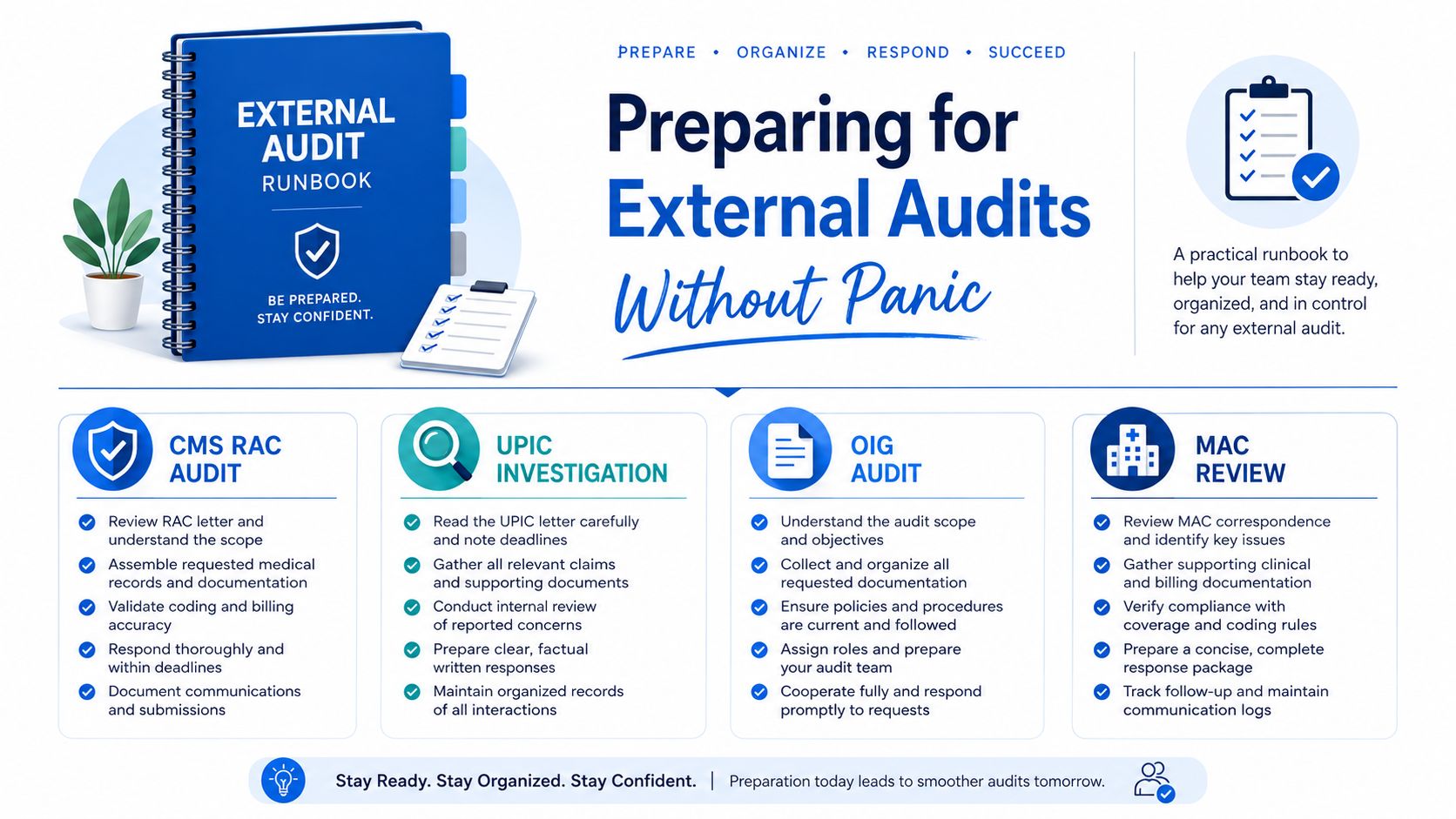
External audits feel disruptive when the internal program is weak. When the internal controls are already in place, they're just another review cycle with a different sender. The main audit types are familiar. CMS RAC reviews, UPIC investigations, CERT reviews, and commercial payer audits each ask for the same basic thing, proof that the service was documented, coded, and billed correctly.
What to send and how to organize it
The documentation package should include the complete chart, signed encounter notes, orders and results, coding rationale, and any internal query responses. Internal consistency is often underestimated. If the claim says one thing and the chart says another, the record loses credibility fast. If the signature is missing or the note is incomplete, the rest of the package gets harder to defend.
Response timing depends on the audit type and the request, but the operational principle stays the same. One person should own the response, the file should be version-controlled, and every submission should be checked against the exact claim under review. When the case looks messy, or when the payback exposure is material, bring in external counsel or a coding defense specialist early instead of after the first response misses the mark.
Audit notices reward preparation, not improvisation. The team that already knows where the policies, logs, and previous audit reports live can respond calmly even when the letter is urgent.
The 30-day readiness checklist
Before an audit notice arrives, keep these items current:
- Current policy stack: the active coding, modifier, query, and payer-variance policies.
- Last two internal audit reports: enough history to show whether previous findings were corrected.
- Denial trend analysis: so the team can identify recurring claim pressure points.
- Payer variance log: especially where payer instructions differ from general coding guidance.
- Single point of contact: one person who coordinates records, responses, and deadlines.
That checklist is what keeps the organization from reacting as if every audit is a surprise. It also protects the larger control program, because the same materials that satisfy an auditor are the materials that help leadership manage denials and recoupment risk every month.
If you want a compliance program that functions as a real revenue-control system, Clarity can help build the operational pieces around coding, billing, and audit readiness, including the workflows that keep claims defensible before they go out and clean up the ones already under pressure. If that's the kind of support your practice needs, visit Clarity and start with a review of your current revenue cycle.
No responses yet