
Popular advice treats revenue cycle recovery like a labor problem. It isn't. If your team is still chasing every denial, reworking every old account, and pushing harder on patients at the point of service, you're probably increasing friction faster than you're increasing cash.
The better approach is narrower and more disciplined. Focus on the leakage points that are recoverable, use the least amount of manual effort needed to collect them, and stop pretending that brute force is a strategy. HFMA's benchmarks make the point plainly, 5% to 10% denial rates are common, less than 5% is the target, 85% of denials within 30 days is the resolution goal, and 95% net collection rate is the floor to aim for, with 97% to 99% optimal, while a 98% clean claims rate signals that the work starts upstream, not in the appeal queue (HFMA KPI guidance).
If you want better cash flow, start by asking which recovery tactics cut waste instead of creating it. That question changes everything.
Table of Contents
- Why Most Revenue Cycle Recovery Efforts Fail
- Initial Assessment and Revenue Leakage Triage
- Denial Management and AR Remediation Strategies
- Underpayment Recovery and Contract Variance Detection
- Staffing Models and Technology Interventions
- KPI Tracking and Recovery Governance
- Implementation Timeline and ROI Expectations
Why Most Revenue Cycle Recovery Efforts Fail
Most revenue cycle recovery programs fail because leaders confuse activity with recovery. They add people to aged AR, tell staff to “work harder” on denials, and then wonder why cash spikes briefly before drifting back down. That approach ignores the core problem, which is that recovery work often creates more administrative load than the organization can sustain.
The strongest guidance goes the other direction. It recommends digitizing and automating operations, standardizing workflows, and using analytics to improve decisions, while also recognizing the burden of patient balances and manual follow-up (McKinsey on revenue excellence). That matters because a recovery program that demands constant labor to sustain itself isn't a program, it's a temporary cleanup campaign.
Stop treating every dollar the same
A denied claim that can be fixed quickly is not the same as a low-value aged account with a weak appeal position. CFOs need to separate recoverable cash from busywork. The practical test is simple, does the work create cash faster than it creates rework?
Practical rule: If a recovery tactic increases touches, escalations, and call volume without lowering future leakage, it's not improving revenue cycle recovery. It's just moving work around.
Patient friction is the other reason brute force fails. Aggressive collections can damage trust if the patient financial experience is opaque or difficult to understand. The result is predictable, staff spend more time explaining bills, patients delay payment, and the organization still hasn't solved the underlying leakage.
For a basic operating standard, keep the focus on process discipline and front-end quality, not heroics. A useful starting point is to align recovery work with the broader revenue cycle discipline outlined in best-practice revenue cycle management, then ask where the money is most likely to be lost before it ever becomes a denial.
Initial Assessment and Revenue Leakage Triage
Start with a leak map, not a worklist. If you skip that step, teams end up fixing whatever is loudest, not whatever returns cash fastest. A good recovery assessment moves from portfolio review to root-cause analysis, then to a hard decision on what deserves labor and what belongs in prevention or escalation.
Sort the portfolio by recoverability, not by age alone
Age matters, but age by itself misleads. A 60-day claim with clean documentation and a clear payer error is usually a better target than a much older account that has already been worked badly. For every bucket, ask four questions, how much money is there, how likely is payment, what documentation supports the claim, and how much staff time will it take to collect?
Use the same standard for denials. Separate preventable issues such as eligibility misses and coding defects from structural problems such as payer policy disputes or contract ambiguity. Preventable items should feed back into front-end controls. Structural issues belong in exception reporting and escalation workflows.
Triage the leak before you try to plug it
Start where the cash is easiest to lose and easiest to recover.
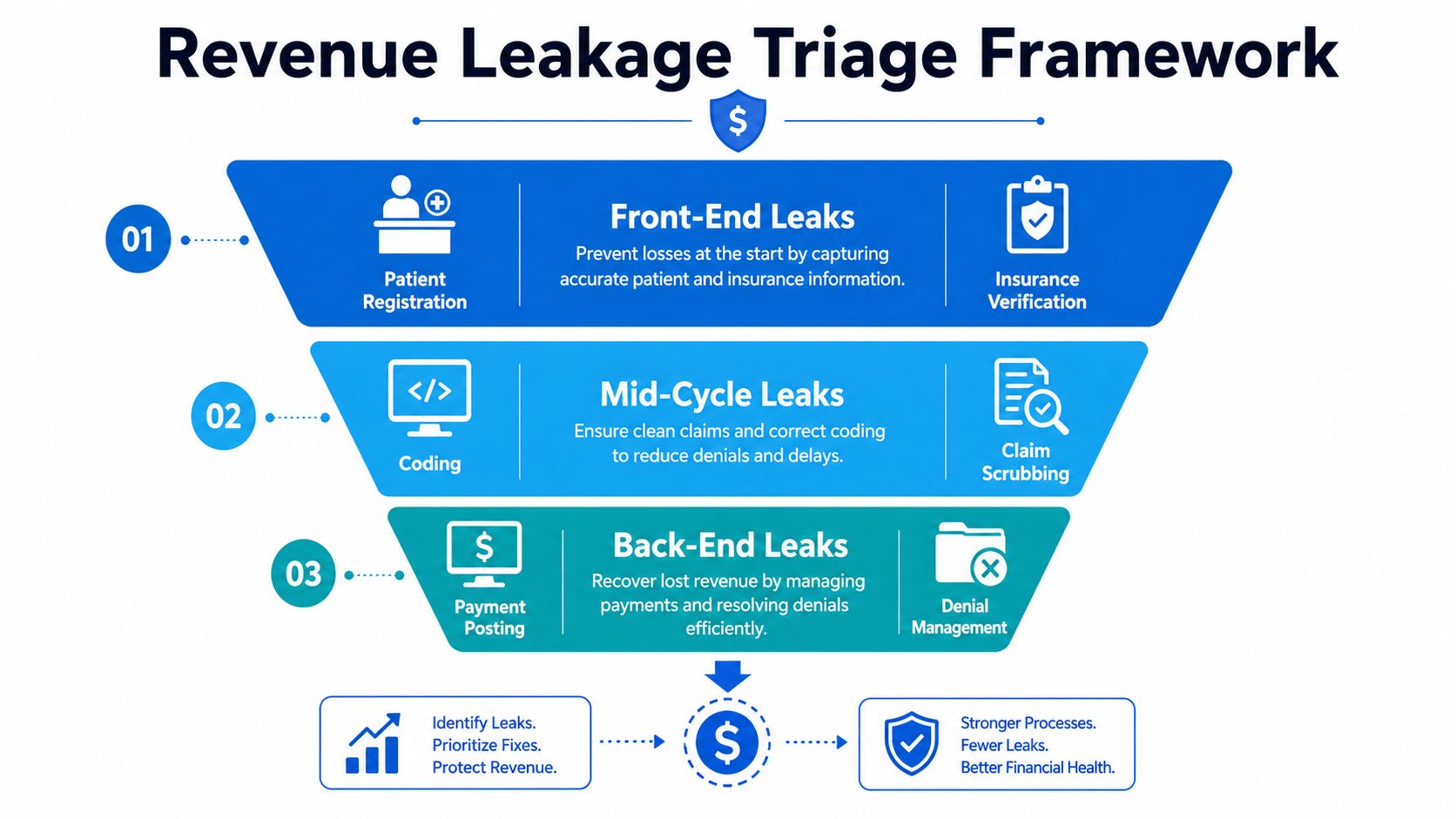
- Front-end leakage first: Check whether eligibility, insurance discovery, and patient access workflows are creating avoidable denials before the claim is even clean enough to submit.
- Mid-cycle leakage next: Review coding accuracy, claim edits, and scrubbing failures to find where revenue disappears after service but before adjudication.
- Back-end leakage last: Look at payment posting, denial follow-up, and remittance handling to identify recoverable dollars that were left untouched.
Operational note: Don't build the recovery plan around what's easiest to count. Build it around what's easiest to collect.
A practical benchmark belongs in this assessment. Industry guidance says more than 25% of A/R aged over 90 days is a warning sign of weak recovery performance (PCH Health metrics guidance). To frame that number against broader recovery performance, use net collection rate benchmarks alongside aging data. The aging view does not tell you where the leak sits, but it does show whether old balances are masking several process failures at once.
For leadership teams, the question is not whether leakage exists. It does. The question is which bucket justifies immediate labor and which one should be pushed into prevention, automation, or contract escalation. That is what turns revenue cycle recovery into financial management instead of firefighting.
Denial Management and AR Remediation Strategies
Denial management fails when teams treat every denial the same. CFOs should care about recoverable cash, not appeal volume. The best work is usually the work with a solid documentation trail, a short remaining appeal window, and a payer pattern your team has already seen.
Work denials in a queue, not a pile
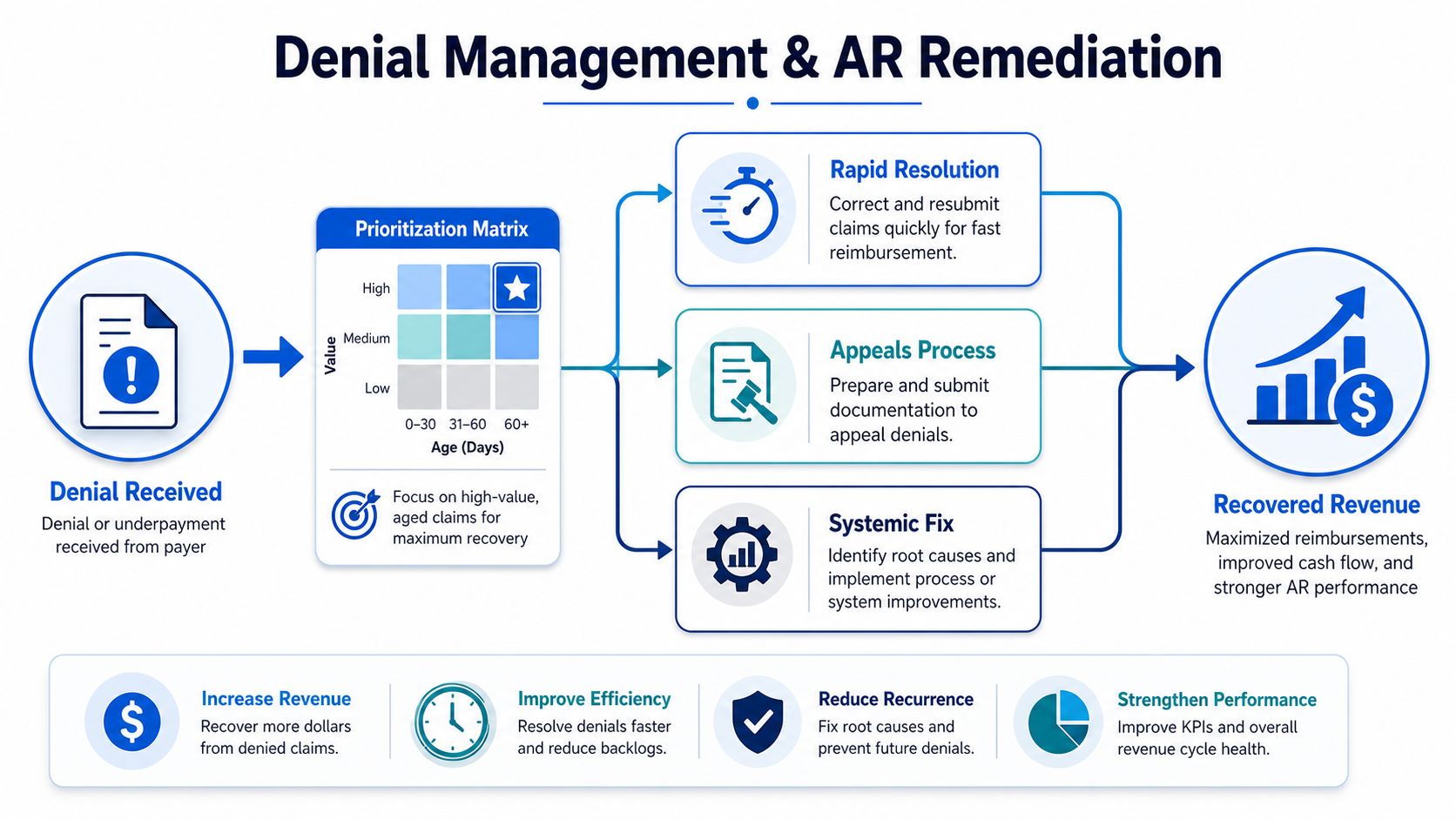
A strong denial team uses a prioritization matrix, not a first-in, first-out queue. Start with claims that are high value and likely to win, then move into lower-probability work only if the return justifies the labor. Every denial should be scored by dollar value, age, denial reason, documentation quality, and remaining appeal time.
The upstream fix matters just as much. Independent guidance recommends exception reporting at patient access, proactive insurance discovery, and eligibility verification before billing, plus checking claims within 21 days of submission and running electronic eligibility verification before every appointment (Inovalon recovery strategies). That is denial avoidance with a lower labor cost than downstream appeals.
Use benchmarks as a control line, not a trophy
HFMA's recovery benchmarks are clear. The industry-average denial rate sits at 5% to 10%, less than 5% is optimal, providers should resolve 85% of denials within 30 days, and the target clean claims rate is 98% (HFMA KPI guidance). Those numbers matter because they show how much of the recovery agenda belongs in front-end process control rather than in the appeal queue.
For AR follow-up, do not spread staff evenly across every bucket. Work the accounts most likely to convert cash quickly, then escalate the claims that need documentation correction or payer challenge. The operating standard to watch is old receivables that sit too long and underpayments that are not recovered, because both point to the same problem, weak prioritization.
A good workflow looks like this.
- Identify the high-probability claims first. Short appeal window, good documentation, clear payer error.
- Escalate the payer-sensitive cases next. These often require contract language, medical necessity evidence, or focused appeal language.
- Feed every avoidable denial back upstream. If the same issue keeps appearing, it belongs in registration, coding, or claim scrubbing, not in a larger appeal pile.
The most expensive mistake is over-investing in old AR while ignoring the new denials creating tomorrow's backlog. Keep one team on current leakage, another on the prevention loop, and do not let either side cannibalize the other.
For a more complete operational view of recovery workflows, Clarity's AR recovery solutions follow the same principle, work the right claims, not all claims.
Denial recovery should feel selective, disciplined, and boring. If it feels like a sprint through every exception in the building, it is probably underperforming.
Underpayment Recovery and Contract Variance Detection
Underpayments are a different problem from denials, and treating them like denials leaves money on the table. The issue isn't just whether the claim was paid, it's whether it was paid correctly under the contract. That requires variance detection, remittance reconciliation, and a workflow that can escalate payer-specific discrepancies without dragging staff into endless manual review.
Reconcile expected payment against actual remittance
The first rule is simple, compare expected payment to actual payment on a regular cadence. Independent guidance recommends doing this at least weekly or monthly, centralizing payer contracts, and tracking payer-specific underpayment trends so leaders can spot compliance issues and negotiate from evidence (MBW RCM underpayment recovery guide). If you only reconcile when a payer complaint surfaces, you're already late.
The second rule is to separate underpayment types. A contract variance tied to a payer edit is not the same as a fee schedule mismatch, and neither should be handled by the same escalation path. Payer-specific patterns matter because recurring variances are often the only visible sign that the contract itself is being interpreted inconsistently.
Build the escalation ladder before the leak grows
A scalable underpayment process needs a clear chain of action.
| Metric | Target | Warning Sign |
|---|---|---|
| Expected vs. remitted payment review | Weekly or monthly | Reconciliation only happens after complaints |
| Centralized contract storage | One source of truth | Contracts live in scattered folders or inboxes |
| Payer-specific variance tracking | Active trend monitoring | Underpayments are reviewed case by case only |
| Escalation workflow | Defined next step for each variance | Staff guess who should pursue the issue |
| Root-cause feedback | Findings returned to billing and contracting | Same discrepancy repeats across service lines |
The point of this table is not administration for its own sake. It's control. Once variances are visible, you can decide whether the right response is appeal, contract review, credentialing correction, or a broader payer conversation.
Contract rule: If you can't show the remittance against the contract in one place, you don't have underpayment recovery. You have suspicion.
This is also where many organizations waste time. They pursue every variance with the same intensity, even when the recovery likelihood is low or the labor cost is too high. Leaders should rank underpayments by recovery probability, contract influence, and the ease of proving the mismatch, then ignore the rest until they become a pattern worth acting on.
Strategic success is the key. Once underpayment detection becomes routine, the organization stops discovering leakage after the fact and starts catching it before it becomes normalized revenue loss.
Staffing Models and Technology Interventions
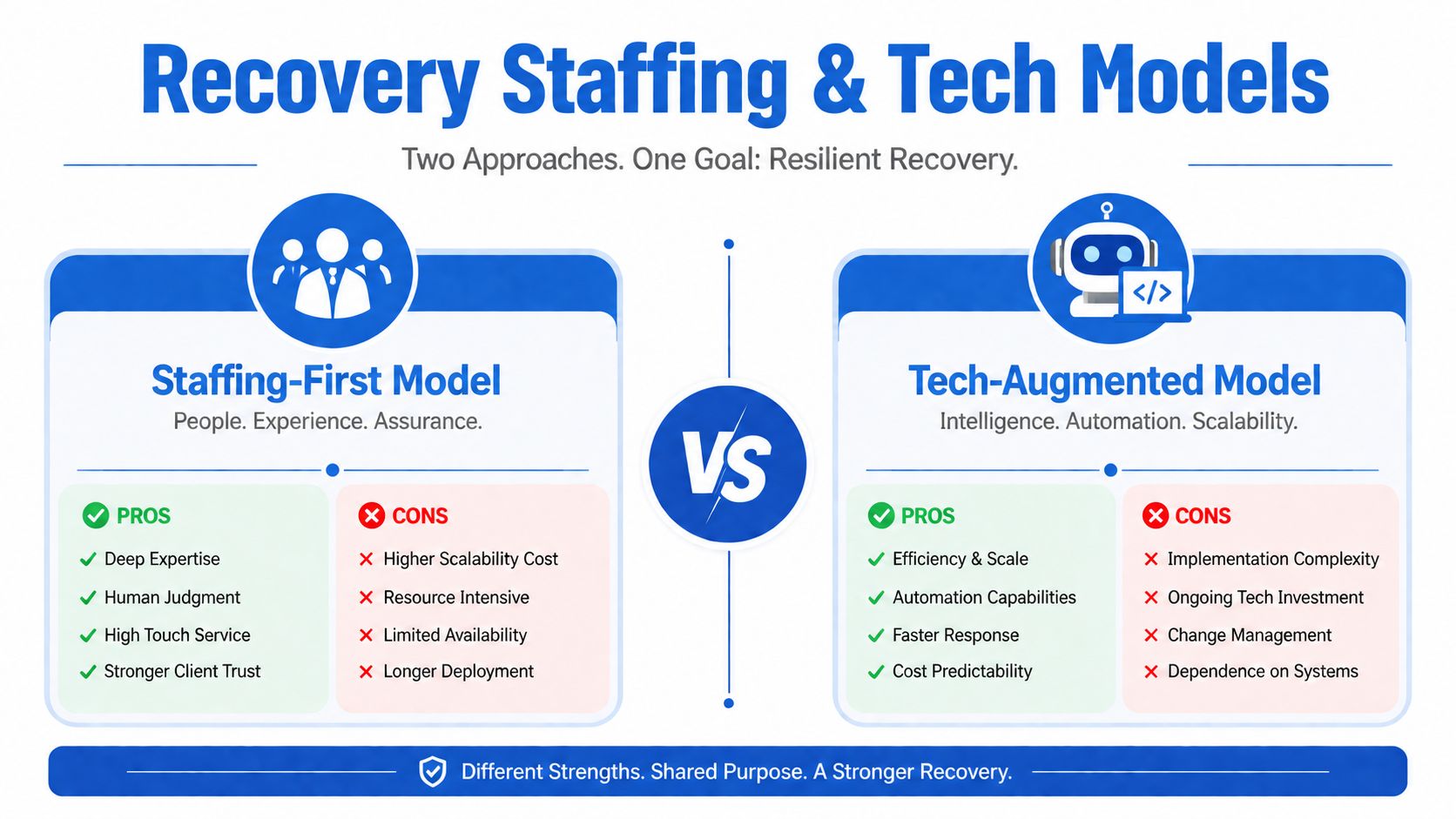
Recovery performance depends on the operating model underneath it. You can hire smart people, but if the workflow is fragmented and the tools still require manual chasing, the labor bill grows faster than the cash. The better model is a tech-augmented team with clear ownership, supported by automation where the volume is high and the logic is repeatable.
Centralize the repeatable work
Centralized teams make sense when the work depends on consistency, payer knowledge, and escalation discipline. Distributed teams can be useful when local knowledge matters, but they often duplicate effort and produce uneven follow-up quality. For denial management and AR remediation, the work that repeats should be centralized, and the exceptions should be routed to specialists.
Specialization matters more than people admit. A generalist can do basic follow-up, but payer-specific appeals, contract variances, and recurring root-cause patterns require people who know where the claim usually breaks. That's why the best staffing model isn't just “more people,” it's the right people at the right stage of the workflow.
Automate the high-friction tasks first
Use automation where the task is frequent, rules-based, and easy to standardize. Eligibility verification, claim status checks, and payment posting are obvious candidates because manual effort there doesn't add much judgment. If your staff is still spending hours on tasks a system can check in seconds, you're paying people to do machine work.
A full-service partner can fit naturally for some organizations. Clarity is one option that provides end-to-end revenue cycle support, including insurance benefit verification, claim status and payment posting, and billing operations support, which can reduce the number of handoffs internal teams need to manage. That kind of support only makes sense if the workflow is already defined, though, because technology and outsourcing amplify bad process just as easily as they amplify good process.
Automation should remove follow-up work, not create a second queue of exceptions nobody owns.
The key test for any technology investment is labor intensity. If the tool is installed and staff still need to chase the same problems, the organization didn't automate a process, it digitized frustration. Automate first where there is volume, then measure whether follow-up touches, rework, and elapsed time declined.
A practical stack usually looks like this, automated eligibility checks, claim status monitoring, payment posting, and exception routing, with humans reserved for judgment calls and payer escalation. That's the mix that improves recovery without turning the department into a bigger version of itself.
KPI Tracking and Recovery Governance
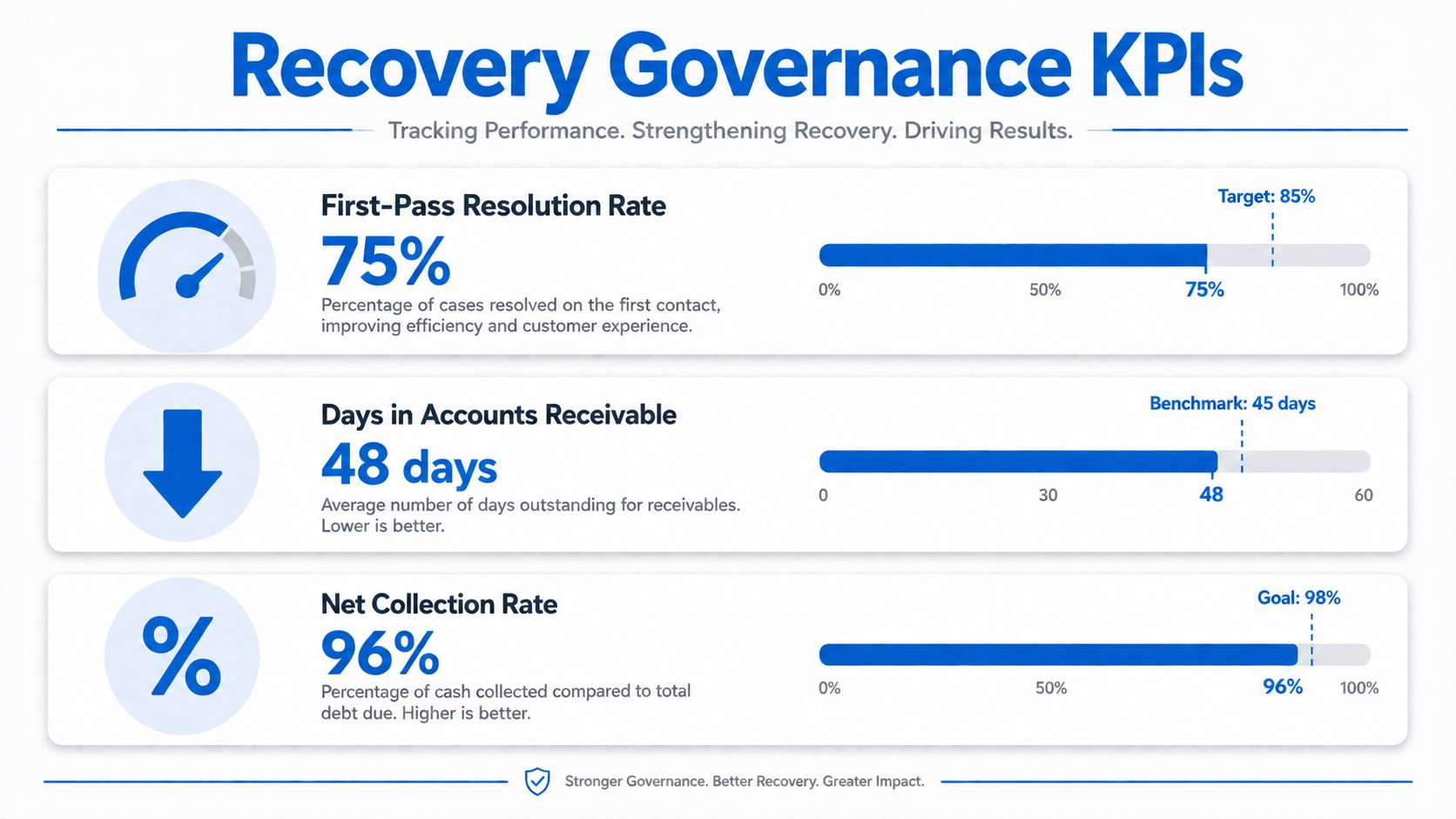
Recovery work falls apart when leaders track too many metrics and no one owns the result. The dashboard should be small, blunt, and tied to cash. CFOs do not need a wall of indicators. They need a short list that shows whether the organization is collecting faster, appealing effectively, and keeping the same leakage from returning.
Track what predicts cash
The best KPIs are the ones that connect process to money. Track net collection rate, clean claims rate, and denial performance, because they show whether the front end is protecting the back end. Pair those with AR aging and appeal success rate, and you will know whether the work is improving or just shifting the problem around.
Use benchmarks as guide rails, not decoration. A 95% net collection rate is the floor, 97% to 99% is the range worth aiming for, 98% clean claims rate is the operational target, and denial resolution within 30 days should cover most recoverable claims. Another useful standard is days in A/R around 35 or less and underpayment recovery of at least 80% on identified variances (PCH Health metrics guidance).
Build governance around decisions, not reporting
A dashboard by itself will not change behavior. Set a review cadence with named owners, and assign payer issues, coding issues, and front-end issues to the people who can fix them. Without ownership, metrics become wallpaper.
Use this meeting structure instead.
- Weekly recovery review: Focus on high-value denials, aging exceptions, and newly identified underpayments.
- Monthly root-cause review: Confirm which issues keep recurring and which ones have been fixed upstream.
- Quarterly payer and contract review: Decide where contract variance, payer behavior, or policy changes require escalation.
If a KPI does not trigger a decision, it does not belong on the leadership dashboard.
Avoid false precision. Appeal counts, call attempts, and work queues matter operationally, but they are not the same as collections. Keep the dashboard focused on outcomes first, then support it with the operational metrics that explain why the outcome moved.
The best governance model makes recovery visible without turning it into bureaucracy. That is the balance CFOs should insist on.
Implementation Timeline and ROI Expectations
Start with the work that can pay back quickly, then move into deeper structural fixes. Trying to fix everything at once usually means nothing gets fixed well. A staged rollout keeps the team focused, lets leadership see cash movement early, and avoids the morale hit that comes from overpromising.
The first phase should be diagnostic and selective. Identify the highest-value denial buckets, the biggest aging risks, and the clearest underpayment patterns, then assign ownership and stop there. The second phase should close obvious front-end gaps, especially eligibility and claim quality, because those prevent the same leakage from showing up again.
A practical rollout sequence
- Days 1 to 30, triage and prioritize. Build the revenue leakage map, rank claims by recoverability, and establish a review cadence.
- Days 31 to 60, attack the fastest cash. Push the most winnable denials, reconcile underpayments, and clean up the highest-friction back-end workflows.
- Days 61 to 90, stabilize the process. Feed root causes upstream, tighten ownership, and reduce dependence on manual follow-up.
- Beyond 90 days, govern for sustainability. Keep measuring, keep comparing payer behavior, and keep the prevention loop active.
This sequence matches the reality that some cash is recoverable quickly while other leakage takes longer to fix. It also keeps the organization from spending months designing a perfect model while old AR continues to age out of reach.
Set expectations in plain language. Early improvement should show up in cleaner workflows and better claim handling, while meaningful revenue recovery usually depends on the age and quality of the claims already in play. The board doesn't need optimism, it needs a realistic path from leakage to cash.
The rule I'd give any CFO is simple, don't fund a recovery initiative unless it reduces labor, improves collection, or lowers future leakage. If it does none of those, it's a cost center with a nicer title.
If you want a recovery program that improves cash without adding unnecessary burden, Clarity can support the operational pieces that usually slow teams down, including benefit verification, claim status follow-up, and payment posting. Visit Clarity to review your current revenue cycle and see where a narrower, more disciplined recovery strategy would fit.
No responses yet