

52% of physician advisors in the 2022 ACDIS report said they do not hold clinical hours at all, which tells you this isn't a side gig anymore. Physician advisor jobs have become a real operating role inside hospitals, not a vague advisory title, and the market now treats them like revenue-cycle and utilization leaders with clinical credibility. If you're a CFO, this is a denial-management and documentation-control function. If you're a physician, it's a career path with real influence, but only if you're willing to live in the space between medicine, compliance, and payment rules.
Table of Contents
- The Evolution of Physician Advisor Roles in Healthcare
- What Physician Advisors Actually Do Day to Day
- Physician Advisor Salary and Compensation Benchmarks
- Required Qualifications and Certifications for Physician Advisors
- Integrating Physician Advisors into Revenue Cycle Strategy
- Where to Find Physician Advisor Jobs and How to Get Hired
- Key Takeaways for Physicians and Healthcare Leaders
The Evolution of Physician Advisor Roles in Healthcare
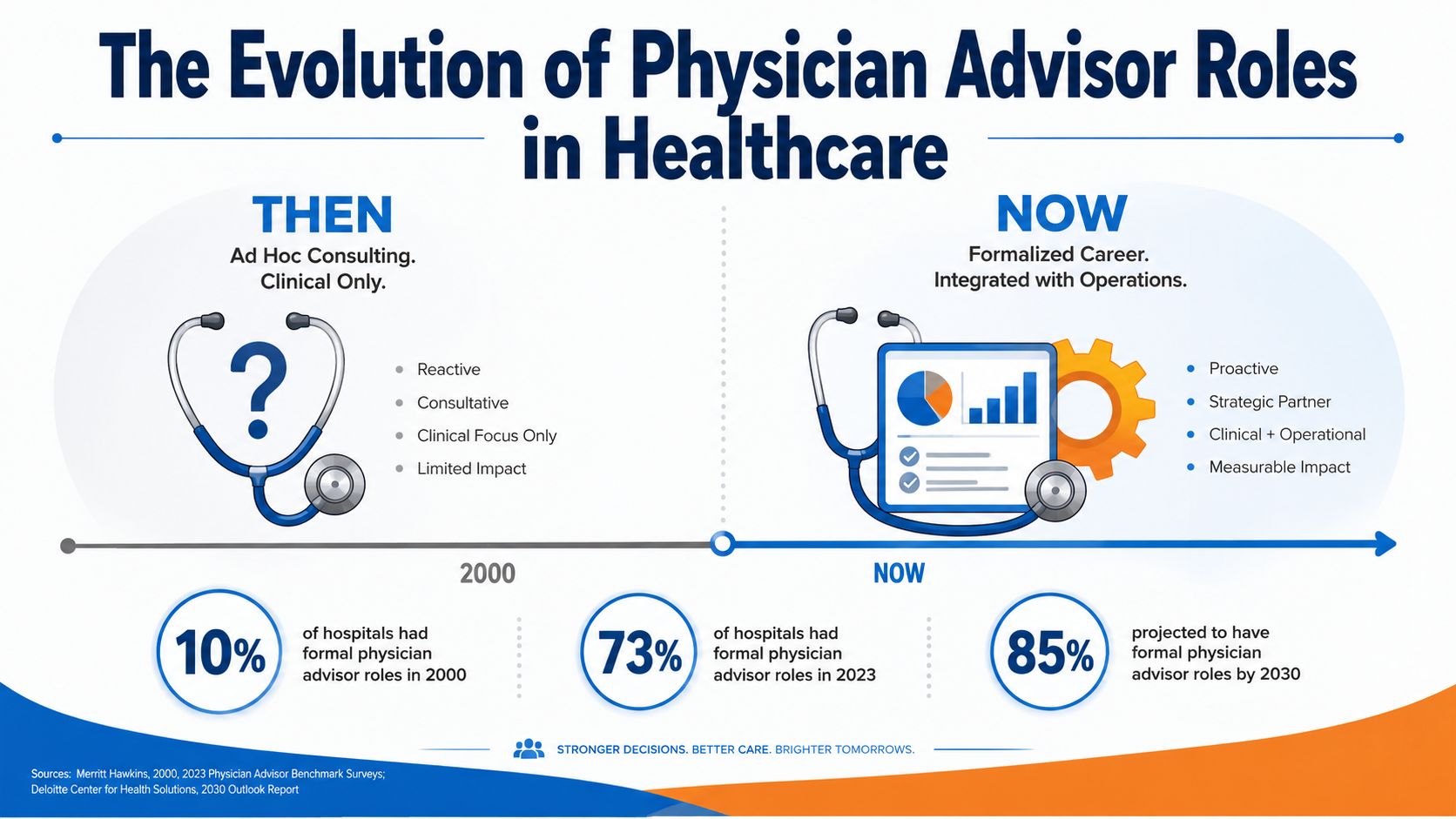
The physician advisor role has moved from informal consultation into a formal job category with budget, accountability, and operational expectations. In the 2022 ACDIS Physician Advisor report, 43% of physician advisors described their position as very formal, meaning it is their primary job with defined responsibilities, and 52% said they have no clinical hours. That matters because it signals a structural shift. Hospitals aren't just borrowing physician judgment anymore, they're staffing for it. 2022 ACDIS Physician Advisor report
The compensation picture reinforces that this is a serious specialty. The ACPA's 2015 survey put average annualized base compensation at about $225,000, and the 2017 survey showed it rising nearly 20% to $267,664. That growth didn't happen because the title sounded better on paper. It happened because hospitals realized physician advisors influence utilization, denial prevention, and medical necessity decisions that affect cash flow.
The job is tied to hospital scale, not just title
The same ACDIS report shows how embedded the role has become across different bed sizes. 33% of respondents reported a staffing ratio of 1.0 FTE physician advisor to more than 350 beds, while 27% were at 250–350 beds and 27% at 150–250 beds. That's not a casual consulting pattern. It's a staffing model built into hospital operations. In practice, larger facilities don't hire physician advisors because it's fashionable, they hire them because concurrent review and denial management need clinical authority that utilization teams can't fake.
The professional background pattern also says a lot. American College of Physician Advisors survey data found that most physician advisors had 5 or fewer years of experience in the role, and many came from hospitalist, primary care, or emergency medicine backgrounds. That tells me the modern physician advisor career was institutionalized quickly in the 2010s and early 2020s. Hospitals needed clinicians who could speak payer, medical staff, and case management without losing the plot. For leaders thinking about broader revenue cycle alignment, the operational context in revenue cycle management trends helps explain why the role keeps expanding.
Practical rule: If the hospital still treats physician advisor work as “extra help,” the organization will keep paying for avoidable denials, weak documentation, and late status decisions.
What Physician Advisors Actually Do Day to Day
A good physician advisor lives in the middle of the hospital's messiest decisions. The work starts with concurrent utilization review, where the advisor rechecks level of care, medical necessity, and continued stay before the case becomes a denial problem. That includes observation status, the CMS 2nd Midnight framework, and cases that need a second look before discharge. This isn't abstract policy work. It's real-time case triage with financial consequences.
The daily rhythm is review, escalation, and education
A typical day usually has a mix of chart review, staff communication, and physician coaching. The physician advisor may review cases flagged by utilization management, discuss borderline admits with hospitalists, and help case managers clarify whether a patient should stay, transfer, or move to a lower level of care. In many hospitals, the role also includes denial response, peer-to-peer discussions, and appeal support when the payer pushes back.
Here's the cleanest way to think about it.
- Clinical judgment: Evaluate whether the patient still meets criteria for acute status, observation, ICU, or telemetry.
- Revenue-cycle protection: Stop weak cases before they become denials or payment cuts.
- Physician education: Explain why documentation, severity indicators, and timing matter.
- Team coordination: Align case management, CDI, UM, and attending physicians so the plan is consistent.
The mix changes by employer, and that's the part many job seekers miss. Some roles lean heavily into utilization management and denial mitigation. Others expect more CDI, compliance, and physician education. That's why generic job descriptions are so misleading. A title alone doesn't tell you whether the employer wants a reviewer, a mediator, or a revenue-cycle operator.
The daily detail matters because physician advisors are often the one physician in the hospital who can translate payer logic into bedside language. The job ad on revenue cycle specialists underscores that this kind of work sits next to claims, documentation, and financial follow-through, not just clinical decision-making.
The best physician advisors don't just answer questions. They prevent bad cases from hardening into bad claims.
For a practical view of how the role fits into the broader process, the RCM process from check-in to payment is a useful frame. Physician advisors operate in the middle of that chain, where one late or sloppy status call can ripple into downstream payment problems.
Physician Advisor Salary and Compensation Benchmarks
Compensation is one of the easiest ways to see that physician advisor jobs are not entry-level administration work. They sit in a high-skill, high-accountability lane, and the numbers reflect that. The ACPA survey data show meaningful upward movement over time, while current market listings still land in a strong income band.
Compensation overview
| Source/Year | Average Base Salary | Typical Range | Bonus Information |
|---|---|---|---|
| ACPA 2015 survey | About $225,000 | Not provided | Not provided |
| ACPA 2017 survey | $267,664 | Not provided | About 40% received a bonus in 2016, mean bonus $27,961 |
| Salary.com, Nov. 1, 2024 | $263,667 | $232,405 to $298,854 | Not provided |
| ZipRecruiter estimate, 2026 for contract physician advisors | $204,193 | $164,500 to $233,000 | Not provided |
The clean takeaway is simple. Full-time physician advisor compensation remains in a premium range, and contract work usually prices differently because it trades stability for flexibility. The 2017 bonus data also matter. Bonuses weren't rare, and that says employers were tying the role to measurable operational impact, not just putting a physician name on a committee.
What the pay difference really means
You should read the spread across sources as a market signal, not a contradiction. Salary.com is reflecting a national employee market. ZipRecruiter's contract estimate reflects a different labor model, where employers buy coverage and expertise without committing to a permanent FTE. That's often attractive to hospitals that need help with denials or concurrent review but aren't ready to fund a full internal seat.
The broader market also looks concentrated, not scattered. The 2023 ACPA survey drew respondents from 45 of 50 states, with the largest groups from Florida (25) and California (21). That tells you there's national demand, but the strongest density sits in larger and more operationally complex markets. For CFOs, that usually means competition. For physicians, it means your compensation expectations need to reflect specialty demand, not just your years in practice.
If you're budgeting for physician advisor jobs, pay for judgment, responsiveness, and payer fluency. If you underpay, you'll get a weaker candidate or a part-time arrangement that never fully absorbs the workload.
Required Qualifications and Certifications for Physician Advisors
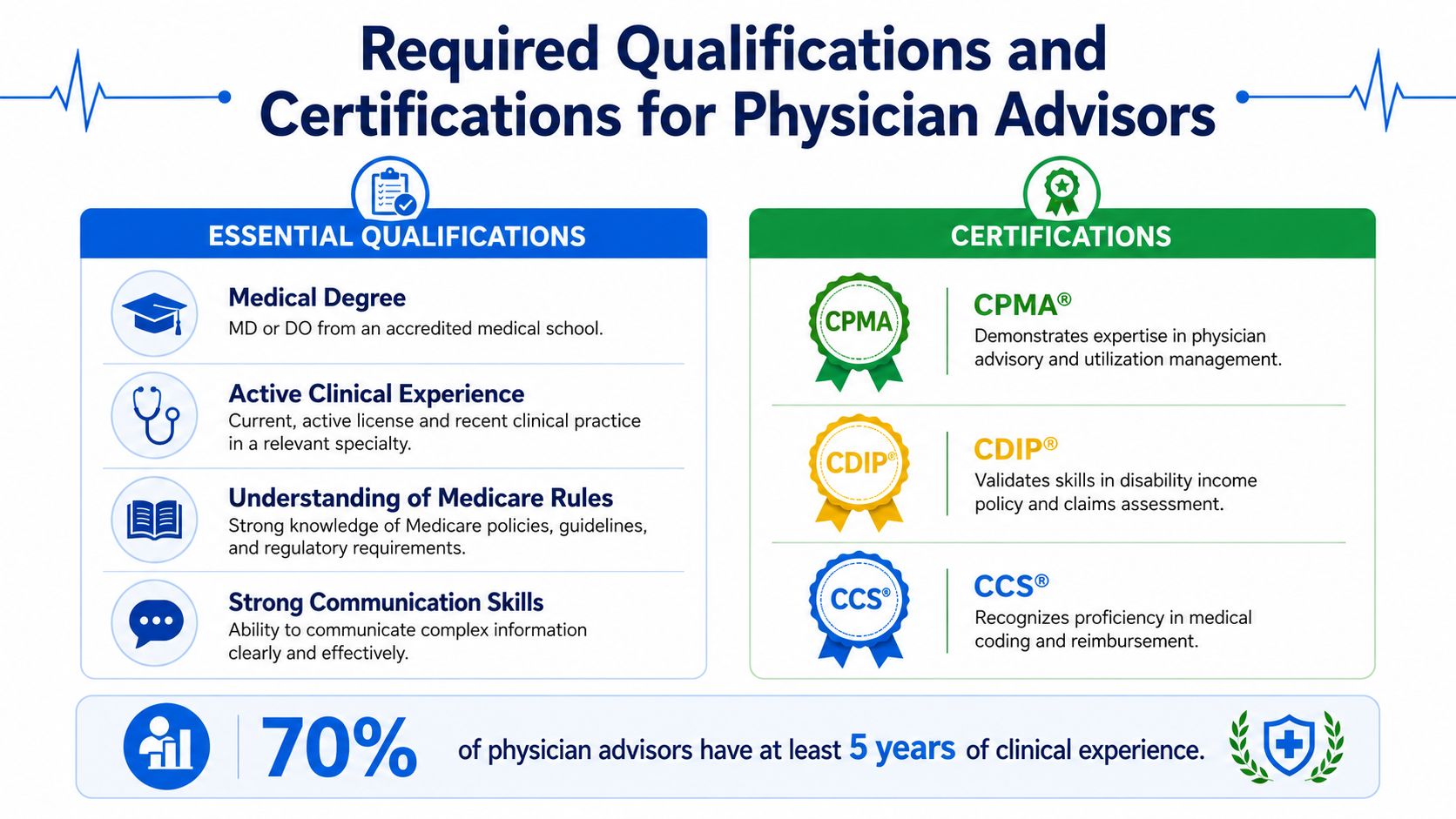
The easiest hiring mistake is assuming any experienced doctor can do this job. They can't. Physician advisor work requires recent hospital exposure, comfort with status decisions, and enough administrative fluency to handle payer, compliance, and documentation conversations without fumbling.
What employers usually want
The job postings in this space tend to favor physicians with recent hospital practice, often around 5 years or more, and many prefer hospitalist background because it maps naturally to utilization review, admit decisions, and length-of-stay pressure. Emergency medicine and primary care also show up because those physicians are used to fast decisions and broad clinical reasoning. That said, the stronger fit is usually the physician who already understands how a hospital moves.
Here's the practical checklist.
- Active medical license: Non-negotiable.
- Recent inpatient or hospital-based experience: Employers want current judgment, not stale memory.
- Communication skill: You'll spend a lot of time translating clinical reasoning for non-clinicians.
- Working knowledge of Medicare and payer rules: If you can't speak to status and necessity, the role will flatten you.
- Comfort with EMRs and chart review: The job lives in the record.
Certifications are leverage, not decoration
Specialized credentials matter because they signal that you can operate in the utilization and compliance layer of the hospital. Job postings commonly ask for credentials such as CHCQM-PHYADV or ACPA-C, and they may also value CDIP, CCS, or similar documentation and coding credentials. Those letters don't replace judgment. They help prove you understand the rules that shape the judgment.
The remote-work question deserves a direct answer. Physician advisor work can be remote, but it's not universally remote-friendly. Many employers still want deep on-site hospital experience before they'll trust a physician to make status calls from afar. Some postings also want recent hands-on hospital practice and familiarity with denial processes, which tells you this is not a plug-and-play telehealth role.
If you want this career path, lead with experience that shows you understand hospital flow, not just clinical expertise. Remote work is possible, but the market still rewards physicians who can prove they've lived inside the inpatient pressure cooker.
Integrating Physician Advisors into Revenue Cycle Strategy
Most hospitals underuse physician advisors by making them reactive. That's a mistake. The role creates the most value when it sits upstream of denial, not after the denial lands. If the physician advisor only appears when the payer has already pushed back, the organization is paying for damage control instead of prevention.
Put the physician advisor into the review loop early
Concurrent review is where the money is protected. A physician advisor who reviews borderline admissions, continued-stay cases, and observation status early can help case management and UM make cleaner decisions before discharge. That can reduce avoidable days, avoid inappropriate ICU or telemetry use, and improve documentation alignment with payer rules. It also helps the hospital avoid the ugly situation where the chart says one thing, the claim says another, and the payer chooses the mismatch.
The advisory role should also be connected to CDI and discharge planning, not separated from them. When the physician advisor educates attending physicians about what needs to be documented, the hospital improves its claim defensibility before the bill ever goes out. That's why I prefer a model where the physician advisor is embedded in daily operational huddles, not tucked away as a backup reviewer.
Use the role as a denial-prevention tool, not just a review title
Hospitals should measure the role by operational outcomes, not vanity metrics. Look at denial prevention, status accuracy, continued-stay review quality, and how often the advisor resolves issues before payer escalation. If the physician advisor is not materially improving those processes, the role is too disconnected from revenue cycle operations.
Direct advice: Don't hire a physician advisor and then starve the role of data, case access, or authority. That's how you pay for a premium function and get a ceremonial one.
Strategic deployment also means understanding where outside support fits. For many organizations, a physician advisor works best alongside a broader revenue-cycle team or a specialized partner that handles the rest of the workflow. The point isn't to replace internal leadership. The point is to stop wasting physician time on tasks that don't need a physician and reserve physician judgment for the decisions that do.
Where to Find Physician Advisor Jobs and How to Get Hired
The market is broader than it looks, but it's still uneven. The 2023 ACPA survey pulled respondents from 45 of 50 states, so the opportunity is national, yet the highest concentration was in Florida and California. That means job seekers should expect both local hospital openings and national or regional contract roles, especially if they're open to remote review work with some onsite expectations.
Where the openings usually live
Most physician advisor jobs show up in hospital system career pages, utilization management vendor listings, and health-system leadership searches. Some are full-time staff roles with set hours. Others are contract or fractional positions, which often appeal to physicians who want flexibility but still want to keep a serious revenue-cycle seat at the table. If you're searching, don't limit yourself to “physician advisor” as a title, because some employers tuck the work under utilization management, care management, CDI, or denials leadership.
Resume positioning matters more than people think. Lead with real examples of status review, length-of-stay reduction, payer appeals, or physician education. If you've worked on denial management, mention the types of cases you handled and how you communicated with UM, case management, and medical staff. Hiring managers want to see that you can deal with conflict calmly and move quickly.
How to evaluate the role before you accept it
Don't accept a job description at face value. Ask whether the role is mainly clinical review, CDI support, denial response, or a mix. Ask how many cases you'll review in a typical day, who owns final status decisions, and whether you'll have direct access to UM and case management data. That tells you whether the hospital wants a physician advisor or just wants a physician signature on a broken process.
On the employer side, the hiring bar should include more than board certification and a warm bedside manner. You should assess whether the candidate can explain medical necessity clearly, work with payers, and understand how provider credentialing and payer enrollment affect practice stability. If your organization is also trying to protect practice revenue through protect practice revenue with credentialing, then the physician advisor should be part of the same operational conversation, because weak upstream processes create downstream payment headaches.
For hospitals that want a broader operational partner, healthcare RCM companies can help structure how physician advisory work fits into the rest of the revenue cycle. The best hires will already think in systems, not silos.
Key Takeaways for Physicians and Healthcare Leaders
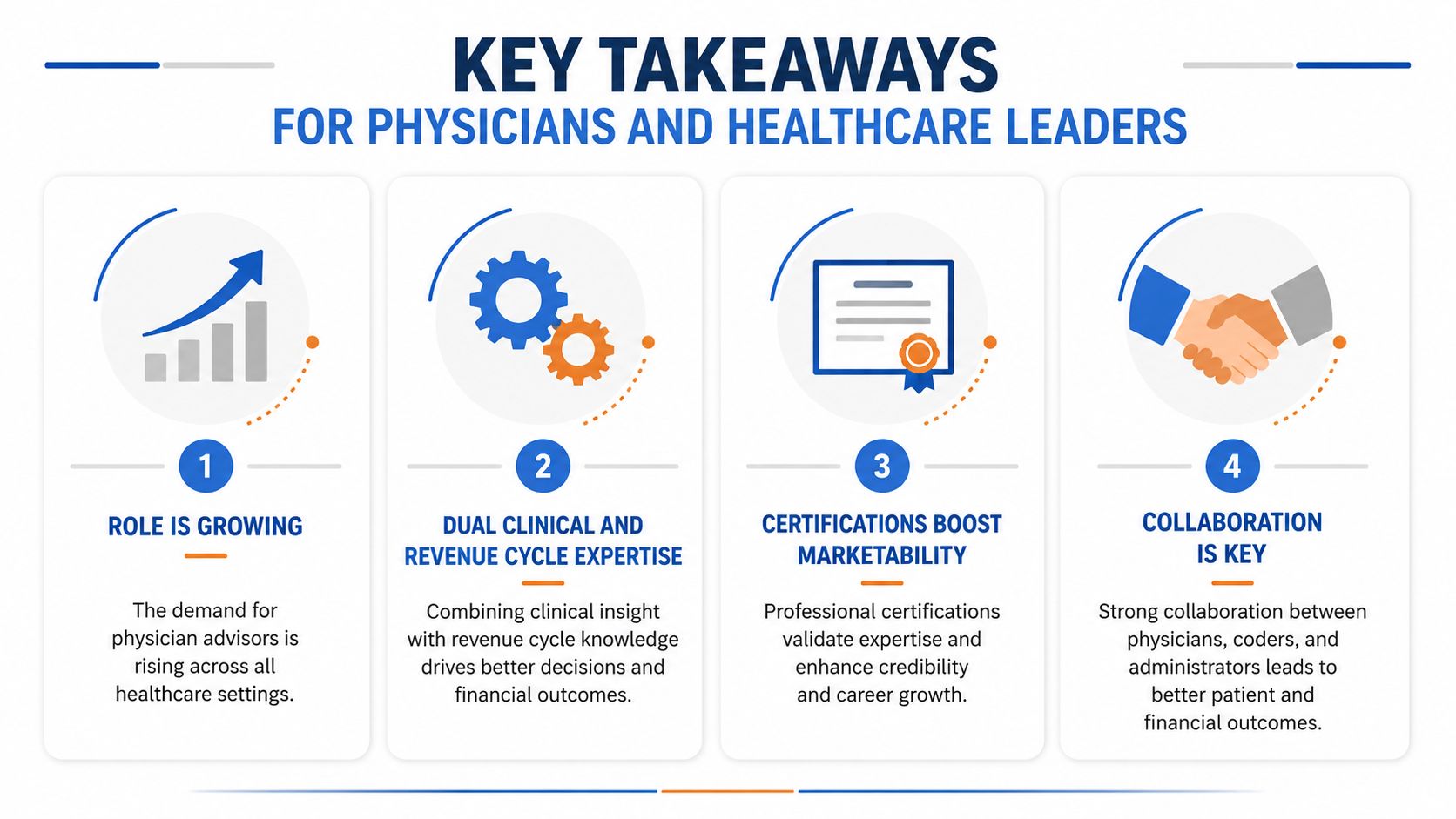
Physician advisor jobs are no longer a fringe hospital function. They're a formal operating role with real compensation, real accountability, and real financial impact. The strongest candidates bring hospital experience, payer fluency, and the ability to translate clinical judgment into clean utilization decisions.
For physicians, the path is attractive if you want influence without full-time bedside practice, but you need to accept that the job is part medicine, part revenue cycle, and part diplomacy. For healthcare leaders, the lesson is blunt. If you want fewer denials and better documentation, put the physician advisor close to utilization review, CDI, and case management, then let the role operate before the claim gets shaky.
Clarity helps healthcare organizations tighten revenue cycle operations without losing sight of clinical reality. If you're evaluating physician advisor jobs, denial prevention, or a better way to connect utilization review with payment performance, visit Clarity and see how a practical revenue cycle partner can support the work.
No responses yet