

Practice management in healthcare is the day-to-day operational discipline that keeps a medical practice running, scheduling, billing, insurance verification, claims follow-up, reporting, and administrative performance. For CFOs and doctors, it's a revenue and margin lever, not an office function, because the systems behind it determine how reliably the practice captures charges, controls accounts receivable, and keeps patients moving.
If you're looking at a desk full of denied claims, a schedule that never feels full enough, and staff who keep asking for exceptions to the process, you're already living the answer to what is practice management. The issue isn't whether the practice has software, it's whether leadership has control.
Table of Contents
- A Clear Definition of Practice Management in Healthcare
- Core Functions Every Practice Management Setup Must Cover
- Practice Management KPIs That Predict Performance
- In-House Team, All-in-One Software, or an Outside Partner
- A Practical Path to Implementing or Upgrading Practice Management
- A Realistic Example of Practice Management Done Right
- Less Discussed Angles and Your Next Steps With Clarity
A Clear Definition of Practice Management in Healthcare
It's Tuesday morning. Phones are ringing, a prior authorization is stuck, the front desk is trying to squeeze in a new patient, and someone just found a claim from last month that never got cleaned up. The physician wants to know why collections are down. The office manager is trying to keep everyone calm while also fixing today's schedule. That is practice management in real life, not the brochure version.
Practice management is the operational and financial control layer of a healthcare organization. In a modern practice management system, that usually includes patient scheduling, registration, insurance eligibility checks, claims management, billing, payment posting, reporting, and analytics (Digital Health guidelines). The point is simple. These functions cut manual handoffs and shorten revenue-cycle time by automating work that otherwise gets delayed, duplicated, or lost. If you want the deeper operational side of that work, see revenue cycle management.
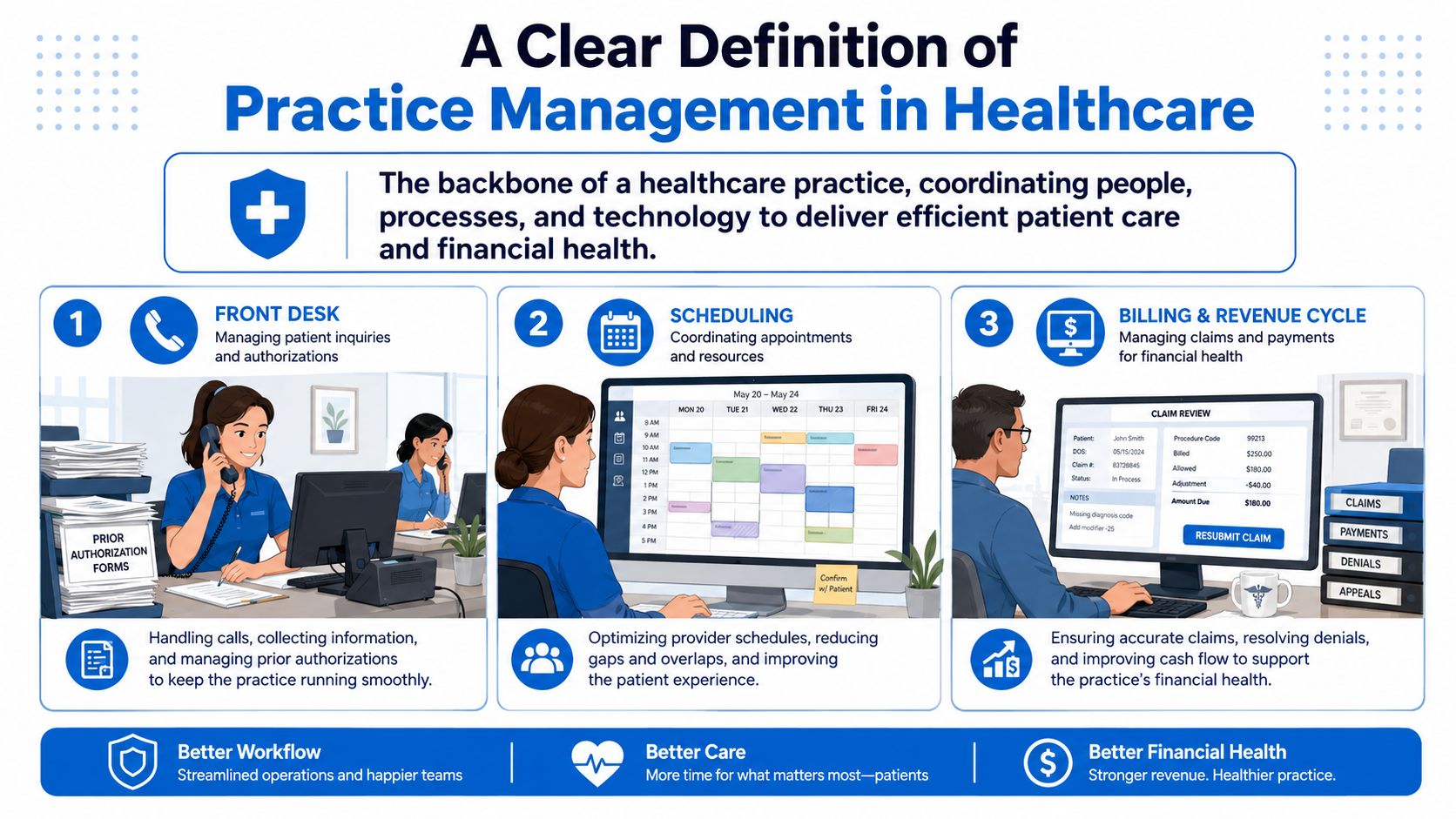
People often blur practice management into software, or into billing. That misses the point. Software is a tool. Billing is one function. Practice management is the system of control that decides whether the practice runs cleanly enough to make the rest of the revenue cycle work.
Practical rule: If a workflow touches access, charges, money, or reporting, it belongs under practice management leadership.
That is why CFOs, CEOs, and physician owners should care. Analysts at Grand View Research place the practice management system market in a strong growth path, which reflects how many providers are buying these systems to improve efficiency, contain cost, and tighten reimbursement compliance. Those numbers matter because providers are not buying systems just to replace paper. They are buying control over workflow, cash flow, and follow-through.
The cleanest way to define what is practice management is this. It is the discipline of coordinating people, process, and technology so the practice can function efficiently and get paid correctly.
Core Functions Every Practice Management Setup Must Cover
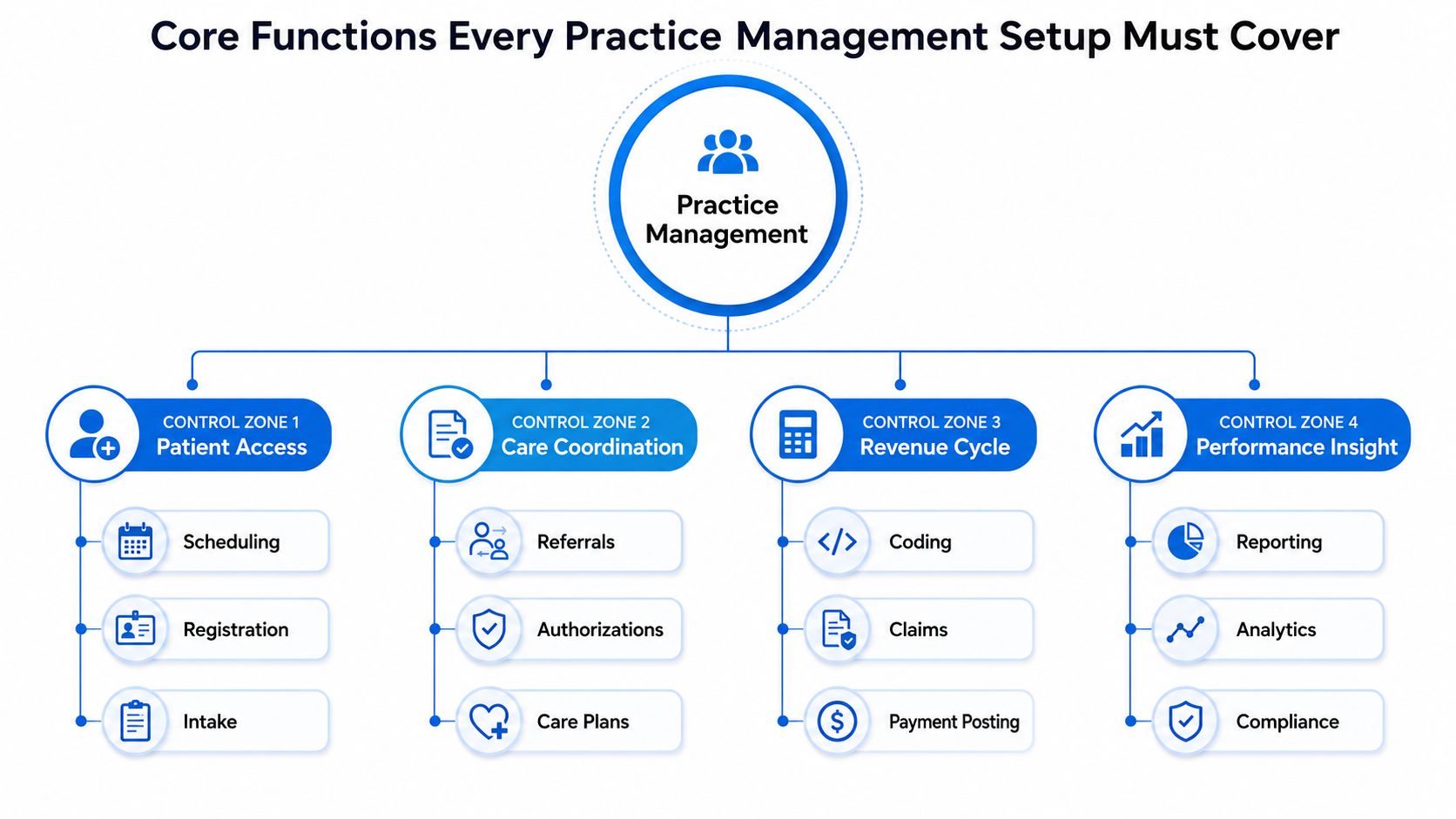
The fastest way to lose money is to let one workflow own a problem that belongs to another. Patient access, charge capture, payment handling, and reporting are separate control zones, and good leaders treat them that way. If you blur them together, you stop seeing where the leak starts.
Patient access and the front end
This zone starts with scheduling, registration, and eligibility verification. If the schedule is sloppy, the rest of the revenue cycle starts behind. If registration data is wrong, the bill will be wrong. If eligibility isn't checked, denials show up later and staff spend time fixing a mistake that never should've happened.
A strong front end is boring in the best way. Appointments are confirmed, demographics are accurate, payer details are checked, and the patient arrives ready to be seen. A weak front end creates avoidable rework for everyone downstream.
Charge capture and claims
The work moves from care delivery to reimbursement. Coding, claim creation, submission, and claim status follow-up all live here. If documentation lags, charges lag. If coding is weak, the claim gets denied or underpaid. If staff don't follow up, cash sits untouched.
The practice management KPI resource notes that average days in accounts receivable is 42 days as a benchmark (Consensus Health KPI resource). That's not a vanity number. It tells leadership how long the practice is waiting to collect what it already earned.
Payment posting and accounting
Once money arrives, it still has to be posted correctly. That means payment posting, reconciliation, fee schedule setup, and patient statements. Bad posting doesn't just distort reports, it hides real problems. You can't fix collections if the books don't show the truth.
A practice that posts payments late or inconsistently is flying blind, even if the schedule looks full and claims are being submitted.
Reporting and performance control
Reporting is where leadership gains insights or gets noise. Operational dashboards, KPI tracking, and denials analytics show where the practice is underperforming. That's where management sees whether the workflow is working, not just whether staff are busy.
For a more tactical look at analytics, healthcare revenue cycle analytics is where the discussion usually turns from theory to action. The lesson is that reporting should force decisions, not decorate a monthly meeting packet.
Practice Management KPIs That Predict Performance
KPI tracking only matters if it tells leadership where to act. Many practices report numbers that look tidy in a dashboard but do little to expose operational failure. The metrics that matter in practice management are the ones that point directly to rework, leakage, or slow cash conversion.
The metrics worth watching
Denial rate shows how often claims are rejected or sent back for correction. A high denial rate usually means the practice is creating avoidable work, often from eligibility errors, coding mistakes, or missing information. Days in accounts receivable shows how long it takes to collect after services are rendered, and the benchmark cited above gives leadership a practical reference point (Consensus Health KPI resource).
Clean-claims rate shows how many claims go out right the first time. First-pass resolution rate shows whether the claim clears without follow-up. Charge lag measures how long it takes to get the charge into the system. Net collection rate shows how much of the expected reimbursement is collected. Percent of patient schedule occupied shows how efficiently the template is being used.
What each KPI exposes
| KPI | What It Measures | Healthy Benchmark | Failure Mode It Signals |
|---|---|---|---|
| Denial rate | Share of claims rejected or needing correction | Lower is better | Eligibility errors, coding mistakes, missing documentation |
| Days in A/R | Time from service to payment | Benchmark cited in MGMA-linked guidance (Consensus Health KPI resource) | Slow cash conversion, follow-up delays |
| Clean-claims rate | Claims accepted without rework | Higher is better | Front-end data problems, coding defects |
| First-pass resolution rate | Claims resolved on first submission | Higher is better | Rework burden, manual correction loops |
| Charge lag | Time from service to charge entry | Shorter is better | Slow provider documentation, delayed charge capture |
| Percent of patient schedule occupied | How much of the template is filled | Higher is better, with healthy access balance | Underused capacity, scheduling friction |
| Net collection rate | Portion of expected reimbursement collected | Higher is better | Coding errors, denial leakage, underpayment |
Low net collection rate usually points to coding or denial issues. Long charge lag means cash is moving too slowly. High denial rate means staff are spending time fixing mistakes instead of producing value. Those are labor-cost problems, not abstract reporting problems.
For a finance team that wants fewer surprises, healthcare revenue cycle analytics should be part of the operating rhythm, not a once-a-quarter review. If leadership cannot tie a KPI to a specific workflow owner, the metric is too vague to be useful.
In-House Team, All-in-One Software, or an Outside Partner
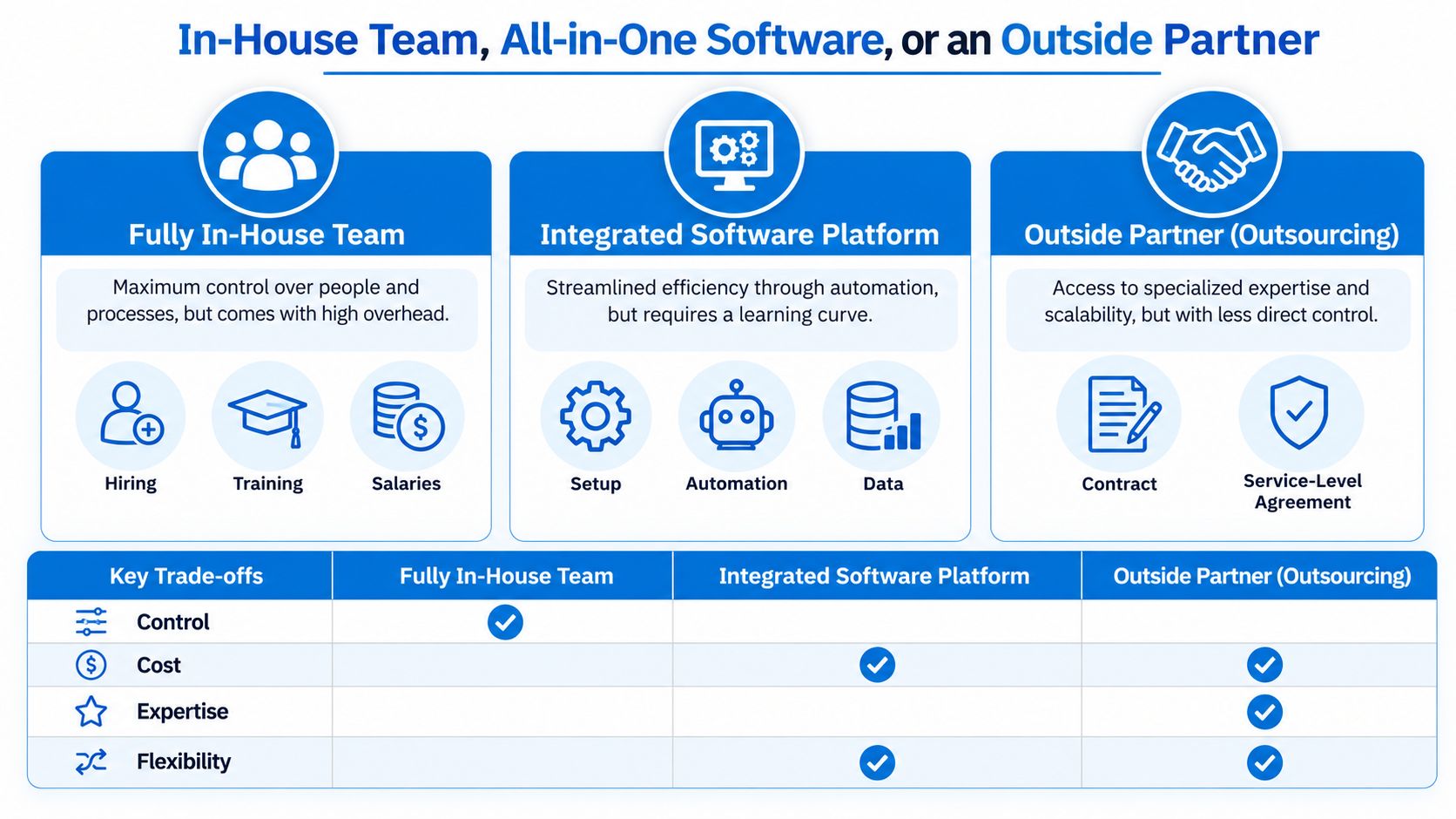
Every practice runs into the same question, who should run the machine? The answer depends on scale, staff stability, and how much operational complexity the team can handle without creating more errors. There is no perfect model. There are only trade-offs.
Fully in-house gives control, but it is fragile
A fully in-house model gives doctors and CFOs the most control over day-to-day decisions. It also puts real pressure on hiring, training, and retention. When the front desk, billing desk, and back office keep turning over, scheduling slips, insurance verification slows, and payment posting gets sloppy. That is how revenue leaks.
If the team is stable, experienced, and led well, in-house can work. If the front desk keeps changing, it will not.
Software helps, but it does not run the business for you
A practice management system can automate scheduling, billing, claims, and reporting. That is useful. It does not replace leadership judgment. Automation can move work faster, but it will not decide whether the fee schedule is wrong, the denial process is weak, or staff are skipping follow-up.
Automation removes friction. It does not remove accountability.
Buying software and assuming the problem is fixed is a mistake. If the workflow is broken, the software will just help the practice break it faster.
Outside partners make sense when functions need discipline
A partner can take defined work off the practice's plate, things like insurance benefit verification, claim status follow-up, payment posting, or full billing support. That works when the practice does not have the time, training, or scale to do those jobs well internally. It also helps when leaders need more predictable execution than a fragile in-house team can deliver.
A partner should be judged by what it fixes. If the issue is billing discipline, use a focused service like medical billing services instead of forcing the office team to patch over repeated errors. Clarity is one example of a partner that can support fee schedule and practice management setup, billing operations support, insurance benefit verification, and claim status and payment posting. That model fits practices that want a customized approach instead of an all-or-nothing handoff. I am not saying every group should outsource. I am saying that if the KPIs are drifting and the team cannot stabilize them, a partner may cost less than another round of hiring.
A Practical Path to Implementing or Upgrading Practice Management
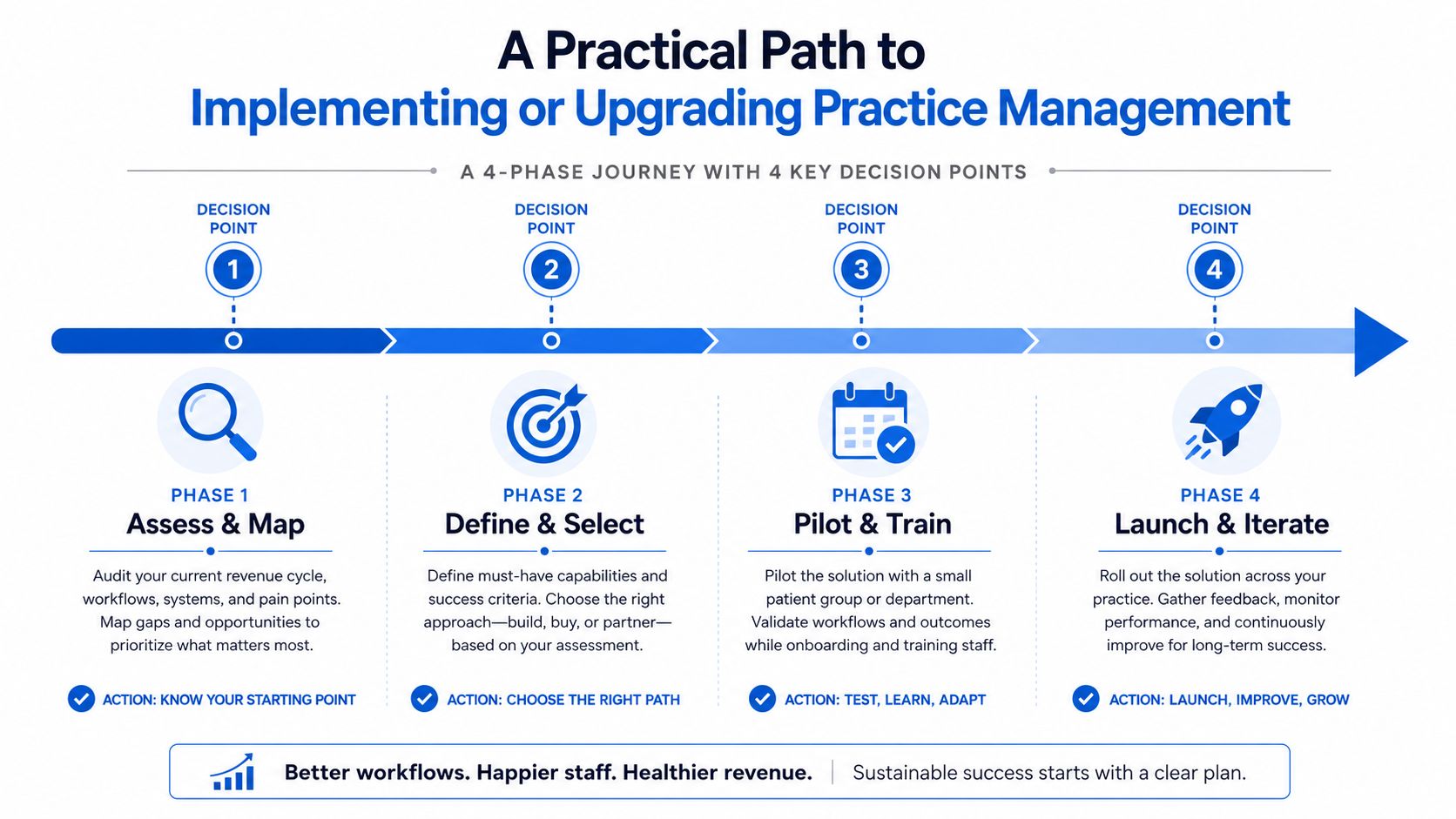
Start with the current state, not the product demo. Most implementation failures come from buying tools before leadership agrees on what problem the practice is trying to solve. If the goal is cleaner cash flow, staff need a different setup than if the goal is faster patient access or better reporting.
Assess and map the bottlenecks
Look at the revenue cycle from first appointment request through payment posting. Find where work stalls, who owns each handoff, and which tasks get repeated. Then decide which failures are process problems, which are staffing problems, and which are technology gaps.
That distinction matters. A broken schedule template is not fixed by a new claims module. A weak eligibility workflow is not fixed by a prettier dashboard.
Decide what stays in-house and what gets delegated
This is the key management decision. Keep functions in-house only if the team can do them consistently, measure them, and improve them. Delegate work when the practice doesn't have the time, training, or scale to do it well.
Build the fee schedule as the financial foundation before you automate around it. If the rates are wrong, every other decision is built on sand. Then select software or a partner that fits the operating model, not the other way around.
Pilot, measure, then roll out
Don't launch everything at once. Test the workflow with a smaller slice of volume, train the staff who touch it, and watch the numbers closely. If your vendor or partner can't agree to measurable outcomes, the contract is too vague.
If a rollout doesn't include measurement on day one, leadership is just hoping for improvement.
The right implementation plan should make it obvious who owns each task, what success looks like, and how fast exceptions get escalated. That's how you keep the upgrade from turning into another expensive interruption.
A Realistic Example of Practice Management Done Right
A 12-provider multi-specialty group has a familiar problem, collections are slipping, two billing roles are unfilled, and leadership can't agree on whether to hire or outsource. The doctors think the issue is payer behavior. The office manager thinks it's staff burnout. The CFO suspects the front end is leaking.
The practice reviews its denials and finds a pattern, eligibility failures are happening before the visit is ever billed. It also sees charge lag because providers are finishing documentation late. Then payment posting gets audited, and the team finds inconsistent handling of remittances. None of those problems is exotic. They're just scattered across different owners.
The fix is disciplined, not dramatic. An outside partner handles insurance verification and claims follow-up. The in-house team keeps scheduling and patient communication. Leadership uses the same KPI set every week so no one can hide behind anecdotes.
That kind of split works because it assigns the right work to the right layer. Staff who know patients best stay close to access and experience. A specialized partner takes the repetitive denial and posting work that was dragging the team down. The CFO gets better visibility, and the doctors stop hearing only stories and start seeing the actual bottlenecks.
The lesson is that practice management isn't about doing everything internally. It's about making sure each function is owned by someone who can execute it well.
Less Discussed Angles and Your Next Steps With Clarity
Most explainers stop at scheduling and billing. That's too shallow. The biggest bottleneck is often the people running the practice, and inefficiency usually hides in plain sight inside the team, not inside the software (SVMIC article). If the front office is chaotic, the fix is rarely another feature. It's usually clearer roles, better accountability, and tighter management.
The second mistake is assuming automation replaces oversight. AMA-aligned guidance emphasizes that practices still need to measure first-pass resolution, denial rates, and accounts-receivable time, because software alone doesn't stop leakage (AMA guidance). That's the hard truth. You can automate steps, but you still need leaders who watch the numbers and act on them.
The third issue is access. Practice management increasingly affects whether a practice serves underserved populations, because staffing and site strategy shape who gets through the door (STFM handbook). That's an operating decision, not a slogan. If leadership only optimizes for internal efficiency, access gets worse by default.
| Practice Management Area | Clarity Service | Primary KPI Improved |
|---|---|---|
| Fee schedule and setup | Fee Schedule & Practice Management Setup | Clean-claims rate |
| Day-to-day billing work | Billing Operations Support | Denial rate |
| Patient eligibility checks | Insurance Benefit Verification | First-pass resolution rate |
| Follow-up and posting | Claim Status & Payment Posting | Days in A/R |
If you're trying to decide whether your practice needs a better process, better staffing, or outside support, start with the current revenue cycle and the numbers that move cash. Clarity offers a complimentary consultation of the current revenue cycle, then maps the work to a setup that can cover part of the cycle or the whole thing. If you want a straightforward review of where money is leaking, visit Clarity and ask for that consultation.
No responses yet