
The revenue cycle management market has moved from a back-office necessity to a core healthcare finance system, and the scale is hard to ignore. Independent market estimates place the global market at USD 58.27 billion in 2024 and USD 65.49 billion in 2025, with projections reaching USD 117.50 billion by 2030 at a 12.4% CAGR and as high as USD 475.42 billion by 2034 at a 12.75% CAGR in another major forecast (MarketsandMarkets revenue cycle management market outlook).
For a hospital CFO, that growth is not just a vendor story. It reflects a finance environment where claim complexity, reimbursement pressure, and manual rework are eating time that should be going to cash acceleration, denial prevention, and patient financial experience. The providers who treat RCM as a strategic operating function, not an administrative afterthought, are the ones better positioned to protect margin.
Table of Contents
- Why the RCM Market Matters More Than Ever
- Mapping the RCM Market: Size and Segmentation
- Key Drivers and Restraints Shaping the Market
- Major Trends Redefining RCM in 2026
- Understanding the Competitive Field: Vendor Archetypes
- Strategic Implications and How to Choose an RCM Partner
Why the RCM Market Matters More Than Ever
The market's size tells you something important, but the operating reality tells you even more. RCM is expanding because healthcare organizations can't afford leaky billing workflows, slow claims submission, or weak denial follow-up when reimbursement is already under pressure. The dominant subsegment remains claims and denial management, which is a direct signal that revenue leakage is still one of the market's central problems, not a side issue (MarketsandMarkets revenue cycle management market outlook).
The financial lens matters more than the software label
A lot of market commentary frames RCM as a technology category. That misses the larger point for providers. The fundamental question is whether the revenue process is reducing friction between care delivery and cash collection, or adding another layer of cost and delay.
One practical way to think about the market is this. If your organization still depends on manual follow-up, inconsistent coding checks, or incomplete eligibility verification, you're already competing in the same operational arena as the largest hospitals and health systems that are buying specialized support to cut leakage. That's why this market keeps expanding, even when margins stay tight.
Practical rule: if denials feel routine, the issue usually isn't one team member. It's a workflow design problem.
The strategic implication is clear. CFOs shouldn't ask whether RCM is growing. They should ask whether their own revenue cycle is becoming more complex than their current internal team can reliably control. If the answer is yes, the market data suggests they're not alone.
Mapping the RCM Market: Size and Segmentation
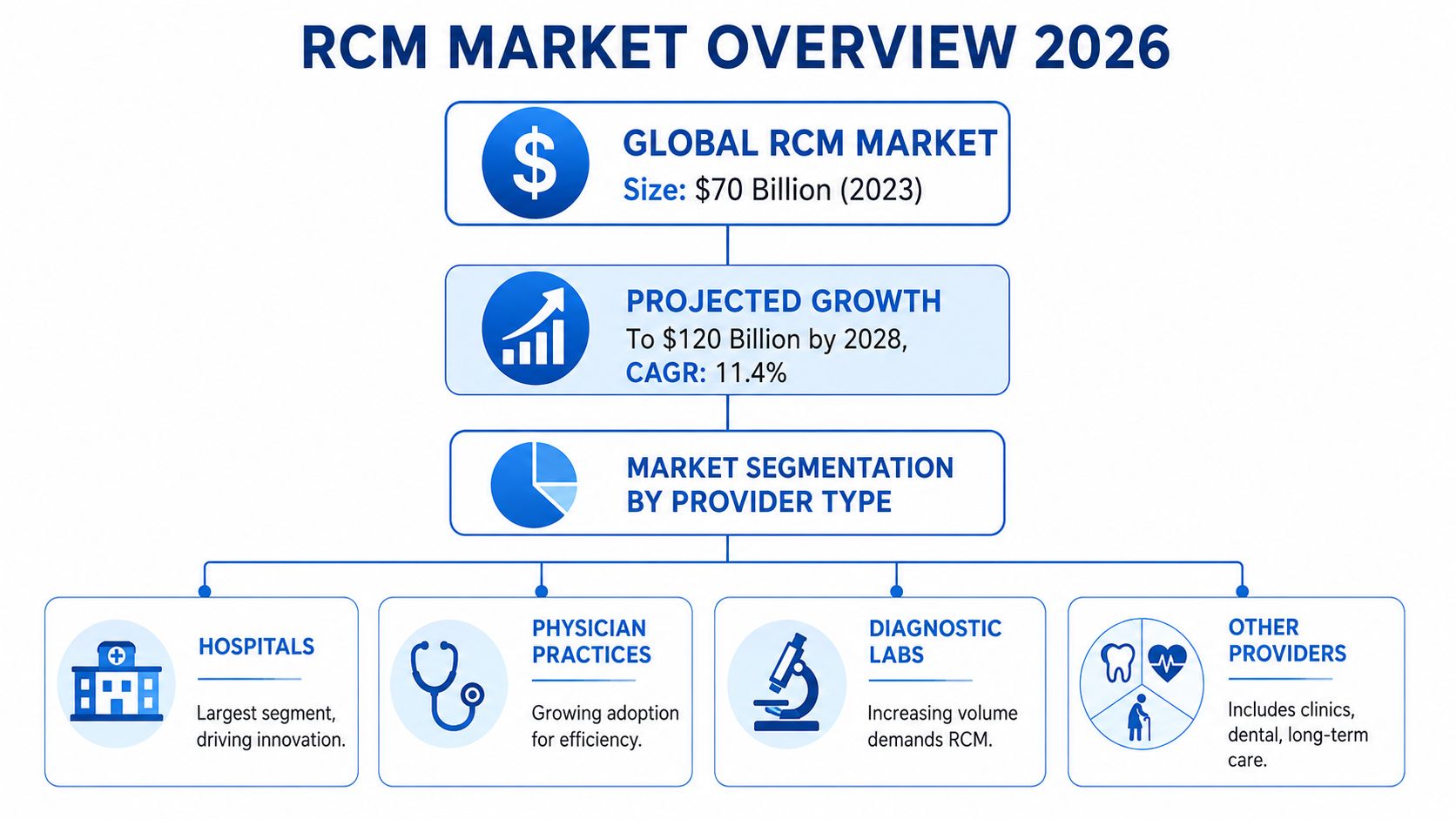
The RCM market is large enough to support several operating models at the same time, which is why provider leaders should segment it instead of assuming one platform or one service line can solve every revenue problem. Independent estimates place the global market at USD 58.27 billion in 2024 and project growth to USD 117.50 billion by 2030 at a 12.4% CAGR (MarketsandMarkets revenue cycle management market outlook). Another major forecast points in the same direction. The message for hospitals is straightforward, demand is still expanding because workflow complexity and payment pressure continue to rise.
What the market is really built around
Operationally, RCM functions as a three-stage control system. The front end covers scheduling, pre-registration, insurance verification, authorization, and price estimation. The mid-cycle handles documentation, charge capture, and coding. The back end includes claims submission, reimbursement, and collections (HFMA revenue cycle management reference).
That structure matters because a weakness in one stage usually creates cost in the next. A missed eligibility check can become a denial. A coding gap can become underpayment. A slow collections workflow can turn a clean claim into aged receivables.
For finance leaders, the useful segmentation is not just by technology category. It is by where labor and decision-making sit inside the process.
- Front-end services focus on eligibility verification, registration quality, and financial clearance.
- Mid-cycle services focus on charge capture, coding accuracy, and documentation support.
- Back-end services focus on claim submission, denial work, collections, and payment posting.
Why segmentation changes buying decisions
The market is also shaped by who does the work. One major report says services account for 77.30% of the global RCM market in 2025, which suggests many buyers are still solving staffing and execution problems rather than merely buying software (Mordor Intelligence RCM market report). That matters for hospitals and physician groups. If the bottleneck is people, process, or follow-through, a software-only purchase may not change the financial result.
The better decision framework starts with cash leakage. If denials are rising, focus on the part of the workflow that is creating preventable write-offs. If throughput is slowing, look at handoffs, not just tools. If payment posting is lagging, examine whether manual work is masking a workflow gap. A useful benchmark for this kind of review is the net collection rate, because it helps connect operational performance to realized revenue.
For providers, the main takeaway is simple. Market size signals broad demand, but the buying decision should map to the exact stage where cash is leaking. If the problem starts with front-end verification, a back-end claims tool will not fix it. If the issue is denial follow-up, another scheduling system will not solve it.
Key Drivers and Restraints Shaping the Market
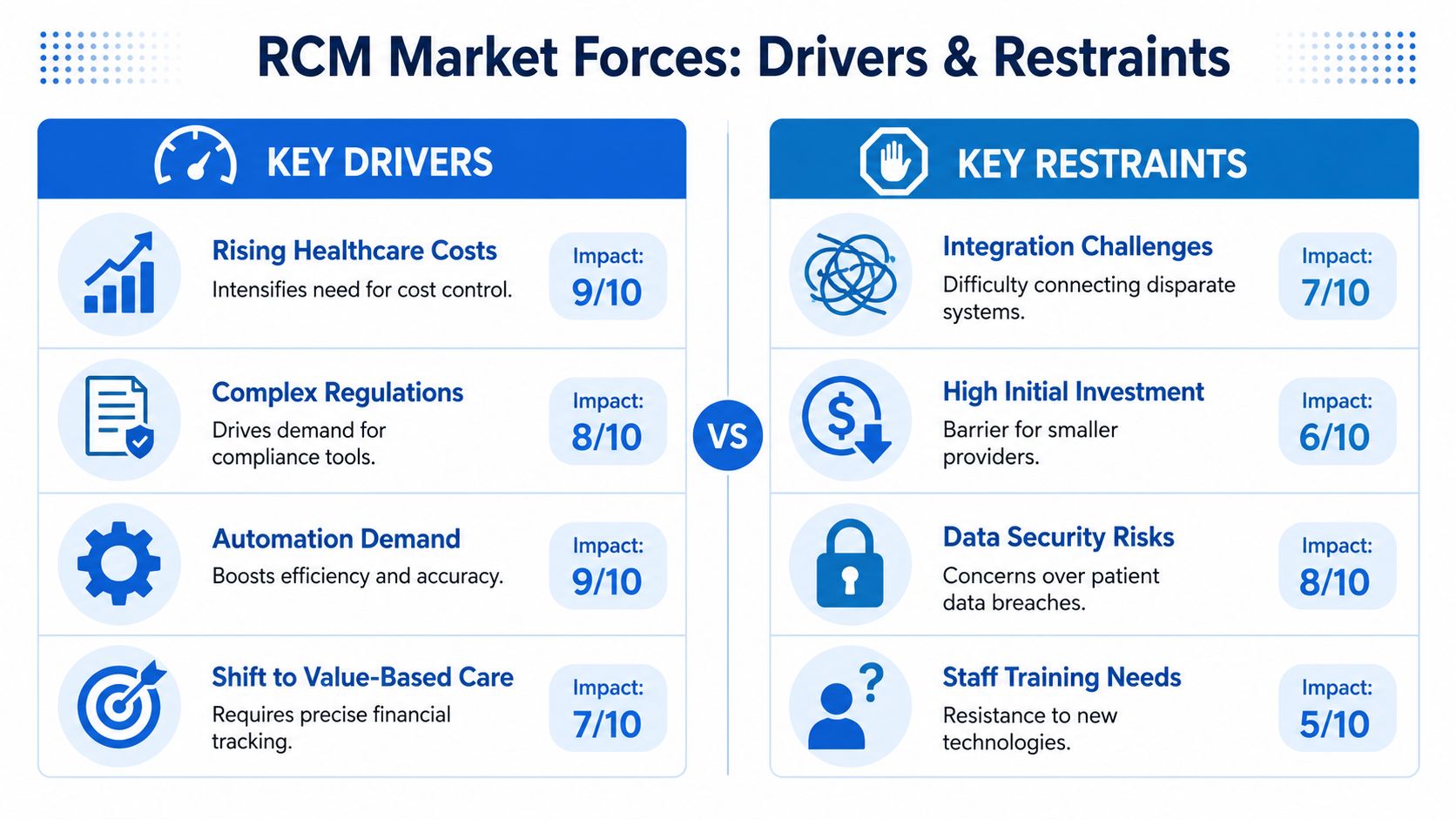
The RCM market keeps expanding because providers are facing more financial friction at the same time. Claims are more complex, denial work is more labor-intensive, and reimbursement logic keeps shifting across payer types. In the U.S., that pressure is amplified by a market environment where North America holds over 55.0% of global RCM market share in 2025, and the U.S. market is valued at USD 141.61 billion in 2024 with a projection to USD 272.78 billion by 2030 at 11.55% CAGR (IMARC revenue cycle management market).
Why the region leads
That concentration isn't accidental. Large provider markets tend to have more payer variation, more administrative overhead, and more incentive to outsource tasks that drain internal teams. The same market also reflects a strong need for denial management, which lines up with the broader global pattern where claims and denial management remain the dominant subsegment.
The business implication is that RCM adoption is not spread evenly. It is strongest where the revenue cycle has the most places to break.
The real constraints buyers run into
The restraints are practical, not abstract. Implementation can be disruptive, data has to move across disconnected systems, and teams need training before workflows change. Many organizations also discover that a tool purchase doesn't solve a staffing gap, it just exposes one.
| Market pressure | What it means for providers |
|---|---|
| More billing complexity | Higher risk of avoidable denials and slower cash conversion |
| More outsourcing demand | Greater reliance on vendors that can execute, not just advise |
| More system integration work | Longer rollout timelines and heavier IT involvement |
| More staff turnover | More need for standardized workflows and automation support |
The first decision should be whether you need software, service support, or both. If the organization can't maintain eligibility checks, coding audits, and payment posting consistently, then the market's growth is pointing to an execution problem, not a product problem. For finance teams measuring cash performance, a strong benchmark like net collection rate should be part of that evaluation, and it's worth reviewing a structured definition such as this net collection rate reference.
Practical rule: the more fragmented your payer and billing operations are, the more value you get from process control before platform expansion.
Why this matters to the CFO
A growing market often tempts leaders to buy fast. The smarter move is to buy where your workflow is weakest. If your denial rate is driven by eligibility, authorization, or coding issues, the solution has to start upstream, not only in collections.
Major Trends Redefining RCM in 2026
The strongest signal in revenue cycle management is not that software will replace the cycle, it is that execution is still being bought. That matters for providers because the market remains weighted toward labor, process control, and service delivery, which points to a broader truth about financial performance. For hospitals and health systems, the primary concern is whether a partner can reduce friction in claims, denials, and cash posting without creating a new layer of complexity. That is why vendor selection should be tied to operating results, not feature lists.

Automation is changing task design, not eliminating accountability
AI and automation work best in repetitive tasks. Claim status checks, payment posting support, and routing are clear use cases. What they do not remove is the need for accurate inputs, governance, and exception handling. If registration data is wrong or coding is inconsistent, automation helps an organization process errors faster.
That is why outsourced services still matter so much. Providers often need an operator that can own the messy middle, not only a dashboard. The strongest implementations are usually hybrid, with software supporting people instead of replacing them.
A vendor should be able to show where automation ends and accountability begins. If that boundary is unclear, the organization may get faster reporting without better cash performance. For a hospital CFO, that distinction affects both labor planning and working capital.
Patient collections are becoming a bigger part of the revenue conversation
RCM is also becoming more patient-facing. High-deductible benefit designs have pushed financial conversations earlier in the care journey, and that changes the sequence of work inside the cycle. Front-end accuracy, financial clearance, and point-of-service collections matter more when a larger share of patient responsibility sits closer to the time of service.
That shift changes how leaders should evaluate vendors. A useful starting point is a directory of healthcare RCM companies, because it helps frame which partners are built for front-end control, which are stronger on back-end recovery, and which combine both.
- Ask how they handle eligibility verification before service.
- Ask whether payment posting is tied to clean reconciliation.
- Ask how exceptions are escalated when automation fails.
- Ask whether reporting shows where denials start, not just where they end.
The practical conclusion is that the future of RCM is not software versus services. It is workflow ownership plus the right technology layer. Hospitals that treat automation as a substitute for process discipline usually end up with faster reporting, not better cash.
Understanding the Competitive Field: Vendor Archetypes
The vendor market is crowded, but it becomes easier to evaluate once you stop comparing every company as if they offer the same thing. A hospital system, a specialty practice, and a diagnostic group rarely need the same type of partner. The mistake is starting with product demos instead of operating needs.
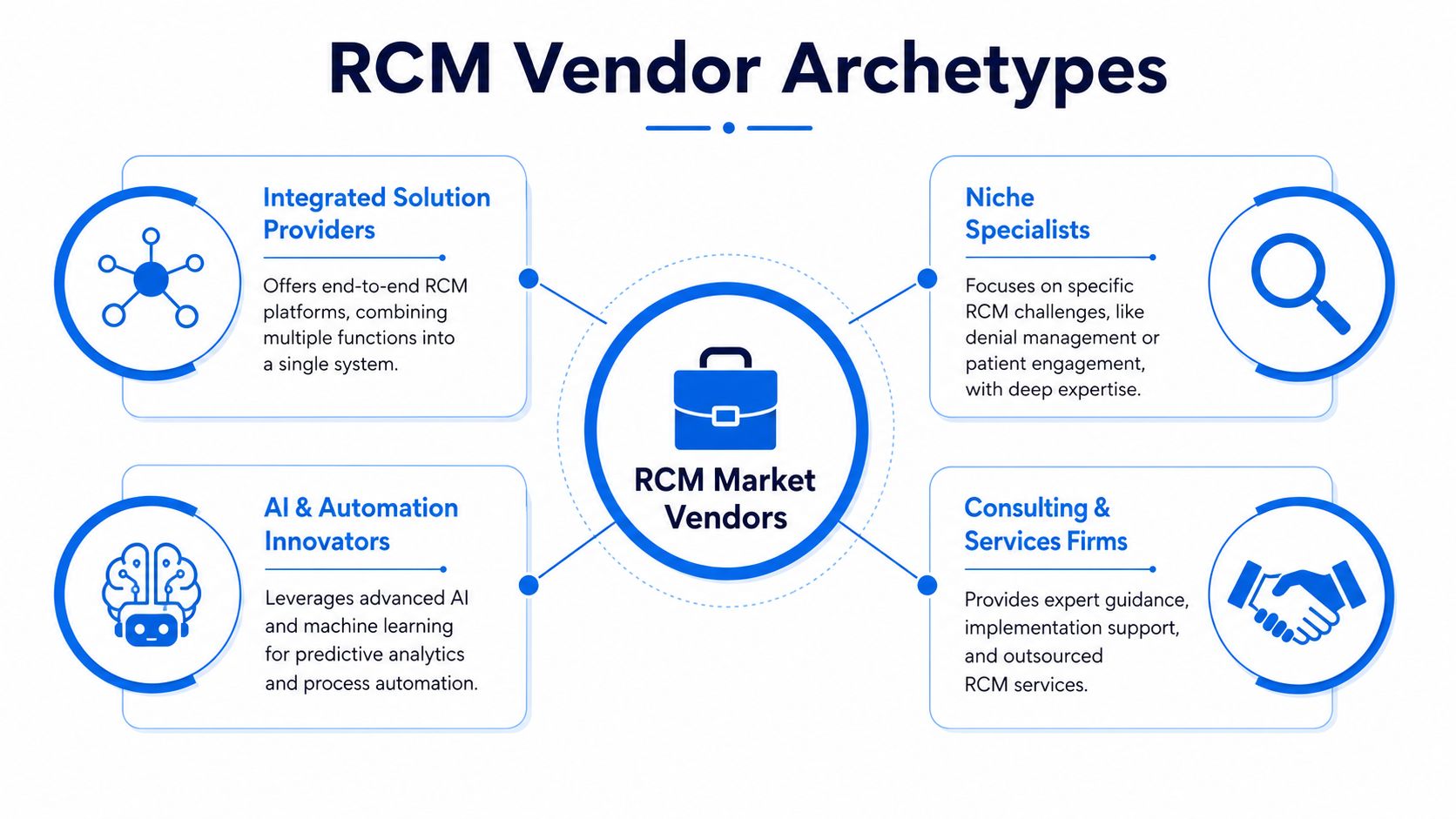
Four vendor archetypes that matter
Integrated solution providers usually offer end-to-end platforms that bundle multiple functions into one system. They fit organizations that want a single operating environment and have the internal team to configure and manage it.
Niche specialists focus on one part of the cycle, like denial management, coding support, or patient engagement. They are useful when the pain point is narrow and clearly defined.
AI and automation innovators sell predictive analytics and process automation. They are strongest when the buyer already has good data hygiene and wants to reduce repetitive manual work.
Consulting and services firms provide implementation, workflow support, and outsourced operations. They fit organizations that need execution help more than they need another dashboard.
For a practical example of how the market groups providers, this healthcare RCM companies reference can help frame the category, but the better filter is still your own workflow maturity.
What to compare before signing anything
HFMA's framework is still useful. RCM spans front-end, mid-cycle, and back-end processes, and performance is judged through indicators like days in A/R, denial rate, and clean-claim performance. That means the right vendor should show how it improves a specific KPI, not just how it looks in a product sheet.
A few comparison questions cut through the noise:
- Can the vendor show specialty-specific experience?
- Does reporting separate preventable denials from payer delays?
- Will the operating model reduce internal workload or just relocate it?
- How does the team handle coding audits, eligibility checking, and payment posting?
Ask for the workflow, not the pitch deck.
Providers should also pay attention to whether a vendor can work across staffing, process, and technology. The market data showing services dominance makes that especially important, because many buyers need an operator who can run parts of the cycle, not only advise on them.
Strategic Implications and How to Choose an RCM Partner
The practical reading of the market is strategic, not investor-focused. Provider organizations need execution support, and that should shape how CFOs and CEOs evaluate RCM vendors. The best partner is often the one that closes the workflow gap draining cash, not the one with the longest feature list.
Start with the problem you can actually measure
A partner review should begin with three questions. Where do denials start. Where is staff time being lost. Which handoffs create avoidable delay. If the current process breaks at eligibility, authorization, coding, or posting, the partner has to prove it can improve that stage, not just promise a broad fix.
The rise of high-deductible health plans makes this more important. In that setting, RCM is a patient-collections and workflow-design problem as much as an insurance reimbursement problem. Front-end discipline has a direct effect on how much revenue reaches the balance sheet, and how fast it gets there.
What good looks like in a partner
A serious RCM partner should be able to show:
- Specialty fit, because billing logic differs across service lines.
- Transparent reporting, so leadership can see where revenue is leaking.
- Operational ownership, not just software access.
- A clear onboarding path, because slow implementation delays cash improvement.
- A willingness to start with a revenue cycle review, which is often the fastest way to identify whether the issue is process, staffing, or technology.
For organizations exploring service support, this medical billing services page is one example of how outsourced work can be framed, but the decision should still rest on measurable fit, not branding.
A useful test is whether the vendor can work across staffing, process, and technology without forcing the hospital to rebuild everything at once. Many providers need an operator who can run part of the cycle, not only advise on it. That distinction matters because the market's service-heavy mix points to a simple fact, many buyers are paying for throughput, follow-up, and cash discipline, not software alone.
If you are a hospital CFO, RCM decisions should be based on workflow evidence, denial root causes, and reporting that shows whether cash is getting to the balance sheet faster. The market shows where pressure is concentrated. Your job is to choose a partner that removes that pressure without adding new friction.
A strong next step is to compare current denial patterns, cash posting speed, and front-end verification against a partner review. If the gaps are unclear, schedule a complimentary revenue cycle analysis with Clarity, and use that review to decide whether you need targeted support or broader outsourced execution.
No responses yet