Tebra Billing Services: In-House vs Outsourced
June 30, 2026 · 27 min read
You made the switch to Tebra. Claims go out electronically, payment posting is faster, and the dashboard actually tells you what's sitting in A/R. But something still isn't working - denials are creeping up, A/R is older than it should be, or the biller is overwhelmed and nobody really knows which claims are being worked and which are quietly aging out.
If you've been asking "is Tebra the problem?". It's probably the wrong question.
The real question is: does your practice have the billing people, payer knowledge, and daily discipline to work Tebra well, or do you need a specialist billing team to operate inside Tebra for you?
This guide answers that honestly. It covers what Tebra's billing tools actually handle, what they can't do without human follow-through, and how to compare the true cost of in-house billing against outsourced tebra billing services. It walks through when each model genuinely wins, how an outsourced team actually works inside a Tebra account, and what questions to ask, and what answers should concern you, before you sign anything. There's also a 10-question scorecard at the end you can use to make the call for your specific situation.
Tebra Billing Features: What the Platform Handles
Tebra is a cloud-based EHR built for independent practices. It was formed from the 2021 merger of Kareo and PatientPop - Kareo contributed the clinical, scheduling, insurance billing, and payment technology; PatientPop contributed patient experience and practice marketing tools. The combined platform is now used by well over 100,000 providers. (Tebra)
If your practice came from Kareo, Tebra is the same company. The product names map this way:
| Legacy name | Current Tebra category |
|---|---|
| Kareo Billing | Tebra Billing |
| Kareo Clinical | Tebra Clinical |
| Kareo Engage / Kareo Office / Practice Growth | Tebra Patient Experience |
(Tebra)
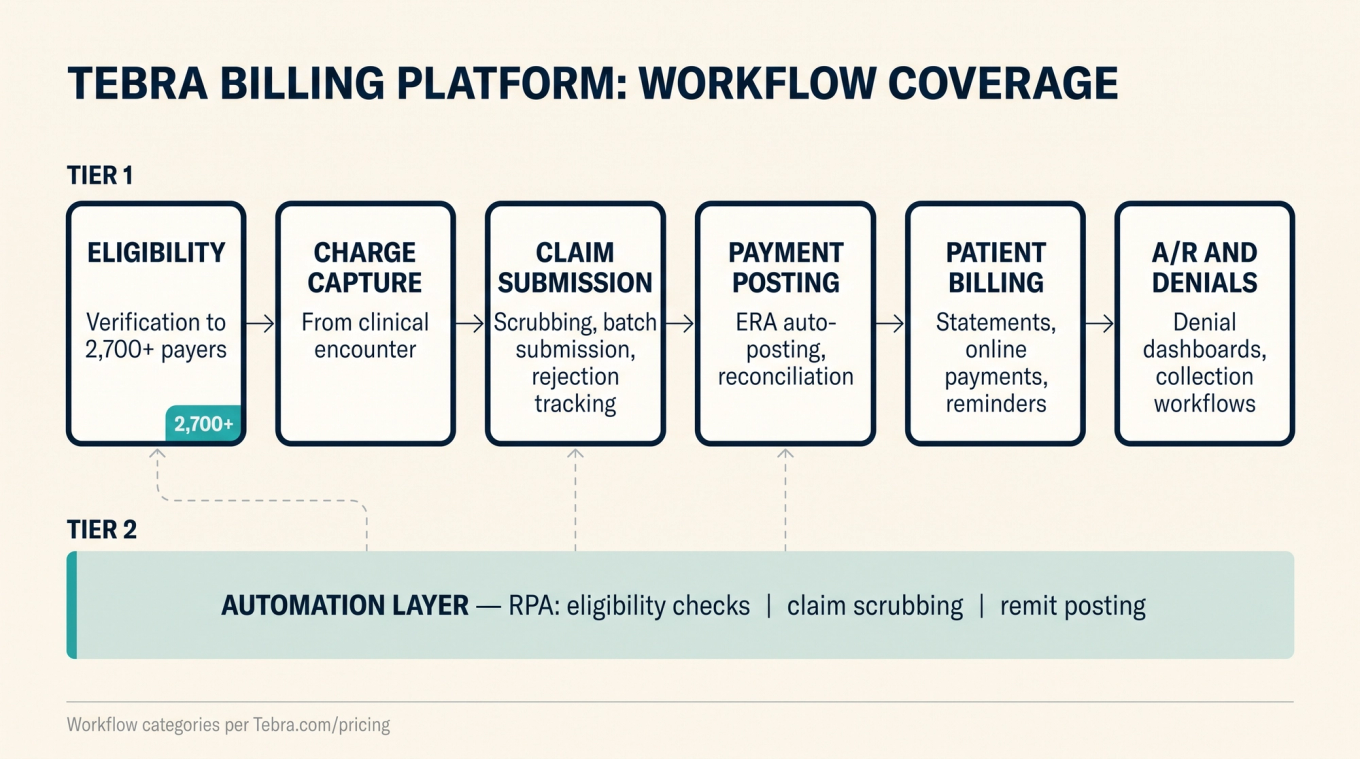
On the billing and payments side, Tebra's toolset is substantial. It includes:
| Workflow | What Tebra handles |
|---|---|
| Insurance eligibility | Sends eligibility inquiries to more than 2,700 payers; returns coverage, copay, deductible, coinsurance data |
| Charge capture | Captures charges from the clinical encounter |
| Claim submission | Electronic claim management, scrubbing, batch submission, rejection tracking |
| Payment posting | ERA (electronic remittance advice) auto-posting, payment reconciliation, account management |
| Patient billing | Automated statements, online payments, mailed statements, payment reminders |
| A/R and denials | Denial dashboards, A/R visibility, collection workflows |
| Automation | RPA for remit posting, eligibility, claim scrubbing |
(Tebra)
Tebra's pricing ranges from $49 to $799 per provider per month, depending on provider type and plan. Therapist plans, which Tebra defines to include behavioral-health and therapy-based providers, start at $225/provider/month for Practice Essentials. Physician standard volume plans start at $599/provider/month. Low-volume starter pricing starts at $99/provider/month for non-physicians, though Tebra's pricing overview and policy define the claim-volume thresholds differently, confirm against your actual quote before modeling costs. (Tebra)
Pricing changes frequently, Tebra's policy shows terms effective July 1, 2026. Verify current pricing directly with Tebra before building any cost comparison.
There are also transactional fees to understand: paper-claim fees depend on the route, Jopari Workers' Comp/Auto paper claims are $1.10 for the first page plus $0.20 per additional page, while non-Jopari clearinghouse paper claims are $1.10 per mailed claim. Patient statements are $1.10 for the first page plus $0.24 per additional page. ERA and real-time eligibility checks are included with no extra charge. (Tebra)
One important note for hospital and facility-adjacent groups: Tebra separately classifies "Facility Providers", organizations that bill Medicare or commercial payers for institutional services, and says all Facility Providers must be on transactional agreements. If your billing involves UB-04/837I institutional claims, confirm exactly how Tebra handles your claim type before assuming standard practice pricing applies. (Tebra)
For outsourced billing, Tebra describes three distinct models: practices can keep billing in-house (staff uses the tools), use Tebra's managed billing program (Tebra matches the practice with a vetted billing partner), or hire an independent Tebra-experienced billing company that works inside the practice's existing Tebra instance. (Tebra, Tebra) The last model, an independent billing company operating inside your current Tebra setup, is generally the best fit for practices that want continuity and visibility without switching platforms.
Where Tebra Stops and Your Biller Begins
Here is the most important distinction in the in-house vs outsourced decision, and most billing discussions skip it.
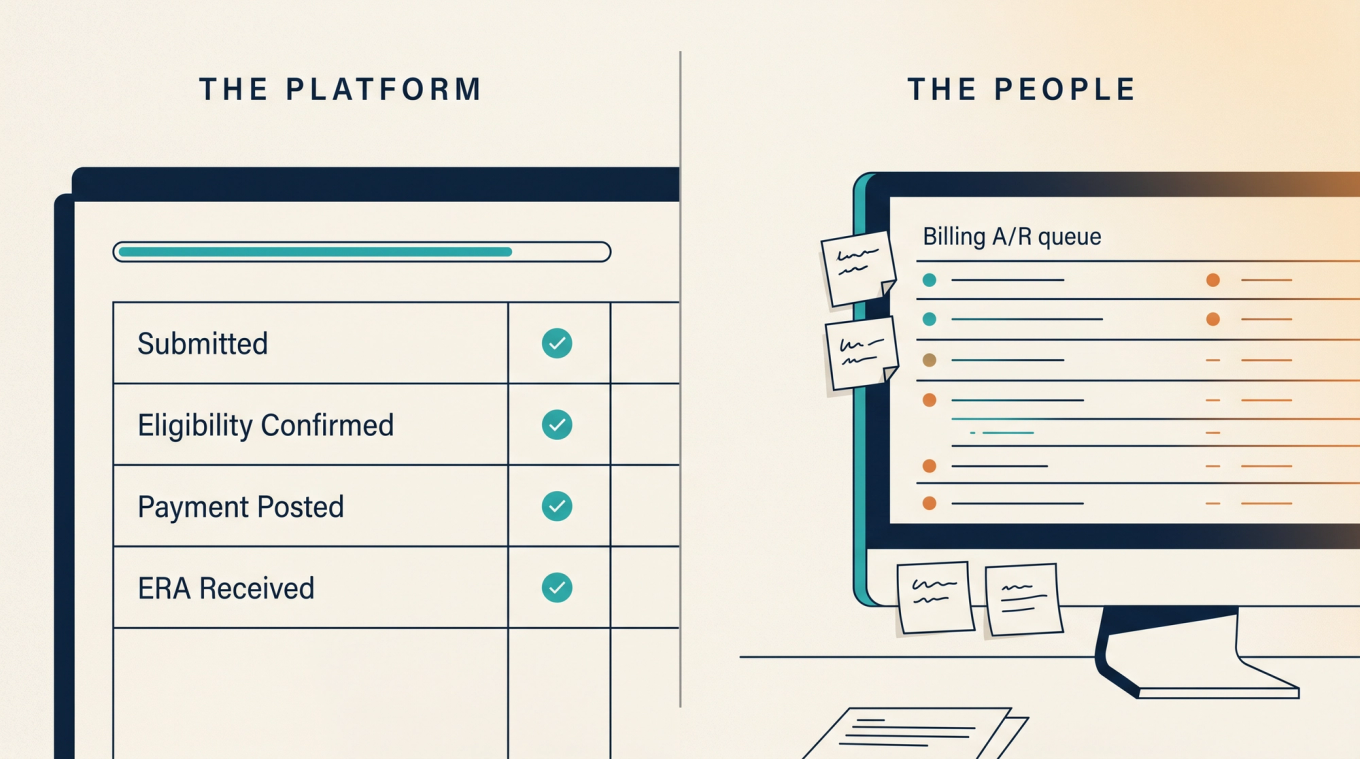
Tebra is a system. It shows you tasks, surfaces denials, displays A/R, and posts ERAs. But it does not make judgment calls, contact payer portals, draft appeal letters, fix documentation gaps, or hold anyone accountable for the revenue cycle.
Tebra itself frames it this way: in-house billing means your staff uses the software; outsourced billing means a third-party company files, tracks, and appeals claims, usually for a percentage fee. (Tebra) The platform is the same in both cases. What changes is who's doing the work.
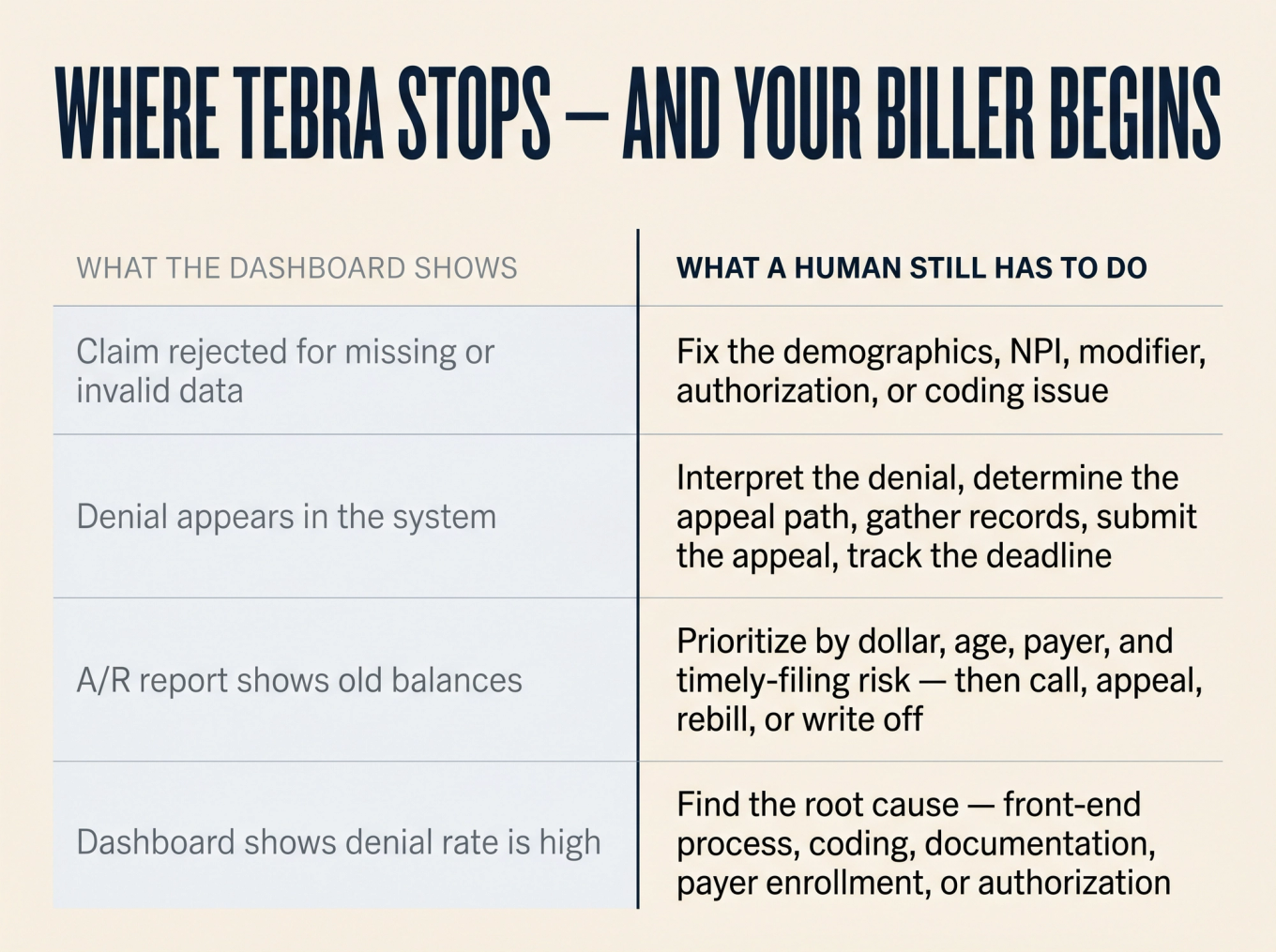
| What the Tebra dashboard shows | What a human still has to do |
|---|---|
| Claim rejected for missing/invalid data | Fix the demographics, NPI, taxonomy, payer ID, modifier, authorization, or coding issue |
| Denial appears in the system | Interpret the denial, determine the appeal path, gather records, submit the appeal, track the deadline |
| Eligibility shows authorization may be required | Confirm the payer-specific rule, obtain the auth, track units and expiration dates |
| ERA posts a contractual adjustment | Catch underpayments, payer mispricing, bundling errors, or wrong fee schedule |
| A/R report shows old balances | Prioritize by dollar, age, payer, and timely-filing risk - then call, appeal, rebill, or write off |
| Dashboard shows denial rate is high | Find the root cause - front-end process, coding, documentation, payer enrollment, or authorization |
Technology does reduce some of the repetitive work. The 2023 CAQH Index puts provider labor costs for manual benefits verification at $7.97 per transaction vs $2.18 electronically; manual prior authorization at $10.97 vs $5.79 electronically - figures that cover the labor time to conduct each transaction but exclude information-gathering, follow-up, and system costs. (CAQH) Those savings are real. But they mostly shift what the biller does, from data entry to exception-handling, denial strategy, payer follow-up, and documentation control. The need for a biller doesn't disappear.
Tebra's terms and BAA make this clear: customer information must be accurate, required patient messaging consents are the customer's responsibility, and the practice remains responsible for its covered-entity PHI obligations. The platform does not absorb compliance responsibilities. (Tebra)
So who should be doing that human work. Your staff, or an outsourced team? Before you can answer that honestly, you need to understand what keeping billing in-house actually costs.
The Real Cost of Keeping Billing In-House
The most common mistake practices make is comparing:
Tebra subscription cost vs outsourced billing percentage
That comparison is wrong, because Tebra is software. Outsourcing is labor, expertise, and process. A practice on Tebra typically keeps paying for Tebra either way, outsourcing doesn't replace the platform, it replaces (or supplements) the human billing function.
The correct comparison is:
Annual in-house cost:
- Tebra subscription
- Tebra transaction/add-on fees
- Loaded biller payroll (salary + benefits + payroll tax)
- Recruiting and hiring
- Training (Tebra, payer portals, coding, auth rules)
- Management/owner supervision time
- Coverage and backfill during PTO or turnover
- Revenue leakage from denials, old A/R, underpayments, and late filing
Annual outsourced cost:
- Tebra subscription (unchanged)
- Outsourced billing fee
- Setup/onboarding fee
- Minimum monthly fees, if any
- Extra scoped fees: credentialing, prior auth, VOB, coding, old A/R cleanup
- Vendor-management time
- Minus: any improvement in collections, denial rate, days in A/R, and staff burden
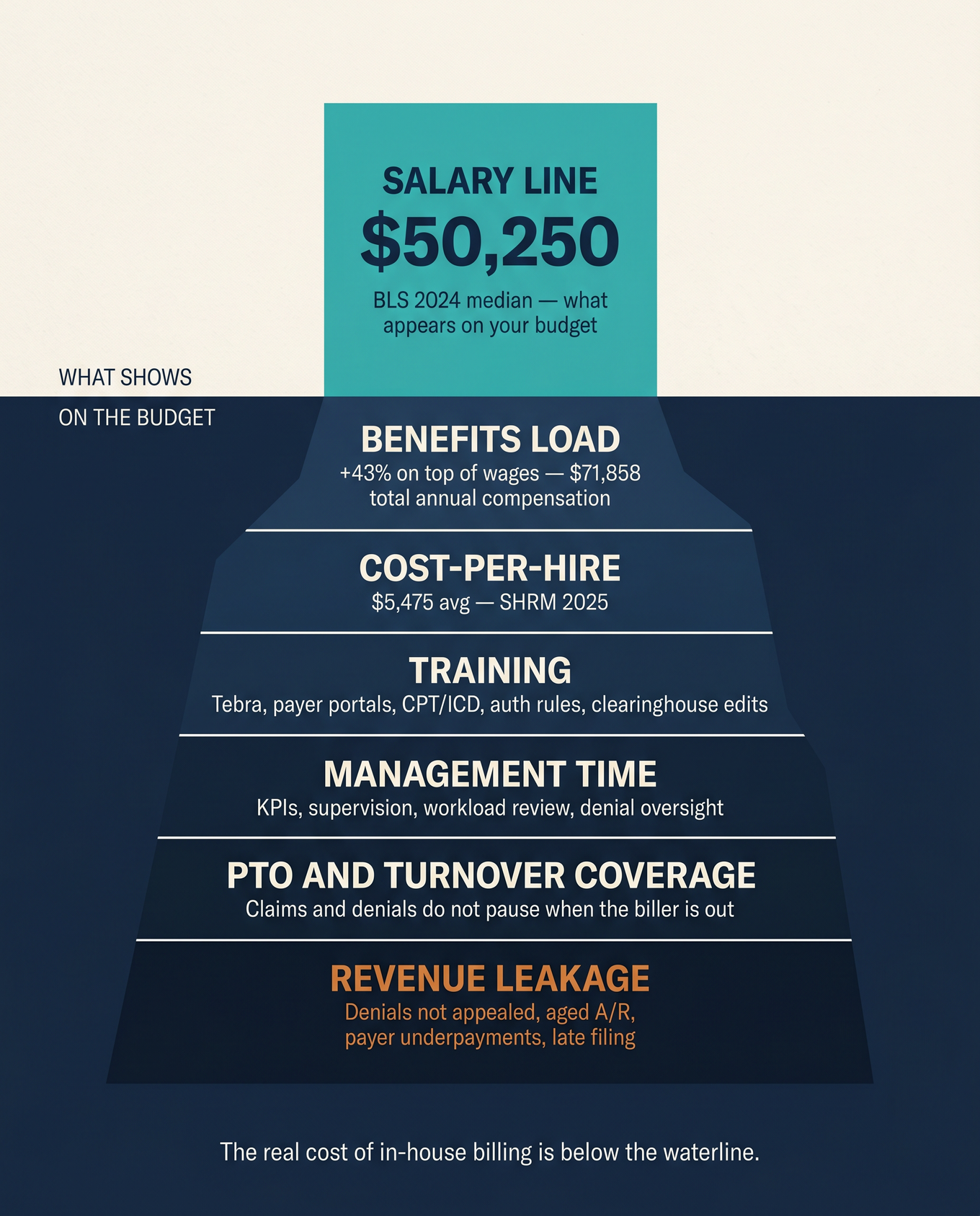
What a medical biller actually costs
BLS 2024 median: Medical Records Specialists, the closest occupational benchmark, earned $50,250 per year ($24.16/hour). The lowest 10% earned under $35,780; the highest 10% earned over $80,950. Industry medians: physician offices at $45,620, hospitals at $56,520. (Bureau of Labor Statistics)
Benefits load: A salary is not the total cost. BLS data from March 2026 shows private-industry benefits run roughly 43% on top of wages - meaning a $50,250 salary carries closer to $71,858 in total annual compensation. (Bureau of Labor Statistics)
Cost-per-hire: And when that biller leaves, SHRM's 2025 recruiting benchmarks put the average cost-per-hire for nonexecutive roles at $5,475. (SHRM) That doesn't count the weeks of delayed claims, aged denials, and missed appeal deadlines that accumulate while the seat is empty.
When outsourcing costs less than one biller
For modeling purposes, 5% - 7% of collections remains a useful range. Tebra's 2026 billing benchmark report found that 5% - 5.99% was the largest current percentage tier, with 6% - 6.99% and 7% - 7.99% each close behind; notably, 28% of respondents used a non-percentage pricing model entirely. (Tebra) Here's what outsourcing costs at different collection volumes across that range:
| Monthly collections | 5% outsourced fee | 6% outsourced fee | 7% outsourced fee |
|---|---|---|---|
| $40,000 | $2,000/month | $2,400/month | $2,800/month |
| $75,000 | $3,750/month | $4,500/month | $5,250/month |
| $120,000 | $6,000/month | $7,200/month | $8,400/month |
| $200,000 | $10,000/month | $12,000/month | $14,000/month |
| $350,000 | $17,500/month | $21,000/month | $24,500/month |
At $40k - $75k/month in collections, outsourcing to a billing team can be less expensive than one fully loaded biller - before accounting for recruiting, PTO coverage, or management time. A practice collecting $120k/month and paying 6% ($7,200/month) in outsourced billing fees only needs to see a 5% improvement in collections ($6,000/month) to nearly break even on the fee itself, not counting the reduction in internal overhead or staff burden.
If you currently have a biller at $70,000/year ($5,833/month loaded), the outsourced option only needs to generate $1,367/month in additional value through better collections, fewer denials, or faster cash to be economically equivalent.
At $200k+/month, the calculation shifts. Percentage fees become significant, and a strong internal team may be cheaper, IF the team is genuinely well-run and KPIs are healthy.
Hidden billing costs beyond the salary line
Beyond payroll, in-house billing carries costs that don't show up on a salary line:
| Hidden cost | Why it matters |
|---|---|
| PTO and sick leave coverage | Claims and denials don't pause when the biller is out |
| Single point of failure | One overwhelmed biller can quietly build a 90-day A/R problem |
| Training | Tebra, payer portals, CPT/ICD, auth rules, appeals, clearinghouse edits |
| Management time | Someone must supervise KPIs, workload, denials, and cash performance |
| Turnover | New biller inherits old mistakes and payer history gaps |
| Payer specialization | A general biller may not know behavioral-health or SUD payer quirks |
| Underpayment leakage | Posting payments is not enough, someone must catch payer mispricing |
| Old A/R decay | Every week of delay makes collection harder |
When Outsourcing Tebra Billing Is the Right Call
The case for outsourcing is strongest when the practice's real constraint is billing expertise, consistency, or accountability, not the platform itself.
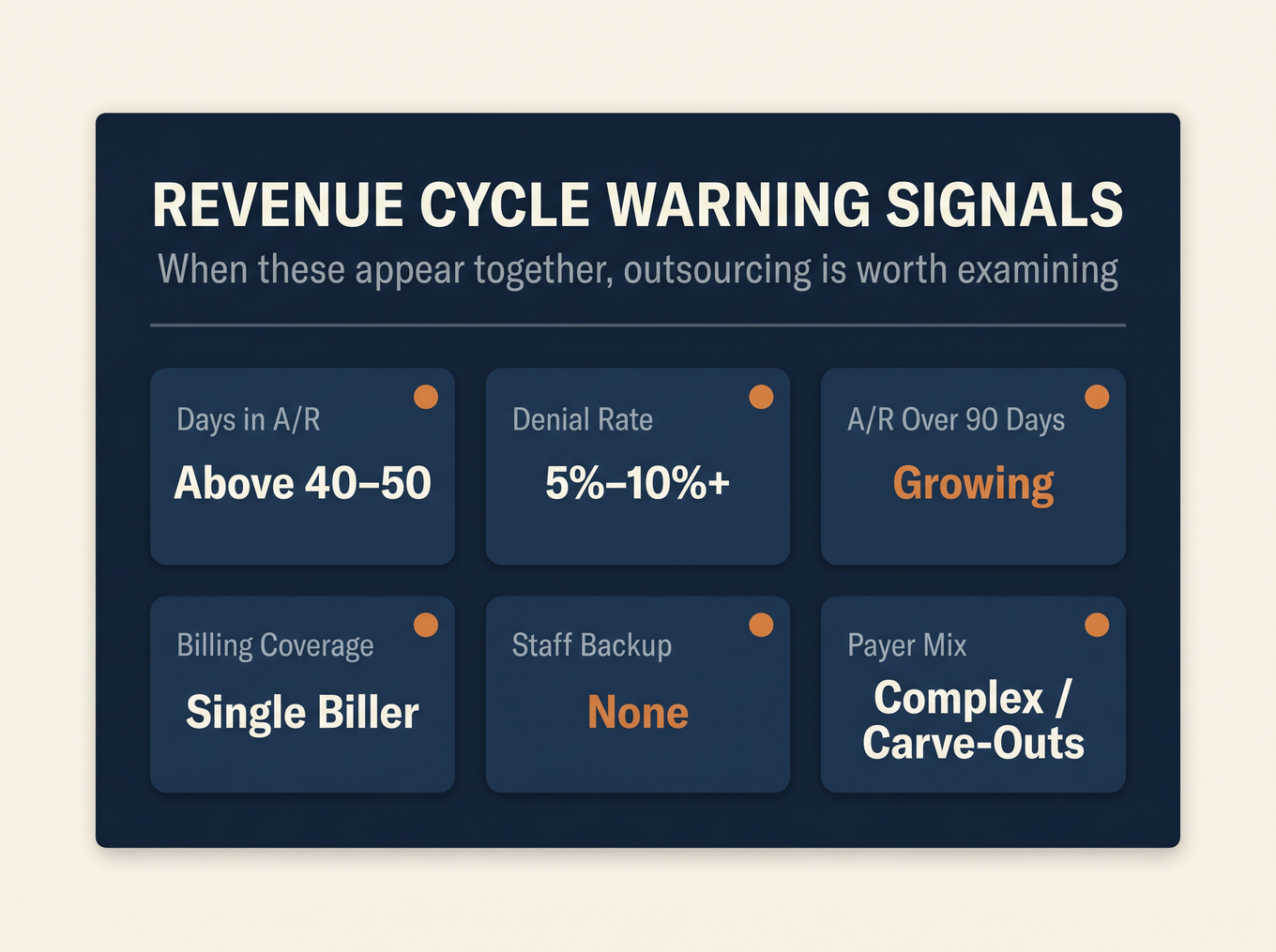
Outsourcing tends to make clear sense when:
| Signal | Why it points toward outsourcing |
|---|---|
| One biller owns everything | Single point of failure; PTO or turnover can freeze cash |
| A/R over 90 days is growing | Claims aren't being worked aggressively or correctly |
| Days in A/R is above 40-50 | Cash is slow; follow-up may be weak |
| Denial rate is over 5% - 10% | Preventable errors or payer issues aren't being resolved |
| No one knows top denial reasons by payer | Practice is reacting to denials, not managing the root cause |
| Eligibility and auth denials are common | Front-end process needs discipline |
| Clinicians aren't fixing documentation gaps | Billing needs a stronger clinical-feedback loop |
| Practice is adding providers or locations | Credentialing, payer setup, and claim volume become harder to manage |
| Behavioral health or SUD payer mix is complex | General billers may not know payer-specific rules |
| Old A/R cleanup is needed | Outside specialists can triage by age, payer, dollar, and appeal window |
| Office manager is supervising billing without RCM expertise | Owner time is being burned inefficiently |
| Biller turnover has already hurt cash | Outsourcing adds continuity and backup coverage |
Behavioral health billing: what general billers often miss
Behavioral health is not simple office-visit billing, and practices that treat it that way consistently leave money on the table.
Common friction points that specialist billers navigate, and generalists often miss - include provider credentialing at the payer level (payers treat LCSW, LMFT, LPC, psychologist, psychiatrist, NP, and MD differently), telehealth POS and modifier rules that change by payer, and psychotherapy time documentation that must support the specific CPT code billed. Time thresholds matter: 90832/90834/90837 have different documentation requirements, and E/M and psychotherapy add-on combinations, visit limits, and group or family therapy coverage rules vary significantly by payer.
Behavioral health benefits are also frequently carved out to separate managed behavioral health organizations - Optum/UBH, Carelon, Evernorth, Magellan. The front desk verifies the medical plan; often no one verifies the behavioral carve-out (which is the actual payer for the claim). Claims go to the wrong payer, authorizations come from the wrong entity, and timely-filing denials follow. A billing team with payer-routing expertise prevents this class of denial before it's submitted.
SUD billing: concurrent reviews and level-of-care complexity
SUD billing adds another layer. Authorization and concurrent review for IOP, PHP, residential, and detox programs must be tracked tightly, a missed concurrent review turns authorized, delivered care into uncollectible revenue. Medical necessity documentation typically needs to support ASAM-style level-of-care criteria. UDS and lab billing can trigger audits. Coordination of benefits is complex when patients have unstable or multiple-coverage situations.
AMA's latest prior authorization survey puts the load at about 40 prior authorization requests per physician per week, with physicians and staff spending roughly 13 hours per week on them. (American Medical Association) CMS estimates prior authorization costs providers approximately $34,000 and 700 hours per provider per year in administrative time, and those costs fall most heavily on specialties with high authorization requirements. (CMS) For SUD programs billing at the IOP or PHP level, this burden is not theoretical. It's a daily operational function that requires someone who knows the payers and the documentation standards.
Hospital groups billing through Tebra: what to verify first
Outsourcing also makes sense for groups running professional billing through Tebra while managing complex payer contracts, high-dollar denials, underpayment recovery, or multi-location credentialing. The caveat: confirm Tebra's exact claim type setup for your organization. Some facility-adjacent groups run professional billing through Tebra while institutional UB-04/837I billing lives in a separate system. Understanding that division clearly matters before building an outsourced workflow around Tebra.
When Keeping Billing In-House Is the Right Call
The honest answer: outsourcing is not always the right move. If a practice has a strong billing team, measured KPIs, and stable payer mix, outsourcing may create more cost and coordination overhead than it removes.
In-house billing makes sense when:
| Situation | Why in-house may win |
|---|---|
| Excellent biller or billing team | Good people using Tebra well can outperform a generalist vendor |
| Billing KPIs are already strong | No need to outsource a healthy process |
| Specialty is straightforward, payer mix is stable | Less need for outside payer specialization |
| Monthly collections are high enough that % fee is expensive | Internal team may be cheaper than 5% - 7% of collections |
| Practice needs tight control over patient communication | In-house team may handle patient billing more sensitively |
| Provider documentation is strong and standardized | Fewer denial and escalation problems |
| There is backup coverage and a trained team | Less single-point-of-failure risk |
| Owner or manager understands RCM and can supervise | Vendor may add coordination burden rather than reduce it |
The 12-question Tebra billing self-audit
In-house billing is only genuinely "cheaper" if it's genuinely managed. Pull these from your Tebra reports and billing operations today:
- What is our clean claim rate?
- What is our first-pass acceptance rate?
- What is our denial rate by payer and denial category?
- What is our net collection rate?
- What are our days in A/R?
- What percentage of A/R is over 90 days?
- How many claims are submitted within 48 hours of documentation completion?
- How many authorizations are missed, expired, or exceeded?
- Who covers billing when the biller is out?
- Who audits underpayments?
- Who owns appeals before timely-filing deadlines?
- Who trains new billers on Tebra and payer-specific rules?
If you can answer all twelve from live data, your billing operation is measured, and that's a legitimate foundation for keeping it in-house.
If several of those questions produce a pause, "in-house" may just mean "unmeasured."
MGMA billing benchmarks: how your Tebra data should look
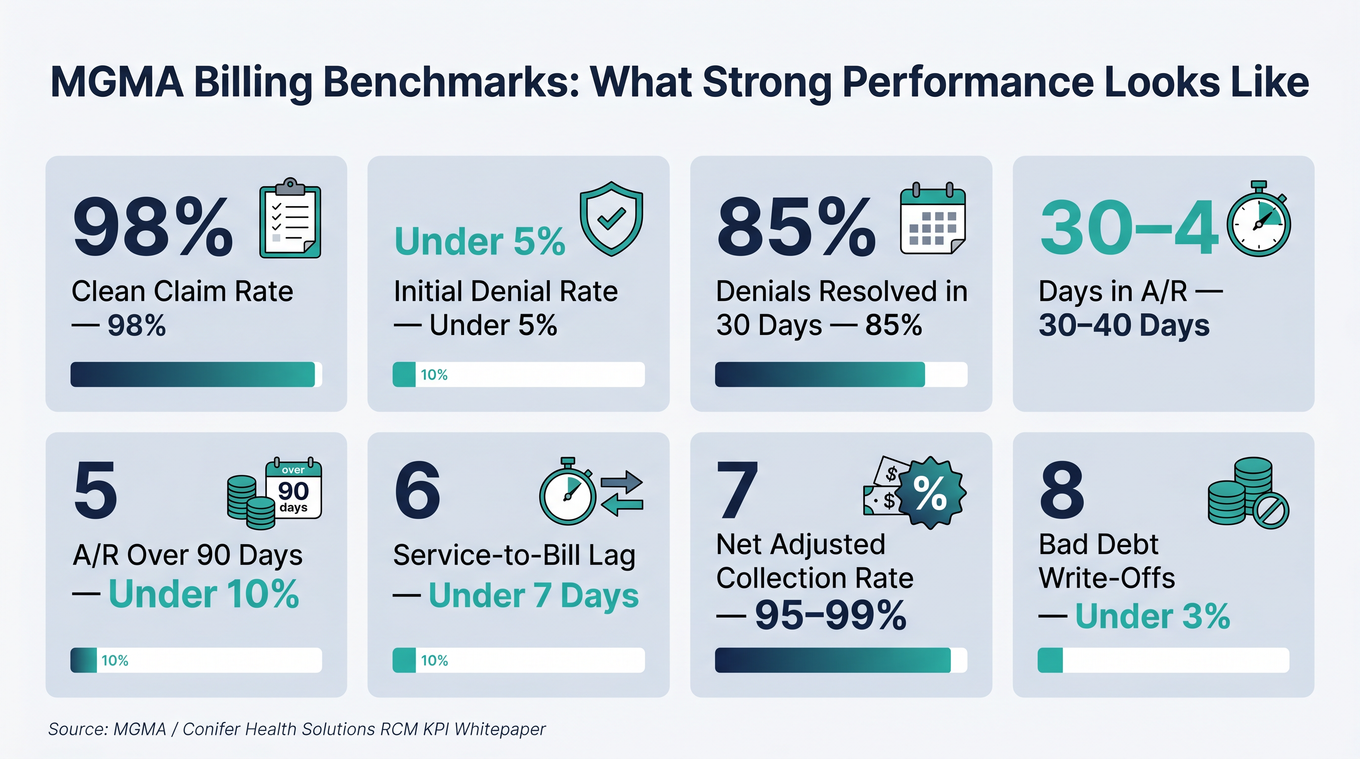
A Conifer Health Solutions RCM KPI whitepaper hosted by MGMA gives useful targets: (MGMA)
| KPI | Target |
|---|---|
| Clean claim rate | 98% |
| Initial denial rate | Under 5% (industry average 5-10%) |
| Denials resolved within 30 days | 85% |
| Days in A/R | 30-40 days (optimal) |
| A/R over 90 days | Under 10% |
| Service-to-bill lag | Under 7 days |
| Net adjusted collection rate | Minimum 95%; optimal 97-99% |
| Bad debt / unnecessary write-offs | Under 3% |
Tebra's own 2026 billing benchmark report - based on a survey of 190 billing professionals - found that 46% reported increased denial rates, the median first-pass acceptance rate was 85%, and fewer than half achieved 90%+ first-pass acceptance. Tebra characterizes 95%+ as the high-performer threshold. (Tebra) If your Tebra reports show numbers consistently below these benchmarks, the issue is almost certainly billing execution, not the platform.
The Hybrid Path: Outsource the Part That's Breaking
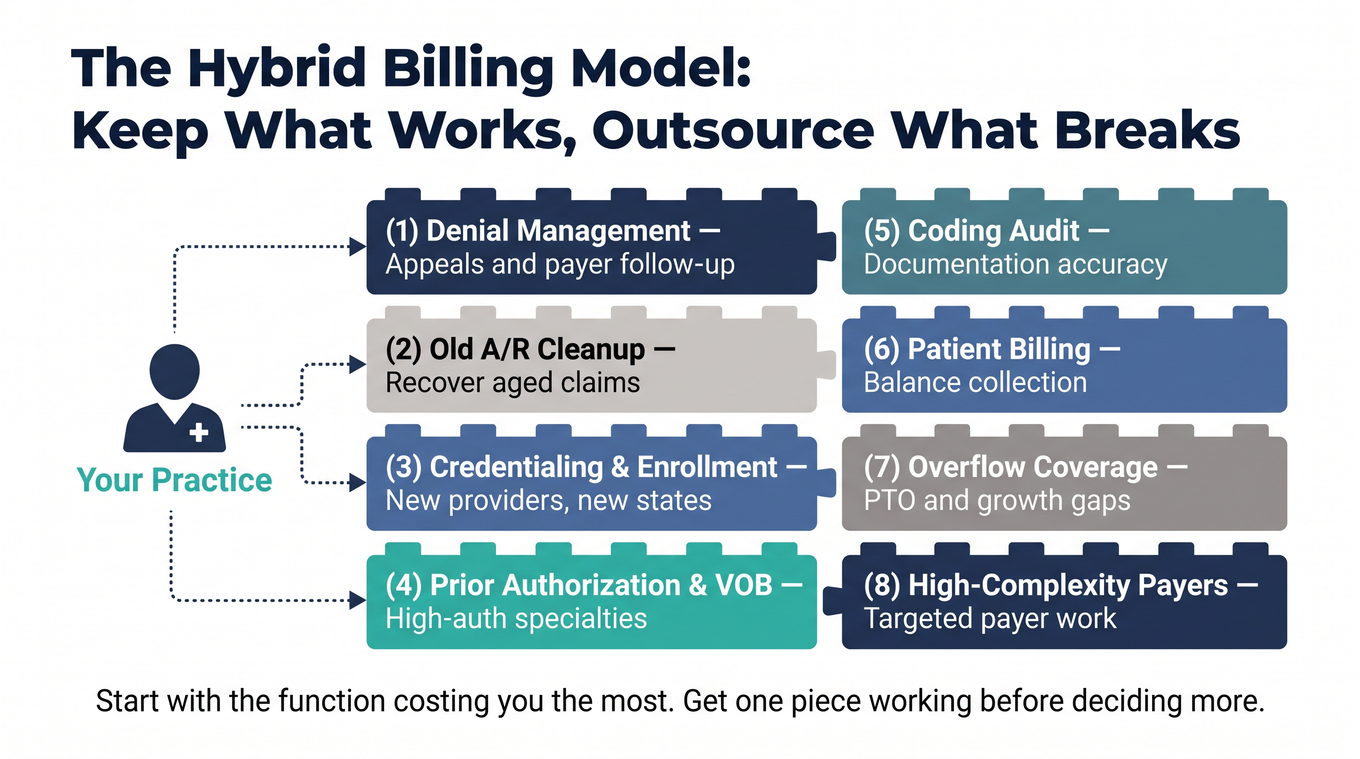
A practice doesn't have to choose between full outsourcing and keeping everything in-house. Often the smartest near-term move is outsourcing the specific function that's causing the most damage.
| Hybrid model | Best for |
|---|---|
| Outsourced denial management only | Practice submits claims competently but struggles with appeals |
| Outsourced old A/R cleanup | Backlog exists; current billing is otherwise stable |
| Outsourced credentialing and payer enrollment | Growth, new providers, new states, or payer setup delays |
| Outsourced VOB and prior authorization | Behavioral health and SUD practices with heavy auth burden |
| Outsourced coding audit | Documentation and coding uncertainty |
| Outsourced patient billing | Practice wants help collecting balances, keeps insurance billing internal |
| Outsourced overflow coverage | Internal biller needs backup during PTO, leave, or growth spikes |
| Outsourced high-complexity payer work | Specific payers are driving most denials |
If you're not ready to outsource everything, start with the function that's costing you the most, whether that's denials, old A/R, authorizations, credentialing, or a specific payer. Getting one piece working well often reveals whether full outsourcing is worth it.
How an Outsourced Team Actually Works Inside Your Tebra Account
Most outsourced-billing discussions skip the operational detail. This section covers what the setup actually looks like so you can evaluate vendors with full information.
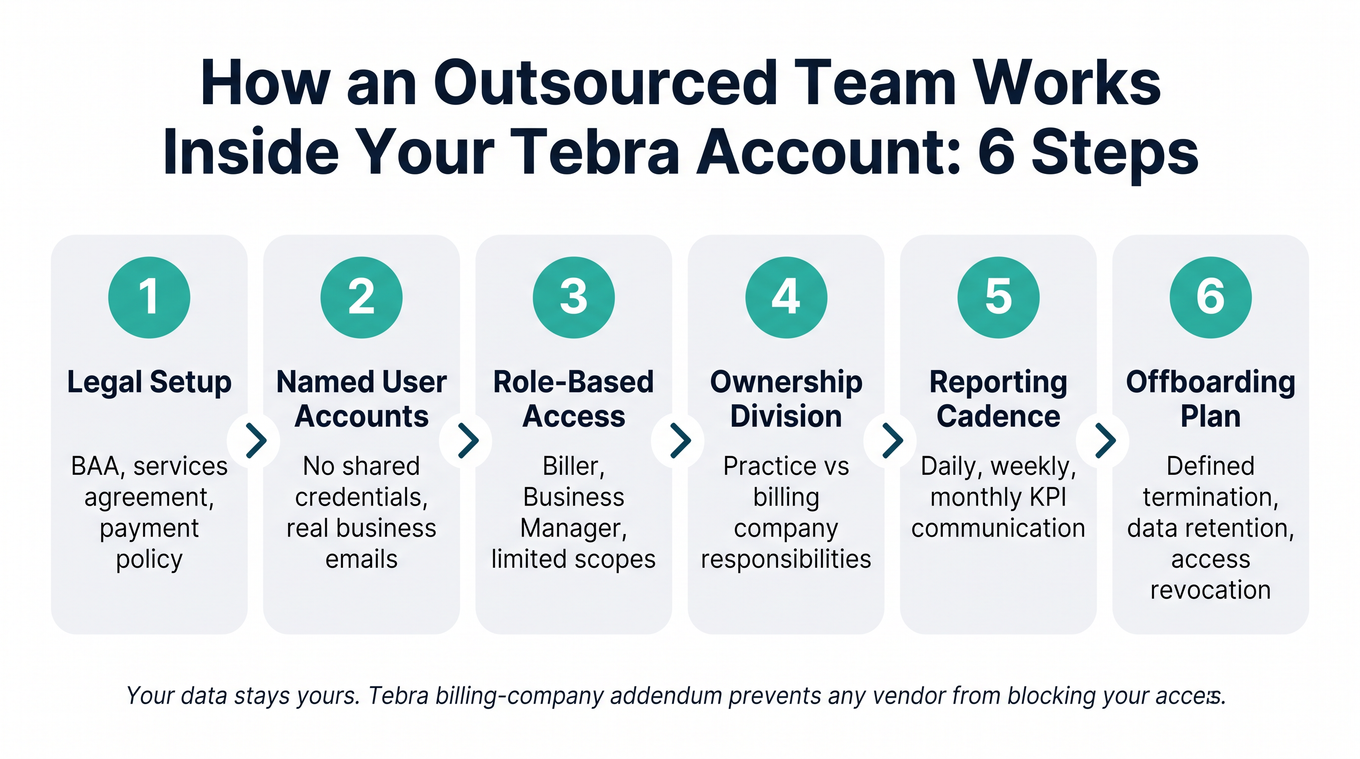
Step 1: Legal setup before granting any Tebra access
Before a billing company gets a single login, several documents should be in place:
| Document | Purpose |
|---|---|
| Business Associate Agreement (BAA) | Required, the biller handles PHI |
| Services agreement | Defines scope, fees, exclusions, KPIs, termination |
| Data-access and offboarding terms | Confirms who owns records and what happens at termination |
| Bank/EFT/payment policy | Confirms payer money goes to practice-controlled accounts |
| Compliance responsibilities | Clarifies coding, documentation, patient billing, refunds, appeals, audits |
Tebra's own billing-company addendum requires that billing companies maintain valid HIPAA-compliant BAAs with each practice, and that billing companies cannot prevent the practice from accessing or using its health data. Tebra also says it may provide data access in disputes and is not responsible for the billing company's services. (Tebra) That last point matters: Tebra coordinates access, but doesn't guarantee the billing partner's work.
Tebra supports HIPAA safeguards, ONC, PCI DSS Level 1, HITRUST, role-based access controls, individual named user logins, and audit logging. (Tebra)
Step 2: Named users only, no shared credentials
Tebra's security guidance is explicit: users should have individual logins, not shared credentials. Tebra uses individual email and phone for login and two-factor authentication. (Tebra Help Center) Any billing company that wants to share a generic "billing team" login is asking you to accept an auditability problem, a security risk, and a compliance exposure, all at once.
The practice's Tebra administrator should create individual named accounts for each billing company staff member using their real business email.
Step 3: Tebra role-based access for each billing function
Tebra's platform includes web roles: System Admin, Provider, Clinical Assistant, Office Staff, Biller, and Business Manager. (Tebra Help Center) The Biller role allows access to billing workflows - charge entries, claim status, patient collections, payment reports, without clinical notes access by default.
A sensible access model for an outsourced billing team:
| Team member | Recommended Tebra access |
|---|---|
| Billing specialist | Biller role |
| Denial/A/R lead | Biller + reporting access |
| RCM manager | Business Manager or custom reporting |
| Credentialing specialist | Limited payer/provider setup access |
| Prior auth or VOB specialist | Limited patient/insurance/scheduling access |
| Coding reviewer | Access to documentation only if explicitly in scope |
| Vendor owner/admin | Avoid System Admin unless truly necessary |
(Tebra Help Center, Tebra Help Center, Tebra Help Center)
Tebra allows user access to be assigned by practice, so if a billing company works across multiple clients, confirm they can only access your specific practice/location. (Tebra Help Center)
Step 4: Who owns what, practice vs billing company
In a clean outsourced Tebra model, the practice and the billing company have clearly defined ownership:
| Workflow | Practice owns | Billing company owns |
|---|---|---|
| Scheduling | Schedule accuracy, visit type, provider/location | Flag scheduling or insurance issues affecting billing |
| Patient intake | Demographics, insurance cards, consents | Audit missing data; request corrections |
| Eligibility/VOB | Contract-dependent | Verify benefits, copay/deductible, coverage, payer-specific rules |
| Prior authorization | Clinical information and medical necessity | Submit/track auth if in scope; warn on expiring units/dates |
| Documentation | Clinician notes, diagnosis, treatment plan, signatures | Flag missing or weak documentation before billing |
| Coding | Provider/coder depending on contract | Code review, claim edits, modifier/POS guidance if in scope |
| Claim submission | Usually biller | Scrub, batch submit, correct rejections |
| Payment posting | Usually biller | Post ERA/EOB, reconcile payments, flag underpayments |
| Denials | Biller leads; practice supplies clinical docs | Appeal, rebill, track deadlines, report root causes |
| A/R follow-up | Biller leads | Work payer queues, portals, calls, escalation |
| Patient billing | Contract-dependent | Statements, payment plans if in scope |
| Reporting | Both | Weekly/monthly KPI reports and operational recommendations |
Step 5: What your billing vendor should report and how often
A billing team that's actually working your A/R should be communicating on a regular cadence:
| Frequency | What should happen |
|---|---|
| Daily | Submit clean claims, fix rejections, address urgent auth/eligibility issues |
| 2-3x per week | Post payments, work denials, update claim statuses |
| Weekly | A/R review, denial trends, missing documentation list, owner/manager check-in |
| Monthly | Full KPI report: collections, charges, payments, denial rate, days in A/R, aging, top payers, top denial reasons, auth misses, underpayments |
| Quarterly | Strategic review: payer issues, contract concerns, provider documentation patterns, credentialing gaps, process changes |
If a vendor can't commit to this cadence, or resists producing monthly KPI reports. That's a meaningful signal about how managed the work actually is.
Step 6: How to offboard a Tebra billing company cleanly
Offboarding should be defined in the services agreement before you start. At termination:
- Lock or unassign all vendor user accounts in Tebra
- Confirm no shared credentials exist or persist
- Confirm all payer portals, clearinghouse access, and payment accounts are practice-controlled
- Export/report open A/R, denials, appeals, and work-in-progress
- Confirm old A/R ownership and final fee calculation
- Confirm patient billing handoff
- Confirm the billing company cannot block access to practice data
Tebra's user guidance says accounts are deactivated rather than deleted to preserve transaction history, and that user accounts should not be repurposed. (Tebra Help Center) Tebra's pricing policy also covers data migration/export scenarios, including migration from a billing-company account to a new customer account. (Tebra)
Questions to Ask Before Hiring a Tebra Billing Company
Working inside Tebra is not the same as knowing how to work Tebra. A billing vendor should be able to answer these without hesitation.
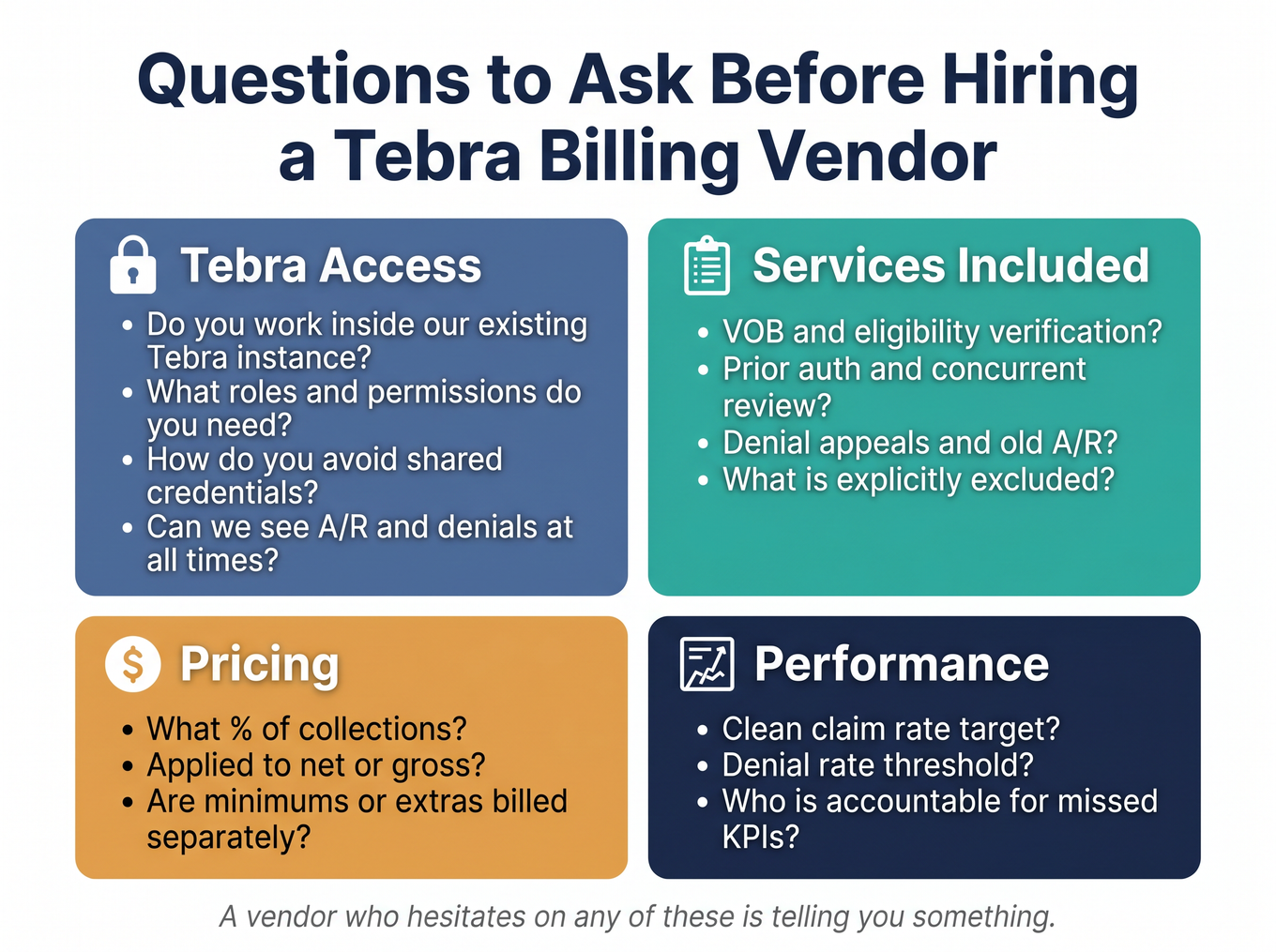
Tebra access: how they work inside your account
- Do you work inside the client's existing Tebra instance, or do you require migration to a different system?
- What Tebra roles and permissions do you require, and why?
- Do you require System Admin access? If yes, what specifically for?
- How do you avoid shared credentials?
- Can the practice see claim status, denials, payments, and A/R in Tebra at all times, without contacting you?
- How do you handle offboarding from Tebra at contract end?
What services are included in the billing fee
- Do you handle eligibility and benefits verification?
- Do you handle prior authorization and concurrent review?
- Do you handle credentialing and payer enrollment?
- Do you handle payment posting, denial appeals, and old A/R?
- What is explicitly excluded from your billing fee?
- Who handles patient billing calls if the patient has questions?
Pricing: what percentage, what's included, and what's extra
- What percentage of collections do you charge?
- Is the percentage applied to insurance collections, patient collections, or both?
- Are refunds, recoupments, and payer takebacks excluded from the fee base?
- Is old A/R or cleanup billed at a different rate?
- Is there a monthly minimum fee?
- Are credentialing, prior auth, VOB, coding, patient calls, and statement fees included or extra?
Note: The percentage should apply to net collections, actual money collected after contractual adjustments, not gross charges. Gross charges are not real economics.
Behavioral health and SUD expertise: questions that reveal fit
- Which behavioral-health provider types do you currently bill for (LCSW, LMFT, psychologist, psychiatrist, PMHNP)?
- Which SUD levels of care do you have direct billing experience with (IOP, PHP, residential, detox)?
- How do you manage authorization units, expiration dates, and concurrent review deadlines?
- How do you handle behavioral carve-outs, do you verify both the medical and behavioral benefit for each payer?
- Can you show sample reporting broken down by payer, denial reason, and provider?
Performance: what KPIs they commit to and who owns misses
- What clean claim rate and first-pass acceptance rate do you target?
- What denial rate do you consider acceptable, and what happens when it's exceeded?
- How quickly are rejections corrected and claims resubmitted?
- How quickly are appeals submitted before timely-filing deadlines?
- Who is accountable when KPIs consistently miss target?
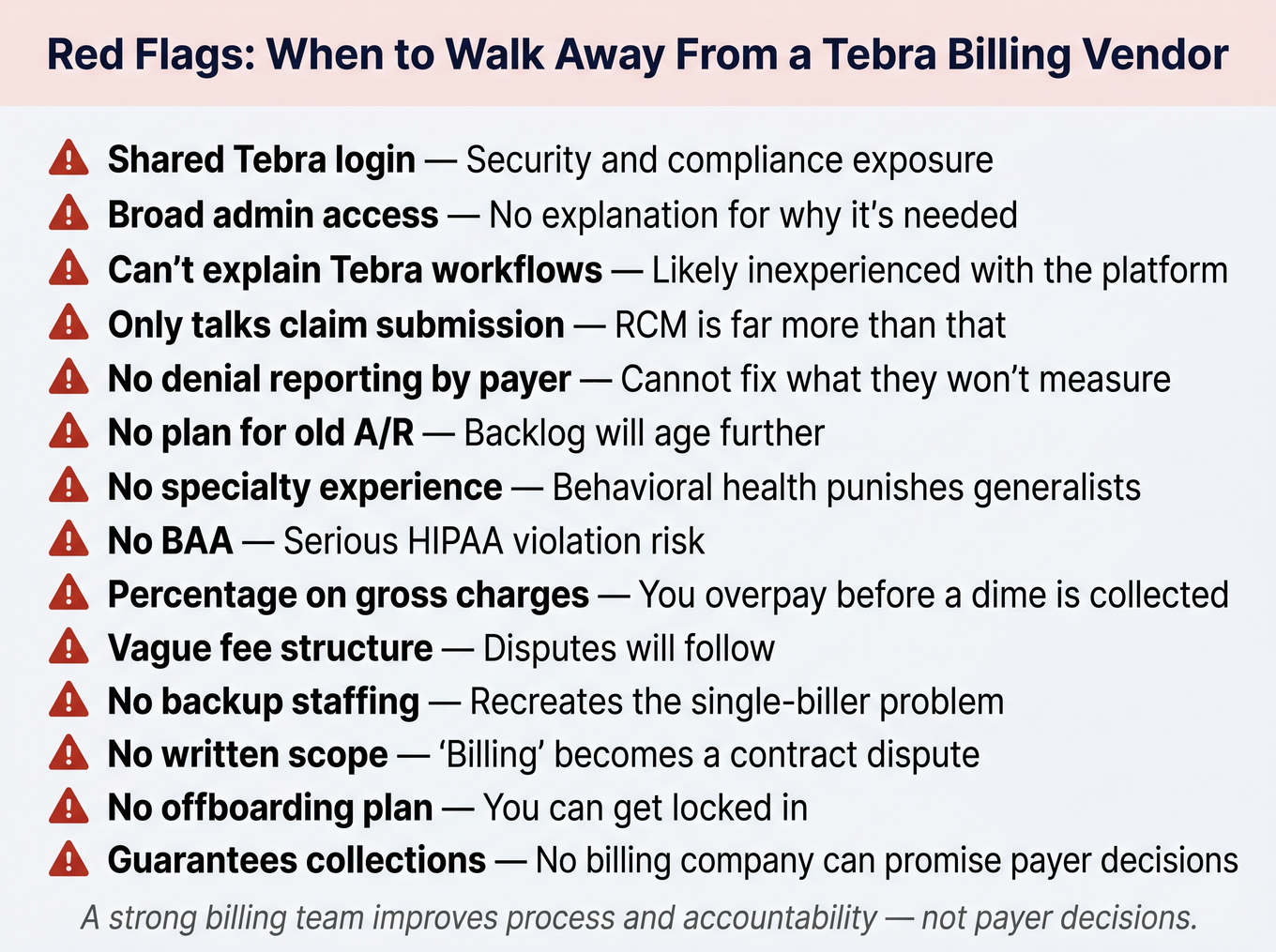
Red Flags in a Tebra Billing Vendor: When to Walk Away
| Red flag | Why it's dangerous |
|---|---|
| Wants a shared Tebra login | Bad security, weak auditability, compliance exposure |
| Requires broad admin access without explanation | Excessive access risk |
| Cannot explain Tebra workflows in specific terms | May not actually be Tebra-experienced |
| Talks only about claim submission | RCM is far more than submitting claims |
| No denial reporting by payer and reason | Cannot fix root causes if they can't identify them |
| No plan for old A/R | Backlog will sit untouched |
| No specialty-specific experience | Behavioral health and SUD billing punishes generalists |
| No BAA | Serious HIPAA compliance problem |
| Percentage applies to gross charges | Bad economics; should almost always be net collections |
| Vague or undefined fee base | You may overpay without realizing it |
| No backup staffing model | Outsourcing may recreate the single-point-of-failure problem you're trying to solve |
| No written scope of services | "Billing" becomes a dispute later |
| No offboarding process defined upfront | You can get trapped |
| Promises guaranteed collections | Payer decisions and documentation outcomes cannot be guaranteed by any billing company |
That last point deserves emphasis: a strong billing team improves process, follow-through, and accountability. Payer decisions still depend on the patient's actual coverage, the documentation the clinician produces, and the payer's own rules. Any vendor promising guaranteed outcomes is either misinformed or misrepresenting what billing services can do.
10-Question Scorecard: Should You Outsource Tebra Billing?
This 10-question scorecard turns the decision into data. Give each item 0, 1, or 2 points based on your practice's current situation.
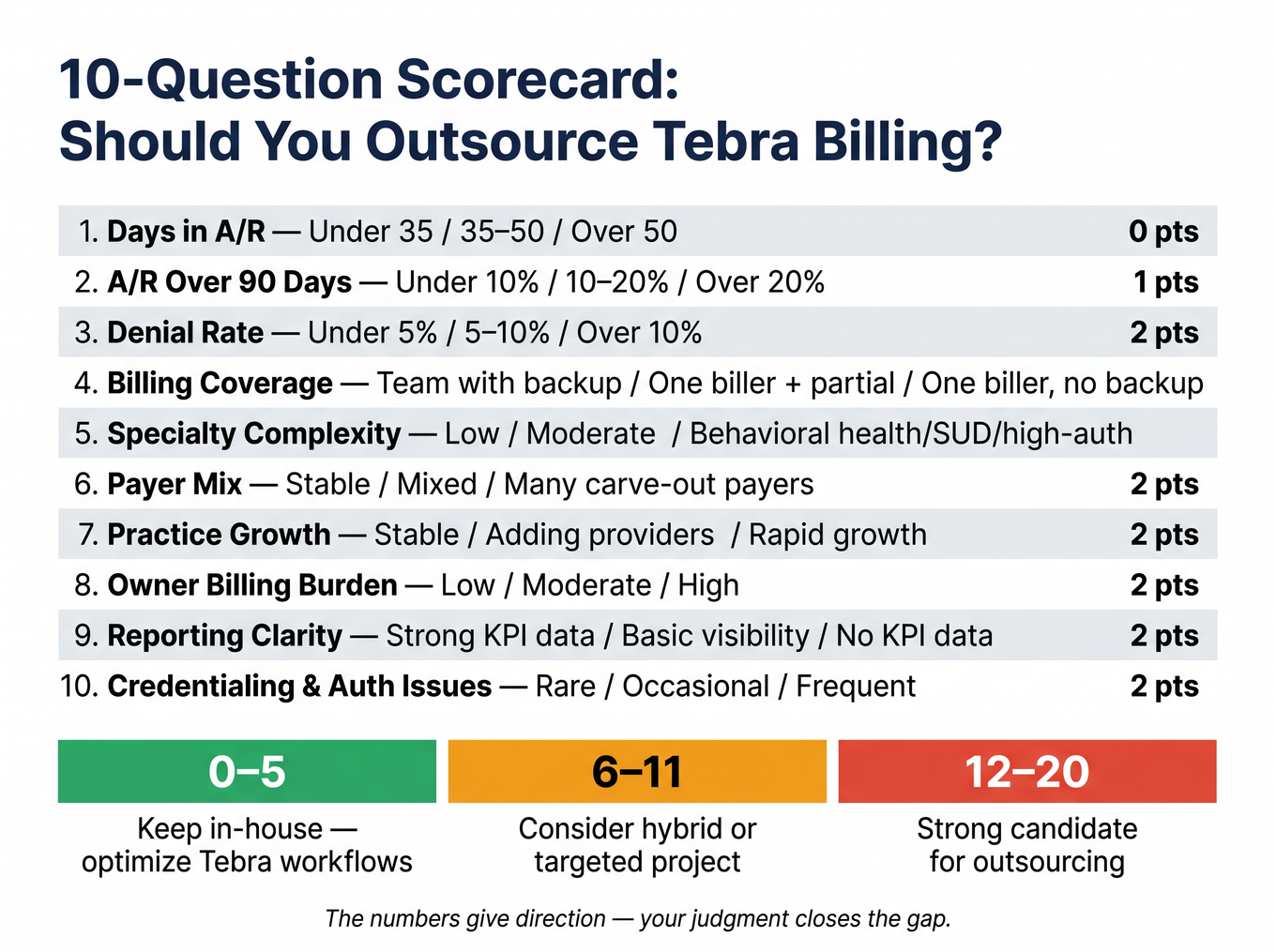
| Question | 0 points | 1 point | 2 points |
|---|---|---|---|
| Days in A/R | Under 35 | 35-50 | Over 50 |
| A/R over 90 days | Under 10% | 10% - 20% | Over 20% |
| Denial rate | Under 5% | 5% - 10% | Over 10% |
| Billing coverage | Team with backup | One main biller + partial backup | One biller, no backup |
| Specialty complexity | Low | Moderate | Behavioral health/SUD/facility/high-auth |
| Payer mix | Stable and straightforward | Mixed | Many difficult or carve-out payers |
| Practice growth | Stable | Adding providers | Rapid growth or new locations |
| Owner/manager burden from billing | Low | Moderate | High |
| Reporting clarity | Strong KPI visibility | Basic visibility | Weak or no KPI data from Tebra |
| Credentialing and auth issues | Rare | Occasional | Frequent |
Add up your score:
| Total | Recommendation |
|---|---|
| 0-5 | Keep billing in-house; optimize Tebra workflows |
| 6-11 | Consider hybrid outsourcing or a targeted cleanup project |
| 12-20 | Strong candidate for outsourced Tebra billing services |
The scorecard is a starting point, not a verdict. A practice with a score of 4 that's adding three behavioral health providers next quarter should probably be planning ahead. A practice with a score of 9 that has a strong biller already solving the denial problem may be fine staying the course. The numbers give you a direction. Your judgment closes the gap.
Tebra Is the Platform, Billing Performance Is the Team
Tebra is the platform. Billing performance comes from the people working the platform.
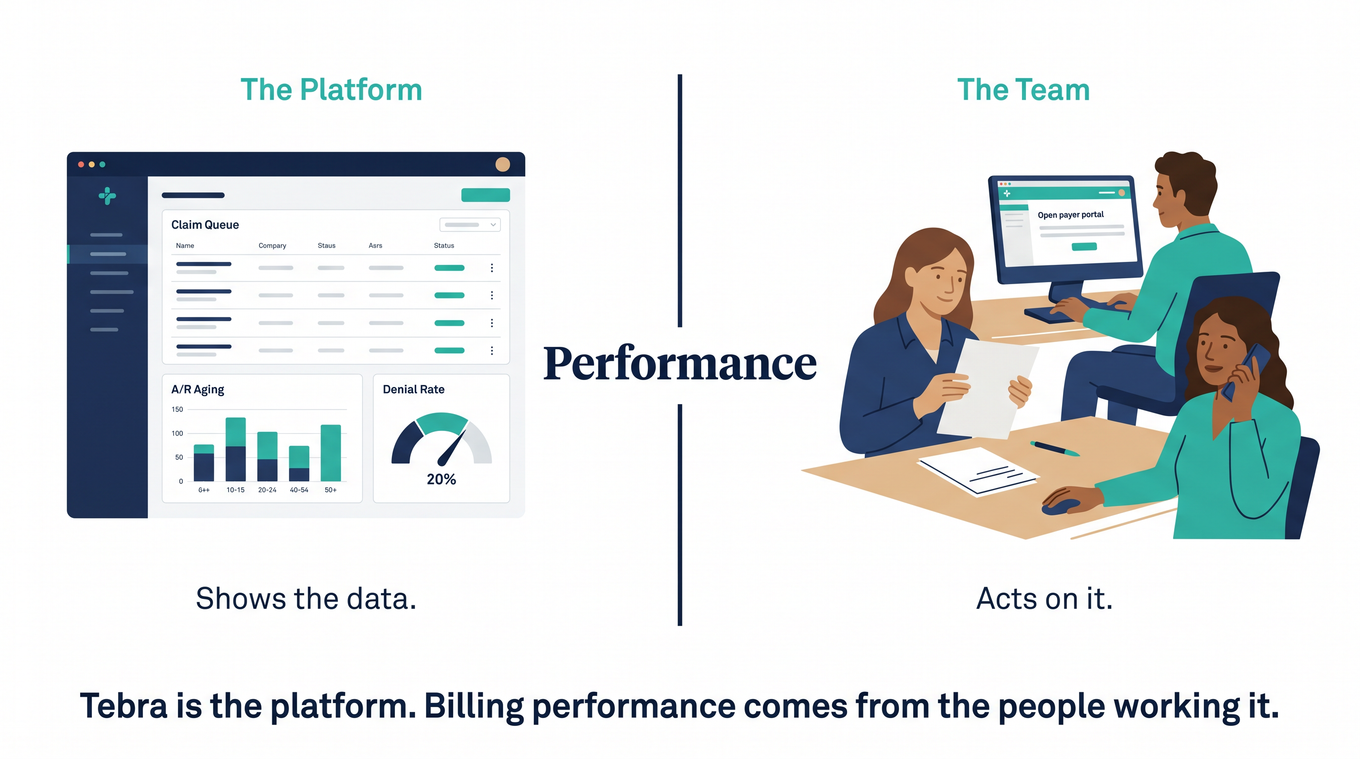
That's the whole thesis of this guide, and it's the reason the in-house vs outsourced decision isn't really about software at all. If your team has the expertise, coverage, and accountability to work Tebra's billing tools well every day - claims submitted on time, denials appealed before deadlines, A/R worked by payer priority, KPIs reviewed weekly, in-house billing can be a genuine strength. Keep it.
If any part of that picture is missing - one biller who owns everything, a specialty payer mix that requires knowledge your team doesn't have, A/R that's aging with no clear owner, or simply no visibility into whether the metrics are on track, outsourcing to a team that works inside your Tebra environment solves a real problem.
Working inside Tebra with practices daily, we've seen both sides of this decision. The ones that struggle with outsourcing usually chose a vendor based on price, not fit, and didn't ask enough questions about Tebra access, specialty experience, or how the workflow division would actually be structured. The ones that thrive usually treated the billing company as an operational partner, with defined scope, regular reporting, and shared accountability for KPIs.
If you're running on Tebra and the billing side is feeling fragile - rising denials, aging A/R, an overextended biller, or just not enough visibility into where the money is. We're happy to walk through what outsourced Tebra billing services look like for practices like yours. Start with a conversation, not a commitment.
Frequently Asked Questions About Tebra Billing
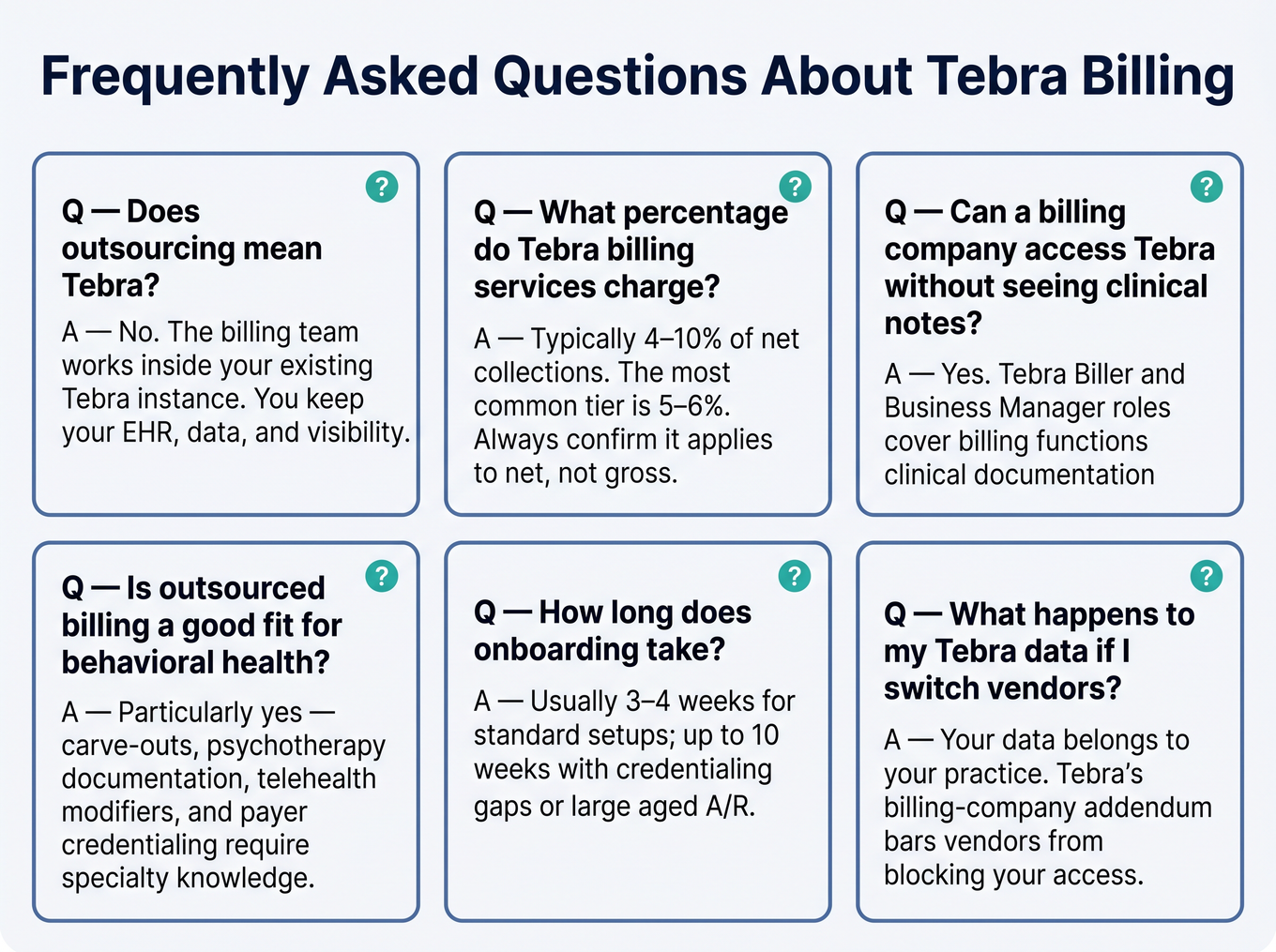
Does outsourcing Tebra billing mean switching away from Tebra?
No. The right model for an existing Tebra practice is a billing team that works inside your current Tebra instance, not a system migration. You keep your EHR, your data, your workflow history, and your visibility. The billing company gets named user accounts with appropriate role-based permissions. You stay in Tebra; they work in Tebra on your behalf.
What percentage do Tebra billing services typically charge?
Outsourced billing fees commonly range from 4% to 10% of net collections. Tebra's 2026 billing benchmark report found that 5% - 5.99% was the largest current percentage tier among billing companies, with 6% - 6.99% and 7% - 7.99% each close behind, though 28% of respondents used a non-percentage model entirely. (Tebra) The exact rate depends on your specialty, claim volume, scope of services, and how much authorization, credentialing, and old A/R work is included. Always clarify whether the percentage applies to net collections (money actually received) or gross charges (what you billed before adjustments). It should be net collections.
Can a billing company access my Tebra account without seeing clinical notes?
Yes. Tebra's role-based permissions allow a billing company to be set up with Biller or Business Manager access - covering billing workflows, claim status, payment posting, A/R, and reporting, without access to clinical documentation. The Biller role in Tebra is specifically designed for this use case. (Tebra Help Center) Coding reviewers may need documentation access, but that should be explicitly defined in your services agreement and limited to what the contract scope requires.
Is outsourced Tebra billing a good fit for behavioral health practices?
Particularly yes. Behavioral health billing involves payer-specific carve-outs, psychotherapy time documentation, telehealth modifier rules, visit limits, provider credentialing variations by payer, and authorization management, all of which require ongoing payer knowledge that general billers often lack. A billing team with behavioral health specialty experience will typically catch billing errors before they become denials, and will know the appeal argument for coverage-based denials that a general biller might write off.
How long does it take to onboard an outsourced Tebra billing team?
Onboarding usually takes several weeks. Tebra says most managed-billing practices are connected and live within 3-4 weeks, while broader Tebra implementation can take up to 10 weeks. (Tebra) The work covered includes legal document execution (BAA, services agreement), Tebra user account setup and permissions configuration, payer/EDI/ERA/EFT verification, open A/R inventory, and initial workflow orientation. Credentialing gaps, a large aged A/R backlog, or complex multi-location setups can push the timeline longer. Ask any prospective vendor for a specific onboarding timeline before signing.
What happens to my Tebra data if I stop working with a billing company?
Your Tebra data belongs to your practice. Tebra's billing-company addendum explicitly states that billing companies cannot prevent the practice from accessing or using its health data. (Tebra) At contract termination, the billing company's user accounts should be deactivated in Tebra; the practice retains all claim history, ERA data, payment posting records, and patient information. Define offboarding procedures, including open A/R handoff, final fee calculation, and data export rights, in your services agreement before you begin.
Does Tebra directly provide billing services, or does it connect practices with billing partners?
Tebra's managed billing offering is partner-led: Tebra matches the practice with a trusted billing company partner who manages RCM work inside the platform. (Tebra) There are also independent billing companies with Tebra experience that practices can hire directly, separate from Tebra's own partner network. Either path keeps you in Tebra, the difference is whether Tebra or you initiates the vendor relationship.