Optum Behavioral Health Billing: Why 87726 Isn't Enough
August 20, 2026 · 56 min read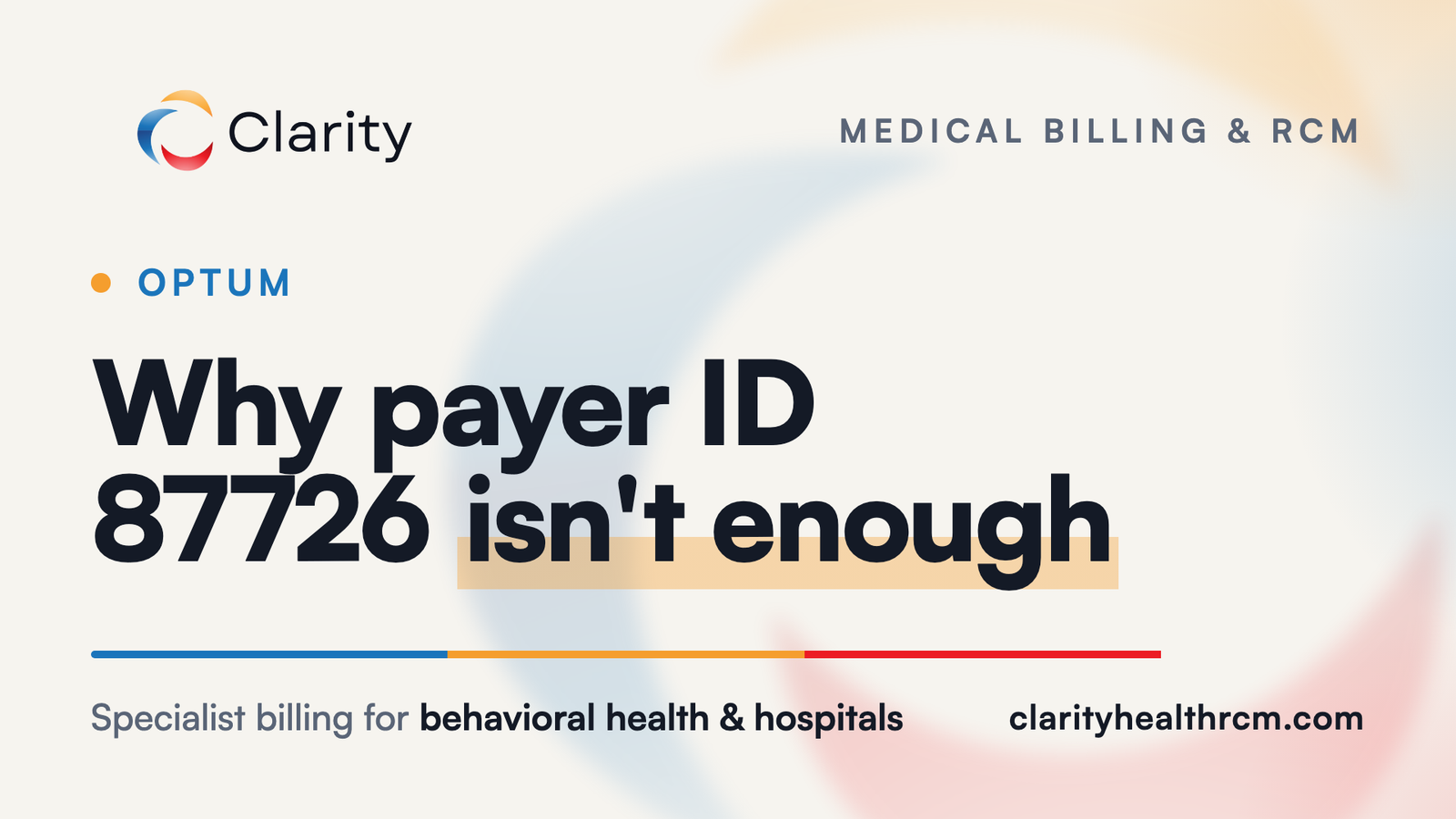
A patient hands you a UnitedHealthcare card. Your front desk verifies coverage and it comes back active. The clinician sees the patient - three sessions, maybe six. Your EHR sends the claims down the same road every other UnitedHealthcare claim takes, and the clearinghouse report says accepted. Then nothing arrives. Not a payment, not a denial, not a rejection. The claims are simply not where you expect them to be, and the oldest date of service is getting older.
You are not imagining the split, and you did not miss an obvious step. Behavioral-health benefits are frequently administered by a different company than the medical benefits printed on the front of the card, and almost nothing about the card tells you that has happened. That single fact is what makes Optum behavioral health billing a discipline of its own rather than a variation on medical billing. We do behavioral-health revenue cycle work, and a correctly coded, cleanly submitted claim sitting in the wrong company's system is one of the most common and most expensive things we get asked to unwind.
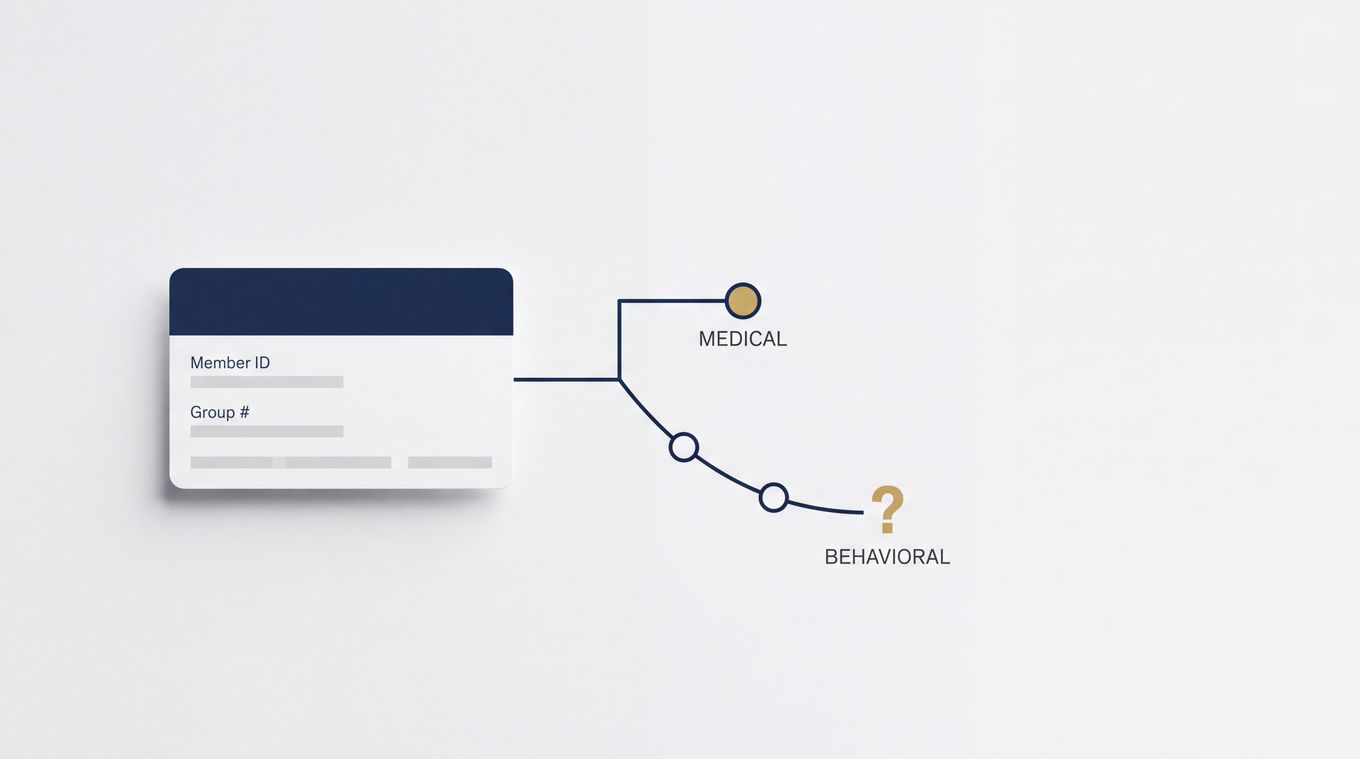
The short answer. Optum publishes payer ID 87726 for electronic behavioral-health and employee-assistance claims, and it is the right answer for a great many Optum-administered members (Provider Express claim tips). It is a default, not a universal identifier. Before you bill, you need to know who administers the behavioral benefit and who adjudicates the claim for that specific product on that specific date of service - because those can be two different companies, and neither is necessarily Optum. Two live examples make the point better than any warning:
- NYCE PPO - New York City Employees PPO members use Optum-contracted behavioral providers while Optum states it is not managing the benefits, and claims go to payer ID 26992 through the NYCE portal, not to Optum (Optum notice, February 2026).
- Surest - members use UnitedHealthcare and Optum behavioral networks, and digital claims go to 25463 through the UnitedHealthcare portal (Surest provider information).
All payer guidance below verified against primary Optum and UnitedHealthcare sources on August 17, 2026. Payer policy moves; check the linked pages before you act on a specific claim.
Why a UnitedHealthcare mental health claim goes missing
Behavioral benefits are often carved out - the mental-health and substance-use portion of the plan is handed to a specialist company to administer, while the medical portion stays with the plan whose logo is on the card. Optum and United Behavioral Health are the usual destination inside the UnitedHealthcare ecosystem, but they are not the only one, and the carve-out is not printed anywhere a busy front desk will see it.
The reason this costs money rather than merely causing confusion is that a carved-out claim fails quietly. There is usually no immediate, unambiguous "wrong payer" message. Instead:
- Your clearinghouse accepts the outbound file while the payer rejects the claim record inside it.
- The medical plan may forward the claim, may reject it, or may return a code telling you to submit it somewhere else - three very different situations that look similar on a report.
- The claim may process under an eligibility record you did not expect, because members can have more than one.
- The claim may load under a different billing or rendering provider record than the one your staff are searching under.
- Your practice can be genuinely in the broad network and still not be loaded for this member's specific product.
- An authorization can exist, and be attached to the wrong entity, provider, site, code family or level of care.
- A facility claim can be sent down the outpatient professional channel, where it will never be accepted.
Meanwhile the clinician keeps seeing the patient, because clinically that is the right thing to do and nobody has told them to stop. By the time somebody establishes who actually administers the benefit, you may be looking at a timely-filing deadline, a missed concurrent review, or both. The card was never going to answer this question. So what does?
The five roles hiding behind one payer name
Practices talk about "the payer" as though one company performs every function. In behavioral health, at least five functions can be split between different companies:
| Function | The question you have to answer | Who it might be |
|---|---|---|
| Plan / brand on the card | Whose coverage does the member appear to have? | UnitedHealthcare, Surest, a UHC Community Plan, NYCE PPO, another employer or health-plan brand |
| Behavioral-benefit administrator | Who verifies behavioral benefits and manages authorizations? | Optum / United Behavioral Health, the plan itself, a state managed-care organization, another delegated entity |
| Network owner | Under whose contract is this clinician participating? | The Optum behavioral network, the UnitedHealthcare network, a rented access network |
| Claim adjudicator | Which company applies benefits and payment rules to the claim? | Optum, NYCE PPO, Surest, a UHC state plan, another administrator |
| Transaction channel | Which portal, payer ID, clearinghouse route and paper address apply? | Provider Express / 87726, NYCE / 26992, UHC portal / 25463, a state-specific route |
One company may perform several of these roles. It does not have to perform all of them, and the gap between "several" and "all" is where claims go missing.
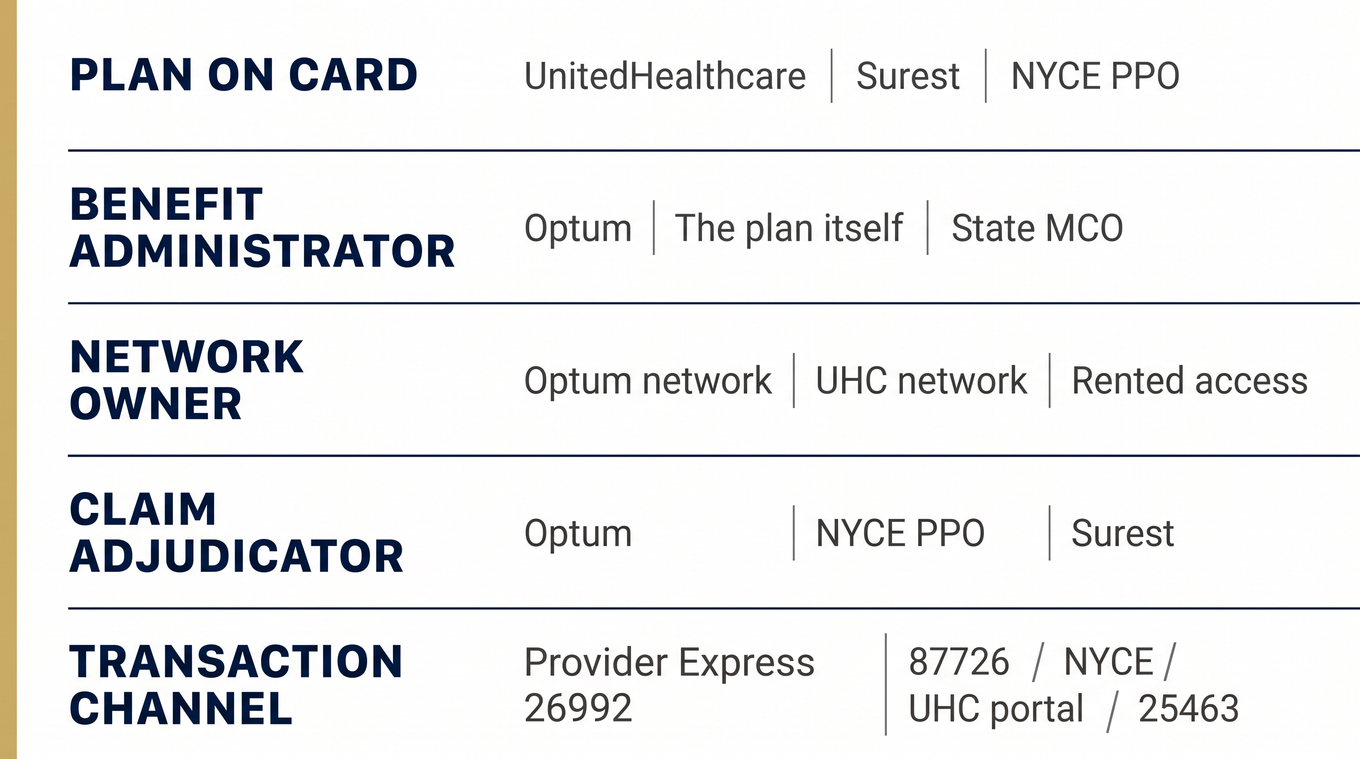
Which gives you the sentence to run your whole verification process on:
The logo tells you whose plan the patient carries. Verification tells you who administers and adjudicates the behavioral-health benefit for that product, on that date of service.
A word on names, because imprecision here causes real errors. Optum Behavioral Health is also seen, historically and contractually, as United Behavioral Health or UBH; Optum's own notice explains that UBH operates under the Optum brand on some contracts and not others, and that the two are the same underlying entity in that context. What you cannot conclude is that every UnitedHealthcare plan delegates behavioral benefits to Optum, or that every product using the Optum network is administered by Optum. Both of those inferences are wrong often enough to be dangerous.
Here is the sequence the card should trigger:
PATIENT'S ID CARD | v What is the exact plan/product, and what is the date of service? | +--> Who administers behavioral-health benefits? | +--> Which network makes this provider participating? | +--> Is this TIN / NPI / location / license loaded for THAT product? | +--> Which entity adjudicates the claim? | +--> Which portal, payer ID, address, authorization rules, clinical criteria, filing limit and appeal route apply?
Every arrow is a place to slow down. Most of the revenue lost in this scenario is lost by jumping straight from the first box to the last one.
Find the adjudicator before you pick a payer ID
The order matters more than it looks. You cannot choose a payer ID until you know who adjudicates the claim, which means the verification call has to happen before the first appointment - not after the first denial.
Before that appointment, capture and keep:
- Identity and plan. Front and back of the current card, member name and date of birth, member ID and suffix, subscriber name and relationship, group number, the exact plan and product name, plan effective and termination dates, and the employer group where relevant.
- The route. The behavioral-health phone number printed on the card, the claims payer name, the electronic payer ID, the paper address, the portal the plan names, the behavioral-benefit administrator, and the claim adjudicator if it is a different company.
- Participation, at the exact level the claim will carry. The billing TIN, billing NPI, rendering NPI, taxonomy, service location, license level and product. Not "are we in network" - is this combination in network for this product on this date.
- The service. Whether it is employee assistance, routine outpatient, specialty outpatient, IOP, PHP, residential, inpatient, opioid treatment, ABA, testing, TMS, ECT or something else; the codes under consideration; telehealth status, place of service and required modifiers.
- Authorization. Whether prior authorization or notification is required, and if so the authorization number, approved provider or facility, codes, units or days, level of care, dates, frequency, review date and contact channel.
- Money and deadlines. Deductible, copay, coinsurance, accumulators, visit or day limits, exclusions, and the timely-filing deadline.
- The proof itself. Representative name and ID, call reference number, date and time, and a portal screenshot or the electronic response.
Optum's eligibility function supports searching by member ID or by name and date of birth, and returns eligibility, accumulators, benefit details and whether the planned service requires authorization; where a request cannot be completed online, Optum directs you to the number on the member's card (eligibility and benefits). Worth stating plainly, because it is the assumption that causes the most damage downstream: a benefit quote is not a guarantee of payment.
The call script that gets past "active coverage"
The failure mode of a verification call is that it answers a question you did not ask. Open by reframing it:
"I'm verifying behavioral-health benefits and the claim route for a specific provider, service and date of service. Please don't verify only the medical plan - I need the entity that administers and adjudicates the behavioral-health benefit."
Then work through, in this order:
- Product identity. What is the exact plan and product name? Is this commercial employer-sponsored, Individual or Exchange, Medicare Advantage, D-SNP, Medicaid or Community Plan, employee assistance, or something else? What are the effective and termination dates for this date of service?
- Administration and adjudication. Who administers mental-health and substance-use benefits? Who adjudicates the behavioral claim? Is Optum administering the benefit, or is the plan only using the Optum network?
- Claim route. What payer name and electronic payer ID should be used? Which portal shows eligibility, authorization, claim status and appeals? What is the paper claim address for behavioral claims? Do professional and facility claims use different channels?
- Participation. Is billing TIN ___, billing NPI ___, rendering NPI ___, taxonomy ___, location ___ and license ___ participating for this exact product on this date? Is the provider loaded under the group agreement, or only individually? Are there product-specific or site-specific enrollment requirements?
- Benefit and authorization. Is this code covered for this diagnosis or level of care? Does it require prior authorization, notification or concurrent review? Does the requirement change by place of service, telehealth, frequency, units or rendering provider?
- Patient responsibility. What is the copay, coinsurance and deductible, and what remains on the accumulator? Are there visit, session, hour, day or dollar limits? Is this an employee-assistance authorization with no cost-sharing, or the medical plan's behavioral benefit?
- Deadlines and proof. What is the original-claim filing limit? What are the corrected-claim, reconsideration, clinical-appeal and authorization-review deadlines? Please give me the call reference number, and spell the representative identifier.
The output of that call is a routing record. If all you have written down is "active," the call did not happen.
Verify twice when the money is real
For high-dollar or recurring care, confirm the route through two independent channels - the current card or an eligibility response, the plan or Provider Express eligibility record, a representative call with a reference number, the product-specific provider guide or official notice, or the current authorization record.
This is not belt-and-braces caution. The NYCE arrangement proves a provider can be inside the Optum network while every administrative function - benefits, prior authorization, claims, appeals - sits outside Provider Express entirely. Optum also notes that a member may have several eligibility records and that a claim can route under a different record than the one you expected. Two sources catch what one source confidently gets wrong.
Re-verify on events, not on the calendar
Annual re-verification is not enough, because the things that break routing do not wait for January. Re-run the check when a new plan year starts, when the member produces a new card, when the employer or group changes, when a payer merger or delegation transition is announced, when employee-assistance sessions end, when treatment escalates from routine outpatient to testing, TMS, IOP, PHP, residential or inpatient care, when your own TIN, location, group, license, taxonomy or rendering NPI changes, when the portal starts showing a different product, when an authorization expires or a concurrent review falls due, when a claim disappears or processes out of network, and when Optum posts a product or manual update.
That is the discipline. Now the question everyone actually arrived here to ask.
Is 87726 the right Optum payer ID?
Usually - and not always, and you cannot tell which from the network name.
87726 is Optum's published payer ID for electronic behavioral-health and employee-assistance claims, and Optum's 2026 commercial notice lists it alongside 86047 as the payer ID for electronic remittance advice (electronic claim submission and EDI, 2026 NPI and taxonomy notice). For a member whose behavioral benefit Optum actually administers and adjudicates, it is correct.
The exceptions are not hypothetical:
| Product | Network relationship | Claims payer ID | Portal | Why it matters |
|---|---|---|---|---|
| Optum-administered behavioral claims | Optum administers the member's behavioral benefit | 87726 | Provider Express or EDI | The national default - not proof for every card |
| NYCE PPO, effective Jan 1 2026 | Uses the Optum behavioral network; Optum does not manage the benefits | 26992 | NYCE PPO provider portal | Optum states explicitly that claims sent to Optum are denied and must be resubmitted |
| Surest | Uses UnitedHealthcare and Optum networks | 25463 digital | UnitedHealthcare provider portal | Separate claim destination and administrative workflow; paper claims go to Surest in Eagan, Minnesota |
| New Mexico Medicaid (example) | UHC Community Plan and state rules | 87748, and 87726 for electronic visit verification claims | State and product workflow | Medicaid payer IDs and enrollment requirements can be state-specific |
Read that table for what it is.
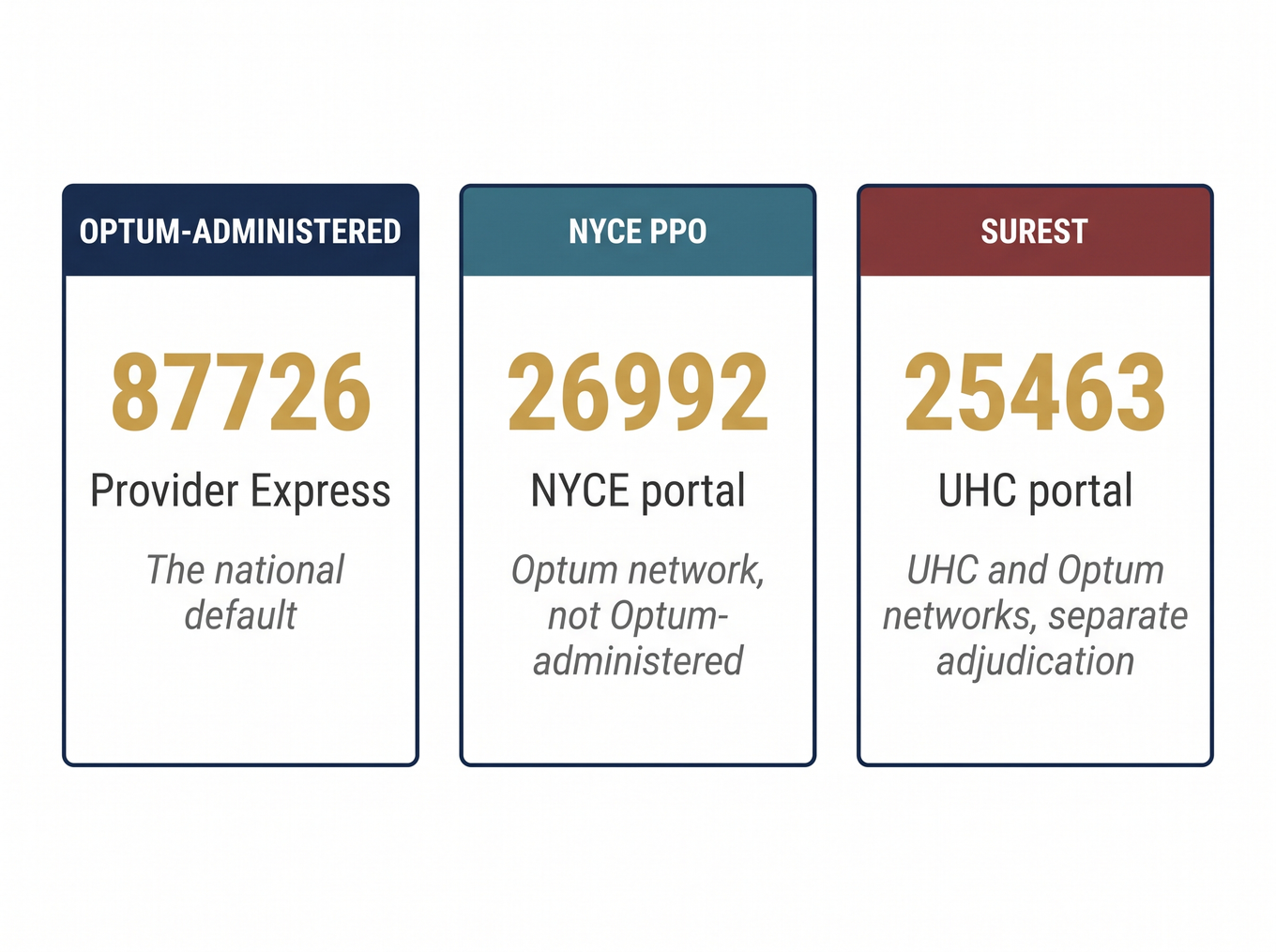
It proves that exceptions exist and that they are current. It is not a complete national list of exceptions, and as far as we can establish no such list is published anywhere - which is precisely why the verification step above is not optional busywork.
Anyone who hands you a single payer ID as the answer to "how do I bill Optum behavioral health" is answering a question about a default and presenting it as a question about your patient.
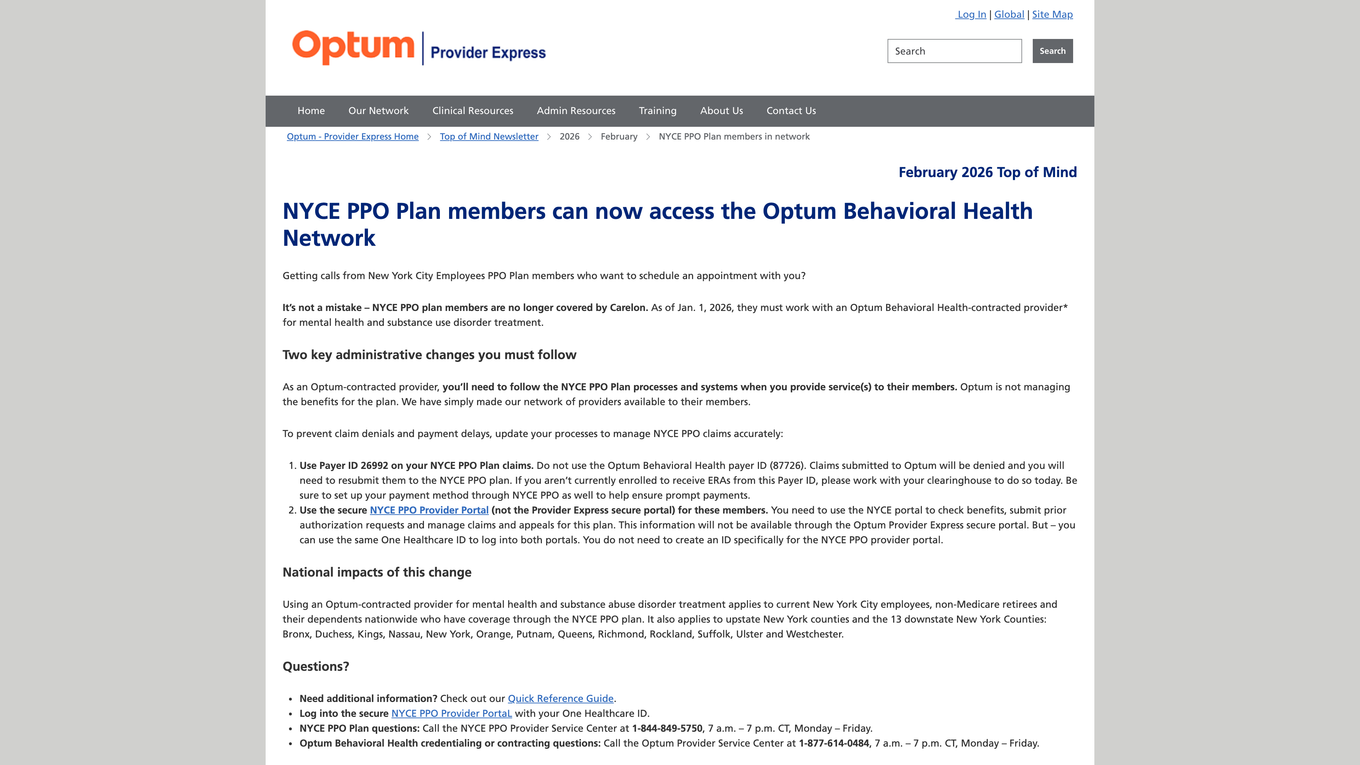
Optum's own February 2026 notice. NYCE PPO members use the Optum behavioral network - and Optum still instructs providers to bill payer ID 26992, not 87726, because claims sent to Optum will be denied. Captured August 18, 2026.
The practical fix inside your own system: make your practice-management payer table product-specific rather than company-specific. One row per product, not one row for "Optum." A payer table organized by company name is a machine for sending claims to the wrong place at scale.
If the payer ID varies by product, so does everything else you log into.
Provider Express or the UnitedHealthcare portal?
Provider Express is the portal for Optum-administered transactions. Surest work happens in the UnitedHealthcare provider portal, even though Optum maintains its own page describing the behavioral-network relationship with those plans (Optum on Surest health plans). NYCE work happens in the NYCE portal. Medicaid and Exchange products route through their own state or product workflows.
The trap is a single sign-on. One credential can get you into several of these systems, and being able to log in somewhere is not evidence that your claim belongs there. A clean login and an empty search result look identical to a claim that was never yours to file in that system.
There is a subtler failure than the wrong portal, though, and it catches practices that have done everything else right: being genuinely in network and still getting paid as though you were not.
Credentialing, contracting, and enrollment: three separate steps in network participation
Credentialing, contracting, and enrollment are separate and sequential components of the provider network participation process. The three words get used interchangeably, and they describe three separate things that fail separately:
- Credentialing asks whether the clinician or organization meets the qualification standard.
- Contracting creates the participation agreement - the product and network terms, and the rates.
- Enrollment places the correct TIN, NPI, taxonomy, location, provider relationship, effective date and line of business into the systems that actually adjudicate claims.
You are not safely billable until all three line up with the claim you are about to send. Enrollment is the one practices skip, and it is the one that produces the in-network-but-paid-out-of-network denial, because a credentialing approval letter speaks only to the first step and says nothing about the third.

Start from a fact that surprises people: UnitedHealthcare's own network page directs behavioral-health and substance-use practitioners and facilities to Optum Behavioral Health Solutions, which handles credentialing and contracting on UnitedHealthcare's behalf, with a separate application path (joining the network for behavioral health). So being contracted for UnitedHealthcare medical services does not, by itself, establish participation for behavioral-health claims. Those are different agreements reached through different doors.
Optum runs distinct application routes depending on what you are (our network):
| Applicant type | What it covers |
|---|---|
| Individually credentialed clinician | A solo clinician, or a clinician in a group that does not currently hold a group agreement with Optum |
| Facility or hospital-based | A facility offering mental-health or substance-use inpatient, residential, PHP or IOP levels of care |
| Group with individually credentialed providers | A group holding a group agreement, with individually credentialed clinicians |
| Group with agency-credentialed providers | A CMHC, FQHC, RHC, opioid treatment program or other entity licensed or certified at the organizational level |
| Autism / ABA | A separate recruitment and application route |
Two details in Optum's own description matter more than they appear. First, the credentialing process described in Optum's credentialing plans begins only after a preliminary determination that Optum wants to pursue contracting or re-contracting with the applicant - so submitting an interest form is not the same as entering credentialing. Second, individual clinicians can track initial status in Provider Express, while groups, agencies, facilities and ABA applicants are directed to network management. Neither of those is the same as holding an effective, loaded contract.
Build a participation matrix, not a yes/no field
A single "credentialed: yes" field in your system cannot represent this. Track, per payer and per product:
- Legal or billing entity - exact name and TIN as contracted
- Billing NPI - loaded to that TIN
- Rendering NPI - for every clinician performing direct services
- Taxonomy - current, and matching the service and license
- Group relationship - rendering clinician linked to the billing group
- Service location - the exact address and place of service
- License level - and whether it is reimbursable for the code
- Network and product - commercial, Exchange, Medicare Advantage, D-SNP, a Medicaid product, employee assistance, or a rented-network product
- Effective date - written, including any product-specific date
- Rate schedule - the one that applies
- Directory listing
- EDI, EFT and ERA enrollment - including which payer ID the remittance routes to
This is the artifact that catches the mismatch before the claim goes out, and maintaining it across products is a meaningful share of what we do when we take on a behavioral practice's revenue cycle.
Two honest limits. We are not going to give you a national credentialing timeline, because Optum does not publish a reliable universal one and the figures circulating in third-party guides are not traceable to a current primary source. Completion varies with network need, application completeness, applicant type, state rules, delegated products, committee schedules, and the contracting and enrollment work that happens after credentialing finishes. What you can safely plan around: it takes weeks to months, and it should start well before you schedule in-network care.
Network availability varies too. Optum's own network page gives a concrete example - Arizona Medicaid additions limited to specified network needs, while commercial and Medicare Advantage networks remained open to behavioral provider types on that notice. "Is Optum accepting providers" has no national answer without geography, specialty, provider type and line of business.
Product access, meanwhile, is inconsistent by design: Surest's current page states that participating UnitedHealthcare commercial professionals automatically participate in Surest plans, while the plan still has its own payer ID, portal and administrative rules. Medicaid and Medicare products can go the other way, imposing separate state enrollment, product loading or certification. The lesson is not "credential separately for everything." It is verify product access and claim routing separately for every product.
Participation sorted, a claim can still fail for travelling down the wrong road entirely.
Professional vs facility claims: CMS-1500 or UB-04
Optum accepts outpatient behavioral and employee-assistance claims two ways: Provider Express Claim Entry, or an 837 EDI claim through a clearinghouse. Claim Entry is free for Optum network clinicians and groups; EDI can be configured for network and out-of-network clinicians and facilities, and Optum states that clinicians may use any clearinghouse vendor, which may charge transaction or monthly fees.
Where it goes wrong is the assumption that one channel serves everything:
| Claim type | Electronic route | Paper form | Claim Entry? |
|---|---|---|---|
| Routine outpatient professional behavioral claim | Provider Express, or 837P through a clearinghouse | CMS-1500, current red 02/12 form | Yes |
| Employee-assistance professional claim | Provider Express, or 837P with required modifiers | CMS-1500 | Yes |
| Facility-based residential, inpatient, PHP, IOP | 837I through a clearinghouse | UB-04 with contracted revenue codes | No |
| Professional fees rendered in a facility setting | Usually 837P, with correct place of service and product route | CMS-1500 | Depends on service and product - never for the facility claim itself |
Provider Express Claim Entry explicitly excludes facility-based residential, inpatient, PHP and IOP claims, and also excludes members whose coverage expired more than 90 days ago (Claim Entry through Provider Express, Optum forms). Which means "just submit through Provider Express" is unsafe advice for any IOP, PHP, residential or inpatient provider - the professional claim (CMS-1500, or 837P electronically) and the institutional claim (UB-04, or 837I) are different transactions on different roads, and a single episode of care can generate both.
Telehealth, license level, and incident-to billing
Three things practices ask about constantly, and all three are product-specific rather than national.
Telehealth policy differs by line of business. Optum maintains separate commercial, Medicaid and Medicare telehealth reimbursement policies, all of which were updated during 2026 (reimbursement policies). Place of service, modifiers, audio-only rules and licensure treatment all vary between them. If you are searching for telehealth billing guidance with a year attached - and plenty of people are - the reason is that undated telehealth advice has burned this field repeatedly. Check the policy that is current for the line of business and the date of service, and keep a payer-by-payer telehealth grid rather than one rule.
License level and services rendered under supervision each have their own reimbursement policy, both updated in mid-2026. Whether a given license is reimbursable for a given code, and whether a supervisee's service can be billed under a supervising clinician, are contract-and-policy questions with real denial exposure attached. A practice billing a supervisee's sessions under a supervisor's NPI without confirming the current policy for that product is carrying a recoupment risk it usually has not priced.
The 2026 commercial NPI and taxonomy requirement
Optum announced that commercial employer-sponsored behavioral claims must carry both billing and rendering NPI and taxonomy information, validated against the national provider registry, with missing information rejected or denied. The notice specifies where the data goes: loops 2310 and 2420 on the 837P and 837I, boxes 24J and 24I on the professional paper form, boxes 76 and 81 on the institutional one, with payer ID 87726 and ERA payer ID 86047.
Here is the part to be careful about. The notice says the requirement begins in 2026 and that the final enforcement date would be announced in the first quarter of 2026. As of August 17, 2026, that page still does not display a final enforcement date. So we are not going to tell you it took effect on January 1, and you should be sceptical of anyone who does. What we will tell you is that the direction of travel is unambiguous and the remediation is cheap: reconcile your billing and rendering NPI and taxonomy data against the federal registry now, while a mismatch is a data-entry task rather than a denied claim.
The baseline data Optum asks for
Optum's claim guidance is specific about the fundamentals - submit a primary ICD-10-CM mental-health or substance-use diagnosis, list clinically appropriate secondary diagnoses, update coordination-of-benefits information when claims pend for annual verification, use the place of service matching the service and level of care, break inpatient, residential and PHP days out by level of service, and send appeals to the care advocate centre that issued the determination (helpful hints for claim submission).
One caution about that same page: it includes a list of frequently used prescribing-clinician codes that it says do not require prior authorization. That list is useful and it is not a promise. It does not establish that each code is covered, reimbursable, accepted for every product, or payable to every license type.
On paper addresses - treat them as a fallback, not an answer. Optum states that it uses multiple claim systems and mailing addresses depending on the member's benefit plan, and that medical and behavioral addresses may differ. The current published addresses (where to submit your Optum claim):
| Group / health plan | P.O. Box | City, state, ZIP |
|---|---|---|
| Employer Groups | 30760 | Salt Lake City, UT 84130-0760 |
| Health Plan Groups | 30757 | Salt Lake City, UT 84130-0757 |
| Harvard Pilgrim Health Care | 30602 | Salt Lake City, UT 84130-0602 |
| Harvard Pilgrim Stride HMO / Stride of NH HMO | 30760 | Salt Lake City, UT 84130-0760 |
| Providence Health Plan | 30602 | Salt Lake City, UT 84130-0602 |
| Ventura County Health Care Plan | 30755 | Salt Lake City, UT 84130-0755 |
| Optum employee assistance | - | Use the behavioral-health claim address on the member's ID card |
That list changes, and it does not cover network-rental exceptions. Verify against the card and the product.
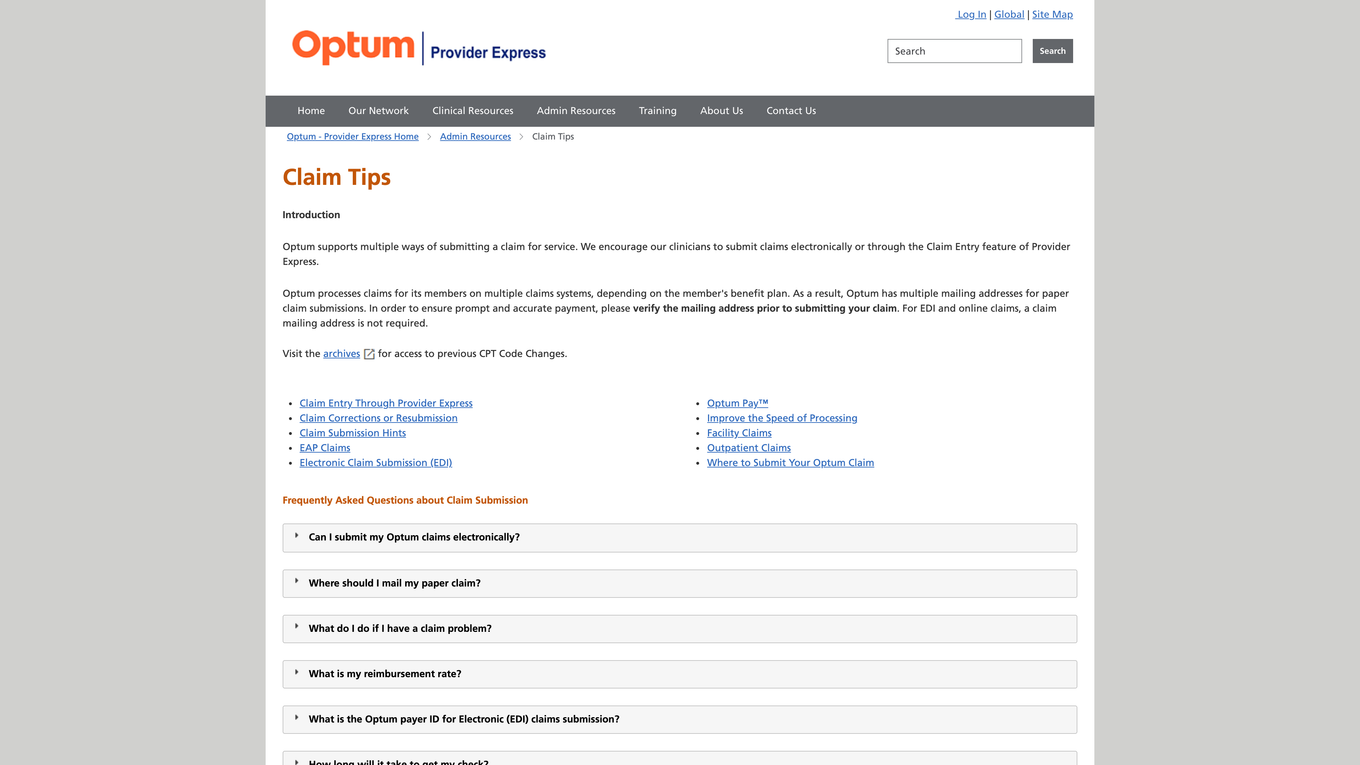
Optum's Claim Tips page: claims run on multiple systems depending on the member's benefit plan, which is exactly why the mailing address has to be verified per product. Captured August 18, 2026.
As for timing: Optum's general claim tips say clean claims are generally paid within four weeks, while the Claim Entry page says generally within 30 days, and both name exceptions including coordination of benefits and state-law modifications. Either way, that is an expectation rather than a commitment.
The claim is formatted and routed. Now - did anyone approve the care?
Which Optum services require prior authorization
Optum's national rule, stated in its own words: plans administered by Optum Behavioral Health require authorization or notification for specialty outpatient services and most inpatient services (prior authorizations and notifications).
What follows safely from that:
- Routine outpatient psychotherapy often does not require prior authorization under Optum-administered plans - but the member's benefits still have to be verified.
- Specialty outpatient services and facility or higher levels of care commonly do require authorization or notification.
- Requirements vary by product, state, code, place of service, diagnosis, provider type and member benefit.
- An authorization is not a guarantee of payment.
- The authorization has to match the actual billing provider, rendering provider or facility, service, code or revenue code, units or days, dates, and level of care. A valid authorization attached to the wrong site or the wrong rendering NPI will not save the claim.
The services worth verifying explicitly every time, because they carry special rules more often than not:
- Psychological and neuropsychological testing
- TMS
- ECT
- Esketamine-related services
- ABA
- IOP, PHP and residential treatment
- Inpatient psychiatric and substance-use care
- Detoxification
- Opioid treatment programs
- Unusually extended or frequent outpatient services
- Unlisted codes
- Out-of-network care
- Single-case agreements and network exceptions
- Professional fees for facility programs
- Telehealth or audio-only under product-specific rules
- Anything subject to a state mandate or contract-specific criterion
You will notice a question we have not answered: does 90837 require prior authorization? There is no safe national yes or no, for that code or any other routine one. What there is: the member's benefit record, which Optum's eligibility function will tell you, and the current product-specific requirement. A blanket answer from any source is a guess wearing a lab coat.
Treat an authorization as a revenue record, not a checkbox
For facility and specialty care, "auth obtained ✓" is not enough structure to protect the money. Log:
Identity and scope
- Member and product
- Authorization or notification type, and the authorization number
- Approved codes and revenue codes
- Approved units, visits, hours or days
- Approved level of care
Dates
- Request, decision, admission, start and end dates
- The next concurrent-review date, and its submission deadline
Who and why
- Rendering provider or facility, with TIN, NPI, taxonomy and location
- Diagnosis and presenting problem
- The determination criteria and version, where identifiable
- Reviewer and reference
Outcome and next action
- Approved, partially approved or denied status
- The adverse-determination reason
- The peer-to-peer or appeal route, and its deadline
- Discharge and step-down requirements
- The claim lines consuming the authorization
How concurrent review actually works
No current primary national Optum source we reviewed supports a universal "review every three to seven days" rule, and you will find that range published confidently in several places. We are not going to repeat it. The actual cadence can be specific to the plan, the level of care, the determination and the authorization itself.
What holds regardless: read the authorization notice for the approved span and the next review date; submit continued-stay material before the stated deadline rather than after it; reconcile authorized days and units against attendance and billed days; treat step-down, leave days, transfers and discharge as authorization events in their own right; keep submission confirmations and reviewer communications; and never infer that an admission notification covers the whole stay.
Gold Card changes the mechanism, not the benefit
Optum administers UnitedHealthcare's national behavioral Gold Card programme, which replaces medical-necessity review with advance notification for selected codes. For the October 1, 2026 cycle, a practice defined by federal TIN must meet every listed criterion: network participation in at least one eligible line of business; at least 10 eligible prior authorizations annually across eligible lines in each of two consecutive 12-month periods; and an approval rate of at least 92% after appeals for eligible codes in each period (Gold Card programme).
The waiver covers selected IOP, PHP and psychological-testing codes. It is granted at TIN level, it is code-specific, state exclusions can apply, all other required authorizations remain in force, and a Gold Card practice still has to confirm eligibility, coverage and network status. It is a change to how those specific services get reviewed, not a change to what the benefit covers.
The dates, as they stand at the time of writing: the review period for waivers effective October 1, 2026 runs April 2, 2024 to March 31, 2026; the status check opens September 1, 2026; status-review requests are due October 1, 2026; and newly earned waivers take effect October 1, 2026. All of those are still ahead of us.
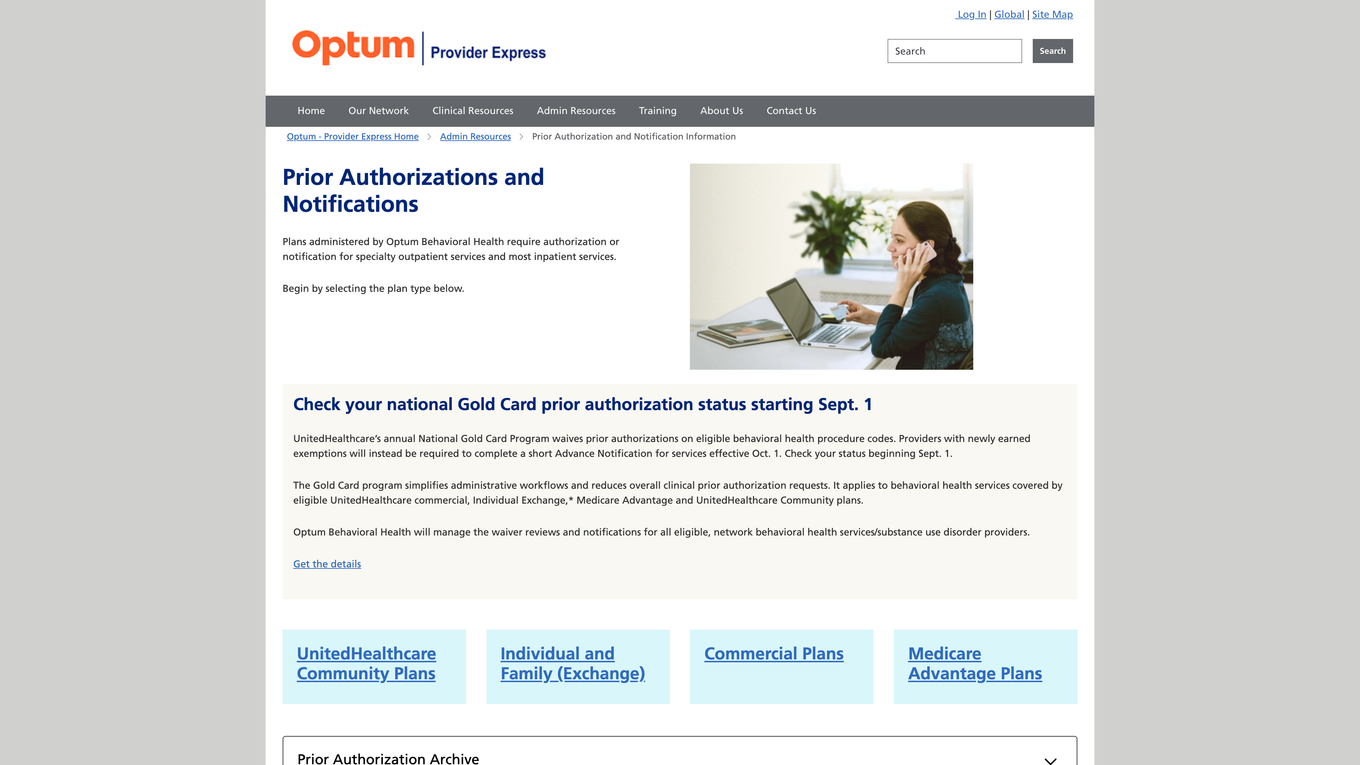
Optum's prior authorization hub, carrying both the national rule and the Gold Card cycle - status checks open September 1, waivers take effect October 1. Captured August 18, 2026.
If medical necessity is going to be reviewed, the obvious next question is: against what standard?
Optum clinical criteria guidelines: ASAM, LOCUS, CALOCUS
Optum states that it uses evidence-based criteria, considers individual circumstances and the local delivery system, and recognises that federal, state and contract requirements may supersede its listed national criteria (clinical criteria and guidelines). The current set:
- ASAM Criteria, Fourth Edition for substance-related disorder determinations
- LOCUS for adults 18 and over
- CALOCUS-CASII for ages 6 to 18
- ECSII for ages 0 to 5
- The APA 2026 psychological and neuropsychological testing billing and coding guide, plus Optum supplemental criteria
- CMS national and local coverage determinations for Medicare behavioral services, including outpatient psychiatric care, inpatient psychiatric hospitalization, PHP, IOP, opioid treatment, testing and TMS
- Optum national behavioral clinical policies, Optum ABA criteria and state mandates, and a substantial body of state and contract-specific criteria
Optum also warns that these are guidelines used to authorize, modify or deny care for similar conditions, and that actual care varies with individual need and covered benefits.
For a clinical review or an appeal, documentation should make the reviewer's decision points easy to locate:
- Diagnosis and differential
- Symptoms, functional impairment and risk
- Current level-of-care needs
- Why a lower level of care is unsafe or inadequate
- Prior treatment and response
- Current interventions and measurable progress
- Barriers, comorbidities and social factors
- Medication status, where relevant
- The discharge and step-down plan
- Treatment goals, with planned frequency and duration
- Testing rationale, and how results will change treatment
- Time, attendance and rendering clinician identity for time-based or unit-based services
- Coordination with other providers
- The relevant ASAM, LOCUS, CALOCUS-CASII or ECSII dimensions
- The exact requested dates, units, codes and level of care
And then the part that is genuinely hard to hear. Criteria do not create coverage. Optum's own criteria page states that references to CPT, HCPCS and other coding methodologies do not imply a right to reimbursement. Meeting medical-necessity criteria does not cure an excluded benefit, an out-of-network restriction, missing state enrollment, an inactive contract, the wrong payer, untimely filing, exhausted authorized units, a non-payable license and code combination, the wrong claim form or place of service, or missing member eligibility. "The care was medically necessary" is true, and compelling, and only one of the conditions for payment.
Worth knowing too that this rulebook moves. Optum's reimbursement-policy index showed roughly two dozen policies updated or reviewed between February and June 2026 alone - add-on codes, ABA, drug testing, ECT, facility-based programme professional fees, diagnosis-code requirements, license level, maximum frequency per day, Medicare IOP and PHP, NCCI edits, new patient visits, non-physician evaluation and management, observation and discharge, opioid treatment programmes, services under supervision, procedure and place of service, testing, esketamine, and all three telehealth policies. A policy your staff saved locally last year may have been replaced or retired.
There is one benefit that sits outside all of this, where the employer pays and the patient owes nothing - and it has its own set of ways to go wrong.
How to bill Optum EAP (Emotional Wellbeing Solutions)
Optum now markets its employee-assistance benefit as Emotional Wellbeing Solutions, which is worth knowing because practices still call it EAP and the two names refer to the same thing (Emotional Wellbeing Solutions).
The shape of the benefit: a brief assessment, referral and counselling intervention delivering a limited number of in-person or virtual sessions with a mental-health or substance-use clinician. The employer covers those visits, and the member has no financial responsibility during them. Network therapists who have completed credentialing and contracting can provide it - no specialised employee-assistance certification is required. Medication management is not part of the benefit.
Authorization is the member's job, obtained either through Optum's member portal or by calling the number on their card, and you can take the details from the member or use the Provider Express authorization lookup. Verify the number of sessions authorized, the start and end dates, the named clinician, whether in-person or virtual is allowed, presenting-issue expectations, remaining sessions, the authorization number, the product's claim route, and whether multiple family members hold separate authorizations.
The coding is unusually narrow. Optum accepts exactly five combinations:
| Service | Claim combination |
|---|---|
| Individual therapy, 30–37 minutes | 90832-HJ |
| Individual therapy, 38–52 minutes | 90834-HJ |
| Family therapy without the patient present | 90846-HJ |
| Family therapy with the patient present | 90847-HJ |
| Group therapy, non-family | 90853-HJ |
Modifier HJ is required. Under the current page, virtual sessions delivered by phone or video also require GT - and we are date-stamping that statement deliberately, because telehealth modifier policy changes and can conflict with other product-specific telehealth rules. Use a confirmed ICD-10 diagnosis rather than a nonspecific symptom code. Allowable codes reimburse at the provider's routine outpatient rate.
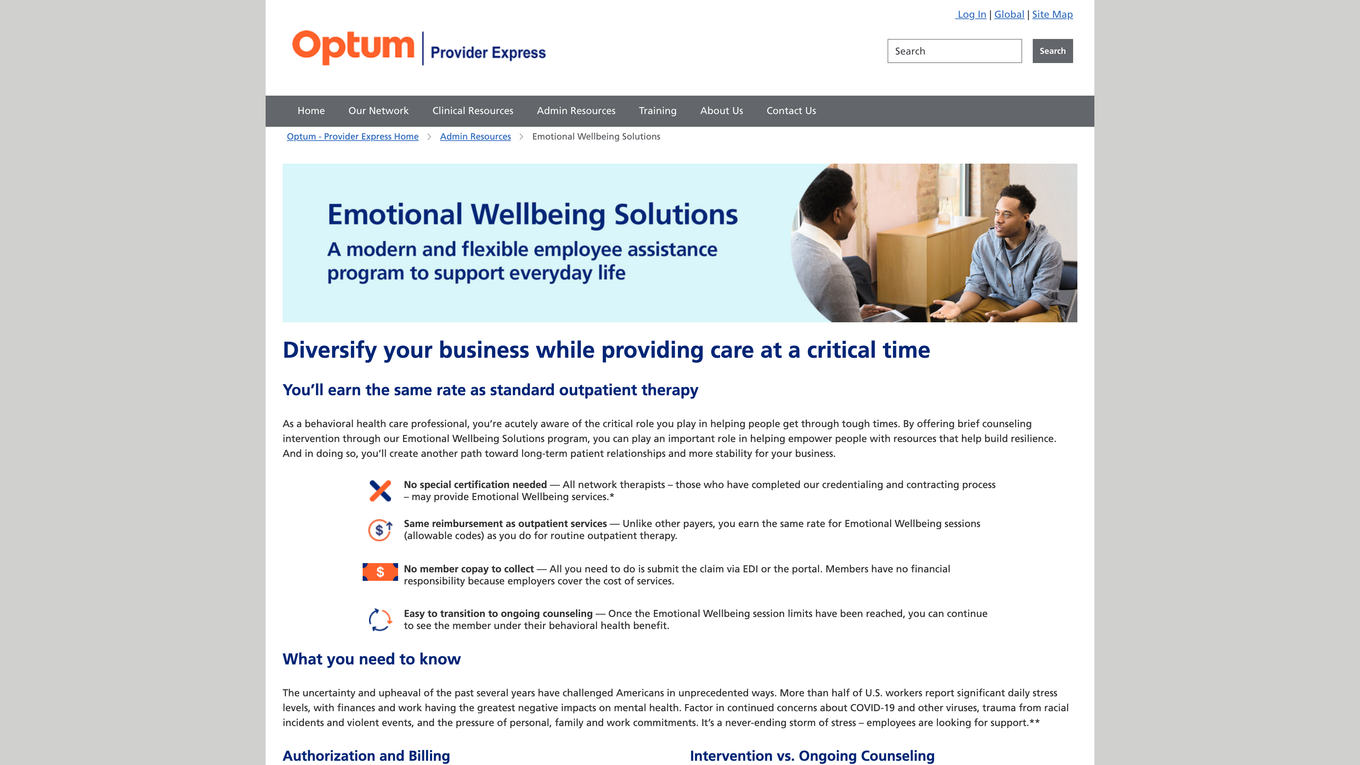
Optum's Emotional Wellbeing Solutions page: no special certification, the same rate as routine outpatient therapy, no member copay, and a documented path into ongoing care once session limits are reached. Captured August 18, 2026.
The transition out is a new billing event, not a continuation
This is where practices quietly manufacture patient-balance surprises. When the authorized sessions end and the patient keeps coming, nothing carries over automatically. Confirm the sessions are exhausted or ending; identify who administers the ongoing behavioral benefit; verify that you participate for that benefit and product; verify ongoing outpatient benefits and cost-sharing; check authorization; stop using HJ unless the visit is still an authorized employee-assistance session; tell the patient their financial responsibility has changed before the visit; route claims to the correct adjudicator; and keep the employee-assistance authorization and the new verification as separate records.
Optum is explicit that the ongoing benefit may include copay, deductible or coinsurance, and may or may not be associated with Optum. There is also no universal session count to rely on - the member's authorization controls how many visits exist.
All of that is prevention. It does nothing for the claims already missing.
Where a missing claim actually broke: 999, 277CA, 835
"The clearinghouse said it went through" is not one fact. It is six or seven different facts, and most of them are not about your payer at all. Sorting them is the difference between fixing a claim and resubmitting it into the same hole.
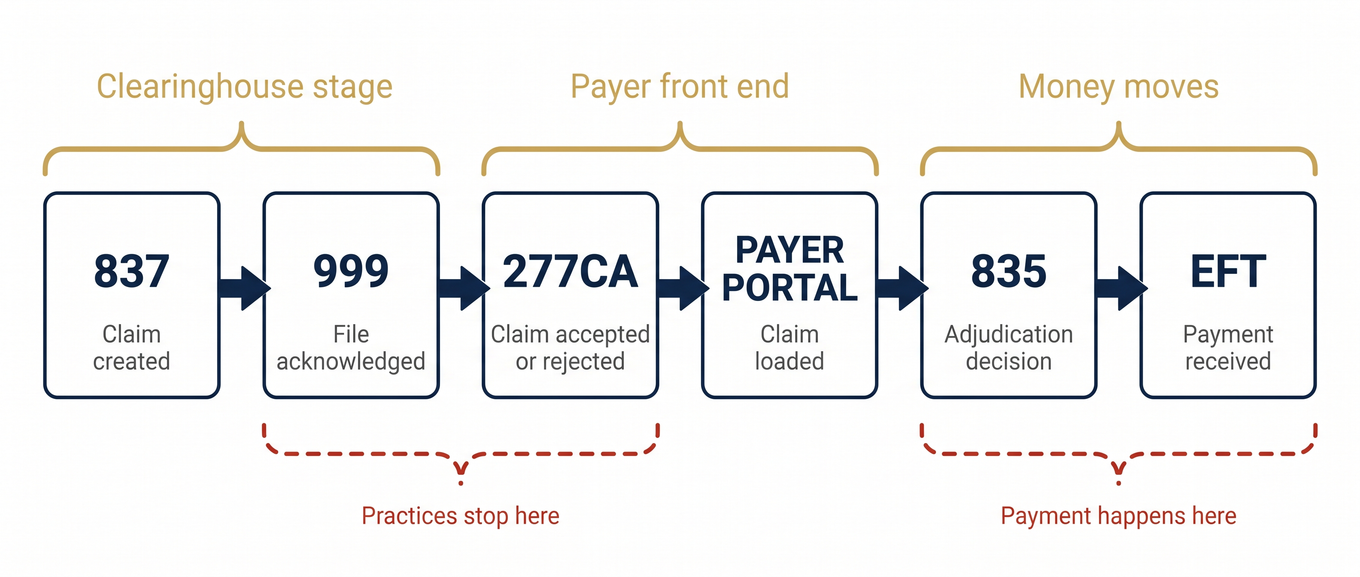
837 → 999 → 277CA → payer portal → 835 → EFT
| Evidence | What it proves | What it does not prove |
|---|---|---|
| Your practice-system batch report | You generated and exported a claim | That the clearinghouse or payer received it |
| Clearinghouse intake report | The clearinghouse received your file | That it routed to the right payer, or that the payer accepted it |
| 999 acknowledgment | The transaction file was syntactically accepted or rejected as a batch | Anything about individual claims |
| 277CA claim acknowledgment | Individual claims or service lines were accepted or rejected at the payer's front end | That any benefit will be paid |
| Payer portal claim record | The payer loaded a claim under a particular record | Final payment |
| 835 ERA or paper remittance | How the payer adjudicated it - adjustments, responsibility, messages | That money actually moved |
| EFT or bank deposit | Money moved | Why any individual claim paid or denied |
In plain terms: the 999 says your envelope was readable. The 277CA says the payer looked at the claim inside it and accepted or rejected it. The 835 says the payer decided. The deposit says you got paid. Practices routinely treat rung two as though it were rung six (CMS on electronic claims, CMS on payment and remittance advice).
Optum publishes its own list of reasons a claim may not appear where you expect: processing delay, searching under the wrong billing or rendering record, out-of-network processing, multiple eligibility records or products, or routing under a different record than expected. It says most submitted claims should show status roughly 48 hours after loading, and that Claim Entry submissions are usually visible in claim inquiry within two to three business days - and recommends printing the confirmation page.
Fifteen questions for a claim that isn't there
Work them in order rather than guessing:
- Was an 837 actually created?
- Which payer ID did you send it to?
- Did the clearinghouse accept the file?
- Is there a 999?
- Is there a 277CA for this specific claim?
- Was it accepted or rejected at claim level?
- Does the payer portal show it?
- Are your staff searching under the same billing and rendering record the claim carried?
- Is the provider loaded as network for this member's product?
- Does the member have more than one eligibility record?
- Did the medical plan forward it, reject it, or tell you to submit to the behavioral plan?
- Was a remittance delivered under a different payer or ERA enrollment?
- Was it sent as professional when it needed to be institutional?
- Did the NPI or taxonomy fail registry validation?
- Is the claim outside the portal's searchable or eligible window?
Do not resubmit until you know what happened
Optum's May 2026 provider outreach notes that its claim analysts are monitoring patterns involving timely filing, duplicate and corrected denials, member eligibility, incorrect coding, and missing or invalid primary explanations of benefits (proactive claims outreach).
Before you send anything again, establish which of these is true: the payer never received it; it was rejected before adjudication; it was accepted and is processing; it was adjudicated; it was forwarded; a corrected or replacement claim is required; reconsideration is required; or an appeal is required. Each one has a different remedy, and sending another original claim into an unclear situation creates duplicate denials and buries the timely-filing evidence you may need later.
Some of those claims did come back, with a code attached. A few of those codes are telling you something very specific.
The denial codes that mean "wrong payer": CARC 300 and 301
The X12 code set has signals built specifically for behavioral carve-outs. These are standard code descriptions rather than Optum-specific ones (claim adjustment reason codes, claim status codes):
| Code | What it is telling you | Immediate action |
|---|---|---|
| CARC 300 | The medical plan received the claim, the benefit is not available there, and the claim was forwarded to the behavioral plan | Find out where it went, get a trace or status, and do not assume it loaded correctly |
| CARC 301 | The medical plan received it, the benefit is not available, and you must submit it to the behavioral plan | Verify administrator, payer ID, portal and deadline, then submit to the correct adjudicator |
| Claim status 792 | Submit these services to the patient's behavioral-health plan | Treat as a routing failure, not a coding failure |
| CARC 302 | The authorization, notification or precertification time limit expired | Review the authorization history, the notice, your late-authorization and appeal rights, and the clinical record |
That third row carries the most important reframe in this section. A carve-out denial is a routing failure. Recoding it will not fix it, adding a modifier will not fix it, and appealing it clinically will not fix it - the claim is in the wrong company's system and it needs to be in a different one.
Other categories show up in the same investigation, and it helps to recognise them by family rather than memorising codes:
| Category | Example codes | What to investigate |
|---|---|---|
| Wrong payer / not this contract | 109, 301, status 792 | The actual adjudicator, the product, your contract |
| Authorization absent, invalid or expired | 197, 284, 296, 302 | Whether the authorization matches provider, service, dates, code and units |
| Timely filing | 29, and B4 in certain uses | The correct deadline, the accepted receipt date, wrong-payer proof, appeal rights |
| Duplicate or replacement problem | 18, status 787 and 799 | Whether the original was received or adjudicated; original versus replacement transaction |
| Coordination of benefits | 22, plus payer-specific remark codes | Primary payer, member COB update, the primary explanation of benefits |
| Patient or provider not identified or not eligible | 31, B7, 299 | Member ID, NPI, taxonomy, group loading, license, product |
| Appeal-process defect | 285, 286 | The correct appeal type, destination and deadline |
| Coding, place of service or programme edit | 272, 273, 282, 306 | The applicable policy, type of bill, place of service, frequency, benefit |
Never read a code alone. The group code, the remark code, the claim status, the payer's own message text, the member's product and the claim history together determine what to do - and a remark code supplements a reason code or carries an informational alert rather than standing on its own (remittance advice remark codes). Read the whole remittance: claim and line status, the group code (CO, PR, OA, PI), reason and remark codes, the payer message, allowed, paid, adjustment and patient-responsibility amounts, provider-level adjustments, received and adjudication dates, the payer's claim control number, and any forwarding or crossover information. Because these lists drift, work from the maintained X12 code lists rather than a table someone copied years ago.
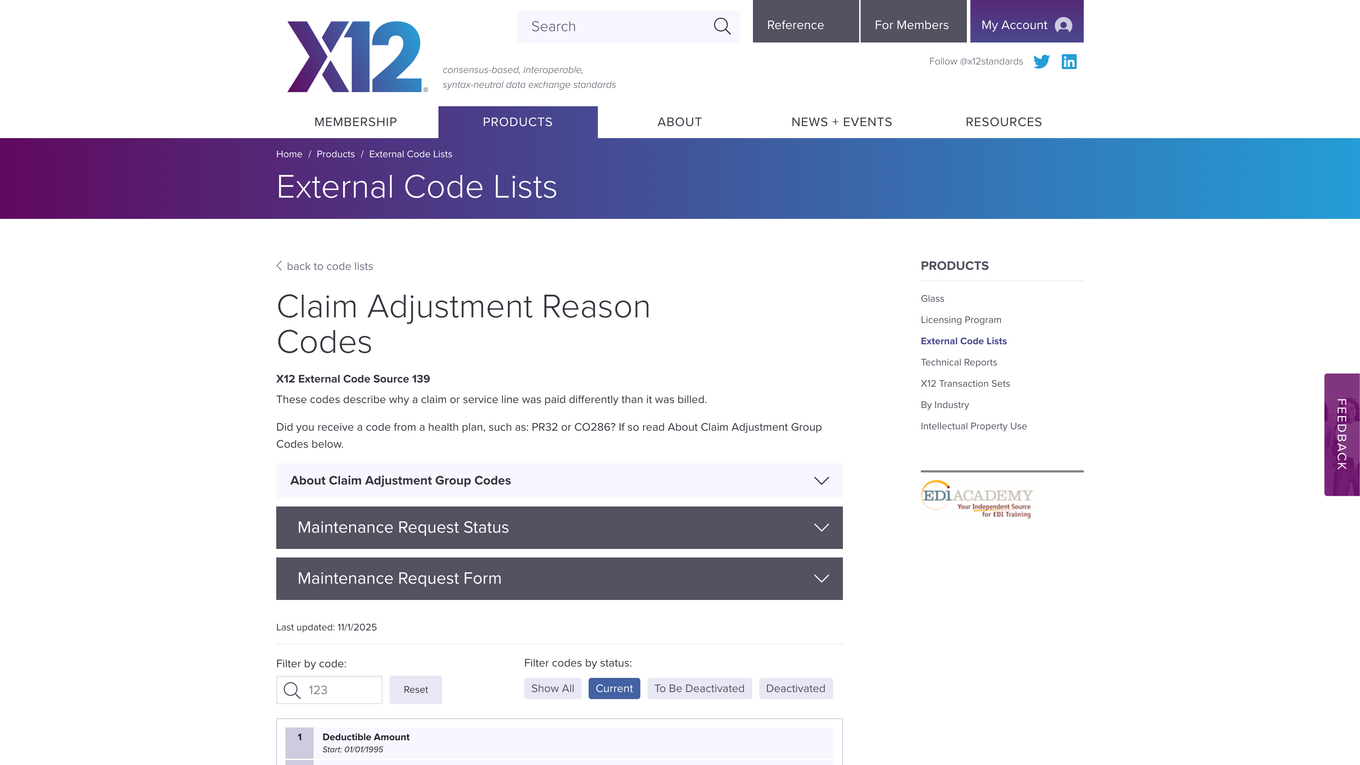
The X12 claim adjustment reason code list - the maintained source, carrying its own last-updated stamp. Work from this rather than a table copied years ago. Captured August 18, 2026.
One line deserves its own paragraph, because the instinct it corrects is both a revenue error and a compliance exposure: a routing denial should not automatically become a patient balance. The claim went to the wrong company. That is not the patient's doing and it may not be the patient's liability. What the patient actually owes depends on the contract, the benefit, notice requirements, the group code on the remittance and applicable law - not on the fact that a claim came back unpaid.
So you have identified it as a routing failure. Here is how the recovery actually runs.
What to do after billing the wrong payer
Stop repeating the route. Put the affected claims in a routing hold before anything else. Specifically, stop your system from automatically resubmitting to the same payer ID and from converting the balances to patient responsibility. Automation will happily industrialise this mistake while you work on it.
Build the evidence timeline, per date of service. Card front and back; the original verification and its call reference; the eligibility response; the claim image or data; the clearinghouse submission report; the 999; the 277CA; the medical plan's explanation of benefits or 835; the reason, remark and status codes; portal screenshots; claim control and trace numbers; the authorization; contract and effective-date evidence; any payer forwarding notice; the date you discovered the error; and every subsequent call, message and resubmission.
Identify the actual adjudicator. Make the plan distinguish, out loud, between the medical plan, the behavioral administrator, the access network, the claim adjudicator, the payer ID, the portal, the paper address, the original and corrected claim rules, the filing rule, and the appeal destination. For a NYCE member, that conversation leads away from 87726 and Provider Express and towards 26992 and the NYCE portal.
Determine each claim's procedural status, because the remedy is different for each. Rejected before adjudication: correct the data or route and submit it as the correct payer's first claim. Adjudicated by the wrong payer: use that remittance as evidence and submit to the correct payer. Forwarded: get the receiving payer and a trace, and verify it actually loaded. Accepted by the correct payer but denied: corrected claim, reconsideration or appeal depending on the reason. Never transmitted: fix the internal or clearinghouse failure. One trap here - do not mark your first claim to the correct payer as a replacement merely because a different payer saw it earlier, unless that payer's instructions require it.
Submit immediately. If the correct route is verified and a deadline is running, do not wait for every phone call to conclude. Send the clean claim and open the filing-limit review in parallel where that is allowed.
Appeal late filing with proof rather than narrative. A packet that works contains:
- A concise chronology
- Member and card evidence
- The verification reference
- Proof of the original submission within a reasonable period
- The wrong-payer rejection or forwarding remittance
- The 999 and 277CA
- The corrected claim
- An explanation of why you reasonably used the first route
- Any product transition notice
- The precise contract or state exception you are relying on
- A request for good-cause or administrative review
Assemble it as a chronology with the evidence indexed to it, and keep the clinical and administrative arguments in separate sections so neither buries the other. One caution on tone: do not assert that the payer is legally required to grant the request unless counsel or a specific cited plan or state rule supports that.
What the 90-day rule does and does not do
Optum's national guidance is that all information necessary to process a claim must be received no later than 90 calendar days from the date of service, and that corrections or additions should be made within 90 days of Optum's receipt of the initial claim (timely and accurate claim payment).
Those are two separate time frames, and conflating them is how a fixable claim dies. The first governs getting the claim in. The second governs fixing it once it is in. A practice that believes it has 90 days total will miss the correction window on a claim it filed on day 80.
And that national default is not proof of any of the following: that a network-rental plan uses the same deadline; that a state Medicaid contract does; that your own provider agreement does not impose something different; that a state prompt-payment or continuity-of-care rule does not supersede it; that the correct payer must accept a claim that first went elsewhere; or that the wrong payer's receipt date preserves timely filing at the correct payer.
That last one is the question every practice in this situation asks, so let us answer it as plainly as we can: no current national Optum source we reviewed establishes a blanket exception that forces the correct payer to honour the wrong payer's receipt date. You can submit proof, you can request review, and outcomes do go the provider's way - but the result may turn on the contract, the product, state law, notice, a delegation transition, payer error, the member's circumstances and appeal discretion. Anyone who promises you the recovery is guessing with your money. Preserve the proof, route the claim immediately, appeal with the full history, and treat the recovery as likely-in-part rather than owed.
Two structural features make this error costlier in behavioral health than in most specialties. The first is a slow feedback loop: an outpatient practice may deliver several sessions before the first remittance reveals anything is wrong, and a facility can accumulate days at a high level of care while the authorization sits with the wrong entity entirely - so by the time the error surfaces, the exposure is a course of treatment rather than a single visit. The second is that the deadlines are stacked. A concurrent-review window can expire before the first claim is even submitted, which means one routing error can cost you both the claim and the authorization standing behind it.
You now have a claim to re-file or a decision to challenge. Those are not the same job.
Reconsideration, appeal, or peer-to-peer: picking the lane
Most wasted effort in denial work comes from putting a problem in the wrong lane. A corrected claim cannot repair a medical-necessity decision. A clinical appeal cannot repair a malformed 837. A peer-to-peer conversation is not a substitute for routing the claim to the correct adjudicator.
| The problem | The lane | What you send |
|---|---|---|
| Data or coding defect - wrong NPI or taxonomy, missing modifier, form error | Corrected or replacement claim, per the payer's instructions | Corrected data, with the original claim control number where required |
| Payer processed the claim contrary to benefits or contract, or misapplied a network or payment rule | Claim reconsideration or administrative dispute | Benefit, contract, claim and remittance evidence |
| Adverse medical-necessity decision | Clinical appeal; peer-to-peer where offered | Clinical record, criteria argument, treatment plan |
| Front-end rejection | Correct and resubmit | The 999 or 277CA, and a corrected 837 |
| Wrong payer | New submission to the correct payer, plus a filing-limit review if needed | Routing evidence |
| Authorization missing or mismatched | Corrected claim only where a valid authorization existed and a data mismatch caused the denial; otherwise clinical or administrative review | The authorization record and a claim crosswalk |
| Urgent ongoing-care decision | The expedited or urgent process named in the determination notice | Evidence of urgency and of clinical harm from delay |
Underneath those lanes sit five distinct kinds of "no," and naming which one you received tells you where to go: a prospective adverse determination (the requested care is not authorized, or authorized at a different level or duration); a retrospective clinical denial (delivered care failed medical-necessity review); an administrative claim denial (the claim lacks or mismatches an authorization, is late, routed incorrectly, or has data defects); a benefit exclusion (the service is outside the member's covered benefit); and a network denial (a provider, site or product participation mismatch).
On deadlines, we are going to disappoint you in a useful way. Provider Express supplies an Optum behavioral reconsideration request form and a reconsideration and appeal quick-reference guide, and appeals go to the care advocate centre that issued the adverse determination. But the exact deadline, destination and review level differ by product, state, determination type, provider contract and member plan. You will find a tidy universal ladder published in several places, and no primary product documentation supports one. Surest settles the argument by itself: reconsiderations go through the UnitedHealthcare portal or to its claims unit, while clinical appeals go to an entirely different address with separate urgent and non-urgent fax numbers. Same corporate family, different lanes, different destinations.
Peer-to-peer is similar. No current primary source establishes a single Optum-wide deadline or telephone route, so take availability and timing from the adverse-determination notice or the product's provider service line. Before the call:
- Establish whether it is an informal discussion, a formal reconsideration or an appeal step
- Confirm who may participate, and whether the treating clinician must be the one to call
- Obtain the criteria and version used
- Identify the disputed dates, level, codes and units
- Prepare a one-page clinical chronology
- Address each criterion with citations to the record
- Explain why a lower level of care is inadequate
- Have discharge and step-down planning ready
- Ask whether additional records can be submitted
- Document the reviewer, time, result and next deadline
- File the written appeal even if the conversation goes badly, as long as rights remain
Every honest answer in this article has ended with "it depends on the product." That is not evasion. Here is the map of what actually changes.
What changes by product: Medicaid, Medicare Advantage, Exchange
| Product pattern | What can be said safely | Portal and claim route | Authorization source | The practice-level risk |
|---|---|---|---|---|
| Commercial, Optum-administered | 87726 is the default EDI payer ID; 90-day national filing guidance; 2026 NPI and taxonomy requirement announced | Provider Express Claim Entry for supported outpatient and EAP; EDI for professional or facility | Commercial authorization resources plus the member's benefit | Assuming a UHC medical contract establishes Optum behavioral participation; missing rendering NPI or taxonomy |
| Network rental / access arrangement | Your Optum contract may make you "in network" while another plan administers benefits and adjudicates claims | The product's portal and payer ID - not necessarily Provider Express or 87726 | The product's rules | The phrase "Optum network" producing false confidence |
| NYCE PPO | Effective Jan 1 2026 members use the Optum behavioral network, but Optum does not manage the benefits | NYCE portal; payer ID 26992; claims sent to Optum deny | NYCE portal | Continuing to use Provider Express and 87726 after the transition |
| Surest | Uses UHC and Optum networks; participating UHC commercial professionals automatically participate | UnitedHealthcare portal; payer ID 25463; paper to Eagan, MN | UHC administrative requirements; Surest Flex activation for listed plannable services at least three business days ahead | Treating activation, authorization, eligibility and claim route as standard Optum |
| Individual & Family Exchange | Optum provides behavioral network resources for these products; requirements are state and product-specific | Verify the current card, the product resource and the payer route | The state-specific Exchange authorization list | Publishing or relying on a national code list; missing out-of-area and out-of-network rules |
| Medicare Advantage | Optum maintains a separate MA authorization section; Medicare coverage determinations can control medical necessity | Verify the MA product, portal, network and product enrollment | The MA list plus Medicare coverage criteria and plan rules | Assuming commercial participation or commercial criteria apply |
| D-SNP | Optum states the Medicare authorization list covers the Medicare side only | The product and state route | Both Medicare and Medicaid requirements may apply | Checking only one side of a dual benefit |
| Medicaid / Community Plan | State enrollment, manuals, codes, payer IDs and authorization lists vary; in some states Optum does not manage the Medicaid benefit | The state and product route | The state and product list, plus state rules | Nationalising one state's rules, or working from an outdated file |
| Employee assistance / EWS | Limited authorized sessions, no member cost-sharing during them, five allowable code-and-HJ combinations | Provider Express or EDI where Optum EWS applies; the card controls the address | Member-obtained authorization | Billing without the authorization or HJ; charging the patient; failing to re-verify when sessions end |

Surest's provider page: participating UnitedHealthcare commercial professionals participate automatically, members reach the Optum behavioral network, and Surest Flex needs activation three business days ahead. Captured August 18, 2026.
Four of those rows deserve a sentence of their own.
Network rental is the most important exception category in this entire article, because it is the one where everything you can see looks correct. You are in the Optum network. The member is using the Optum network. And the claim still does not go to Optum.
D-SNP members carry two benefits, and Optum says plainly that its Medicare authorization list is not inclusive of Medicaid services and that providers should also check the coordinating state Medicaid list. Checking one side of a dual benefit is a specific, common and expensive error.
Medicaid has no single "Optum Medicaid" rule to learn. Optum's authorization index links dated files by state and product, and some files on that current page are years older than others - so "I checked the index" is not the same as "I checked a current file." Optum also states that it does not manage Medicaid benefits in several named states, where requirements must be confirmed with the relevant managed-care organization instead (Medicaid prior authorization codes by state).
Exchange products work the same way, state by state (Individual and Family plan authorization lists, UnitedHealthcare Exchange plans). An archived Washington list shows just how granular one state file gets - inpatient mental-health and substance-use revenue codes, IOP and PHP, residential treatment, psychological testing, TMS, unlisted psychiatric codes and ABA all appearing in a single document (archived 2024 Washington Exchange list). That file is historical and is here only to show the shape of these documents; use the current one linked from Provider Express. A code appearing on one state's list establishes nothing about another state.
And one reading habit that will save you at least once a year. A UnitedHealthcare notice about New Mexico Medicaid state enrollment carried one date in its article body while its update moved the actual requirement to October 1, 2026 (New Mexico Medicaid enrollment notice). Anyone who read only the body would have published - or worked to - a superseded date. Read the update banner and the modified date, not the first date you find in the text.
The fix is one row per product
Not one row per company. Build a payer-routing matrix with a row for every product you touch: NYCE PPO separately, Surest separately, each Medicaid product, each Exchange state, each Medicare Advantage product, employee assistance. For each row, record:
- Display name, and the card clues that identify it
- Line of business
- Behavioral administrator, network, and adjudicator
- Professional and facility payer IDs, and the ERA payer ID
- Portal, and paper address
- Original and corrected filing limits
- Authorization source
- Telehealth policy
- Contract effective date
And then four fields most practices skip: last verified, source, owner, and next review.
Those last four are what turn a document into a control. Without them you have a snapshot that quietly goes stale.
Which raises a fair question, if you have read this far: should your practice be doing all of this?
When to keep Optum billing in-house, and when not to
For a lot of practices the answer is yes, and that is the right answer rather than a grudging one. A small outpatient practice - often a single provider - can run this workflow well itself when it has:
- Low claim volume
- A small number of states and products
- Routine outpatient services
- A stable TIN, NPI and location
- No facility levels of care
- A disciplined verification script
- A current product matrix
- A reliable submission workflow
- Staff time genuinely protected for weekly claim-status work
- Authorization and filing-limit controls
- A monthly denial review that looks at root cause rather than just totals
If that describes you, the answer is a better process, not a vendor.
The calculus changes when the work stops being claim entry. It becomes materially harder when a practice has:
- Multiple states, or multiple UnitedHealthcare and Optum products
- Multiple TINs, locations or rendering clinicians
- Group or facility credentialing in progress
- Medicare Advantage, D-SNP or Medicaid business
- Exchange business
- Any of IOP, PHP, residential, inpatient, opioid treatment, ABA, testing or TMS
- Concurrent review obligations
- Recurring out-of-network or provider-not-eligible denials
- Aged accounts receivable approaching filing limits
- A mix of employee-assistance and ongoing behavioral benefits
- Clearinghouse or remittance-enrollment mismatches
- A real volume of missing claims
- Nobody who owns payer follow-up
- No denial data broken out by root cause
That is the honest line, and it is not really about size. It is about how many product-specific routing decisions your practice has to get right every week, and whether anyone owns them.
That picture usually changes for one of four reasons: the practice is growing - new clinicians, new locations, a new state; the payer or service mix has genuinely got more complex; nobody has the time the billing side actually needs; or collections have slipped and nobody can say precisely why. None of those is about size. We work with practices of every size, from a single clinician to a multi-state group, and we take on a single piece of the cycle as readily as the whole of it. The question is never whether a practice is big enough to be worth helping - it is which part of the cycle needs owning.
Which is the actual work, and it is worth being precise about what it is. A specialist billing team does not simply send Optum claims. It maintains the member-, product-, provider- and date-specific routing evidence that keeps a claim out of the wrong system in the first place, and then follows that claim through acknowledgment, adjudication, denial and appeal. In our own behavioral-health work that means the payer matrix and the verification discipline sitting upstream of submission, credentialing and enrollment tracking so that "loaded" is verified rather than assumed, authorization and concurrent-review tracking for higher levels of care, transaction-level tracing when a claim goes missing, denial categorisation that separates routing failures from clinical ones, and root-cause reporting by payer, product, code, location and provider so the same denial stops recurring.
Equally worth being precise about what no billing team can do, ours included. We cannot make an excluded service covered. We cannot guarantee retroactive authorization. We cannot force acceptance of an untimely claim without a controlling exception. We cannot manufacture clinical necessity or replace clinician documentation. We cannot create a contract effective date the payer did not grant. We cannot guarantee reimbursement or appeal success. We cannot promise one payer ID works for every plan. And none of this is a substitute for legal advice on patient billing, parity, state appeal rights or contract disputes. Any vendor who tells you otherwise is selling you something that does not exist.
The expensive mistake is not the payer ID
It is treating the card as the answer to a question the card cannot answer.
87726 is a good default and it will be right more often than it is wrong. But the practices that lose money on Optum behavioral claims are almost never the ones that memorised the wrong number. They are the ones that never established, before the first appointment, who administers the benefit, who adjudicates the claim, and whether their own TIN and NPI are loaded for that member's specific product. The payer ID is the last thing you learn in that sequence, not the first.
Here is something concrete to do tomorrow. Take your ten highest-dollar accounts with a UnitedHealthcare-branded card and a behavioral service, and for each one write down five things: the behavioral administrator, the claim adjudicator, the payer ID, the portal, and the filing deadline. The rows you cannot fill in are your current exposure, and they are ranked by dollar value already.
Our take, after doing this work across behavioral practices: the routing question is almost always cheaper to answer before the visit than after the denial, and the practices that stay ahead of it are not the ones with the biggest billing teams. They are the ones that treat the payer matrix as a living control with a named owner and a review date, rather than a document somebody made once. If you are staring at a batch of missing claims right now and the filing dates are getting close, the order of operations is: hold the route, build the evidence, confirm the adjudicator, submit clean, then appeal with the history. In that order. And if you would like a second set of eyes on where a specific batch actually broke, that is a conversation worth having sooner than later - filing deadlines do not pause while you investigate.
Common questions about Optum behavioral billing
Is Optum Behavioral Health the same as UnitedHealthcare?
They are part of the same corporate group, and Optum - historically and contractually also seen as United Behavioral Health - frequently administers UnitedHealthcare behavioral benefits. But the roles and the transaction route vary by product. A plan can also use Optum's provider network without Optum administering benefits or adjudicating claims.
What is the Optum Behavioral Health payer ID?
Provider Express publishes 87726 as the standard Optum payer ID for electronic behavioral-health and employee-assistance claims, with 86047 for electronic remittance advice. It is not universal: NYCE PPO uses 26992, Surest uses 25463, and Medicaid products can carry state-specific IDs. Verify the payer ID for the member's exact product rather than inferring it from the network name.
Do I bill UnitedHealthcare or Optum for therapy?
Bill whichever entity adjudicates the behavioral benefit for that member and product, using the payer ID and portal you verified for that date of service. The logo on the front of the card does not settle it, and a UnitedHealthcare medical contract does not settle it either.
Can I submit Optum claims through Provider Express?
Yes for supported outpatient behavioral and employee-assistance claims on a CMS-1500. Provider Express Claim Entry does not accept facility-based residential, inpatient, PHP or IOP claims - those go through EDI as an 837I, on a UB-04 with contracted revenue codes if submitted on paper. It also excludes members whose coverage expired more than 90 days ago.
What is Optum's timely filing limit?
Optum's national guidance is 90 calendar days from the date of service for all information needed to process the claim, and 90 days from Optum's receipt of the initial claim for corrections or additions. Those are two separate time frames. Your contract, the member's product, state rules or a different adjudicator may impose something different, so confirm the deadline that actually controls your claim.
Does 90837 require prior authorization from Optum?
There is no safe national yes or no. Routine outpatient psychotherapy often does not require prior authorization under Optum-administered plans, but the requirement varies by product, state, place of service, provider type and member benefit - and routine does not mean unlimited. Check the member's benefit record and the current product requirement rather than relying on a blanket answer.
How do I bill Optum EAP?
Confirm the member's Emotional Wellbeing Solutions authorization, then bill one of five allowable combinations - 90832-HJ, 90834-HJ, 90846-HJ, 90847-HJ or 90853-HJ - with modifier HJ required and, under the current page, GT added for virtual sessions. The member has no cost-sharing for authorized sessions, and medication management is not part of the benefit.
Why is my Optum claim not showing in Provider Express?
Optum lists several causes: processing delay, searching under the wrong billing or rendering record, out-of-network processing, multiple member eligibility records, or the claim routing under a different product than expected. Before working through those, confirm the claim was actually sent to an Optum-adjudicated product - if the member's plan only rents the Optum network, the claim was never going to appear there.
Am I in network for UHC behavioral health if I have a UHC medical contract?
Not necessarily. UnitedHealthcare routes behavioral-health credentialing and contracting through Optum Behavioral Health Solutions, so behavioral participation is a separate agreement. Confirm that your billing TIN, billing and rendering NPI, taxonomy, location and license are loaded for the specific product on the claim - credentialing approval is not the same as being loaded for adjudication.
What we verified, and when
Everything above was checked against primary Optum, UnitedHealthcare, X12 and CMS sources on August 17, 2026. Four things were unresolved at that date, and we would rather say so than fill the gaps with confident guesses:
- The 2026 commercial NPI and taxonomy enforcement date. Announced for 2026, with a final date promised for the first quarter of 2026. The notice still showed no final enforcement date on the day we checked.
- The operative national network manual. Optum's index listed a manual effective September 1, 2026 and the April 1, 2026 version as previous. On August 17 the September manual was still future, which makes the April version the operative dated manual unless a contract notice says otherwise (network manuals).
- Gold Card status for the October 2026 cycle. The status check opened September 1 and waivers took effect October 1 - both after our verification date, so treat those as forthcoming rather than current.
- Reimbursement policy currency. Roughly two dozen policies were updated or reviewed between February and June 2026. Consult the current policy index rather than treating any code example here as evergreen.
Payer routing changes at date boundaries, and that is exactly when old payer tables cause damage - NYCE PPO's behavioral network moved to Optum access on January 1, 2026 while the administrative route stayed with NYCE, which is precisely the kind of change that makes a payer table written in December wrong in January.
This article is operational guidance for revenue-cycle staff, not plan-specific legal, clinical, coding or reimbursement advice. Every national default described here is subject to contract, product, state and member-benefit exceptions. For a specific member, a specific claim or a specific date of service, verify against the current primary source and the member's own benefit record.