CPT 90834 vs 90837: 52/53-Minute Rule, Pay & Audit Risk
August 19, 2026 · 35 min read
The session ran long. Not dramatically - it ended somewhere around the fifty-minute mark, close enough to the boundary that you had to think about it. Now the EHR is offering you two codes, and somewhere in the back of your mind is the thing a supervisor or a consultant or a forum thread told you: be careful with the longer one, it gets you audited.
Here is the actual line.
CPT 90834 covers 38 to 52 minutes of individual psychotherapy. CPT 90837 begins at 53 minutes.
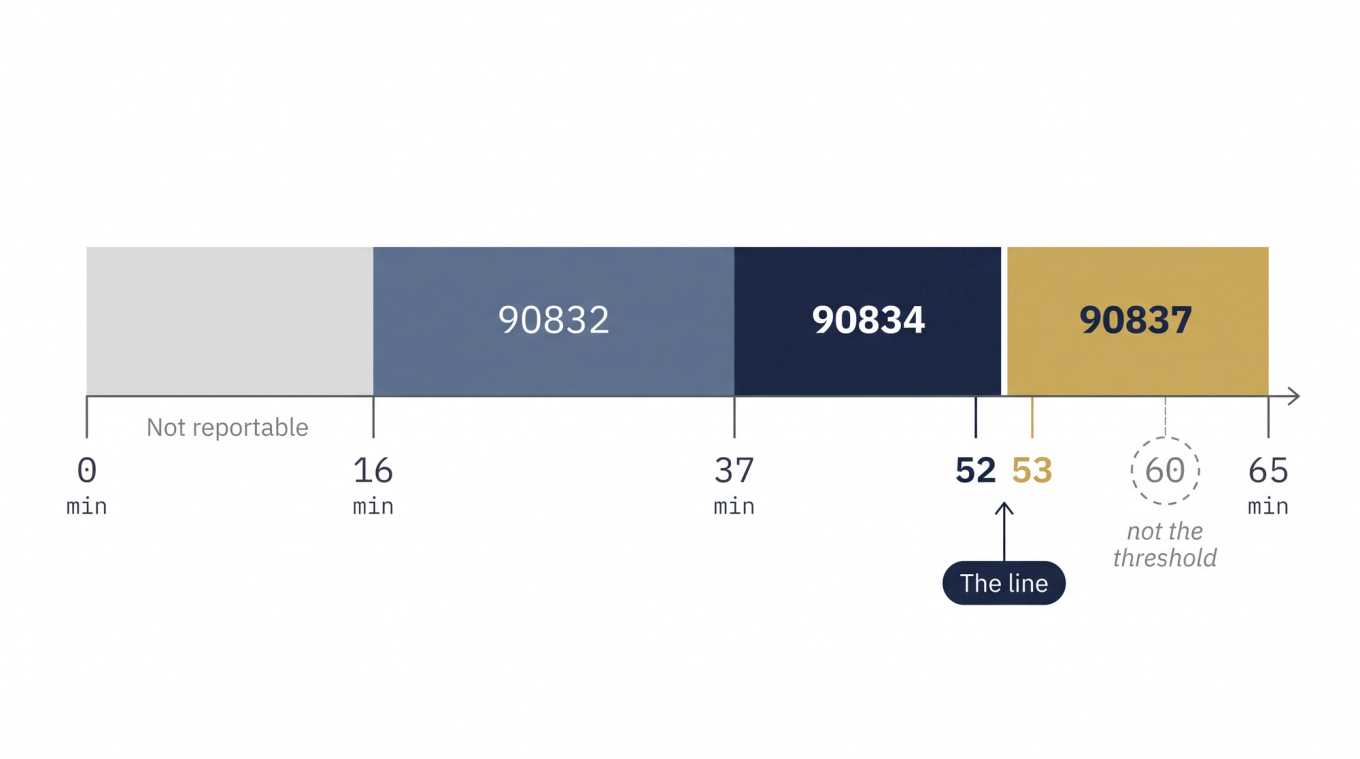
Fifty-two does not round up. Fifty-three does not have to reach sixty. Below sixteen minutes, none of these codes apply at all.
That is the whole coding answer, and it is simpler than the anxiety around it. What makes the decision feel harder than it is are two things that get tangled together and shouldn't be: which code describes the service is a question about the clock, and whether the service holds up is a question about the record. The clock selects the code. The record defends it. Whether the payer covers it is a third question again, with its own answer.
We bill behavioral and mental health claims for a living, which means we spend a fair amount of time undoing what practices have been told about this specific decision. So the most useful thing we can do on this page is separate the sourced rules from the folklore - including the folklore that pays us more. By the end you will know exactly where the line falls, what time actually counts toward it, what has to be in the note for either answer to hold, what a payer review genuinely looks like when it happens, and what the 2026 difference is worth. You will also know which of the numbers circulating on this exact search - the audit percentages, the "safe" code-mix ratios, the commercial rate tables - nobody can trace to a source. That last part is most of the fear.
The line falls at 53 minutes, not at 60
Medicare's contractor guidance sets the psychotherapy time bands explicitly, and it instructs clinicians to report the code closest to the actual time. There is no interpretation involved:
| Documented psychotherapy time | Standalone code | With a separately identifiable E/M service |
|---|---|---|
| Under 16 minutes | Not reportable in this family | Not reportable in this family |
| 16–37 minutes | 90832 | +90833 |
| 38–52 minutes | 90834 | +90836 |
| 53 minutes or more | 90837 | +90838 |
Those bands come from CMS's current psychiatry and psychology billing article and its companion article on psychiatric diagnostic evaluation and psychotherapy services, both current as of August 2026.
Two boundaries do all the damage.
Fifty-two minutes is 90834. It stays 90834 if the session was the hardest one on your calendar, if the patient disclosed something significant at minute forty-eight, if you were fully engaged the entire time. Clinical intensity is real and it matters enormously to whether the service was medically necessary. It cannot add a minute to the clock.
Fifty-three minutes is 90837. It does not need to reach sixty. This is the boundary practices get wrong in the expensive direction, because the shorthand everyone uses - "the 45-minute code" and "the 60-minute code" - quietly turned two numbers that appear nowhere in the rule into the numbers people bill by. A 56-minute session is not "not quite a 90837." It is a 90837 by eleven minutes.
One thing that does not apply here, because it comes up constantly: there is no eight-minute rule in psychotherapy. That arithmetic belongs to a different family of timed services entirely. Psychotherapy uses defined bands, and you are either inside one or you are not.
So the clock picks the code. Which means everything now rests on the clock measuring the right thing - and in our experience most boundary errors are not judgement calls at all. They are measurement errors that nobody caught.
What actually counts as psychotherapy time
The bands are built on face-to-face time with the patient, with the patient present for all or some of the service. That framing quietly excludes more than most schedules assume.
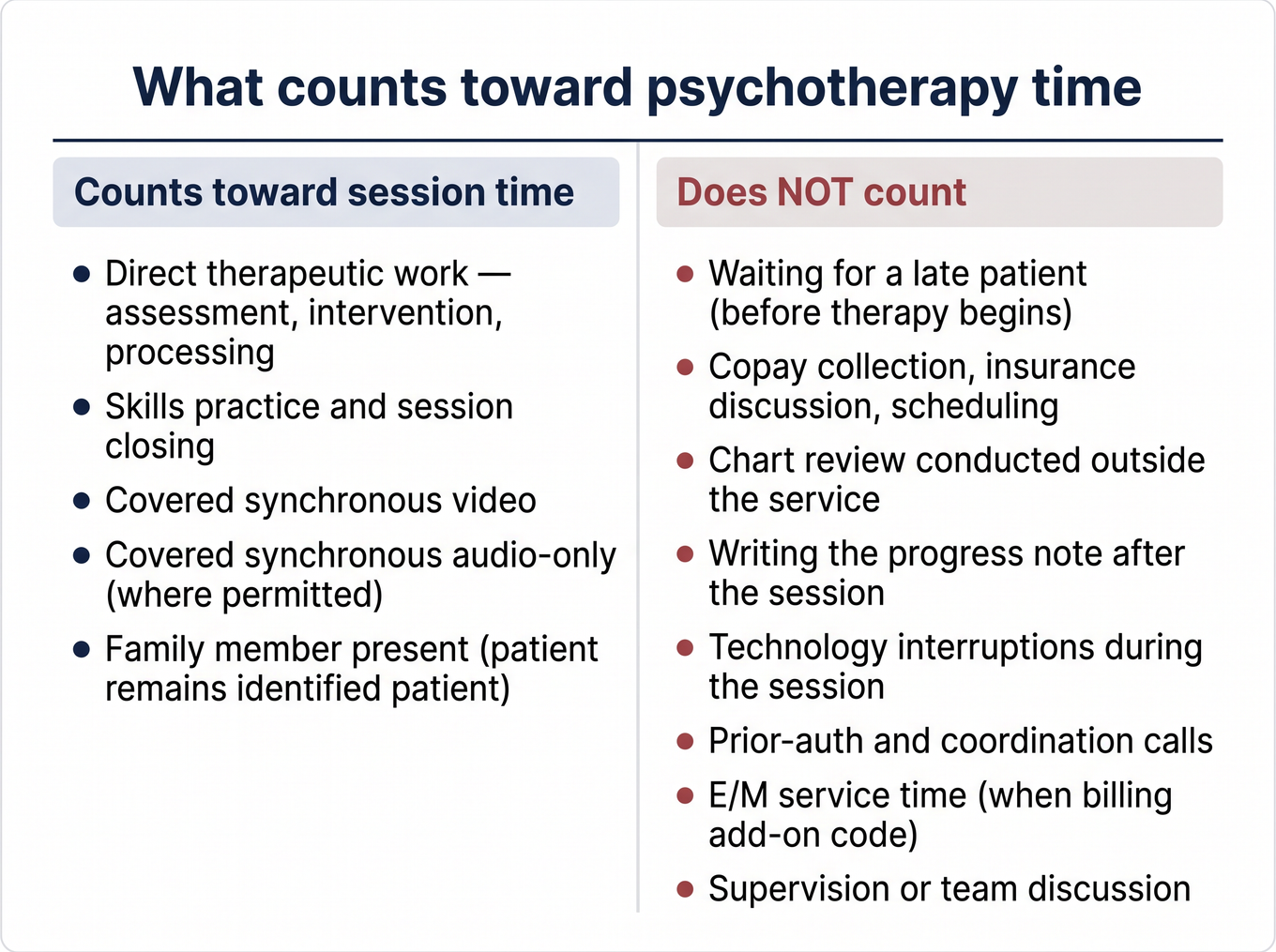
Time that generally counts is the direct therapeutic work: assessment, intervention, processing, skills practice, and the closing of the session. Covered synchronous video counts. Covered synchronous audio-only counts where the payer and current law permit it. Time with a family member present can count when the patient remains the identified patient and the encounter is genuinely still individual psychotherapy - though that is a service-characterization judgement, and you should document who participated and why.
Time that generally does not count toward 90834 or 90837:
- Waiting for a patient who is running late, before therapy begins
- Copay collection, insurance discussion, scheduling, and other administrative work
- Chart review conducted outside the direct service
- Writing the progress note after the session has ended
- A technology interruption during which psychotherapy is not being furnished
- Prior-authorization calls, coordination calls, and collateral contacts outside the coded encounter
- Time devoted to a separately identifiable E/M service when you are reporting +90833, +90836, or +90838
- Supervision, team discussion, or trainee review that is not itself the covered patient service
That last exclusion is worth a second look if you are a prescriber, and we come back to it below.
Start and stop times: what CMS actually requires
Here is a correction worth making loudly, because several pages ranking for this search state the opposite as fact.
CMS permits start and stop times or total time. The current contractor article says exactly that for 90832, 90834, and 90837. Total time alone is not categorically invalid, and any page telling you that start/stop is universally mandatory is overstating a national rule.
That said - record both anyway. Optum's October 2025 provider education tells clinicians submitting records to verify signature, credentials, and start/stop times, so individual payers absolutely do ask. And a line like Psychotherapy 2:04–2:58 p.m.; total 54 minutes is stronger evidence than either element alone, because it shows its own arithmetic and surfaces errors before a reviewer does. The minimum and the best practice are two different standards, and it is worth being clear which one you are meeting.
The practical consequence of all this is that the code follows what actually happened, not what was scheduled. Booked for sixty, patient arrived eleven minutes late, forty-seven minutes of psychotherapy occurred: that is 90834. Booked for forty-five, clinical need extended the work to fifty-four minutes: that is 90837, assuming the record supports the service. A video call that lasted sixty minutes with seven minutes of dropped connection is not a sixty-minute service.
Which covers the clean cases. The arguments happen elsewhere.
90834 or 90837? A decision tree for the hard sessions
Run the encounter through this in order. Most disputes come from skipping straight to step three.
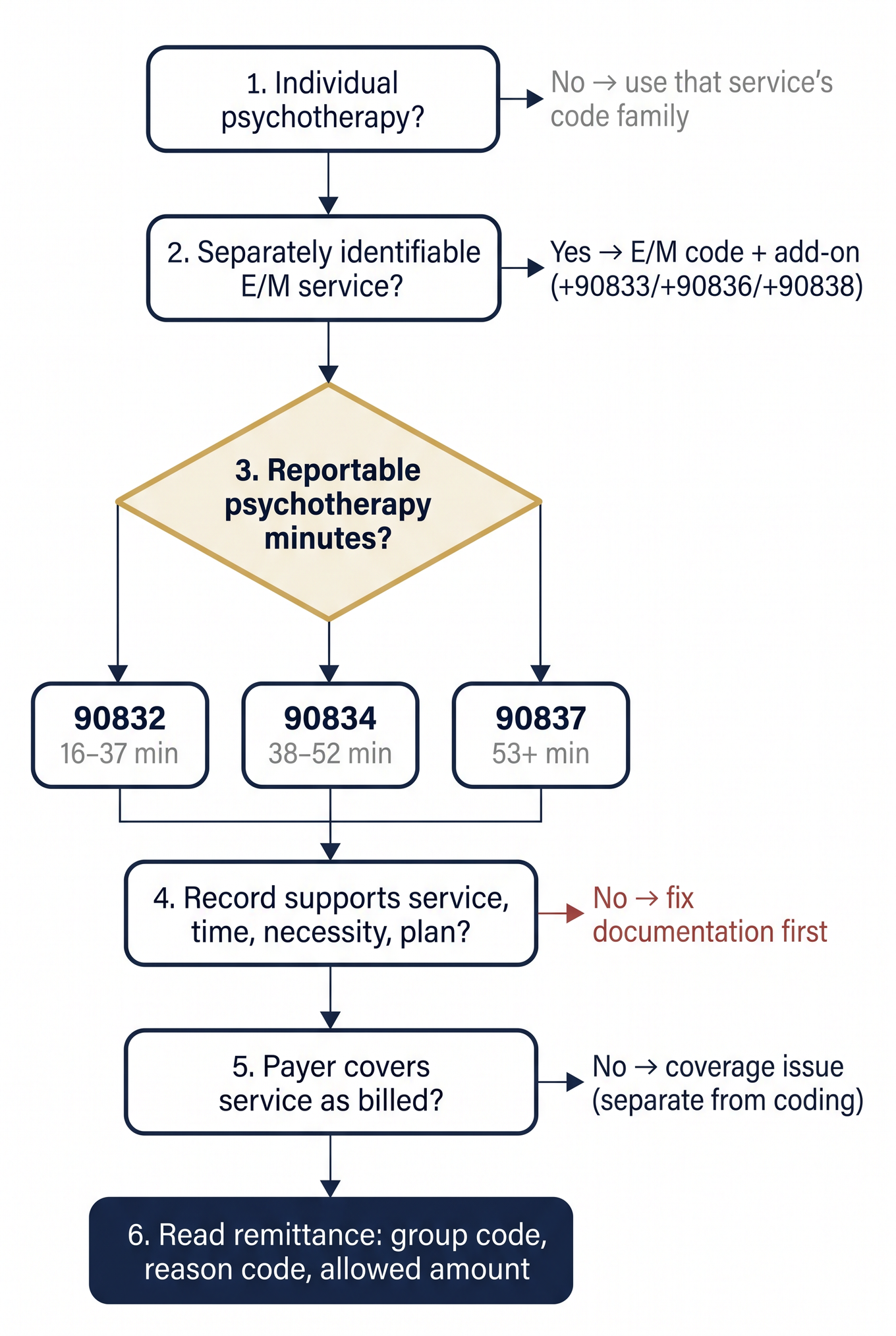
- Was this individual psychotherapy - rather than family, group, crisis, a diagnostic evaluation, or primarily an E/M service? If not, use that service's own code family.
- Was psychotherapy delivered without a separately identifiable E/M service by the same billing clinician? If yes, use the standalone family (90832 / 90834 / 90837). If an E/M service was also furnished and separately identifiable, use the E/M code plus the matching add-on (+90833 / +90836 / +90838), where the clinician and payer rules permit it.
- How many reportable psychotherapy minutes actually occurred? 16–37 → 90832. 38–52 → 90834. 53+ → 90837.
- Does the record support the service, the time, the medical necessity, and the relationship to an active treatment plan? If not, fix the documentation and the process. The time band alone does not save a claim.
- Does this patient's payer, product, benefit, authorization, and telehealth policy cover the service as billed? Coverage is separate from code selection, and it fails independently.
- When the remittance arrives, read the group code, the reason code, and the allowed amount before concluding anything about what the payer did.
Here is how that plays out on the encounters that actually generate arguments:
| What happened | Code | Why |
|---|---|---|
| 60-minute slot, patient 11 minutes late, 47 minutes of psychotherapy | 90834 | The scheduled slot is irrelevant. 47 falls in 38–52. |
| Connected 58 minutes, but 9 minutes were scheduling and documentation | 90834 | 49 psychotherapy minutes. Administrative time doesn't convert. |
| 53 minutes of direct psychotherapy, note written afterward | 90837 | Post-session documentation doesn't count toward the 53 - but the therapy already reached it. |
| 52 minutes, clinically intense | 90834 | Complexity supports medical necessity. It cannot add a minute. |
| 53 minutes, clinically routine, medically necessary under the plan | 90837 | No rule requires a "complex" diagnosis to cross the band. Coverage policy still governs. |
| Prescriber: medication management plus 40 minutes of psychotherapy | E/M + +90836 | Not standalone 90834. E/M time is excluded from the psychotherapy total. |
| Prescriber: medication management plus 55 minutes of psychotherapy | E/M + +90838 | Same principle. |
| Family joins part of an individual session to support the identified patient | Possibly 90834/90837 - verify | If treatment is directed at the family system, 90846/90847 may be the accurate answer. |
| A qualifying crisis service | 90839 / +90840, or applicable HCPCS crisis codes | Crisis psychotherapy is a distinct family, not 90837 with extra time. |
None of which addresses the question most people actually came here with.
Does billing 90837 get you audited?
The precise answer has two halves, and most pages give you only one of them.
Yes - payers can scrutinize heavy or unusual utilization of longer psychotherapy.
No - there is no national rule that makes 90837 inherently improper, no verified percentage at which it becomes unsafe, and no instruction anywhere to manufacture shorter claims for appearances.
The actual source is a single sentence in the current Medicare local coverage determination: clinicians with high utilization of psychotherapy services per patient compared with peers may be reviewed for medical necessity.
Read what that supports. Peer comparison can be used. Per-patient utilization can matter. A review can focus on medical necessity. All real, all worth planning for.
Now read what it does not support - because the following claims appear on pages currently ranking for this exact search, stated as fact, and no primary source could be found for any of them:
- ✗ "More than 20% above the peer average triggers a UnitedHealthcare audit"
- ✗ "A 90% 90837 mix is automatically suspicious"
- ✗ "A 30–40% split is the safe ratio"
- ✗ "Cigna requires authorization after the eighth session"
- ✗ "Make every eighth or tenth visit a 90834"
- ✗ "Vary your documented minutes - 58, 61, 55 - so the data looks natural"
- ✗ "90837 is only valid for certain diagnoses"
Not one of those is traceable to a payer policy, a coverage determination, or a federal source. They circulate because they sound like the kind of thing that would be true, and because a specific number is more comforting than an honest uncertainty. If you have a current written product policy from a payer that states one of them, follow your contract. Absent that, you are being asked to change how you report clinical care on the strength of a rumor.
The more useful reframing is this: outlier status starts a question. It does not answer it. A clinician can sit well above peers for entirely legitimate reasons - specialty focus, patient acuity, practice model, treatment modality. Being asked is not being accused.
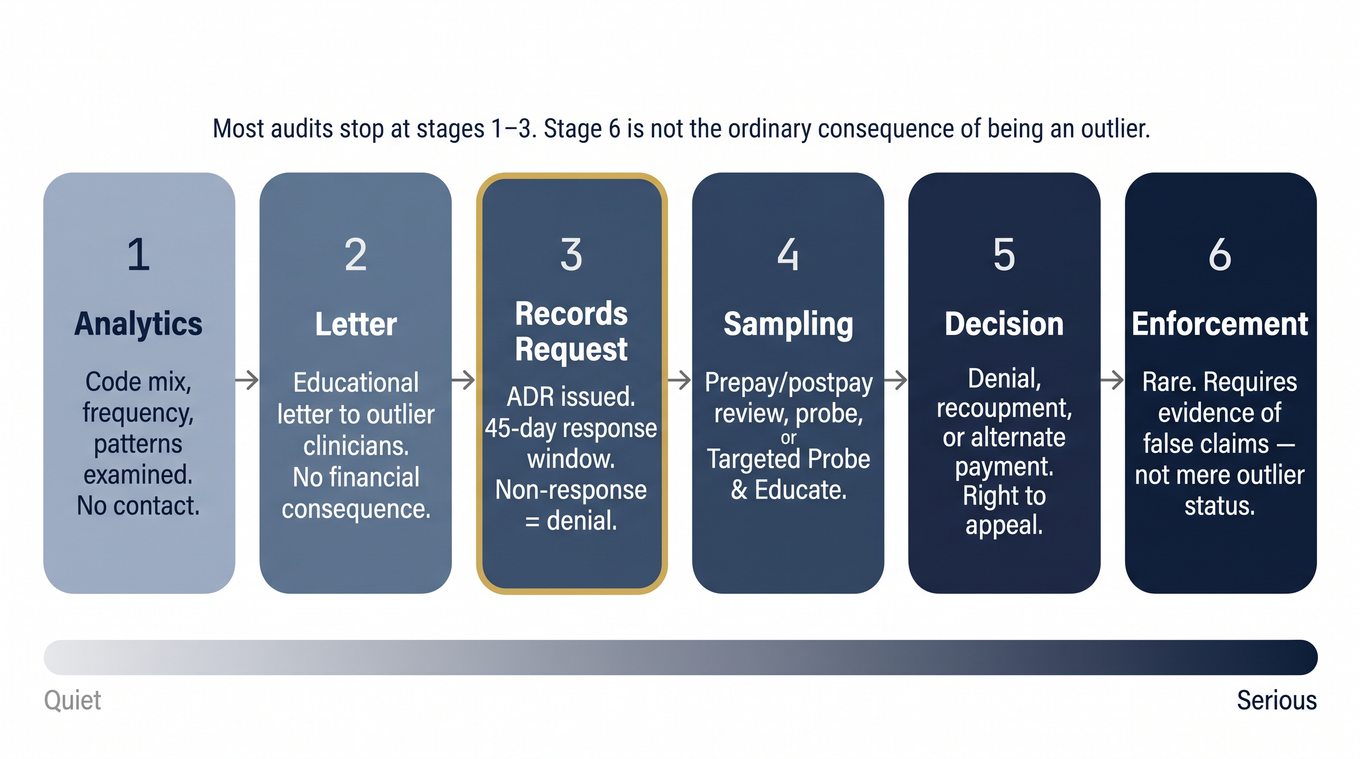
And "audit," in the sense people picture it, is the last stage of six.
What a psychotherapy audit actually looks like, stage by stage
Stage one is analytics. A payer or Medicare contractor examines code mix, per-patient frequency, specialty, place of service, diagnoses, modifiers, overlapping times, and changes in billing behavior. Nobody has contacted you. Nothing has happened.
Stage two is a letter. Professional-association reporting from 2017 documents Anthem and Highmark sending letters to clinicians whose 90837 use ran higher than peers, and APA Services reported at the time that Highmark characterized at least one round as educational, without immediate financial consequences. That is historical and payer-specific - not a current national policy - but it is a real picture of what stage two has looked like in practice.
Stage three is a records request. When CGS Medicare ran a post-payment review of 90832, 90834, and 90837 claims in 2021, it selected claims through data analysis, then issued Additional Documentation Requests - the formal request for the chart - with a 45-day response window. It reviewed time, medical necessity, signatures, treatment plans, whether the service was actually delivered, and correct coding. Failing to respond meant denial and recoupment. Non-response was the avoidable failure, and it remains the one we see practices walk into most often.
Stage four is sampling. Prepayment review, post-payment review, probe review, or Targeted Probe and Educate, which the OIG's July 2026 Novitas audit describes as claim sampling aimed at providers with high denial rates, unusual billing compared with peers, or services posing program risk. The design pairs review with education, though adverse findings can escalate.
Stage five is a decision - denial, payment at a different amount, or recoupment - and your right to appeal it.
Stage six is enforcement, and it is genuinely not the ordinary consequence of being a statistical outlier. It involves evidence that claims were false, not medically necessary, or billed at a higher intensity than the service supplied. A 2021 federal settlement with a Georgia behavioral-health provider alleged exactly that pattern - and allegations resolved by settlement are not the same as a finding at trial.
What the OIG psychotherapy audits actually found
This is the part that should change how you feel about the whole subject.
OIG's nationwide psychotherapy audit, covering March 2020 through February 2021, examined a universe of roughly $1 billion across more than 13.5 million services. In a sample of 216 enrollee days, 84 met requirements and 128 did not, and OIG estimated $580 million in improper payments - $348 million telehealth, $232 million non-telehealth.
The recurring failure was missing psychotherapy time. The other was missing signatures.
Not fabricated sessions. Not therapy that never happened. Not clinicians gaming the bands. The single largest category of failure in a billion-dollar federal audit was that the record did not say how long the session lasted, or nobody signed it.
Two things follow. First, "improper payment" is not a synonym for fraud. A payment is improper when the reviewer cannot verify it, which includes documentation gaps, coding errors, and guidance failures. That estimate also came from a sample taken during an extraordinary pandemic year, and it should be read with both caveats attached.
Second, the failure mode is boring and therefore fixable. The 2026 Novitas audit found 35 of 60 sampled psychotherapy items noncompliant - 25 not supported as reasonable and necessary, seven insufficiently documented, three not separately payable, with categories overlapping. What "not reasonable and necessary" looked like in practice was a record that did not support the frequency of treatment, or progress toward goals, or the patient's ability to participate meaningfully. In several items, a plan review had been documented where face-to-face psychotherapy was billed. (That report's roughly $19.5 million estimate covered all of its selected service categories, not psychotherapy alone.)
The provider-level audits show where this ends when controls are absent. In one 2020 OIG audit, only nine of 120 sampled claims met requirements; every noncompliant claim involved a treatment-plan defect, and the provider's EHR had overwritten historical treatment plans, making it impossible to prove which plan applied on the date of service. In another, 82 of 100 sampled services lacked psychotherapy time, with overlapping timestamps that could not all have been true.
Those are not prevalence estimates for ordinary outpatient practice. They are what failure looks like when it is selected for.
So a reviewer is asking for something unglamorous - the time, the signature, the plan, the progress. Which means the defense is the same regardless of which code you chose.
What your note must document for either code
There is no magic sentence. This needs saying plainly, because a persistent piece of advice holds that 90837 requires its own special justification paragraph while 90834 does not.
CMS's sources do not create a nationwide magic phrase. Both codes require an accurate service record, documented time, and medical necessity. What legitimately differs between a 90834 note and a 90837 note is the factual content - the documented time falls in a different band, and where a longer or repeatedly longer course of treatment is clinically meaningful, the record should make that visible through the actual work, the patient's need, the functional impact, the response, and the plan.
A reviewer needs to be able to answer:
- Who received what service, from whom, and on what date?
- How many reportable minutes occurred?
- What condition and functional effects were being treated?
- What therapeutic work was performed?
- How did the patient participate and respond?
- How does the encounter connect to an active, individualized plan?
- Is there progress - or maintenance where deterioration would otherwise be expected?
- Why are the type, frequency, and duration reasonable for this patient?
- Is the note signed, with credentials and a reliable date?
CMS's psychiatry article lists the reviewable record elements - patient and date, service type, time, modality and frequency, diagnosis, symptoms, functional status, mental-status information, treatment plan, prognosis, progress. It also makes a distinction worth knowing if you have ever felt uneasy about a records request: you can maintain separately protected psychotherapy notes while extracting into the ordinary medical record the information required for medical-necessity review. A reviewer needs the reviewable record. That is not the same as your process notes.
The difference between a note that survives and one that doesn't is usually visible at a glance.
Weak:
60-minute session. Patient discussed anxiety. Supportive therapy provided. Continue weekly.
"60-minute session" may be describing the appointment slot rather than reportable psychotherapy. There is no explicit total, no functional impact, no specific intervention, no response, no goal, and nothing connecting weekly frequency to a plan.
Defensible, 50 minutes, 90834:
Individual psychotherapy by secure video, 10:02–10:52 a.m. (50 psychotherapy minutes). Addressed avoidance that is impairing attendance at work. Used graded-exposure planning and cognitive restructuring tied to treatment-plan goal 2. Patient identified two avoidance triggers, completed an in-session rehearsal, and rated the planned first step as achievable. Continue weekly; review adherence and functional response next visit.
Defensible, 56 minutes, 90837:
Individual psychotherapy in office, 3:01–3:57 p.m. (56 psychotherapy minutes). Addressed persistent symptoms and functional disruption affecting sleep and work. Used structured trauma-informed stabilization and skills rehearsal tied to treatment-plan goals 1 and 3. Additional time was used to complete the planned intervention and confirm return to baseline before closing. Patient demonstrated the skill independently and identified a home-practice plan. Continue current frequency; reassess duration after response to the next two sessions.
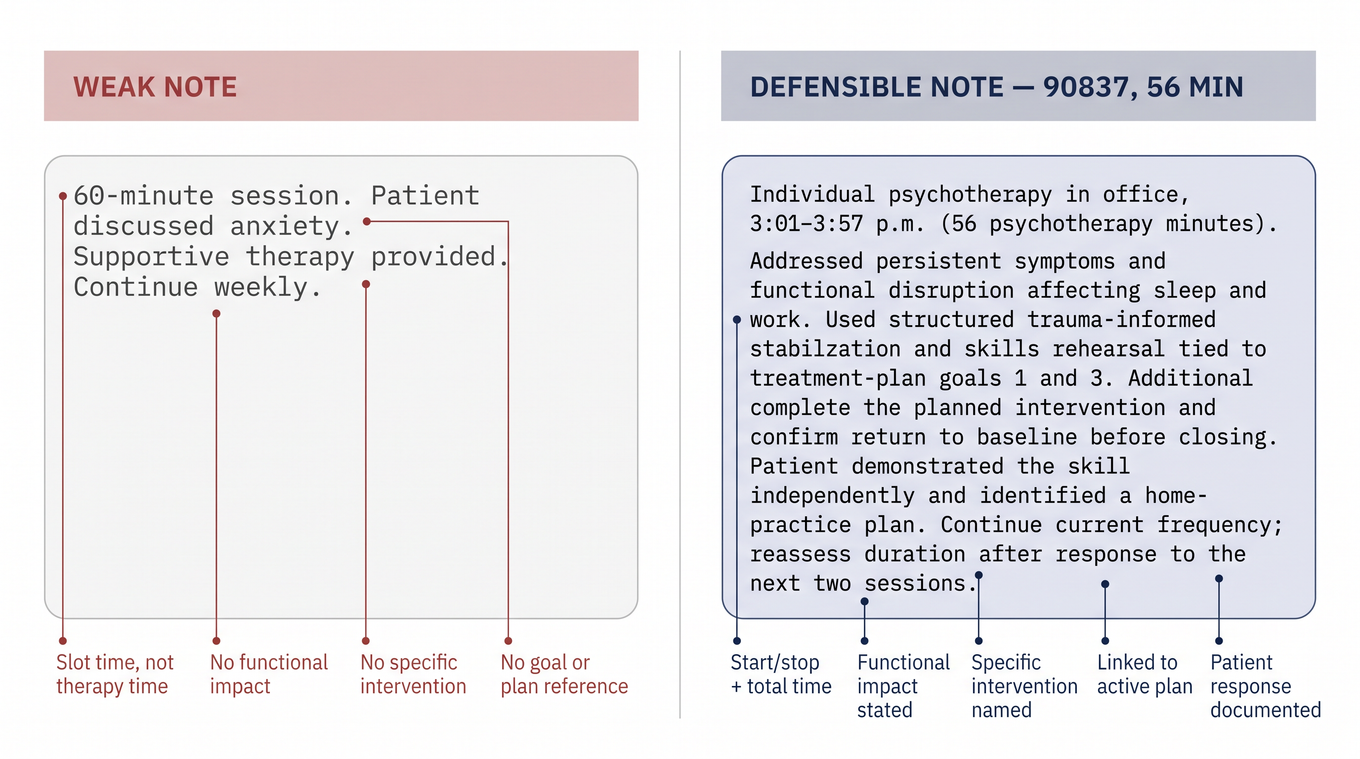
Notice what makes the second one work. It is not the phrase "additional time." It is that the note describes a specific patient on a specific day. The fastest way to weaken a 90837 defense is to paste the same justification sentence into every longer session - cloned language reads as a template to exactly the audience you least want reading it that way, and the OIG audits above are full of records that failed on precisely this.
Two treatment-plan controls are worth building before you need them: preserve historical plan versions with effective dates, so you can prove which plan applied on the date of service, and keep the plan's stated frequency and duration current rather than carrying an expired recommendation indefinitely. Both were load-bearing failures in the provider audits.
Once you have determined that the service genuinely reached 53 minutes, our full guide to documenting and billing 90837 goes deeper into the note, the add-on mechanics, and the appeal path than a comparison page should.
If both codes demand the same discipline, that raises a fair question: how much does the choice actually cost when it goes the wrong way? More than most practices have ever measured.
How much more 90837 pays than 90834 in 2026
On the 2026 national non-facility benchmark drawn from the Medicare Physician Fee Schedule:
| Code | 2026 national non-facility benchmark | Difference |
|---|---|---|
| 90834 | $113.90 | - |
| 90837 | $167.00 | $53.10 (46.62%) |
The 90837 figure comes from APA Services' 2026 Medicare payment analysis, built on the CMS fee schedule. We will be precise about the other one, since precision is the whole point of this page: $113.90 is the widely-cited 2026 national non-facility benchmark for 90834, but it does not appear in that same APA table - so pull 90834 from the CMS fee-schedule lookup for your own locality before you build a forecast on it. The underlying machinery is set by the January 2026 RVU release and the CY 2026 PFS final rule.
These are benchmarks, not checks. Fee-schedule payment combines work, practice-expense, and malpractice RVUs, adjusts them by geographic practice cost indices, and multiplies by a conversion factor - and 2026 uses two of them, roughly $33.57 for qualifying APM participants and $33.40 for everyone else. On top of that, any of the following can move the number you actually see:
- Facility versus non-facility setting
- The patient's deductible and coinsurance
- Sequestration and other payment adjustments
- Secondary coverage
- Whether this is Original Medicare or a Medicare Advantage plan with its own rules
Your rendering clinician's credential moves it too. CMS pays independently billing marriage and family therapists and mental health counselors at 75% of what a clinical psychologist receives under the fee schedule. Clinical social workers are paid on a statutory percentage tied to the same anchor. NPs and PAs billing under their own identifiers are generally paid at 85% of the physician amount.
It also helps to keep four different numbers separate, because people call all of them "reimbursement":
- Charge - what you submitted
- Allowed amount - what the plan recognizes
- Plan payment - what is paid after patient responsibility
- Net collection - what you actually keep after refunds, reversals, and write-offs
With all of that stated, here is the scale of the thing. Assume every session genuinely contained 53 or more reportable minutes and met coverage requirements, and assume 46 billable weeks:
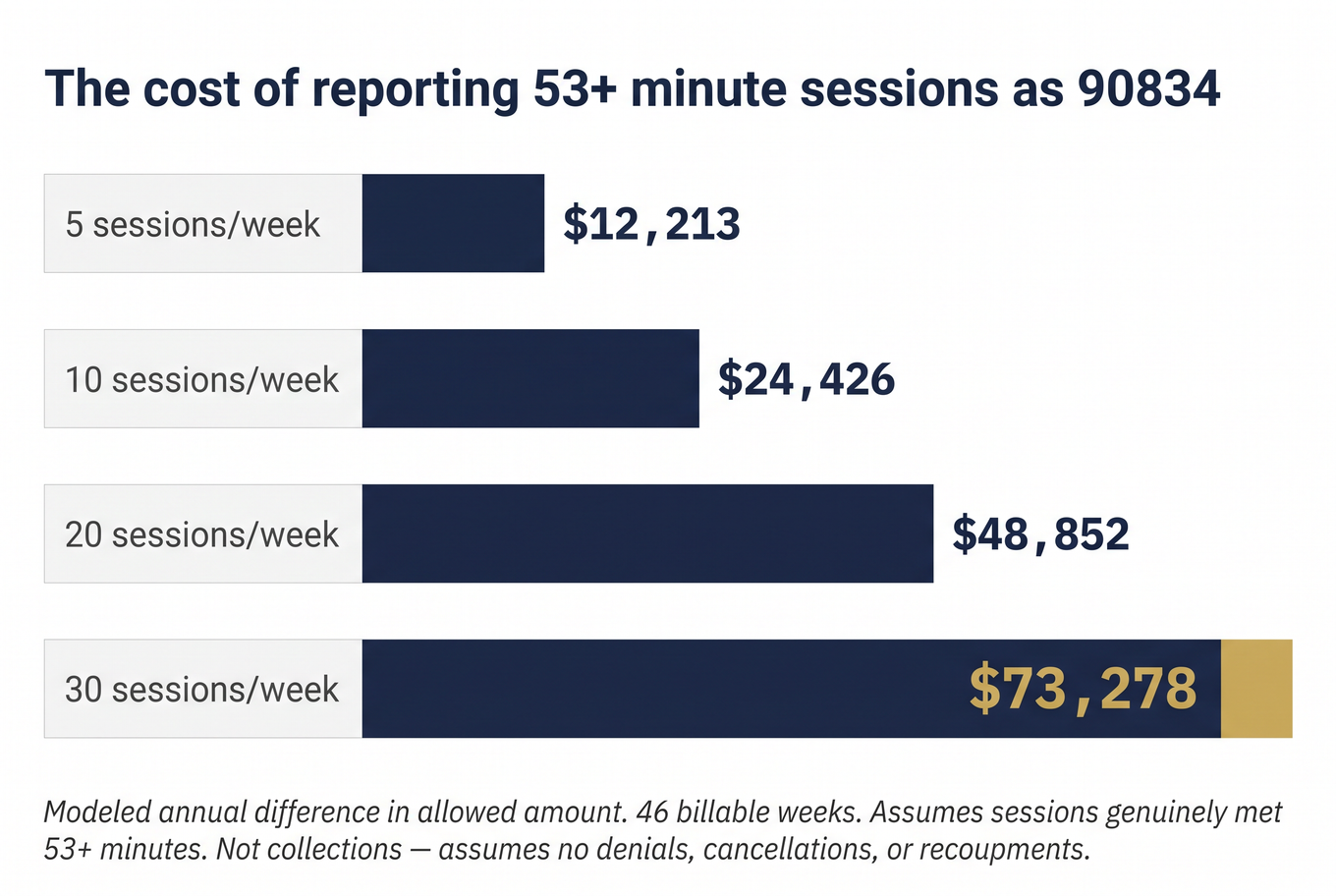
| Qualifying sessions per week reported as 90834 instead of 90837 | Sessions/year | Modeled annual difference in allowed amount |
|---|---|---|
| 5 | 230 | $12,213 |
| 10 | 460 | $24,426 |
| 20 | 920 | $48,852 |
| 30 | 1,380 | $73,278 |
Read that table carefully, because it is easy to read it wrong. It is a modeled difference in allowed amounts, not collections - it assumes no cancellations, denials, bad debt, recoupments, or contract variance. And it is emphatically not an argument for billing more 90837. It is the price tag on systematically misreporting sessions that genuinely met the longer band. If the sessions were 48 minutes, none of this money exists and reporting it would be fraud.
One more thing this section cannot give you, and the honesty matters. Several pages ranking for this search publish tidy tables of "average" Aetna, UnitedHealthcare, Cigna, BCBS, or Medicaid reimbursement for these codes. No defensible nationwide 2026 commercial rate table exists. Commercial allowed amounts are specific to contract, product, geography, credential tier, and network, and negotiated rates are frequently confidential. Published averages tend to blend years, markets, and payer types into a number that describes nobody. Your real figure lives in the payer portal, the contract fee exhibit, a fee-schedule notice, or a representative paid claim. Medicaid adds a further layer: rules and fee schedules are state- and delivery-system-specific, and official state pages can lag behind the current schedule - we have seen live state pages still referencing retired code ranges. Pull the current schedule, check whether the patient is fee-for-service or managed care, and save the version you relied on.
Which brings us to the moment most practices actually discover a problem: the remittance says something unexpected, and everyone reaches for the wrong explanation.
Denied, downcoded, or just paid the contract rate? How to tell
"They downcoded us" is one phrase covering five genuinely different events, each needing a different response:
- Front-end rejection. The claim never reached full adjudication - missing or inconsistent member ID, taxonomy, NPI/TIN, modifier, place of service, diagnosis, or format. Fix and resubmit. Do not appeal medical necessity.
- Full denial. The service was adjudicated and paid zero: benefit exclusion, coverage, medical necessity, authorization, timely filing, wrong payer, or duplicate.
- True code-level reduction. The payer determined the record supports a lower code - 52 minutes documented on a 90837 claim - and reprocessed or sought repayment at the lower level. This is the only one of the five that is actually a downcode.
- Contractual payment equalization. The claim stayed coded as 90837, but the contract assigns the same or a lower allowed amount than expected. Nothing was recoded.
- Bundling. The service is included in another, conflicts with a same-day line, or is not separately payable in that setting.
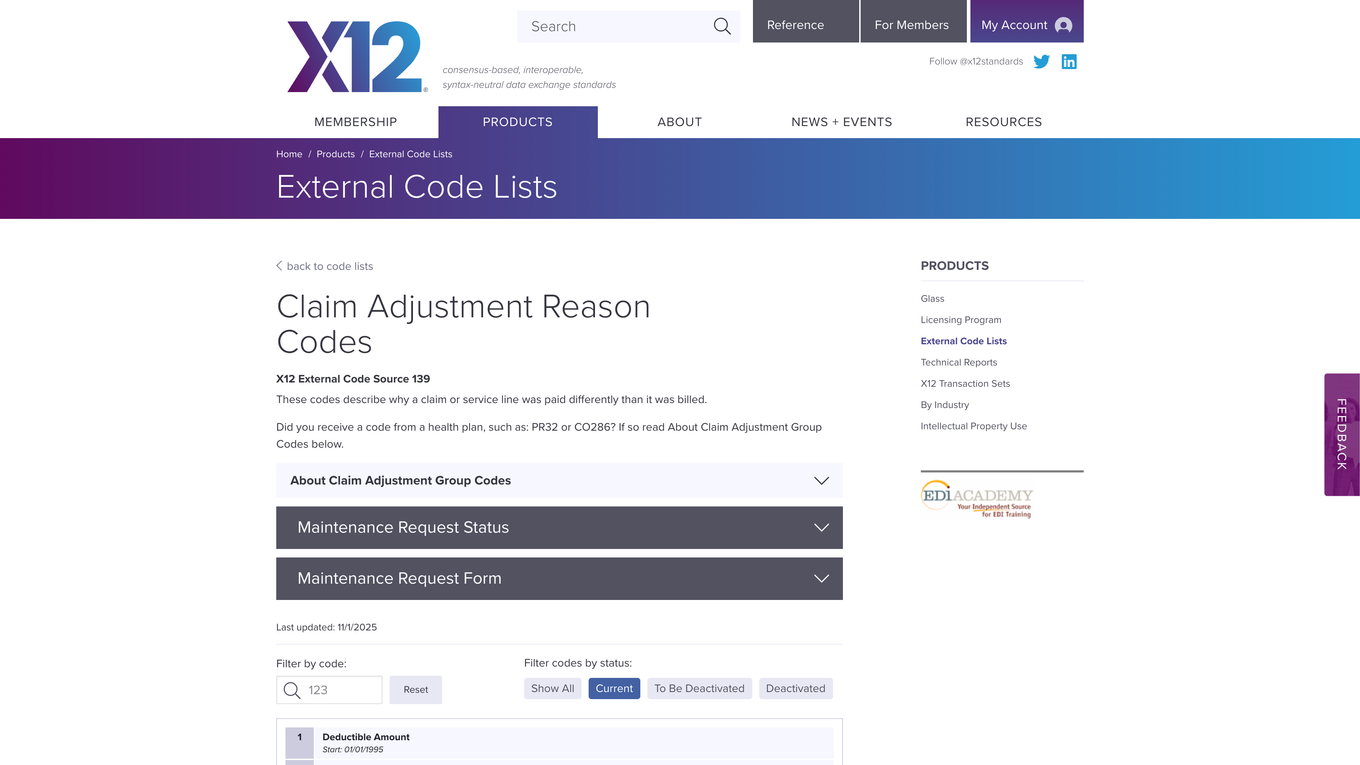
You cannot tell which one happened from the deposit. You can tell from the remittance. X12 defines claim adjustment reason codes as the explanation for why a line paid differently from the billed amount; the two-letter group code assigns responsibility - contractual obligation, payer-initiated reduction, patient responsibility - and a remark code often carries the detail that actually identifies the problem.
X12 maintains the canonical list, and the page itself shows the structure you are decoding - a group code paired with a reason code, in the PR32 and CO286 shape it opens with:
For any disputed 90834 or 90837 line, capture the submitted code and modifiers, the adjudicated code if visible, the charge, the allowed amount, the plan payment, patient responsibility, the group code, the reason code, every remark code, the policy reference, the authorization record, the contract fee exhibit, and the claim history. Then assign root cause. Not before.
A few reason codes carry most of the traffic on psychotherapy claims:
| Code | What it can point toward |
|---|---|
| 4 | Procedure code and modifier are inconsistent |
| 11 | Diagnosis inconsistent with the procedure |
| 16 | Missing information or a billing error - the remark code identifies more |
| 18 | Exact duplicate claim or service |
| 29 | Timely-filing limit expired |
| 45 | Charge exceeds the fee schedule or contracted amount - often a contractual adjustment, not evidence of downcoding |
| 50 | Not deemed medically necessary |
| 97 | Included in another service already adjudicated |
| 109 | Not covered by this payer - send to the correct payer |
| 151 | Frequency or number of services not supported |
| 152 | Length of service not supported |
| 197 / 198 | Authorization absent, or exceeded |
| 204 | Not covered under the patient's current benefit plan |
| B12 | Services not documented in the record |
Code 45 is the one that most often gets misfiled as a downcode. And 2026 produced a clean illustration of why that distinction matters: therapists affiliated with the network platform Alma reported an Aetna proposal that would have consolidated the 90834 and 90837 reimbursement rates for that network. A later communication indicated negotiations prevented the consolidation and preserved credential distinctions, though broader mental-health reductions remained and new rates took effect on August 15, 2026, with the final figures visible inside affected providers' accounts rather than any public table. Independent reporting covered the dispute as it developed.
What that episode proves is narrow and important. A payer or network can seek to pay two correctly coded services at the same rate. That does not change the CPT time bands. And a lower or equal payment is not necessarily a downcode - it may be exactly what the contract says. This was one network's contract negotiation, not Aetna's national policy, and it should not be generalized to every Aetna provider, product, or state.
When a genuinely valid service is denied or reduced, the appeal package that works is indexed rather than voluminous:
- The remittance, with the adjustment codes highlighted
- The claim, and any corrected-claim history
- Eligibility and authorization evidence for that date of service
- The applicable contract or policy version, with its effective date
- The signed note, with time and service type
- The current treatment plan and relevant progress summary
- A short cover letter matching each denial reason to the specific evidence that answers it
Say what remedy you want - reprocess as submitted, reverse the recoupment, or explain the contract calculation. Do not send an unindexed chart dump when the payer asked about one date of service; make the reviewer able to find each fact.
This is the layer where most of the recoverable money actually sits, and it is the part practices most often stop doing when the office gets busy. Working a denial to root cause takes longer than rebilling it, and rebilling it is why the same denial arrives again next month.
A handful of edge cases break the two-code comparison entirely, and they are worth knowing before you meet one.
Telehealth, E/M add-ons, and the edge cases
Telehealth does not change the bands. Current HHS telebehavioral guidance lists 90834 at 38–52 minutes and 90837 at 53 or more, with both on the permanent Medicare telehealth services list. Fifty-two minutes by covered synchronous video is 90834. Fifty-three is 90837.
Here it is on HHS's own page. The same two bands you would use in the room, with permanent telehealth coverage marked against each code:
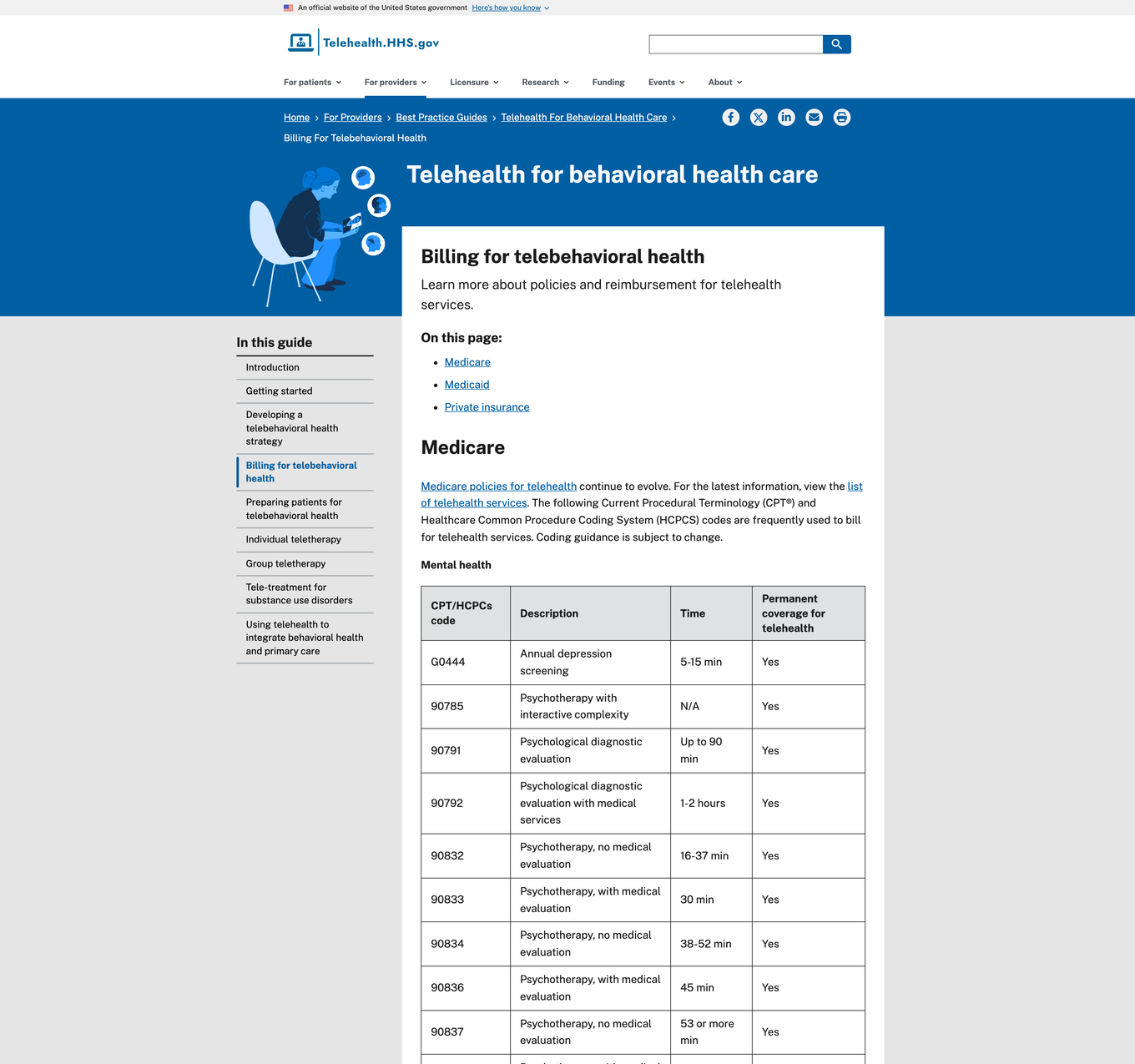
What telehealth changes is everything around the code. Place of service is location-based: POS 10 is telehealth with the patient in their home, POS 02 is telehealth with the patient somewhere else. So the operative question is not "which POS do we use for therapy" but "where was the patient sitting" - ask, and document it, every session.
On timing, as reflected in CMS's current Medicare telehealth FAQ and the telehealth extensions enacted for 2026, three different clocks are running and it is worth keeping them apart. The general Medicare telehealth flexibilities - home as an originating site, the geographic waivers, audio-only delivery - currently run through December 31, 2027. Behavioral health sits outside that clock in two respects: the geographic and originating-site restrictions were removed permanently, and audio-only delivery is permanently available where the clinician is technically capable of audio-video but the patient cannot use it or does not consent to it. And the in-person visit requirement for home-based mental-health telehealth is deferred to January 1, 2028, with patients who began home-based mental-health telehealth on or before January 30, 2026 treated as already established. Recheck these dates before you rely on them. They move by statute, they have moved repeatedly, and any page - including this one - is a snapshot of the date it was written.
On modifiers, resist the universal answer. HHS's Medicare fee-for-service billing page identifies modifier 93 and/or FQ in its audio-only discussion, but Medicare, Medicaid, commercial plans, behavioral carve-outs, and facility settings do not align. Some plans want 95, some use 93 for audio-only, some adjudicate from place of service, and legacy GT instructions still persist in product-specific material. The rule is the current payer and product policy for that date of service. There is no national modifier table for this, and pages that print one are guessing.
When an E/M service is in the mix, the code family changes. If an eligible clinician furnishes a separately identifiable E/M service plus psychotherapy on the same date, the psychotherapy goes on the add-on: +90833 for 16–37 minutes, +90836 for 38–52, +90838 for 53 or more. Document them separately, exclude E/M time from the psychotherapy total, and do not count the same minutes twice. Optum's provider education specifically flags time-code mismatches and failure to separate E/M from psychotherapy as recurring errors.
A few adjacent codes that get misused as workarounds:
- 90785 (interactive complexity) is not an extra-time code. It is not payment for eight more minutes, not a "difficult patient" code, not a substitute for 90837, and not automatic whenever family attends. APA Services' guidance on reporting it is worth reading before you use it.
- Crisis psychotherapy (90839 / +90840) is a distinct family with its own requirements - notably that total face-to-face crisis time need not be continuous, which is specific to crisis and should not be generalized to ordinary psychotherapy. Do not bill 90837 and add 90840 because the visit ran long.
- Family (90846 / 90847) and group (90853) are separate services. A family member's presence during an individual session does not mechanically decide the code; the treatment focus and identified patient do.
- 90791 / 90792 are not repeatable longer first sessions. Diagnostic evaluation has its own purpose and repeat rules.
- A Medically Unlikely Edit is a ceiling, not a permission. CMS's MUE program sets claim-processing limits on units that are improbable for a service and date. That a system accepts two units does not make two units payable. For an ordinary single encounter, submit the one code that represents the service.
What to bill for a 90-minute session (an unresolved conflict)
Here is a genuine unresolved conflict, and we would rather show it to you than pick a side.
CMS's article A57520 contains language indicating that a prolonged-service code may be reported alongside standalone 90837 when psychotherapy reaches 90 minutes or more. CMS's article A56937 - also current - carries revision history stating that the former prolonged-service codes 99354–99357 were removed effective January 1, 2023, and are no longer valid for psychotherapy sessions. Those codes were in fact deleted from CPT for 2023 dates of service.
You can check this yourself rather than take our word for it. A57520 sits in CMS's Medicare Coverage Database with its revision date on the page, which is the first thing to look at before relying on any contractor article:
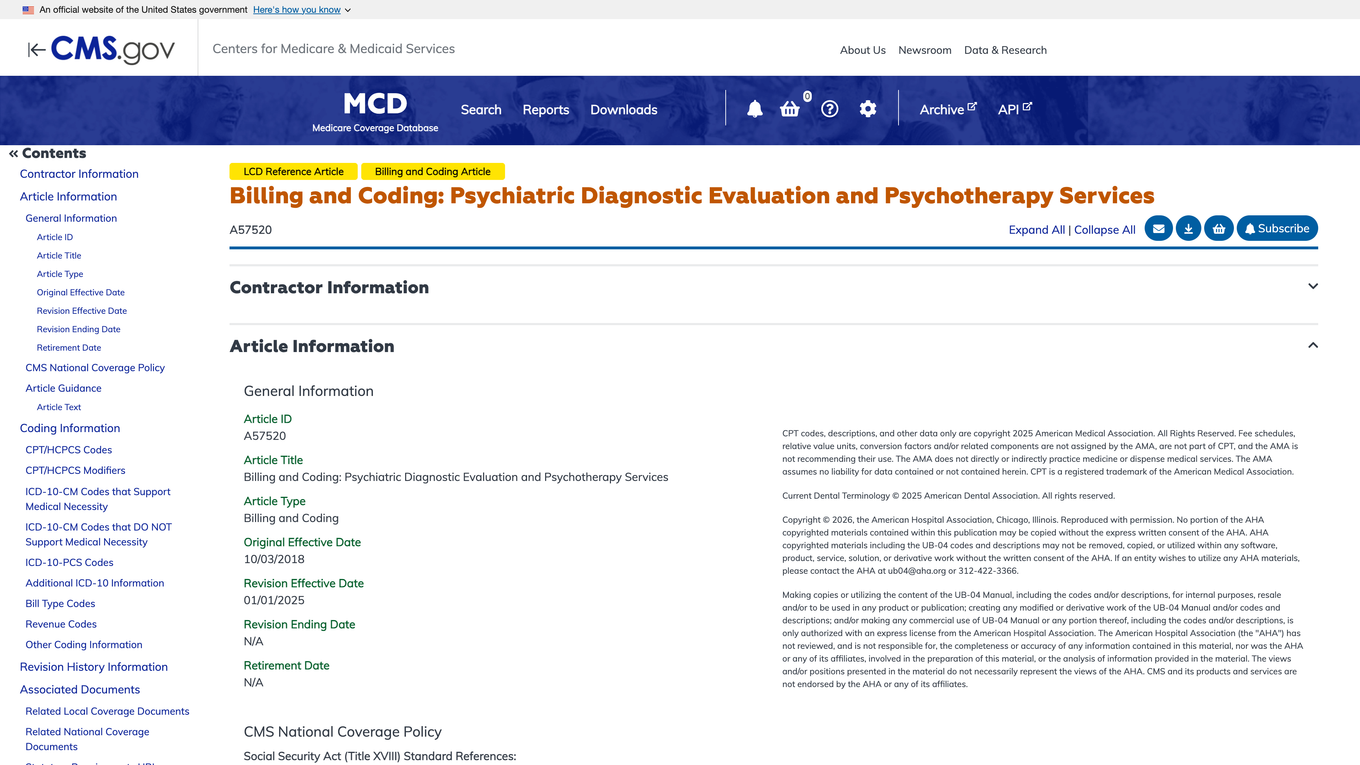
Two current Medicare contractor articles disagree with each other. Every page we reviewed on this topic either picks one silently or omits the question.
The nationally safe position: 90837 remains the base code for 53 minutes and up. For a session of 90 minutes or more, do not append an old or generic prolonged-service code, and do not bill additional 90837 units, unless the patient's current payer or your MAC gives explicit, current, written authority for that exact combination. If you routinely run sessions that long, get that answer in writing from the payer before you bill it - and our 90837 billing guide covers the longer-session and appeal paths in more depth.
Underneath every one of these edge cases sits the same question, and it is not really a coding question.
Upcoding, defensive downcoding, and the ethical middle
There are three distinct behaviors here, and only one of them is accurate.
Accurate coding. The session genuinely contained 53 or more minutes of reportable psychotherapy, the service was medically necessary, and the record supports it. That is a 90837, and it is not a risky choice. It is the correct one.
Upcoding. The reportable time was 52 minutes or less and the claim says 90837. That fails the published band. Found, it produces denial, recoupment, or an obligation to return an identified overpayment - and knowingly submitting false information can escalate into civil or criminal exposure depending on the facts. An isolated mistake is not a crime. Doing it deliberately is not a gray area.
Defensive downcoding. The service genuinely met the 90837 band, and the practice reports 90834 anyway to keep its head down. This is the one nobody names, and it deserves naming, because it is not a cautious version of compliance. It is also a misstatement of what happened. It puts an inaccurate service on the claim. It feeds a false utilization profile back into the analytics that everyone is so worried about. It loses reimbursement that compounds across a caseload. It creates notes and claims that disagree with each other - which is its own audit exposure. And in group practices where compensation follows the code, it quietly asks clinicians to donate labor.
We are not going to tell you that every downcoded claim is insurance fraud; that is fact-specific and depends on intent, contract, and overpayment rules. But it is inaccurate, and it is expensive, and the reasoning behind it is usually a rumor.
That reasoning produces some genuinely strange operational advice. In a 2026 practitioner forum thread, an associate described being told the group encouraged 53-plus-minute sessions but also instructed clinicians to deliberately include some 52-minute sessions, leaving the associate tracking whose "turn" it was to take the lower-paid one. In another, a clinician described an EHR generating an "extended" or "prolonged" justification sentence on nearly every 90837, and worried the language itself conceded that 90834 was the norm. These are individual accounts, not evidence about how often payers audit anyone - but they are an accurate picture of what myth-driven billing operations do to the people inside them.
No primary source supports engineering code variation as an audit defense. The compliant form of variation is unglamorous: if actual time is 52, bill 90834. If it is 53 or more, bill 90837. If a patient clinically needs a shorter or longer format, plan and deliver that care for clinical reasons. Do not shorten care to flatten a histogram. Do not extend care to cross a reimbursement threshold. CMS itself says the duration of a course of psychotherapy must be individualized - which cuts against both distortions at once.
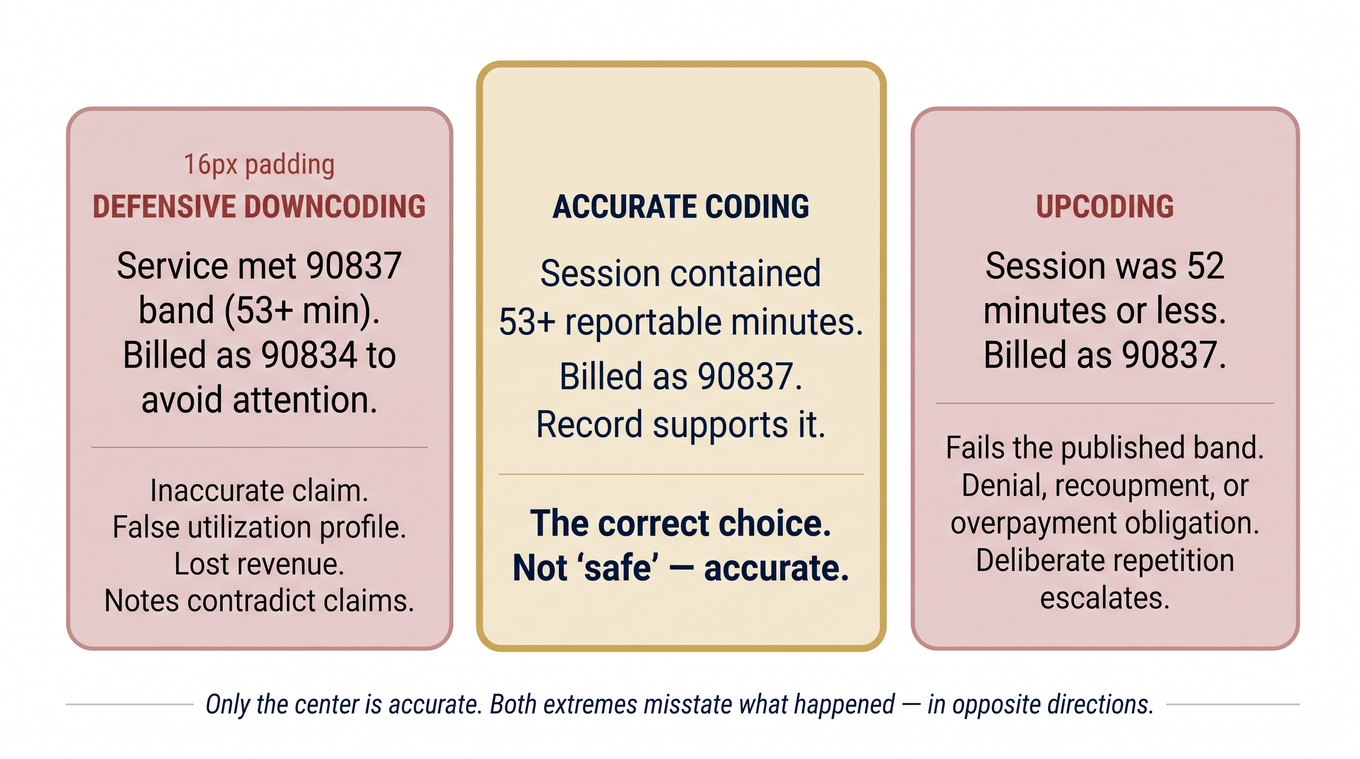
Bill 90834 for 38–52 minutes and 90837 for 53 or more. Do not add minutes to reach the longer code, do not round 52 up, and do not erase a real 53-plus-minute service to avoid attention. Accurate time chooses the code; the patient-specific record supports why the service and the treatment pattern were medically necessary.
Which leaves the practical question of what to actually do before the next claim goes out.
A five-minute check before the claim goes out
Six questions, in order:
- Is this the right service family - individual, family, group, crisis, diagnostic, or E/M plus psychotherapy?
- What were the actual reportable psychotherapy minutes?
- Does the time in the note match the code on the claim?
- Is medical necessity visible - condition, function, intervention, response, progress, plan?
- Does this payer and product require authorization, a specific place of service, or modifier handling?
- Is the rendering clinician eligible and enrolled for this service with this payer?
Then, monthly rather than per-claim:
- Run a code-mix report by clinician, payer, product, location, and rendering credential
- Flag any note whose time contradicts the claim
- Test for missing or delayed signatures, and for overwritten treatment plans
- Look for overlapping sessions and impossible daily totals
- Sample your highest-frequency cases for current goals and individualized duration
- Keep payer policies versioned with effective dates
- Preserve the original claim, remittance, records request, submitted package, decision, and appeal for anything disputed
The point of running that report yourself is not to engineer your distribution. It is that being told your own numbers by a payer is a much worse way to learn them. If an educational letter does arrive, treat it as a prompt to validate your records - not an instruction to downcode truthful services going forward.
A small practice can absolutely handle all of this itself, and where that is true we would rather say so than sell around it. If you have a limited payer panel, a reliable EHR field for actual psychotherapy time, clear contracts and portal access, low denial and records-request volume, and an owner or administrator who genuinely reads the remittances and runs a monthly note-versus-claim check - you do not need a billing company for this. Accurate coding is not an outsourcing problem.
It becomes one when the operational surface outgrows the attention available:
- Several clinicians across credentials, states, or entities
- Many commercial plans and behavioral-health carve-outs, where the payer on the card is not the payer you bill
- Frequent telehealth, and patients who travel
- Prescribers billing E/M plus psychotherapy
- Repeated records requests, recoupments, or authorization denials
- No reliable reporting on reason codes or contract variance
- Old A/R and missed appeal deadlines
Or the signal that matters most to whoever owns the practice: nobody can say whether the revenue you are losing is a coding problem, a coverage problem, a contract problem, or a workflow problem.
That picture usually changes for one of four reasons: the practice is growing - new clinicians, new locations, a new state; the payer or service mix has genuinely got more complex; nobody has the time the billing side actually needs; or collections have slipped and nobody can say precisely why. None of those is about size. We work with practices of every size, from a single clinician to a multi-state group, and we take on a single piece of the cycle as readily as the whole of it. The question is never whether a practice is big enough to be worth helping - it is which part of the cycle needs owning.
The bottom line, and what to do this week
Choosing between 90834 and 90837 at a single encounter is genuinely simple: the clock selects the code, the record defends it, and coverage is a separate question with its own answer. Fifty-two is 90834. Fifty-three is 90837. Neither one is the safe code, and neither one is the dangerous code - the accurate one is both.
What is not simple is keeping the note, the claim, the payer rule, the authorization, the remittance, and the appeal aligned across thousands of encounters, while the rules underneath them move.
If you suspect you are losing money here, the most useful thing you can do this week is not to change your code mix. It is to take a small sample - ten or fifteen claims - and follow each one the whole way through: the note, the claim as submitted, the remittance with its group and reason codes, the payer policy that applied on that date, and what happened on appeal. You will usually find one product, one modifier, one clinician's missing times, or one contract update sitting underneath what felt like a general problem with 90837. The pattern tells you more than any single denial does, and it is the difference between fixing a claim and fixing a cause.
That end-to-end alignment is the work we do. It is not a different answer to the coding question - the bands are the bands, and no billing company changes them.
Common questions about the 52/53-minute decision
Is 52 minutes 90834 or 90837?
- The longer band begins at 53 minutes, and 52 does not round up regardless of how clinically demanding the session was.
Does 90837 require a full 60 minutes?
No. CMS's band begins at 53 minutes. A 54-minute session is a 90837, and the "60-minute code" label is shorthand that appears nowhere in the rule.
Can I bill 90837 every week?
There is no national ban on weekly 90837. Each encounter has to contain 53 or more reportable minutes, and the record should support the service plus the type, frequency, and duration of treatment. High per-patient utilization compared with peers may prompt a medical-necessity review, which is a request for records rather than a finding against you.
Does billing 90837 automatically trigger an audit?
No. Payers can profile utilization and request records, but no universal threshold, safe percentage, or automatic audit rule could be verified against any primary source. The specific numbers circulating online - 20% above peers, a 30–40% safe mix, 90% being automatically suspicious - are not traceable to payer policy.
Do I need start and stop times?
CMS permits start/stop times or total time. Recording both is the stronger practice, and individual payers may specifically ask for start/stop, so meeting the higher standard costs nothing.
Does time spent writing the note count?
Not toward selecting 90834 versus 90837. Documentation written after the psychotherapy has ended is not reportable psychotherapy time, though it does not retroactively reduce time that was already furnished.
Do I need a special diagnosis or a justification sentence for 90837?
No. There is no list of diagnoses that qualifies for the longer code and no nationally mandated justification phrase. What the record needs is accurate time plus enough patient-specific clinical detail to show why the service and the treatment pattern were reasonable.
Can I bill 90837 with an E/M code?
Not as standalone 90837. When the same eligible clinician furnishes a separately identifiable E/M service plus 53 or more minutes of psychotherapy, report the E/M code plus +90838, subject to payer and provider rules, and keep the E/M time out of the psychotherapy total.
What if the payer pays 90837 at the 90834 rate?
Read the remittance before concluding anything. The payer may have reduced the code, denied part of the service, or simply applied your contracted allowed amount - which is a contract question, not a coding one. The group code and reason codes tell you which.
Is telehealth different?
The time bands are identical for covered teletherapy. What differs is place of service, modifier requirements, permitted modality, patient location, licensure, and plan policy - and those vary by payer, so there is no universal telehealth modifier for these codes.
What do I bill for a 90-minute session?
90837 remains the base code for 53 minutes and up. Current Medicare contractor articles conflict on whether any prolonged-service pathway still applies to psychotherapy, so do not append a prolonged code or bill extra units without current written authority from the payer or your MAC.