Aetna Mental Health Billing: Find the Right Payer First
August 21, 2026 · 48 min read
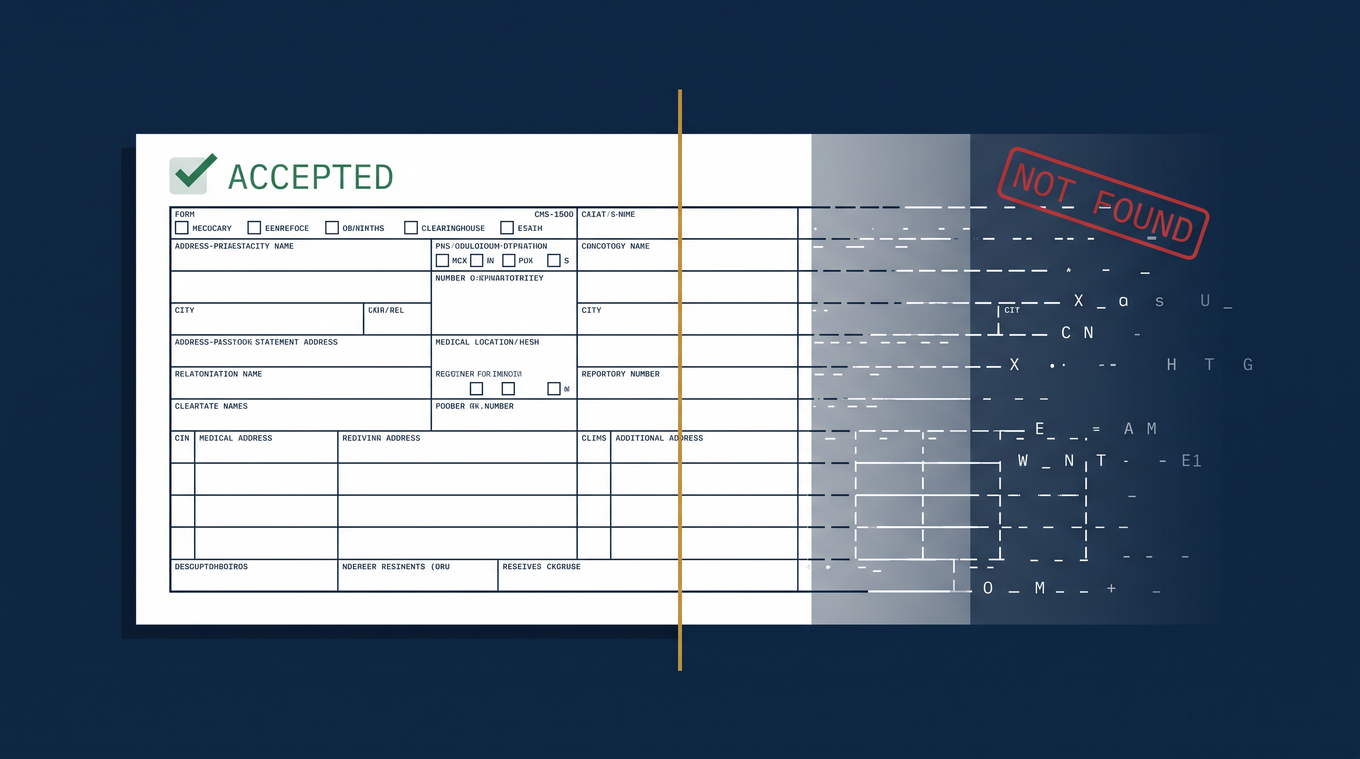
Your clearinghouse says the claim was accepted. Aetna says there is no claim. You have the batch report open in one window and a representative on the phone in the other, and the two of you are describing different realities. A biller on a public coding forum put the whole experience into five words: "We are sending, but it's not received?" - an anecdote, not a statistic, but one that almost every behavioral health practice recognizes.
If you have already read two or three guides to Aetna mental health billing, you probably came away with a payer ID and a timely filing number. Then the denials kept coming. That is not because you misunderstood the advice. It is because the advice answered a question you were not actually asking. Neither the payer ID nor the filing deadline is a constant across Aetna's products - and a page that hands you one number for either is describing a single setup it happened to see, not a rule you can apply to the card in front of you.
So this guide does something different. By the end you will be able to work out which Aetna entity is actually responsible for a given claim, which rulebook governs it, which of at least six deadlines is running, and what evidence to keep so you can prove it later. You will also learn which questions have no published national answer at all - because knowing that stops you hunting for a number that does not exist, and it stops you pasting someone else's number into your payer master.
We run behavioral health revenue cycles for a living: credentialing and payer enrollment, claim submission, denial work, appeals. The Aetna claims that fail in our queues rarely fail at the claim form. They fail earlier, at a routing or evidence decision made before anyone opened the claim - and that is a much cheaper problem to fix once you can see it.
Verified against Aetna's live provider materials on August 17, 2026. Payer policy moves. This is operational guidance for billing teams, not legal advice, coding instruction, or a coverage determination. The member's plan documents, ID card, current eligibility response, your provider agreement, and Aetna's response to your specific claim always control.
Why "Aetna" is not one behavioral health billing destination
The Aetna logo on a member's card tells you less than you think. It can sit in front of at least six materially different workflows, each with its own administrator, rulebook, authorization path, filing period, and appeal address.
| What the member has | Who administers behavioral health | Who actually adjudicates the claim | The trap |
|---|---|---|---|
| Aetna commercial, fully insured | Aetna Behavioral Health, an internal Aetna business unit | Aetna, through its standard commercial workflow | Treating a national guide as a coverage guarantee |
| Self-funded employer plan administered by Aetna | Usually Aetna - but the sponsor can buy different benefit and authorization features, or opt out of programs | Aetna, if the card and eligibility response say so | Assuming fully insured rules apply to an ERISA plan |
| Aetna Signature Administrators, Meritain, or another rented-network arrangement | Aetna may supply network access and some utilization management; the administrator remains the payer | The third-party administrator named on the card | Seeing the Aetna logo and sending the claim to Aetna |
| Aetna Medicare Advantage | Aetna, with Medicare coverage rules layered over plan terms | Aetna Medicare, unless the card says otherwise | Importing Original Medicare's rules, or using an ABN as though this were fee-for-service |
| Resources for Living (Aetna EAP) | Aetna Resources for Living, under a separate network and authorization | A separate EAP claim lane with its own payer ID | Billing the visit as an ordinary behavioral health claim |
| Aetna Better Health (Medicaid/CHIP) | Varies by state; some states integrate care, others keep specialty carve-outs | The state-specific plan - or another state-designated entity entirely | Publishing one "Aetna Medicaid" payer ID or filing rule |
Aetna's own Office Manual for Health Care Professionals, June 2026 edition, is unusually direct about the first row: Aetna Behavioral Health is an internal business unit of Aetna, and behavioral care is integrated across the product spectrum. That is genuinely useful, and it retires the old assumption that every Aetna behavioral claim gets carved out to some separate national managed-behavioral company.
But "internal" is not "uniform." The same manual preserves exceptions for benefits Aetna administers without controlling, for self-funded sponsors who purchased different authorization requirements, for state rules that supersede national policy, for products excluded from the national behavioral authorization list, for delegated and rented-network arrangements, and for Medicaid programs whose behavioral system is defined by the state.
The rented-network case deserves its own sentence, because it is the one that quietly destroys filing deadlines. Aetna's Signature Administrators Provider Guide (April 2026) explains that in these arrangements Aetna provides the PPO network, negotiated rates, policies, and certain utilization and case management functions - while the payer or third-party administrator receives the claim, adjudicates it, issues the explanation of review, and pays it. The guide tells providers to recognize both logos on the card, to select the administrator rather than Aetna when checking eligibility, and to send the claim to the payer ID on the member's card.
An Aetna logo does not prove Aetna receives the claim.
That is the single most useful sentence in this entire guide, and it is not on any claim form. The manual gives the same instruction for Meritain Health and Schaller Anderson Medicaid members: use the member's ID card rather than Aetna's general paper-claim table.
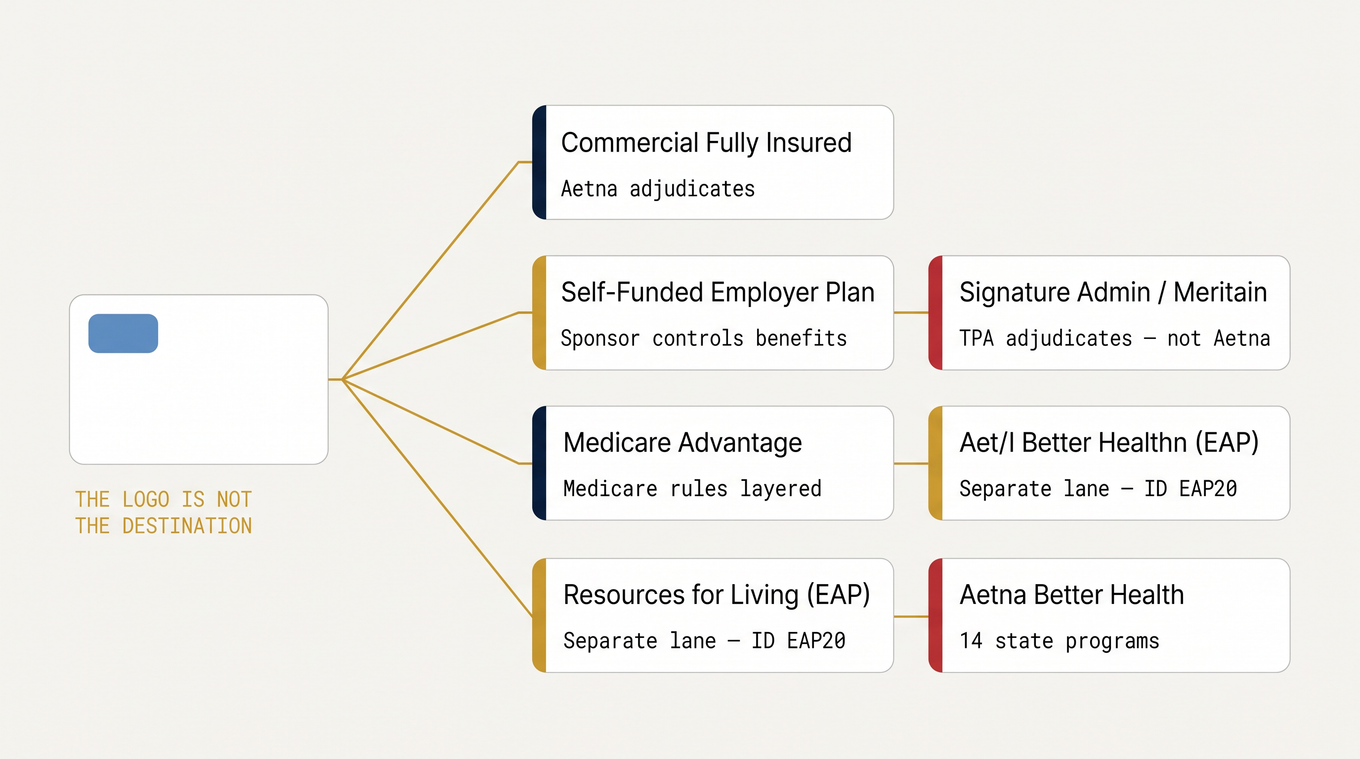
Which means the first question is never "what is the payer ID." It is "whose claim is this." Here is how to answer that in the first few minutes of a new patient relationship, before a single claim leaves your system.
Start with the member's product, not the payer ID
Most Aetna routing failures are not decisions. They are inheritances - a payer ID copied into a practice management system three years ago that has outlived a contract change, a TPA switch, or a new plan year. Nobody chose wrong. Nobody chose at all.
Capture the evidence, not just the subscriber number
At registration, store more than the member ID:
- The front and back of the card
- Plan and product name, with any network label
- Group number and coverage effective date
- The claims administrator's name, with its electronic payer ID and paper address as shown on the card
- The behavioral health and authorization phone numbers
- The complete, dated eligibility and benefit response you pulled on the date of service - the item practices most often skip
Aetna's manual points providers to Availity for current product and benefit information, and Aetna's claims and payment resources cover digital ID card access through the same tools. Save that response. A generic web page cannot tell you who is responsible for one member's claim; a dated eligibility response can, and it is the document that wins arguments six months later.
Note specifically whether the response identifies Medicare, Medicaid, CHIP, EAP, student health, Signature Administrators, Meritain, a dual-eligible product, or any other delegated arrangement. If you verify by phone, record the reference number and the representative's name.
Ask which product bucket this is
Then work through the questions in order. Is this commercial, Medicare Advantage, Medicaid or CHIP, EAP, or another supplemental product? If commercial, is it fully insured or self-funded? Does the card name a third-party administrator, or use language suggesting Aetna supplies only network access? Does the member have a separate behavioral administrator or fall under a state public behavioral health system? Is this particular visit being delivered under an EAP authorization rather than the medical benefit?
"Aetna PPO" is not an answer to any of these.
The fully insured versus self-funded distinction earns its keep here. A fully insured policy sits under the insurance contract and state insurance mandates. A self-funded employer plan can carry sponsor-selected benefits and administrative arrangements that differ from Aetna's national default. Aetna's telehealth language illustrates it precisely: telebehavioral services are offered to all fully insured commercial members and to self-insured plan sponsors unless those sponsors opt out. Same carrier, same service, two different answers depending on a decision made by an employer you will never speak to.
Verify benefits by service category, not by "mental health"
Ask for benefits at the level you will actually bill:
- Diagnostic evaluation
- Individual psychotherapy
- Psychiatry evaluation and management with a psychotherapy add-on
- Family and group work
- Psychological and neuropsychological testing
- Crisis services
- Telehealth and audio-only
- Intensive outpatient
- Partial hospitalization
- Inpatient psychiatric care
- Residential treatment
- Applied behavior analysis
- Transcranial magnetic stimulation
- Electroconvulsive therapy
- Out-of-network care with any network exception
The same member can carry different authorization requirements, cost sharing, network rules, and claim formats across that list. A single "yes, mental health is covered" answers none of it.
One more distinction worth separating in your own head, because Aetna's manual separates them and denials follow when practices don't: referral, coverage, network status, and prior authorization are four different things. The manual's "direct access" language means a member may not need a referral to seek behavioral care. It does not prove the clinician is in network for that product, that the service is covered, that the deductible is met, or that no authorization is required.
Get all of that right and you can still be denied - because being contracted is not the same as being in the payer's claim system.
Credentialing, contracting, and being loaded for claims
Practices routinely collapse three separate processes into one word. They are not one process, and the gaps between them produce denials that look like coding errors.
Contracting is agreeing to network terms and fee schedules. Credentialing is validating the clinician's or facility's qualifications. Enrollment and loading is placing that provider, TIN, NPI, specialty, taxonomy, location, and effective date correctly into the payer's claim system for the relevant product.
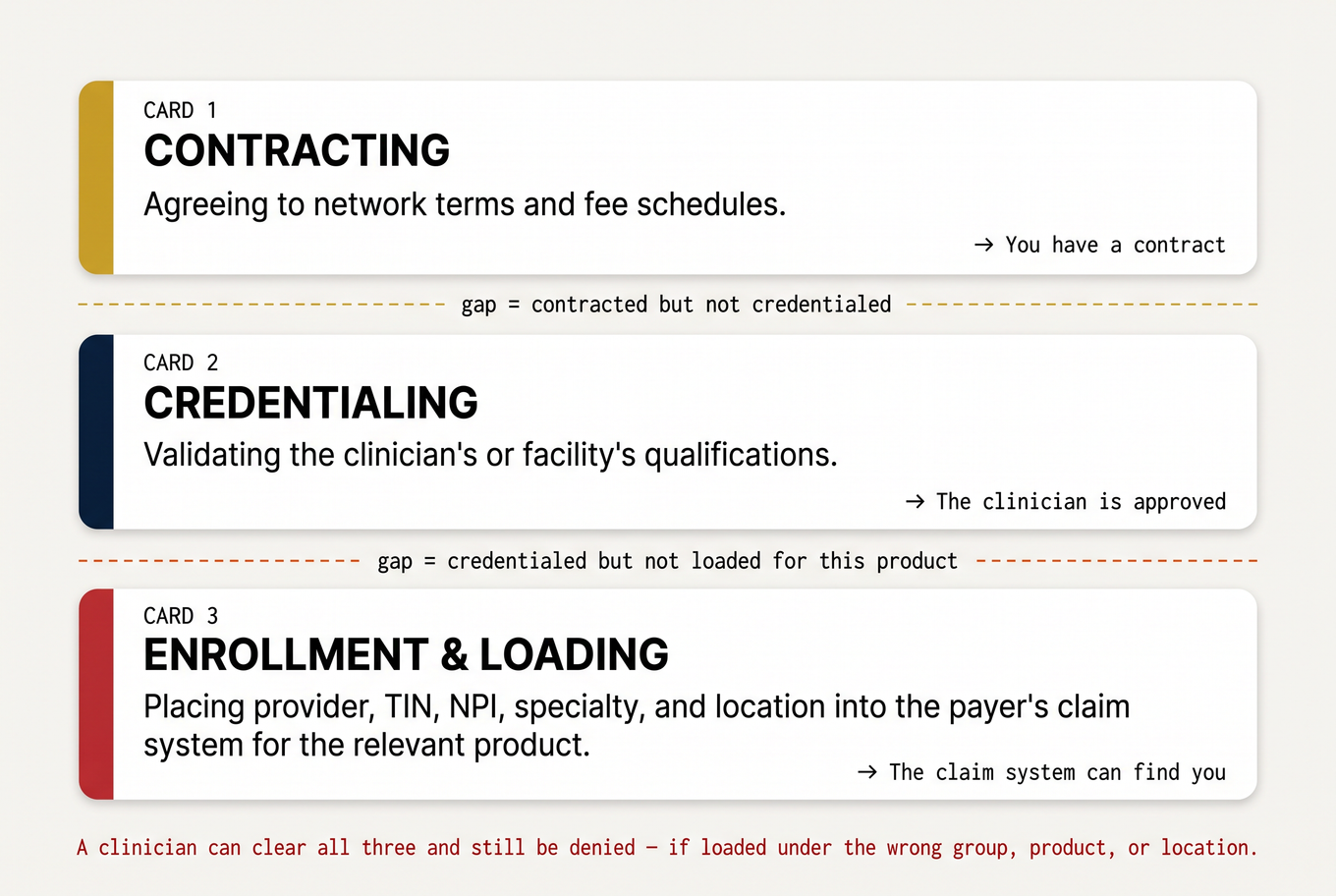
A clinician can be credentialed but not loaded under the right group or location. A group can be contracted while a rendering clinician remains out of network. A Medicaid clinician can be approved by the managed care organization and still not be enrolled with the state. And a clinician in Aetna's behavioral network is not thereby in the separate EAP network.
On the mechanics, Aetna publishes real detail: providers must be credentialed to participate, recredentialing generally occurs every three years unless law or accreditation requires otherwise, verification runs through an NCQA-certified credentialing verification organization, and in most states Aetna uses CAQH ProView with the provider authorizing Aetna's access to the application.
What Aetna does not publish is how long it takes.
We want to be plain about that, because a number is circulating. You will find vendor pages quoting 90 to 120 days for Aetna credentialing. That range does not appear in the official materials. Actual duration depends on application completeness, state law, provider type, network need, delegated credentialing arrangements, committee timing, and contracting - and we would rather tell you to start early and check status through Aetna's credentialing customer service than repeat a timeline Aetna has never committed to.
Before you bill the first date of service under a new approval, get written or portal confirmation of:
- The contract and product name
- The effective date
- Billing TIN and NPI
- Rendering NPI
- Specialty and taxonomy
- Practice and pay-to addresses
- Service location
- Group affiliation
- EFT and ERA enrollment
- Telehealth status, if tracked separately
- Whether retroactive claims are permitted, and how far back
- Whether existing authorizations need amending to the new provider record
Then run an eligibility inquiry and one low-risk test claim. A contract signature date is not a claims-system effective date, and finding out which is which costs one claim rather than sixty.
This is also where that forum quote from the opening finally makes sense. The 837 really did contain the rendering provider. The payer's adjudication system simply never mapped that provider to the group, product, and location - so from Aetna's side, there was nothing to receive. Both people on that phone call were telling the truth.
Get the provider record right and you are still one gate away, because some services need permission before anyone renders them.
Which mental health services require prior authorization
This is the section where the internet is least reliable about Aetna behavioral health, so we are going to be careful about what is established and what is not.
As of August 17, 2026, Aetna's live precertification page and its precertification lists index link two separate documents: a general participating-provider list updated August 1, 2026, and a link labeled "2025 behavioral health precertification list" whose PDF carries an effective and last-updated date of August 1, 2024.
We are flagging that openly rather than quietly building on it. The document is two years old and labeled with a third year. It is not invalid - Aetna is actively linking it as the current behavioral reference - but it is a strong argument for verifying against the member through Aetna's code-search and eligibility tools rather than trusting any static screenshot, including the table below.
What is on Aetna's national behavioral health list
| Service category | Codes or scope Aetna names | What it means operationally |
|---|---|---|
| Inpatient confinements | Hospital, psychiatric hospital, SUD facility, residential examples | Obtain preadmission authorization; report emergencies and admissions under the plan's rules; expect concurrent review |
| Partial hospitalization (PHP) | H0035, H2036, S0201; G0410 and G0411 for Medicare Advantage | Do not assume IOP and PHP share a rule; verify level, units or days, facility, and review schedule |
| Applied behavior analysis | 97151–97158, 0362T, 0373T | The authorization must align to the assessment or treatment code, the rendering staff, units, dates, and plan |
| Residential treatment | H0010, H0011, H0017, H0018, H0019, H2034, T2048 | Written level-of-care and per-diem or unit authorization is essential; a step-down can require a new one |
| Transcranial magnetic stimulation | 90867, 90868, 90869 | Use the current clinical policy bulletin and request form; document criteria and prior treatment |
| In-network benefit for an out-of-network provider | No single code list | Obtain the network-exception determination before non-emergency care |
| ⚠ Everything else | - | Absence from this list is not a coverage guarantee. See below - this row is the most important one in the table. |
Source: Aetna's behavioral health precertification list, effective and last updated August 1, 2024, still linked from Aetna's live precertification page on August 17, 2026. The list also covers procedure categories outside the scope of this guide.
Why "not listed" is not "not required"
The national behavioral list does not show ordinary office psychotherapy codes such as 90832, 90834, or 90837. It does not show intensive outpatient, psychological testing, or electroconvulsive therapy. And it publishes no national threshold at which routine therapy triggers review.
You will see pages that publish exactly such a threshold - commonly "concurrent review after 20 sessions" or "after 30 sessions." We could not find that rule in Aetna's live national behavioral list or in the June 2026 manual. It may reflect somebody's specific contract or internal experience. It is not established as a national Aetna rule, and it should not be treated as one.
But the correct conclusion is emphatically not "Aetna never requires authorization for therapy." The June 2026 manual states that outpatient care inconsistent with evidence-based, goal-directed treatment, with Aetna's clinical policy bulletins, or with clinical guidelines may be subject to quality and utilization review - and may become subject to authorization. The member's plan, the employer's setup, state requirements, the code-search response, and the treatment history can each create a requirement the national list does not show.
So the safe formulation, which is worth adopting verbatim in your own internal documentation:
These services are not named as universal national behavioral health authorization items on Aetna's current linked list. The member's plan, state, employer setup, clinical policy, and utilization history can still create a requirement. Verify per member, before treatment.
That is also why documentation matters even when no authorization is required at intake. What makes a course of treatment defensible if it is reviewed later:
- Diagnosis and current functional impairment
- Treatment goals and measurable progress
- The intervention and the member's response
- The rationale for frequency and duration
- Documented psychotherapy time
- Coordination with medical care
- Discharge or step-down planning
Not documentation written to please an insurer, but documentation clear enough that the clinically necessary work can be understood by someone reading it cold.
A reference number is not an approval
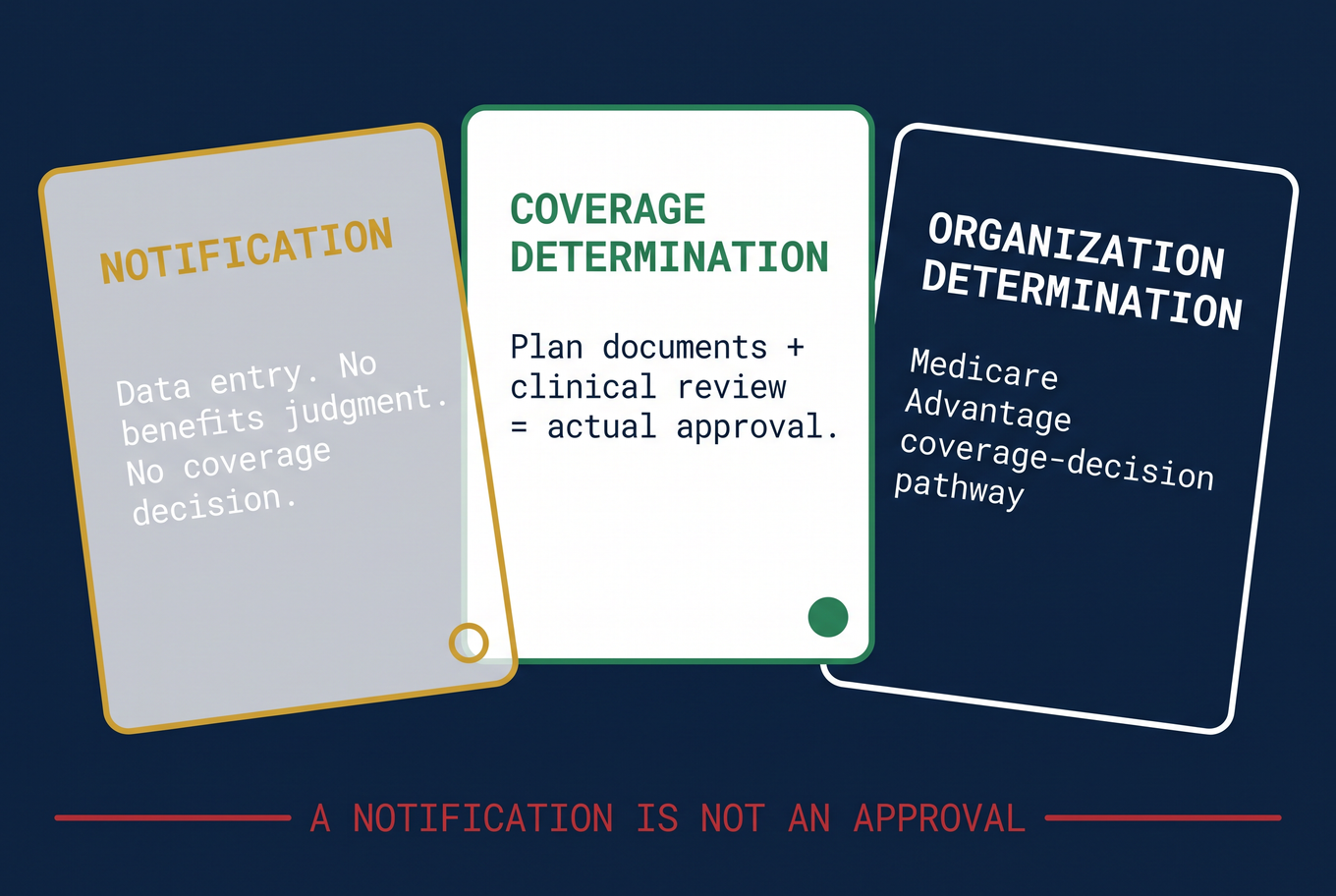
Aetna's general precertification list distinguishes a tracking number, assigned while records are under review, from an actual coverage decision. It says so explicitly. The distinction is easy to lose in a busy intake process, and expensive when it is lost.
Aetna's precertification overview separates three things worth keeping separate: notification, a data-entry process that involves no benefits judgment; a coverage determination, decided on plan documents and clinical review; and an organization determination, the Medicare Advantage coverage-decision pathway. A hospital admission notification can exist without any proof that subsequent days or services were approved. Ask which one you actually have.
Before you submit, reconcile the authorization against the claim:
- Member and product
- Authorization status
- Authorization number
- Approved level of care and place of service
- Approved codes or service category
- Approved visits, units, or days
- The exact approved date span
- Provider and facility identifiers
- Whether the rendering clinician must be named
- The concurrent-review due date
- Whether a discharge, readmission, or step-down needs a new request
Step-down is a new authorization
Aetna's manual is explicit that moving to a less restrictive level of care within the same facility - even within the same unit - requires authorization. An approval for inpatient detoxification does not carry into inpatient rehabilitation, residential care, partial hospitalization, or intensive outpatient.
Request the next level before the transition, with:
- Current presentation and risk
- Progress achieved at the present level
- Why the lower level is now appropriate
- The proposed schedule and intensity
- The discharge environment and supports
- The medication and follow-up plan
- The requested start date and unit count
Concurrent review runs on the same principle. Aetna describes it as evaluation of the course of care during a facility episode, and its national manual publishes no single universal behavioral cadence - the interval depends on product, level, state, authorization, and reviewer. So at admission, capture:
- The first and last approved day
- The next review date and its submission deadline
- The reviewer's submission channel
- The required clinical elements
- Whether weekend rules shift the due date
- Whether a peer-to-peer review is available
Treat each authorized day as a revenue asset with an expiry. Clinical staff should never learn after discharge that a review was due two days earlier.
Two further points on criteria. Aetna identifies several sources depending on the case: CMS national and local coverage determinations and Medicare manuals for Medicare Advantage, its own clinical policy bulletins, MCG, the ASAM Criteria third edition, LOCUS, CALOCUS-CASII, New York's LOCADTR where applicable, and ABA guidelines. A medical-necessity submission that names the governing criteria and maps the record to them criterion by criterion is materially stronger than a general treatment summary.
And the state supplement will defeat any universal rule you try to build. California's supplement states that effective March 1, 2024, outpatient behavioral health services do not require authorization for specified fully insured commercial products, while inpatient behavioral services do. Massachusetts lists routine behavioral therapy and routine outpatient psychopharmacology without authorization, with separate state rules for substance use disorder. Aetna's national precertification material says its precertification programs do not apply to fully insured Indiana members at all. Find the supplement for your state before you conclude anything.
Authorization in hand, the claim can still be denied - because the authorization has to match, and the claim has to arrive.
Payer IDs, claim submission, and proving the claim arrived
Availity is Aetna's front door for professional and institutional claims, eligibility and benefits, claim status, authorization requests, clinical uploads, and disputes. It is not, by itself, an answer to "who is the payer." For Aetna Better Health, Availity typically launches an Office Ally Medicaid claim-entry workflow. For Signature Administrators, Aetna tells you to select the administrator. For EAP, the claim leaves through an entirely separate lane. "Use Availity" and "identify the payer" are different instructions.
Professional claim or institutional claim?
Most independent therapist, psychologist, and psychiatrist claims travel on an 837P - the electronic equivalent of the CMS-1500. But facility programs may require an 837I, the institutional format behind the UB-04, depending on licensure, contract, and service. Inpatient psychiatric hospitals, partial hospitalization programs, and residential facilities can all sit on the institutional side.
Which is why "mental health claims use the CMS-1500" is a statement worth retiring. The claim format has to match the contracted billing entity and the benefit arrangement, not the specialty.
Payer IDs are product-specific, not brand-level
You will see 60054 published as the Aetna payer ID. Here is the accurate version: 60054 appears in official Aetna material - specifically the Medicare Advantage PPO guide for nonparticipating providers - and many clearinghouse directories use it for standard Aetna transactions. That is real. What it is not is a brand-level constant, because EAP uses its own identifier, Aetna Voluntary Plans use 57604, Signature Administrators claims use the administrator's payer ID, Aetna Better Health plans use state-specific identifiers or Office Ally routing, and your own clearinghouse enrollment can require a different receiver.
Verify the payer ID from the member's card, the current eligibility response, and your clearinghouse's payer list. Do not apply an Aetna commercial ID to an EAP, administrator-managed, or Aetna Better Health claim simply because the card carries an Aetna logo.
On paper claims, the June 2026 manual gives two fallback addresses by provider location - PO Box 14079 in Lexington, Kentucky for one group of states, and PO Box 981106 in El Paso, Texas for another - with all Aetna Medicare Advantage and Aetna Student Health paper claims going to El Paso, and Aetna Voluntary Plans to Lexington. Signature Administrators, Meritain, and Schaller Anderson Medicaid claims are excluded from that table entirely; use the card. And a paper address is not an electronic payer ID. They are different fields solving different problems, and they should never be treated as interchangeable in your payer master.
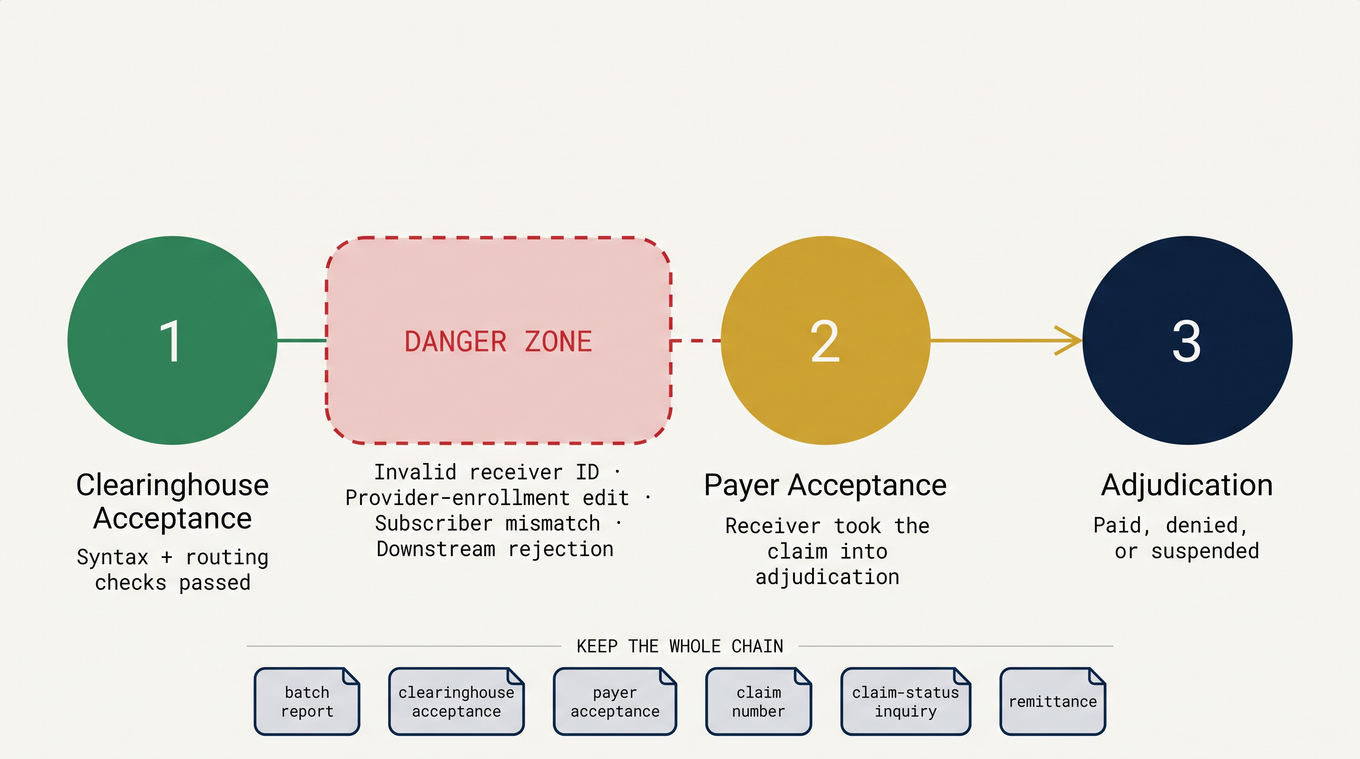
Two acceptances, not one
This is the control most practices are missing, and it is the one that decides timely-filing disputes.
There are three distinct states, not two. Clearinghouse acceptance means the file passed the clearinghouse's syntax and routing checks. Payer acceptance means the receiver took the claim into adjudication. Adjudication means the payer paid, denied, or suspended it. A claim can show as accepted in your EHR and never reach the payer at all - because of an invalid receiver ID, a provider-enrollment edit, a subscriber mismatch, or a downstream rejection nobody reviewed.
Keep the whole chain: the practice management batch report, the clearinghouse acceptance or rejection, the payer-level acceptance or rejection, the claim number in the payer's system, the claim-status inquiry, and the final remittance. Aetna's manual tells providers to review vendor rejection reports and correct rejected claims. Aetna Better Health of Louisiana and Virginia go further and expressly point providers to second-level acceptance evidence when a filing dispute arises.
A claim visible in your clearinghouse but absent from the payer's system is not a denied claim. It is a transmission, mapping, enrollment, or routing investigation. Treating it as a denial sends staff down the wrong path for weeks.
Corrected claims are not duplicates
When you correct an electronic claim, use the correct claim frequency or replacement indicator, include the original payer claim control number, rebill the lines as the payer requires, fix the actual data error, and retain both the original and corrected claim images alongside the acceptance and final remittance.
Sending the same claim again is not correcting it. It produces a duplicate adjustment code, and it preserves nothing if the real problem was authorization, enrollment, routing, or medical necessity. Meanwhile the filing deadline keeps getting closer.
Out-of-network claims carry their own preconditions. Before non-emergency out-of-network care, get written confirmation of:
- Whether the plan has out-of-network benefits
- Whether the member is requesting a network-gap exception
- The allowed amount or single-case rate
- The authorization and its dates
- Provider and facility identifiers
- Payment direction and assignment rules
- The member's cost sharing
- Records and claim-format requirements
- Balance-billing constraints Aetna publishes an outpatient behavioral health preauthorization request for nonparticipating providers for this pathway. Be aware that a nonparticipating provider may need to be loaded in the payer's system before an otherwise valid electronic claim can adjudicate at all.
There is one service configuration where all of this gets re-litigated per plan, and where the gap between "covered" and "payable" is widest.
Telehealth billing: covered does not mean payable
Aetna's June 2026 manual says Aetna Behavioral Health offers telehealth services to all commercial fully insured members, and to commercial self-insured plan sponsors unless the sponsor opts out, with the clinician acting within scope and holding the licensure the relevant state requires.
That is a benefit statement. It is not a claim-edit table, and the manual does not publish one national instruction saying every behavioral telehealth claim uses the same place of service and modifier.
Four claims circulate widely and all four flatten real differences between commercial, Medicare Advantage, and Medicaid rules:
- "Aetna always requires modifier 95."
- "Use place of service 10 for every teletherapy claim."
- "Audio-only is always covered."
- "Aetna telehealth follows Medicare for every plan."
For any given member, verify instead:
- Whether telehealth and audio-only are covered
- The patient's location
- The clinician's location and licensure
- Synchronous video versus audio-only
- Place of service
- Modifier
- Provider type
- The code and diagnosis combination
- Whether cost sharing differs
- Whether the employer opted out of, or narrowed, the benefit
For Medicare Advantage, the sequence runs through Medicare's rules first. CMS's telehealth guidance - with its FAQ updated February 26, 2026 - continues broad location flexibility through 2027, and behavioral health telehealth retains flexibility beyond the general restrictions. CMS's place of service code set defines 02 for telehealth provided somewhere other than the patient's home and 10 for telehealth with the patient at home, and the service still has to appear on the current list of Medicare telehealth services. Confirm Medicare eligibility for the service, then the plan's benefit and any authorization or organization determination, then choose place of service by patient location, then apply the current modality instruction, then verify licensure and enrollment, then retain the consent and location documentation.
For Medicaid, each Aetna Better Health state sits inside a different state telehealth framework governing covered providers, originating and distant sites, home and school services, audio-only, place of service and modifier combinations, consent, documentation, enrollment, and encounter reporting. The national commercial manual is not the source of truth for those claims.
When a telebehavioral claim denies, resist the urge to change the modifier and move on. Compare the product, the patient's location on the date of service, the clinician's location and licensure, place of service, modifier and modality, taxonomy and enrollment for telehealth, the code and diagnosis combination, whether this is a benefit exclusion or a claim-format edit, the authorization, whether the payer processed it as facility or non-facility, the full remittance codes, and a previously paid claim under the same member and product. Get the actual adjustment and remark codes and the dated policy before you change a clinically correct claim across your whole panel.
And then there is one lane where none of the above applies, because the claim never belonged in your Aetna workflow to begin with.
How to bill Aetna EAP claims (Resources for Living)
If you take Aetna Resources for Living referrals, this section is worth more than the rest of the guide combined, because an EAP session billed as an ordinary Aetna claim tends to fail silently, and the practice usually discovers it after the deadline.
Aetna's Resources for Living EAP Provider Manual, dated March 2026, describes a separate provider network with its own credentialing, and a member-specific authorization process. Standard Aetna network status is not proof of EAP participation.
Before the first EAP visit, obtain the authorization showing the member's identity, the authorization number, the number of authorized sessions, the start and end dates, the applicable EAP rate, and any referral or case notes the program requires. That authorization is member-specific and nontransferable. Employers commonly design a small defined number of sessions, but the number on the individual authorization controls - not a generic "Aetna EAP limit" someone remembers from a different employer.
Then the claim rules, which differ from the medical benefit in every respect that matters:
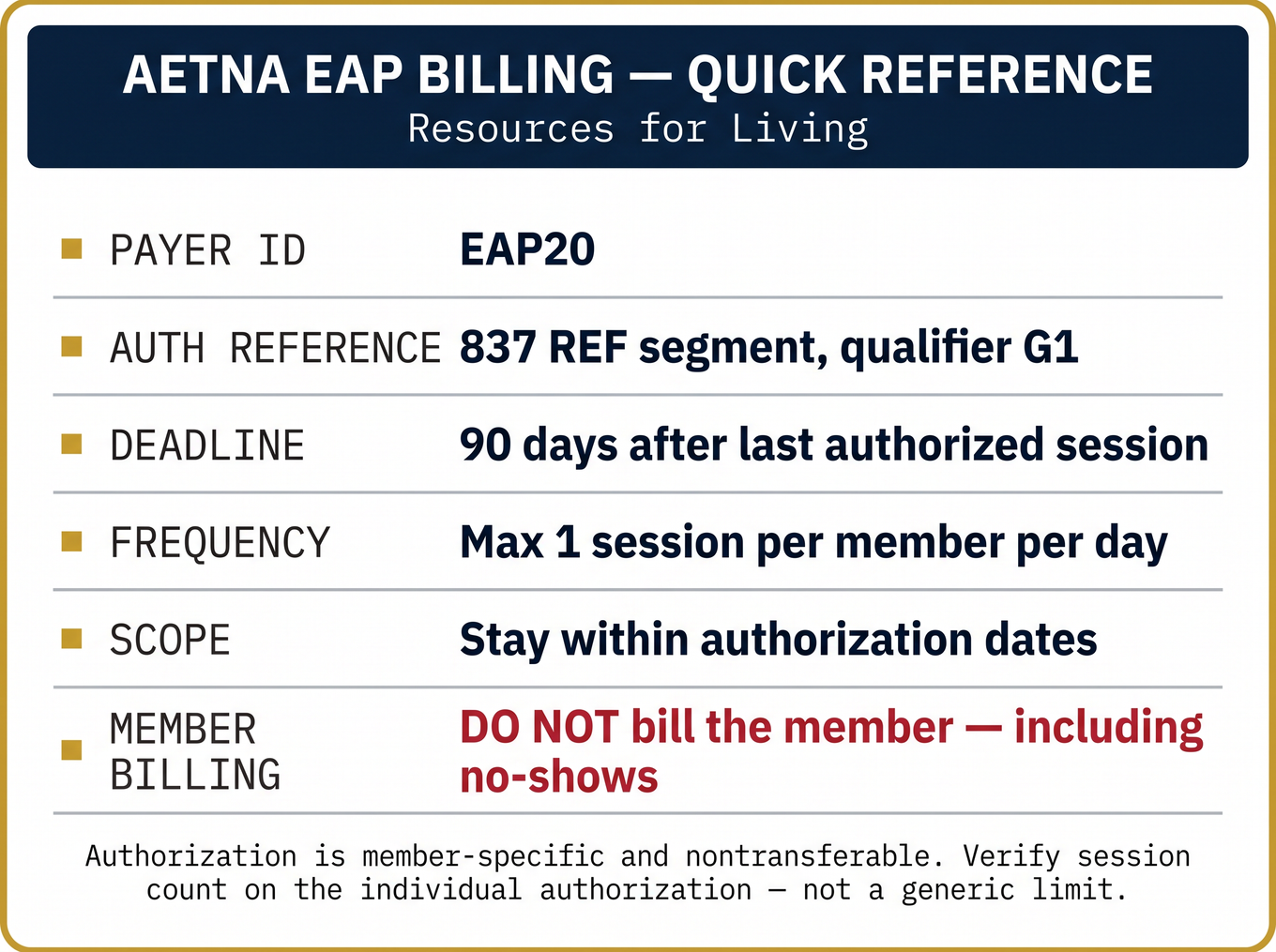
- Use electronic payer ID EAP20.
- Place the authorization reference in the 837's
REFsegment with qualifierG1. - Submit after each session or after the authorized series, but no later than 90 days after the last session date.
- Bill no more than one EAP session per member per day.
- Keep services within the authorization dates.
- Do not bill the member for an EAP service - including a no-show, and including an authorized session that goes unpaid.
That 90-day rule deserves a second look, because it is not what people assume. It is not 90 days from each date of service. It runs from the last session date in the authorized series. Even so, submit promptly after each session rather than treating the final day as a batching strategy.
There is a contradiction in circulation here that we should name without naming anyone. A widely-read practice-software support article gives Aetna as an example of billing EAP through the normal payer ID with an EAP service code. Aetna's own current manual instructs providers to use EAP20 with the member-specific authorization. For an Aetna claim, Aetna's manual is the controlling source.
Two operational cautions. First, successful claim submission and successful remittance enrollment are separate implementation problems - a practice can route claims correctly to EAP20 and still have no working ERA setup, which is exactly the gap one biller described on a public forum when trying to identify the right 835 enrollment. Test claim acceptance, EFT enrollment, ERA enrollment and receiver ID, and reconciliation separately. Second, the EAP manual contains a billing-code table with some older or conditional coding families in it; verify the current code set, your contract, the authorization, and the clinician's scope for each date of service rather than treating that table as a standing CPT guide.
The EAP deadline is one of several running simultaneously - and most practices are tracking the wrong one.
Aetna timely filing limits: which deadline applies, and what proves it
At least six separate deadlines can be running on the same episode of care: the initial claim, measured from the date of service, plus the corrected or replacement claim, coordination-of-benefits claim after the primary payer acts, reconsideration, appeal, and external review or state complaint.
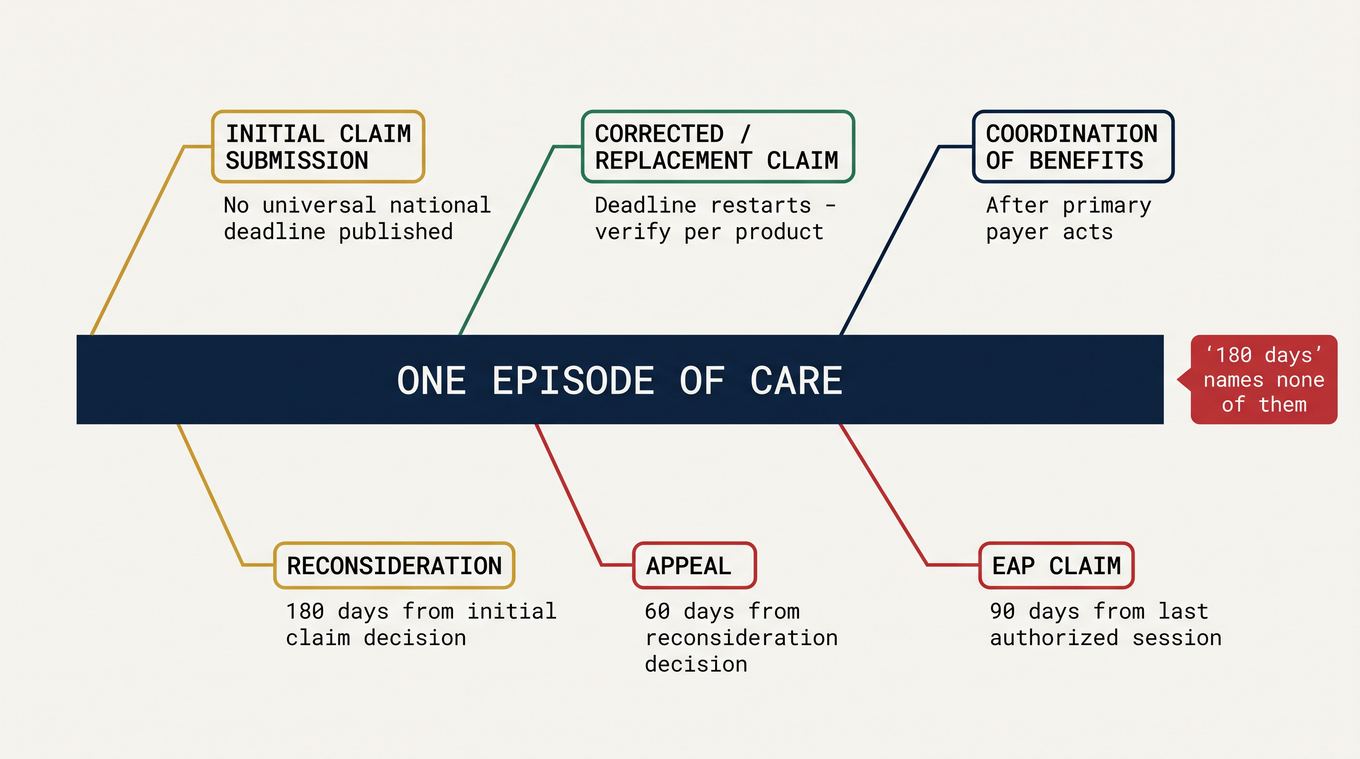
"Aetna's timely filing is 180 days" names none of them - which is exactly how a practice misses a deadline it was certain it still had.
| Deadline | The honest national answer |
|---|---|
| Initial commercial claim | No universal number is published in the June 2026 manual. Check your provider agreement, product terms, TPA instructions, and the claim response. |
| Reconsideration | 180 calendar days from the initial claim decision |
| Appeal after reconsideration | 60 calendar days from the reconsideration decision |
| EAP claim | 90 days after the last authorized session |
| Medicare Advantage | Verify under the plan and provider agreement - Original Medicare's rule does not automatically apply |
| Aetna Better Health (Medicaid) | 120 days to one year depending on the state program - see the matrix below |
The 180-day figure is real, and it is the one most often misused. Aetna's disputes and appeals page states that a provider must file a reconsideration within 180 calendar days of the initial claim decision. That is a post-adjudication dispute deadline. It says nothing about how long you have to file the original claim from the date of service. A text review of the current manual does not locate a national initial-claim period at all: the manual defines a clean claim as one received timely and complete, without supplying one number for every commercial product.
For rented-network and self-funded arrangements, the administrator's contract controls. You cannot preserve a TPA's filing limit by repeatedly asking Aetna to locate a claim Aetna never adjudicated.
Medicare Advantage deserves precision because a specific error is widespread. Original Medicare's fee-for-service rule, at 42 CFR § 424.44, generally requires a claim no later than one calendar year after the date of service. But CMS's Medicare Managed Care Manual guidance says Medicare Advantage organizations need not follow Original Medicare claims-processing procedures and may establish their own billing and payment procedures. Some pages cite a prompt-payment regulation as though it created a mandatory 12-month initial-filing floor for Medicare Advantage. It does not; prompt payment and timely filing are different questions. Verify the deadline under the Aetna plan and your provider agreement, and note separately that a noncontracted Medicare provider has up to 65 days in the direct-appeal circumstance Aetna's dispute page describes.
Proof of timely filing matters as much as the deadline itself.
Strong evidence:
- Payer-level electronic acceptance showing the date received
- The claim number and payer status
- Trackable mail, for an allowed paper claim
- Portal submission confirmation
- A state-required second-level acceptance report
- The primary payer's EOB, for coordination-of-benefits timing
- A retroactive eligibility notice
- A payer ticket showing a routing or system error
Weak evidence, on its own:
- An EHR "created" date
- A batch marked "sent" with no downstream acceptance
- A screenshot of a clearinghouse queue with no receiver response
- A phone note that does not identify the claim
- A freshly generated claim image with no transmission record
One control failure is worth naming because it is so common. A biller described on a public forum the experience of claims being reprocessed repeatedly while representatives confirmed an authorization was on file - until the whole thing ended in a timely-filing denial. That is an anecdote, not a prevalence figure, but the lesson generalizes: a call-center reprocessing promise should not be assumed to pause the formal dispute deadline unless the payer confirms that in writing. File the formal dispute before the deadline even while reprocessing is pending, keep every call reference number in the packet, and escalate when a claim has been reprocessed more than once without anyone correcting the root cause.
The remittance is where you find out which deadline you were actually working against - and, if you read it properly, what went wrong upstream long before anyone printed a claim.
Denial codes: read the remittance before you change the claim
Four different events end up in most practices' single "denials" queue, and giving staff one generic instruction to rebill is the most expensive process failure in behavioral health billing.
A front-end rejection means the transaction never became an adjudicated claim; there may be no appealable claim number yet. Acceptance followed by denial means the claim adjudicated but no payment was allowed. Payment with an adjustment, downcoding, or bundling means the payer allowed something other than what you billed - a coding and payment-policy question, not a denial appeal. Recoupment means the payer previously paid and is taking money back, with its own notice, lookback, and appeal rights.
Then read the codes properly. X12's claim adjustment reason codes explain the broad financial adjustment; remittance advice remark codes supply the detail. A reason code that instructs you to consult a remark code is incomplete without it - and these are generic industry code definitions, not statements of Aetna policy.
| Code | General meaning | What it often signals in this workflow | First evidence to pull |
|---|---|---|---|
| 16 | Missing or invalid information | NPI or taxonomy, a claim field, modifier, diagnosis, authorization reference, or attachment | Full remark codes, claim image, payer edit message |
| 18 | Duplicate | An unchanged claim was rebilled, or a replacement lacked the frequency code and original control number | Original claim status, frequency code, payer claim number |
| 29 | Filing period expired | A deadline expired - or the payer cannot see earlier timely receipt | Payer acceptance, contract or state rule, chronology |
| 50 | Not medically necessary | A clinical or level-of-care determination; needs a clinical appeal, not a corrected claim | Adverse determination, governing criteria, records |
| 96 | Noncovered charge | Product exclusion, wrong benefit bucket, missing modifier or place of service, or a carve-out | Remark code, plan benefits, eligibility, service category |
| 97 | Bundled | A code-edit or payment-policy question | Claim lines, payer policy, documentation |
| 109 | Not covered by this payer | The routing tell - wrong administrator, carve-out, TPA, EAP sent to the medical payer, or coordination-of-benefits error | Card, eligibility response, routing evidence |
| 197 | Authorization absent | The authorization tell - no auth, or an auth that failed to match code, provider, date, or level | Written approval, authorization number, billed fields |
| 204 | Not covered under the current plan | A true benefit exclusion, or a wrong product assumption | Plan benefits, evidence of coverage, service eligibility |
| 206–208 | NPI issue | Rendering or billing provider missing, invalid, or not matched to the TIN | Claim provider loops, enrollment roster |
| 210 | Authorization not timely | Late request, missed concurrent review, or retroauthorization not permitted | Submission timestamps, admission and step-down chronology |
Two of these deserve special attention. 109 is almost always a routing problem - compare the date-of-service card and eligibility response against the receiver ID actually used on the claim, rather than trusting the payer name stored in your practice management system. 197 is rarely binary. The authorization usually exists; it simply fails to match, because of a wrong billing or rendering NPI, a facility-versus-professional mismatch, the wrong code family, an approved level that differs from the billed level, exhausted units, a date outside the approved span, an unauthorized step-down, an authorization under a different administrator, a reference entered in the wrong field, or a concurrent review that was never completed. Map every billed field against the written approval in a one-page table. "Auth on file" is not a diagnosis.
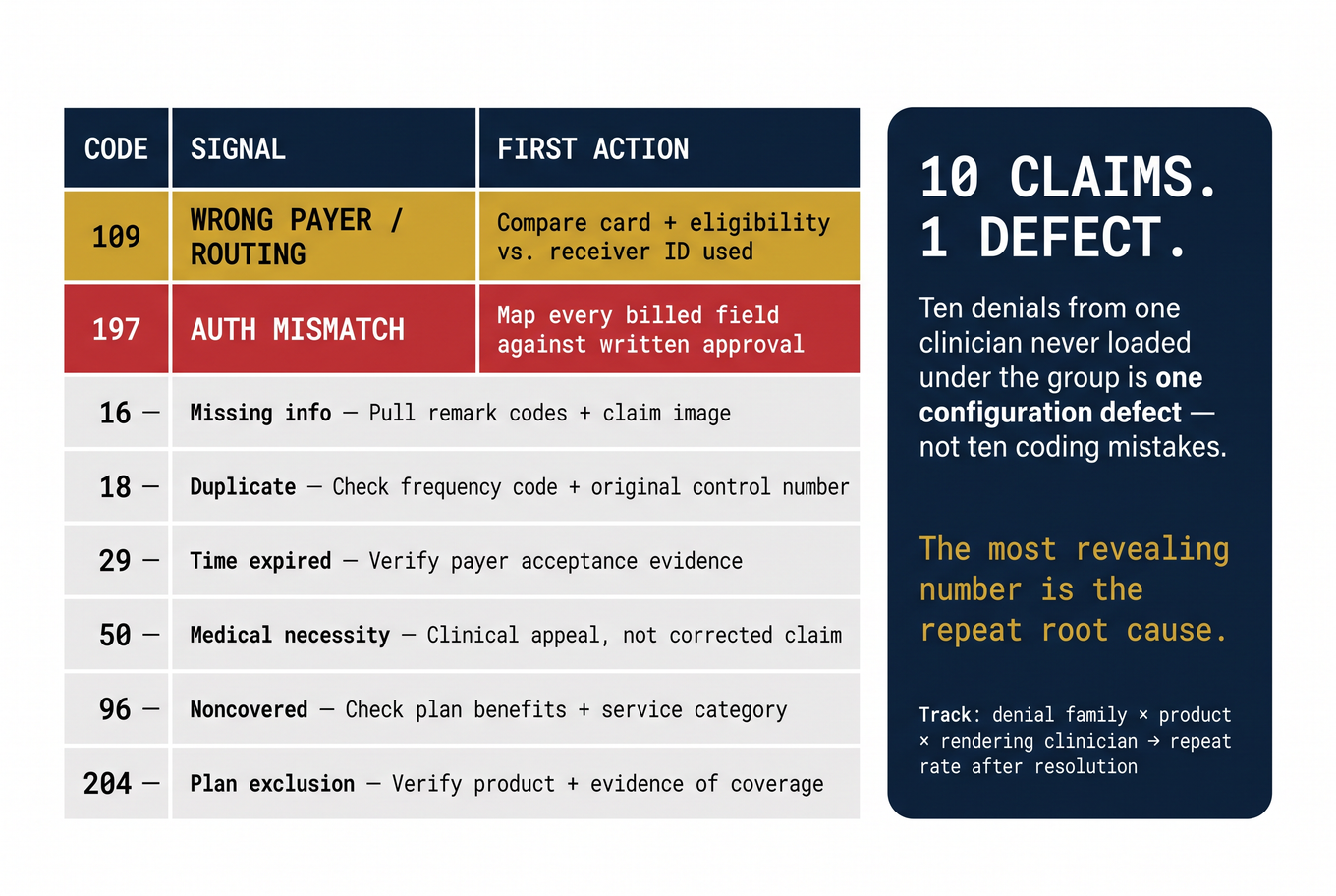
There is one more point here, and it is the one that should change how a practice owner or CFO reads a denial report.
Ten claims denied because one clinician was never loaded under the group is one configuration defect, not ten coding mistakes. The most revealing number in a denial report is not the denial count. It is the repeat root cause - how many of this month's denials trace back to the same unfixed configuration. A team that works denials claim by claim can stay busy indefinitely without the rate ever improving, because nothing upstream ever changes.
Which is why a useful Aetna denial report separates:
- Rate stages - rejection rate before adjudication, first-pass payer acceptance, initial denial rate
- Denial family - routing, eligibility, provider data, authorization, coding, medical necessity, duplicate, timely filing, coordination of benefits, noncovered, underpayment
- Product - commercial fully insured, self-funded, administrator-managed, Medicare Advantage, EAP, and each Medicaid state separately
- Service and rendering clinician
- Outcomes - overturned versus written-off dollars, days from denial to first action, appeal success by family, and the repeat-denial rate after "resolution"
A word on underpayment, which hides inside paid claims. Proving the service was covered does not resolve a payment variance. Compare the contracted allowed amount, the billed code against any payer-substituted code, units and modifiers, multiple-procedure and bundling policy, member liability, program-specific adjustments, prior payments and offsets, and expected versus actual allowed amount. One biller's summary of chasing repeated downcoding is worth quoting because it names the real cost rather than the headline one: *"At some point the administrative burden … starts to become the real issue."* A denial you can technically overturn can still be economically destructive if every instance costs calls, records, and an appeal.
Finally, a documentation note that prevents a whole denial family. CMS's psychiatry and psychology billing article sets the psychotherapy time bands used across the industry: 16 to 37 minutes, 38 to 52 minutes, and 53 minutes or more for the three standard individual psychotherapy levels, with under 16 minutes not separately reportable. When an evaluation and management service is billed with a psychotherapy add-on, the psychotherapy must be significant and separately identifiable - select the E/M level by medical decision making rather than counting psychotherapy time toward it, document both distinctly, and do not overlap the time. Unusually long sessions need clear documentation of both time and necessity. And while behavioral diagnoses are expected to be current and consistent with the DSM, claims carry ICD-10-CM codes; invalid or insufficiently specific codes get rejected or delayed.
One more thing to keep straight across all of it: a clinical policy bulletin describes Aetna's view of clinical policy. It is not the member's benefit contract. A service can satisfy a bulletin and still be excluded by the plan - which is why testing policy, group psychotherapy policy (updated May 8, 2026), TMS policy, and ECT policy each need to be read alongside the member's benefits rather than instead of them.
Once you know what the remittance is telling you, the next decision is which ladder to climb.
Classify the denial, then pick the right appeal
Sending the wrong instrument is how practices spend a deadline without spending it usefully.
Aetna's dispute page describes reconsideration as review for issues such as reimbursement, coding, and reprocessing, filed within 180 calendar days of the initial claim decision. Include:
- The reason for review
- Member ID and patient name
- The TIN
- The Aetna claim ID
- Dates of service and billed amounts
- The disputed codes and modifiers
- The remittance
- A corrected claim or payment calculation, where relevant
- Supporting records or authorization evidence
- A clearly stated requested resolution
Submit through Availity, by mail to the address on the denial, or to a state-specific address; Aetna says a response usually issues within 30 business days.
But some issues bypass reconsideration and go directly to appeal - medical necessity, payment policy, experimental or investigational determinations, certain no-precertification denials, adverse utilization decisions, retroauthorization requests, and some Medicare nonparticipating-provider matters.
So classify before you file. Is this a claim correction (a wrong demographic, code, or field), a reconsideration (reimbursement, coding, processing, contract application), a clinical appeal (medical necessity, level of care, coverage policy), an authorization appeal (absent, mismatched, or retroactive), a network or benefit appeal (out-of-network exception, benefit classification), a provider-data dispute (enrollment, effective date, taxonomy, location), or a member appeal requiring the member's own rights and process?
On deadlines, Aetna states that an appeal follows within 60 calendar days after the reconsideration decision; that where reconsideration does not apply the page gives up to 180 days for commercial and Medicare; that Medicare noncontracted providers have up to 65 days in the stated direct-appeal circumstance, commonly with a waiver-of-liability form; that post-service appeals are not eligible for expedited handling; and that state-specific exceptions apply. Aetna publishes separate destinations - commercial disputes to PO Box 14020, Medicare contracted appeals to PO Box 14835, and Medicare noncontracted appeals to PO Box 14067, all in Lexington, Kentucky - but use the address on the denial notice or the current state and product form when it differs. Aetna says it will issue an appeal decision within 60 business days of receiving the appeal or the additional information it requested. Medicare-specific dispute routes have their own requirements.
A complete packet is focused. A clinical appeal explains why the record meets the governing criteria, criterion by criterion. A payment appeal shows the contractual calculation. A routing appeal proves the member's product and the payer's own instructions. Combining all three into an unfocused cover letter forces the reviewer to reconstruct your case, and reviewers who have to reconstruct a case tend to uphold the original decision.
Beyond internal review, options depend on the plan, the issue, the amount, the state, and whether internal review is exhausted - member external review for some eligible clinical disputes, a state insurance department complaint, a Medicaid fair-hearing or provider-dispute process, a Medicare independent-review path, an ERISA plan appeal, or a contract or prompt-pay mechanism. There is no single national path for every provider payment disagreement, and this is the point where the question stops being a billing question. Preserve your deadlines and follow the route named in the decision letter and the applicable state supplement.
None of this ladder transfers cleanly to Medicaid, because Aetna's Medicaid business is not one payer.
Aetna Better Health: fourteen Medicaid programs, not one
Aetna's Medicaid site currently presents fourteen Aetna-branded state programs. They are not interchangeable. They include comprehensive managed care plans, CHIP, managed long-term care, a specialized child behavioral health program, and dual-eligible products - with different filing periods, different identifiers, different enrollment gates, and different answers to the question of whether Aetna is even responsible for the behavioral claim.
The table below is a snapshot of public claim pages checked on August 17, 2026. It is not a substitute for the current provider agreement, plan manual, or a later state update. "Not stated" means the live page did not publish the number - not that no deadline exists.
| Program | Initial claim | Corrected claim | Electronic route | Behavioral routing to verify |
|---|---|---|---|---|
| Florida | 180 days from service; inpatient from discharge | 180 days from paid date | Availity → Office Ally; training material identifies 128FL | Generally within the managed care benefit; verify product, enrollment, service-specific authorization |
| Illinois | 180 days | 180 days; secondary within 90 days of primary disposition | Availity → Office Ally | Integrated pathway; verify state enrollment and authorization rules |
| Kentucky | 365 days; inpatient from discharge | 730 days from paid date | Availity → Office Ally; 128KY | Integrated, with specialized youth programs; confirm program rules |
| Louisiana | 180 days | 180 days | Availity → Office Ally; page labels 128LA | Handled within Louisiana's managed care structure; state specialty manuals control |
| Maryland | 180 days | 60 days from paid date | Availity → Office Ally; 128MD | ⚠ Specialty mental health and SUD can run through the state behavioral ASO, not the Aetna plan |
| Michigan | 365 days | 180 days for revised claims | Availity → Office Ally | ⚠ Basic behavioral with the plan; specialty services via regional public systems |
| New Jersey | 180 days | 180 days | Availity → Office Ally; page says use 46320 for your provider ID - not a payer ID | ⚠ Integration phased from January 1, 2025 - the answer depends on the date of service |
| New York | 120 days | Not stated | Availity → Office Ally | ⚠ The Aetna-branded program is managed long-term care - establish whether Aetna owns this claim at all |
| OhioRISE | 365 days | Per current manual | Availity → Office Ally | The specialized behavioral program is the product; enrollment and program authorization are central |
| Oklahoma | Not stated | Per manual and remit | Office Ally or reciprocal clearinghouse; 128OK | Within the SoonerSelect arrangement; state-specific service and authorization rules |
| Pennsylvania (Kids) | One year | 180 days | Availity → Office Ally | ⚠ This is CHIP, not Pennsylvania Medicaid behavioral HealthChoices |
| Texas | Not stated | Publishes reconsideration and COB deadlines instead | Office Ally; 38692 | Program-specific; higher-acuity care may carry separate authorization |
| Virginia | 365 days | 365 days | Availity → Office Ally | Medicaid enrollment, service type, taxonomy and program requirements must all match |
| West Virginia | One year | 120 days | Availity → Office Ally | Integrated, with state-specific authorization rules |
Look at the range: initial filing runs from 120 days to a full year, and corrected-claim windows run from 60 days to 730. Any page that compresses this into "Aetna Medicaid timely filing is 180 days" is wrong in most of these states.
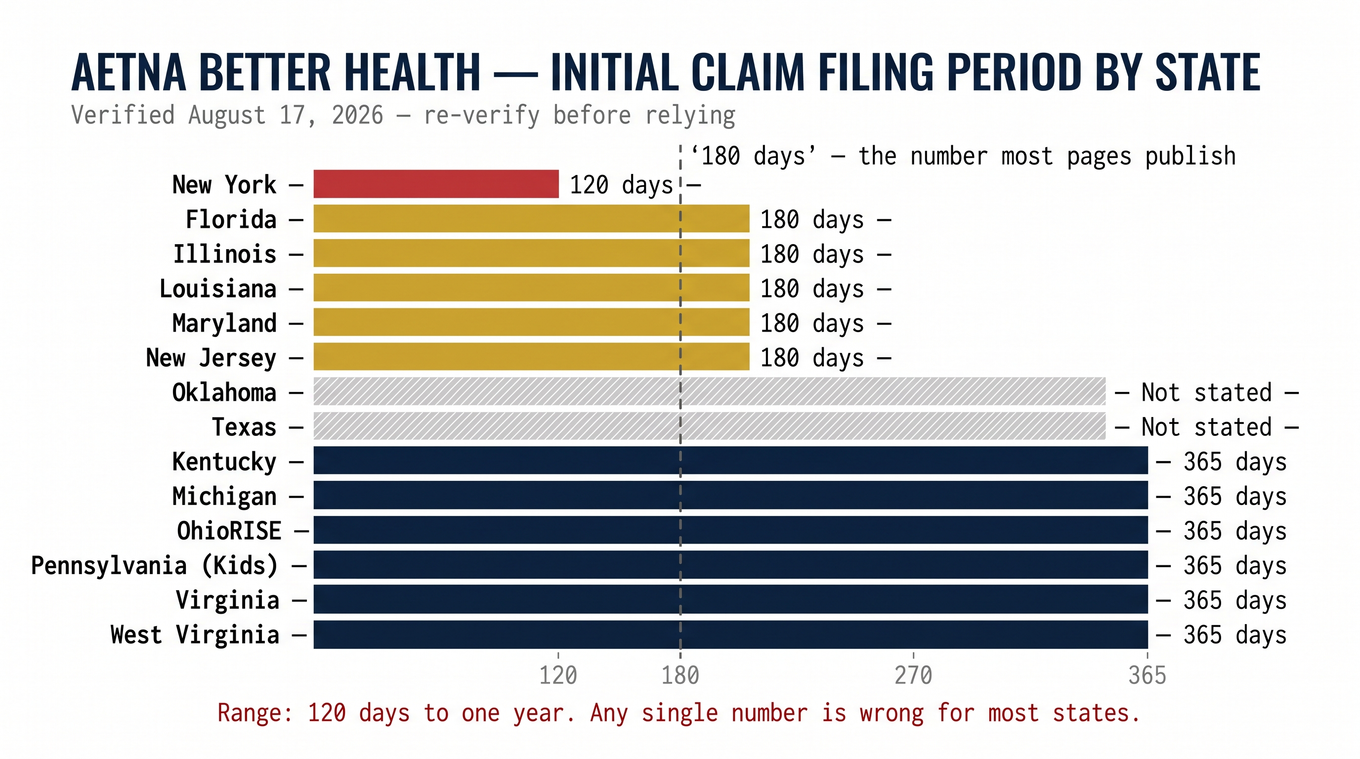
The dispute deadlines vary just as much - Illinois publishes 90 days for reconsideration and another 90 after it, Louisiana 180 then 90, Oklahoma 30 and 30, Texas a 120-day clean-claim reconsideration with a 95-day coordination-of-benefits window, and New Jersey, Pennsylvania Kids, and Virginia each publish 60-day appeal periods against West Virginia's 90.
The carve-outs are what produce wrong-payer denials, and they are worth knowing by name. Maryland is the clearest case: the state's public behavioral system uses an administrative services organization for specialty mental health and substance use services, so a claim can be sent to Aetna, with Aetna eligibility active, and still come back as not covered - because Aetna was never the responsible entity for that service. Michigan splits basic behavioral care (with the plan) from specialty mental health, developmental disability, and substance use services (through regional public systems), and the routing is determined by the service and eligibility pathway rather than the diagnosis. New Jersey's integration phased in from January 1, 2025, which means an older billing guide can be correct for a date of service before the transition and wrong after it. New York's Aetna-branded program is managed long-term care, which is not evidence that it adjudicates a member's ordinary outpatient psychotherapy claim. OhioRISE is a specialized program for eligible children and youth - the question is whether the child is enrolled and the provider authorized under it. And Pennsylvania's Aetna-branded plan is CHIP; Pennsylvania Medicaid behavioral services run through county-level arrangements.
For every Aetna Better Health claim, retain:
- The state program and product name
- The member ID and eligibility segment
- Proof of state Medicaid enrollment
- The plan's network effective date
- Billing and rendering NPI, with taxonomy and service location as enrolled with both the state and the plan
- The carve-out determination
- The current authorization
- The state-specific routing setup
- The frequency code and original control number, for replacements
- Payer-level acceptance
- The full remittance codes
- The state-specific dispute deadlines
All of this is manageable in-house. Right up until it isn't - and the honest question is where that line sits for your practice.
When to outsource behavioral health billing (and when not to)
Start with the question of whether you need anyone at all.
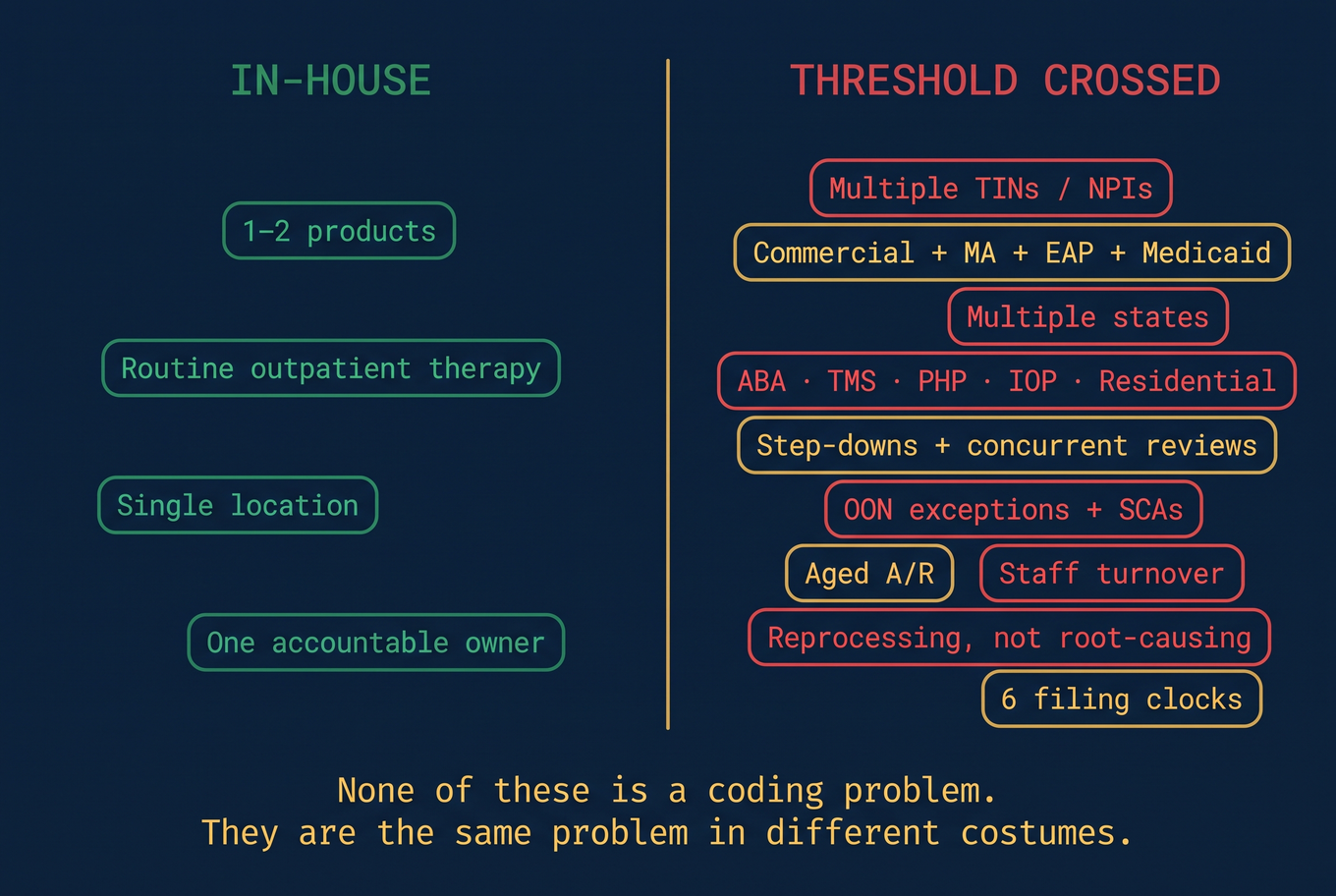
A practice can reasonably run Aetna itself when it has a small number of clinicians and locations, mostly routine outpatient psychotherapy and psychiatry, a limited set of Aetna commercial products, little authorization-dependent volume, one accountable person who owns eligibility, claim acceptance, remittances, and denials, current payer contracts and fee schedules, disciplined provider-data maintenance, documented appeal workflows with deadline tracking, and enough claim volume to see patterns without drowning in them.
A solo clinician with a reliable EHR and clearinghouse and a simple payer mix can usually manage routine Aetna claims once the payer setup is genuinely correct. That is not a consolation prize. It is the right answer for a lot of practices, and if it describes yours, the rest of this guide is the whole job.
The threshold shifts when the practice accumulates multiple TINs, NPIs, locations, or new clinicians; commercial, self-funded, administrator-managed, Medicare Advantage, EAP, and Medicaid products sitting in the same accounts receivable; Medicaid work across several states; ABA, TMS, testing, intensive outpatient, partial hospitalization, residential, or inpatient services; frequent step-downs and concurrent reviews; out-of-network exceptions and single-case arrangements; recurring provider-not-loaded, authorization-linkage, wrong-payer, or timely-filing denials; aged receivables with unclear submission evidence; frequent downcoding disputes; staff turnover that leaves nobody owning the appeal deadlines; or a denial queue being reprocessed rather than root-caused.
Notice that none of those is a coding problem. They are all the same problem in different costumes: maintaining product-specific routing, provider enrollment, authorization evidence, payer-receipt proof, denial classification, and six filing deadlines simultaneously, while also seeing patients.
That picture usually changes for one of four reasons: the practice is growing - new clinicians, new locations, a new state; the payer or service mix has genuinely got more complex; nobody has the time the billing side actually needs; or collections have slipped and nobody can say precisely why. None of those is about size. We work with practices of every size, from a single clinician to a multi-state group, and we take on a single piece of the cycle as readily as the whole of it. The question is never whether a practice is big enough to be worth helping - it is which part of the cycle needs owning.
That work - building and maintaining the payer and product matrix, verifying benefits at the service-category level, checking provider and product effective dates, keeping authorization and concurrent-review calendars, matching claims to the correct administrator and identifier, monitoring payer-level acceptance, posting remittances and classifying code patterns, filing corrected claims and appeals against the right deadline, and reporting repeat root causes back to the practice - is what we do as a behavioral health revenue cycle team. It is also, deliberately, work a disciplined in-house team can do.
So the commercial question is not really what a billing vendor charges as a percentage. It is whether your internal labor, preventable write-offs, delayed cash, and compliance exposure add up to more than the cost of owning this properly, by whoever owns it.
The claim form is the last step, not the first
Everything in this guide reduces to one idea. "Aetna" is a routing decision before it is a payer. Answer which product, which administrator, which rulebook, and which deadline - and the claim form becomes the easy part, because by then you already know where the claim is going and what proves it arrived.
Here is a concrete way to test that on your own data this week. Take your last ten Aetna denials and sort them into four buckets: wrong product or administrator, provider record not loaded correctly, authorization that did not match the claim, and a missed deadline. Do not sort by CPT code. If our experience of behavioral health receivables holds for your practice, the pile will collapse into far fewer distinct causes than it has claims, and the fix will be a configuration change rather than ten appeals.
Our take, after enough of these: the practices that get Aetna right are not the ones with the best coders. They are the ones that treat routing evidence and filing proof as assets worth keeping, and that fix the configuration instead of reworking the claim. That discipline is learnable, and for a lot of practices it is entirely doable in-house.
If your Aetna denials have stopped looking like isolated mistakes and started looking like a pattern, we are happy to look at the routing and denial data with you and tell you what we see - including if the answer is that your setup is basically sound and needs a specific fix rather than a new vendor.
Aetna mental health billing FAQs
What payer ID should I use for Aetna mental health claims?
There is no safe brand-level answer. Use the electronic payer ID returned for the member's current product and administrator and supported by your clearinghouse. The commonly cited 60054 appears in official Aetna material for a Medicare nonparticipating-provider context, but EAP uses EAP20, Aetna Voluntary Plans use 57604, administrator-managed claims use the administrator's ID, and Aetna Better Health plans use state-specific routing.
Does Aetna require prior authorization for 90837?
Aetna's current linked national behavioral health precertification list does not name ordinary office psychotherapy as a universally precertified service. That is not proof 90837 is always exempt - the member's plan, state requirements, employer setup, and utilization review can all create a requirement. Verify for the specific member before treatment, particularly where frequency or duration may attract review.
What is Aetna's timely filing limit?
Name the product and the deadline first. The current national manual does not publish one universal initial-claim deadline for commercial products. Aetna publicly gives 180 days from the initial claim decision for reconsideration and 60 days after that for appeal; EAP claims are due 90 days after the last authorized session; Medicaid state pages range from 120 days to one year; administrator-managed plans follow the TPA's terms.
Does Aetna cover telehealth therapy?
Aetna's June 2026 manual says telebehavioral services are offered to fully insured commercial members and to self-insured plan sponsors unless the sponsor opts out, subject to licensure and plan terms. Coverage is not the same as a claim recipe - the payable place of service, modifier, and modality remain product-, state-, and date-specific, and Medicare Advantage and Medicaid follow separate rulebooks.
How do I bill Aetna EAP sessions?
Obtain the member-specific EAP authorization before the first visit and stay inside its dates and session count. Use payer ID EAP20, place the authorization reference in the 837's REF segment with qualifier G1, bill no more than one session per member per day, and submit within 90 days after the last authorized session. Do not bill the member for an EAP service, including a no-show.
How long does Aetna credentialing take?
Aetna's public manual explains the application, credentialing, and recredentialing process but does not publish a completion time, so treat any 60-, 90-, or 120-day figure you see elsewhere as unverified. Track application completeness, CAQH and verification-organization review, contracting, product loading, roster linkage, and the effective date as separate milestones - and start well before you need to bill.
Why does Aetna say the rendering provider is missing when it's on the claim?
Because the claim containing a valid NPI and the payer's system mapping that NPI to your group are different things. Check whether the clinician was credentialed and loaded for this product, whether the participation effective date precedes the date of service, whether the group affiliation is active, whether the service location and taxonomy match what was enrolled, and whether a roster change ever reached claims configuration.
Does Aetna Medicaid cover behavioral health the same way in every state?
No, and this is one of the more expensive assumptions in behavioral billing. Aetna's Medicaid site currently lists fourteen Aetna-branded state programs with initial filing periods ranging from 120 days to one year, and several states keep specialty behavioral services outside the Aetna plan entirely - Maryland routes specialty mental health and substance use services through a state administrative services organization, and Michigan routes specialty services through regional public systems.
How much does Aetna reimburse for 90837?
There is no honest universal figure. Contracted rates are provider-, product-, locality-, and contract-specific, so use your own agreement and Aetna's authenticated fee-schedule and estimator tools, then compare the allowed amount on the remittance. Third-party "average reimbursement" tables are modeled estimates and are not a substitute for your contract.
Verified against Aetna's live provider materials, CMS resources, and Aetna Better Health state claim pages on August 17, 2026. Payer policy, payer identifiers, filing periods, and addresses change - re-verify load-bearing details against current sources and the member's own plan, card, and eligibility response before relying on them. This guide is operational information for billing teams, not legal advice, coding instruction, or a determination of coverage for any member. Where sources conflict, the member's plan documents, current eligibility response, written authorization, your provider agreement, and applicable state and federal rules control over any general guidance, including this page.