
The hospital revenue cycle management market isn't growing because finance teams want another dashboard. It's growing because reimbursement has become too complex to run on disconnected workflows. The global hospital RCM market reached USD 92.57 billion in 2024 and is projected to reach USD 184.35 billion by 2030, with hospitals holding a 65.40% revenue share in 2025 according to Grand View Research's hospital revenue cycle management market report.
For a hospital CFO, the more useful question isn't whether hospital revenue cycle management software matters. It's where value comes from. In practice, the biggest financial drag rarely comes from a missing feature. It comes from broken handoffs between registration, clinical documentation, coding, billing, claims, and payment posting. When those handoffs fail, staff create workarounds, denials rise, underpayments slip through, and A/R lingers longer than it should.
The strongest RCM strategies fix the pipeline, not just the endpoint.
Table of Contents
- Why Hospital Revenue Cycle Management Is a C-Suite Priority
- What Is Hospital RCM Software
- Key Modules of an Integrated RCM Platform
- The Financial Impact and ROI of RCM Software
- Choosing and Implementing the Right RCM Solution
- Software Is the Tool Not the Entire Strategy
Why Hospital Revenue Cycle Management Is a C-Suite Priority
Hospital revenue cycle management has moved out of the business office and into the boardroom. That shift makes sense. Payment delays, denials, missed charges, and patient balance friction all hit liquidity. In a margin-constrained environment, the revenue cycle is no longer an administrative support function. It's core financial infrastructure.
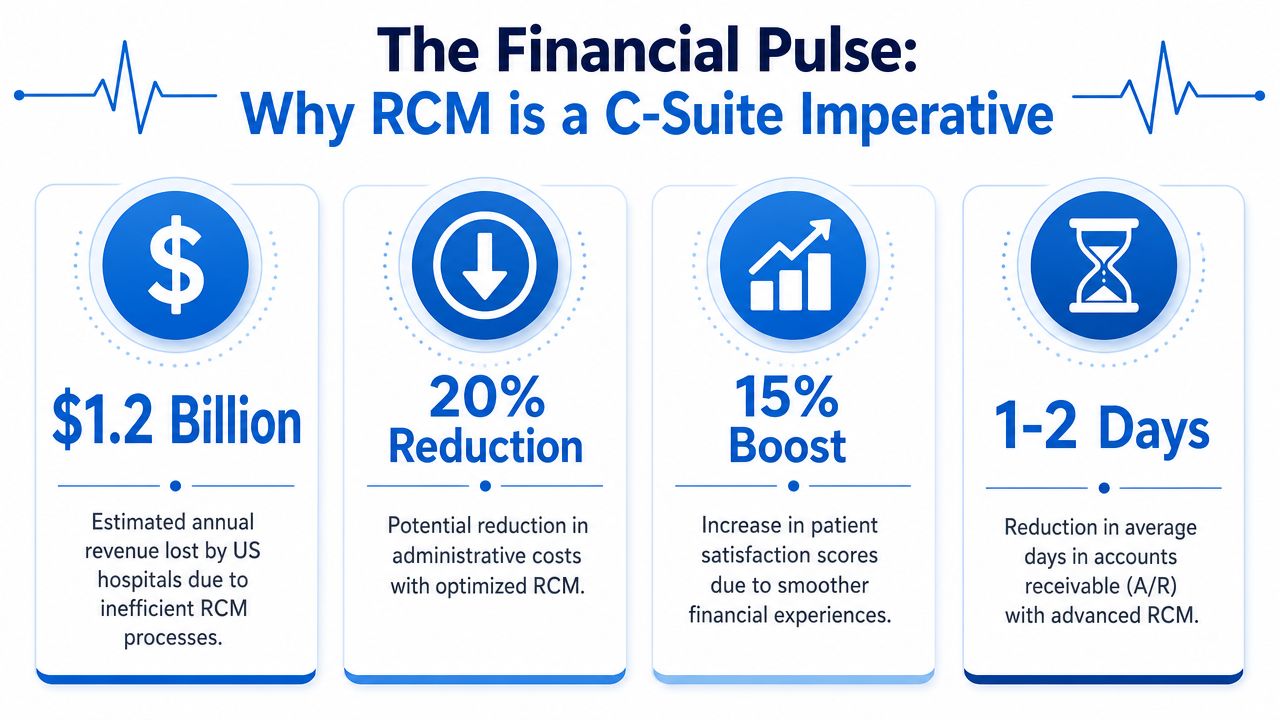
A useful way to frame hospital revenue cycle management software is this: it gives leadership a chance to reduce preventable friction in how revenue is captured, validated, billed, and collected. That matters because hospitals aren't dealing with a single workflow. They're coordinating patient access, clinical operations, coding, payer communication, and collections across departments that often use different systems and different definitions of “complete.”
Why leadership attention has intensified
The growth of the software market tells you how urgent the problem has become. Hospitals are the largest end-user segment, and that concentration reflects where complexity sits. Facility billing, payer rules, authorization requirements, charge capture, and remittance reconciliation all create failure points that manual processes can't reliably absorb at scale.
A CFO usually sees the consequences before seeing the root cause:
- Cash arrives later than expected because claims aren't clean on first submission.
- Staff spend time on rework because registration, coding, and billing don't share a dependable data stream.
- Forecasting weakens because the organization can't see where claims are stalled.
- Recovery work expands because issues that should've been caught up front are discovered after submission.
Practical rule: If finance, patient access, HIM, and billing each maintain their own exception lists, the hospital doesn't have one revenue cycle. It has several disconnected ones.
This is why many executive teams now evaluate software less as a billing application and more as a control system for revenue integrity. It also explains the rising interest in medical revenue recovery strategies that address leakage across the full lifecycle rather than only after denials appear.
What the C-suite should really watch
A feature demo can look impressive and still miss the actual issue. The stronger question is whether the platform improves handoffs between departments and external parties. If it can't connect those transitions cleanly, even good automation gets trapped inside silos.
That's the strategic lens. Hospital revenue cycle management software should improve visibility, standardize workflows, and reduce avoidable delay. When it doesn't, the hospital ends up buying sophistication without gaining control.
What Is Hospital RCM Software
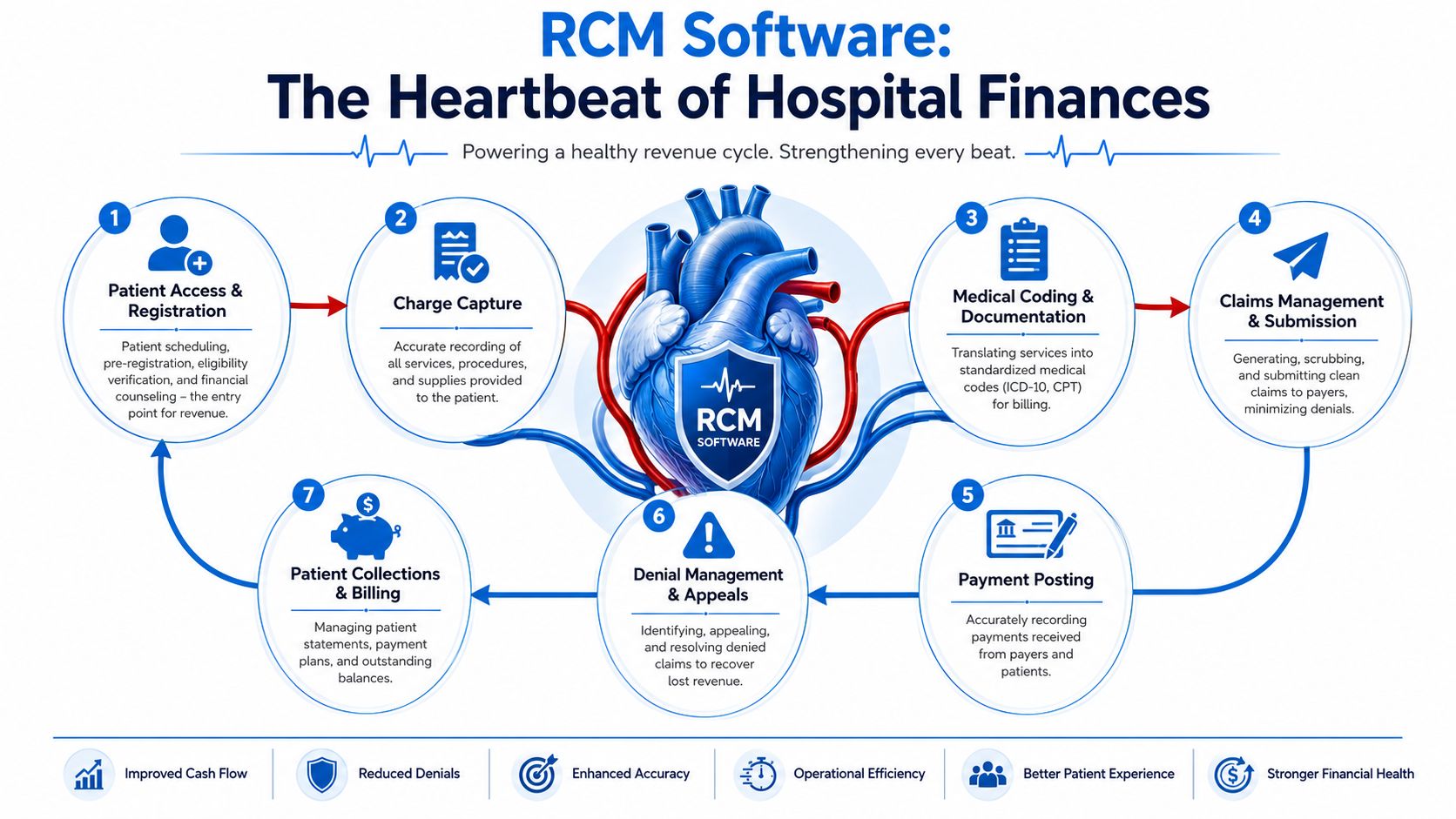
Hospital revenue cycle management software is best understood as the operating system for reimbursement. It connects the events of care to the financial actions required to turn that care into collectible revenue.
A financial circulatory system
A hospital's revenue cycle works like a circulatory system. Patient access is where intake begins. Clinical documentation and charge capture move the financial signal forward. Claims, remits, denials, and patient billing determine whether the organization is paid. The software acts as the heart and vessels, moving validated information from one point to the next without losing detail along the way.
When that flow breaks, revenue doesn't disappear in one dramatic moment. It leaks in small operational failures. A wrong subscriber selection at registration. A missing authorization note. A charge that never reaches billing. A remittance that doesn't reconcile cleanly. Each one forces staff into manual correction.
A quick visual overview helps make the end-to-end flow concrete:
The three operating zones
Most modern platforms organize work into three functional zones.
Front-end revenue cycle work starts before the claim exists. Scheduling, registration, insurance verification, benefit checks, estimates, and authorization support all live here. Here, many preventable denials are either avoided or created.
Mid-cycle work sits closer to the clinical encounter. It includes charge capture, clinical documentation support, coding workflows, and reconciliation between what happened in care delivery and what is billable. This zone is often underestimated because teams focus on denials after submission instead of leakage before billing.
Back-end work includes claim generation, scrubbers, submission, status follow-up, payment posting, denial management, appeals, and patient collections. This is the most visible part of RCM because it produces the clearest reports. It's also where hospitals often spend labor correcting upstream failures.
The software matters most when it reduces the distance between those three zones. If each one runs well in isolation but shares poor data with the next, the hospital still pays for fragmentation.
A strong platform doesn't just automate tasks. It creates continuity. Registration feeds clean insurance data into the claim. Documentation supports accurate code assignment. The claim scrubber reflects payer-specific logic. Payment posting and denials route back into analytics so the organization can fix root causes instead of chasing symptoms.
That's the practical definition. Hospital revenue cycle management software isn't one module or one department's tool. It's the system that keeps financial data usable from patient access through final payment.
Key Modules of an Integrated RCM Platform
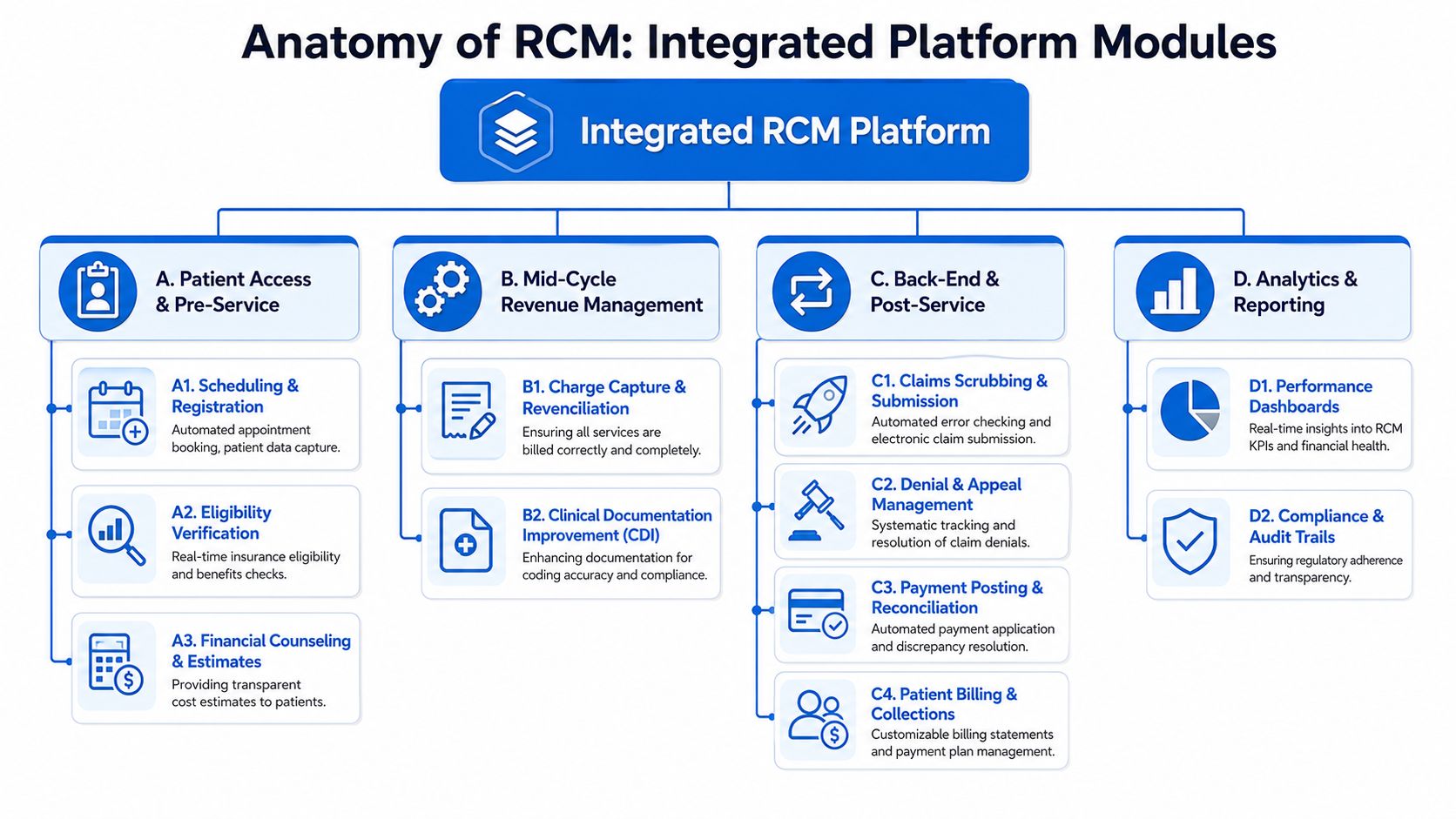
The easiest mistake in software selection is treating modules as a checklist. A CFO should evaluate each one by the financial leak it prevents and the handoff it improves.
Front-end controls that stop preventable leakage
Eligibility verification is not a convenience feature. It is one of the strongest defenses against avoidable denials. Enterprise-grade platforms connect to payer APIs through EDI 270/271 transactions to verify active coverage, copay and deductible status, and prior authorization requirements in real time. That architecture can produce a 12.8% reduction in patient insurance-related denials according to Corpsoft's review of healthcare revenue cycle management software.
That matters because registration errors spread downstream fast. If the wrong plan is selected or active coverage isn't confirmed, every later step becomes recovery work.
Key front-end modules include:
- Scheduling and registration: These tools should capture patient and guarantor data once, then feed it forward without rekeying.
- Insurance card capture and OCR: AI-driven OCR can reduce manual extraction errors when staff upload insurance cards and the system identifies the correct coverage.
- Real-time eligibility checks: Strong platforms validate coverage while the patient is still in the scheduling or preregistration workflow.
- Authorization support: The best tools don't just store authorization details. They surface missing requirements before service dates create a claim problem.
Mid-cycle tools that protect earned revenue
Inefficient revenue cycle management causes many hospitals to leave money behind. Charge capture and reconciliation tools compare documentation, logs, and billing records so services performed are captured for billing. Clinical documentation improvement tools help coders and clinical teams close gaps before coding is finalized.
A practical concern here is the pre-billing gap. When nursing notes, pharmacy records, or procedure logs don't reconcile to billable activity, finance often doesn't see the problem until after month-end. By then, staff are auditing retrospectively instead of preventing leakage in real time.
Useful mid-cycle capabilities include:
| Module | What it solves |
|---|---|
| Charge capture reconciliation | Finds services or supplies that were documented but not billed |
| Clinical documentation support | Reduces ambiguity that slows coding or leads to missed specificity |
| Coding workflow management | Routes records cleanly and flags missing documentation |
| Exception queues | Focuses staff attention on records that actually need review |
Hospitals that want better control here need more than features. They need shared workflow ownership between clinical departments, HIM, and finance.
Back-end automation that shortens the wait for cash
Claims management should do more than transmit claims. It should scrub them against payer-specific edits, route exceptions, and give teams visibility into where claims are stalling. Payment posting and reconciliation should ingest ERAs cleanly, match them to expected reimbursement, and isolate variances quickly.
Analytics matters here too, but only if it's actionable. A dashboard that shows denial categories without tying them back to registration, coding, or payer configuration won't change performance. That's why many finance leaders prioritize platforms with strong healthcare revenue cycle analytics capabilities rather than generic reporting.
Operator's view: The best denial management module isn't the one with the prettiest work queue. It's the one that helps you prevent the same denial from happening again.
Look for these back-end components:
- Claim scrubbing and submission: The platform should apply rule libraries before claims go out, not after rejections come back.
- Denial management workflows: Root-cause tagging, appeal tracking, and ownership routing should be standard.
- Payment posting and reconciliation: ERA processing must be tight enough to surface underpayments and posting anomalies quickly.
- Patient billing and payment tools: Statements and payment options should reduce confusion, not create more call volume.
The common thread across all modules is simple. Integration is what creates value. A best-in-class point solution can solve one problem well, but if it introduces another handoff, the hospital may still lose ground overall.
The Financial Impact and ROI of RCM Software
A credible ROI discussion starts with operating results, not vendor promises. Advanced RCM software has been associated with a 33% reduction in days in accounts receivable, and organizations that integrated digital health platforms with RCM capabilities reported a 15% to 20% reduction in claims processing time along with a 12% decrease in claim denials, according to Industry Research's healthcare revenue cycle management market report.
What CFOs should expect from a serious platform
Those metrics matter because they touch the three financial outcomes executives care about most.
First, cash accelerates when claims move through the system with fewer manual delays. Lower A/R days improves liquidity and gives finance more control over forecasting.
Second, revenue integrity improves when cleaner upstream data produces fewer denials and fewer avoidable edits. That reduces write-off risk and lowers the amount of labor spent recovering claims that should've paid correctly the first time.
Third, staff capacity shifts toward exception management instead of repetitive transaction work. That doesn't mean fewer responsibilities. It means billing teams can focus on underpayments, high-value denials, and payer behavior instead of basic cleanup.
Where ROI gets overstated
Not every hospital realizes those gains evenly. Software produces the strongest return when workflows are standardized, payer rules are actively maintained, and departments agree on ownership of exceptions.
A common failure pattern looks like this:
- The platform goes live, but registration still uses workarounds
- Coding and charge capture stay disconnected from clinical operations
- Denial teams fix symptoms without feeding root causes back upstream
- Leadership measures output volume, not quality of handoffs
In those environments, the hospital may automate existing inefficiency rather than remove it.
Better software can shorten the revenue cycle. It can't, by itself, fix weak accountability between departments.
That's why CFOs should treat hospital revenue cycle management software as a financial performance investment with operational prerequisites. The business case is strong. The outcome depends on whether the organization uses the platform to redesign flow, not just digitize old habits.
Choosing and Implementing the Right RCM Solution
The right decision usually isn't about choosing the longest feature list. It's about deciding which platform can carry clean data from intake through payment without forcing staff into manual repair at every transition.
Modern platforms use HL7 and FHIR standards to connect EHR and EMR documentation with clearinghouses and payer portals. That interoperability matters because up to 40% of revenue leakage occurs before claims are ever submitted when nursing notes, pharmacy records, and surgical logs aren't reconciled with billing records in real time, as described in Deorwine's guide to healthcare revenue cycle management software.
Questions that expose real interoperability
Vendor demos often hide the hard part. Every product looks integrated when the workflow is scripted. A better procurement process pushes into exceptions, dependencies, and ownership.
Ask questions like these:
- How does the platform reconcile clinical source data with charge capture? If the answer stays high-level, the pre-billing gap probably remains.
- Where do eligibility, authorization, and payer response data live? If teams must check multiple places, front-end denials will keep slipping through.
- How are rule updates managed? Claim edits, payer changes, and workflow configuration need active governance.
- What happens when data is incomplete or contradictory? Good systems create clear exception paths. Weak ones leave staff to discover problems later.
A short decision table helps separate marketing from operational fit:
| What to evaluate | Strong answer | Warning sign |
|---|---|---|
| Interoperability | Clear HL7/FHIR connections and defined data ownership | Custom interfaces with unclear maintenance responsibility |
| Pre-billing control | Reconciliation between clinical documentation and charge capture | Focus stays almost entirely on denials after submission |
| Exception handling | Workqueues, routing rules, and accountability by role | Staff rely on email, spreadsheets, or memory |
| Scalability | Supports multi-facility workflows and payer variation | Works only with heavy local customization |
Implementation decisions that determine outcomes
Implementation is where many RCM projects lose momentum. Hospitals underestimate workflow redesign because the technical build gets more attention than the operational model.
What works in practice:
- Map handoffs before go-live: Document where data originates, who owns it, and how downstream teams consume it.
- Define exception ownership: If a claim fails, staff should know whether patient access, clinical operations, HIM, coding, or billing owns the next action.
- Pilot with high-friction workflows: Test the areas where broken handoffs are already visible instead of choosing the easiest service line.
- Train to the workflow, not just the screen: Staff need to understand why the process changed and what happens when they bypass it.
What usually doesn't work:
- Treating implementation as an IT project only
- Allowing departments to keep separate shadow processes
- Accepting vague vendor language about interoperability
- Waiting for denials to reveal setup problems
Hospitals should also examine the suite strategy carefully. A fragmented stack can look flexible during procurement and become expensive during operations if handoffs require continual staff intervention. In most organizations, software selection and implementation should be judged by one standard: does the platform reduce friction between departments, or does it merely relocate it?
Software Is the Tool Not the Entire Strategy
Hospitals often assume the hard part ends after they buy the platform. It doesn't. The software may be excellent and still underperform if the organization hasn't solved the human and operational side of the revenue cycle.
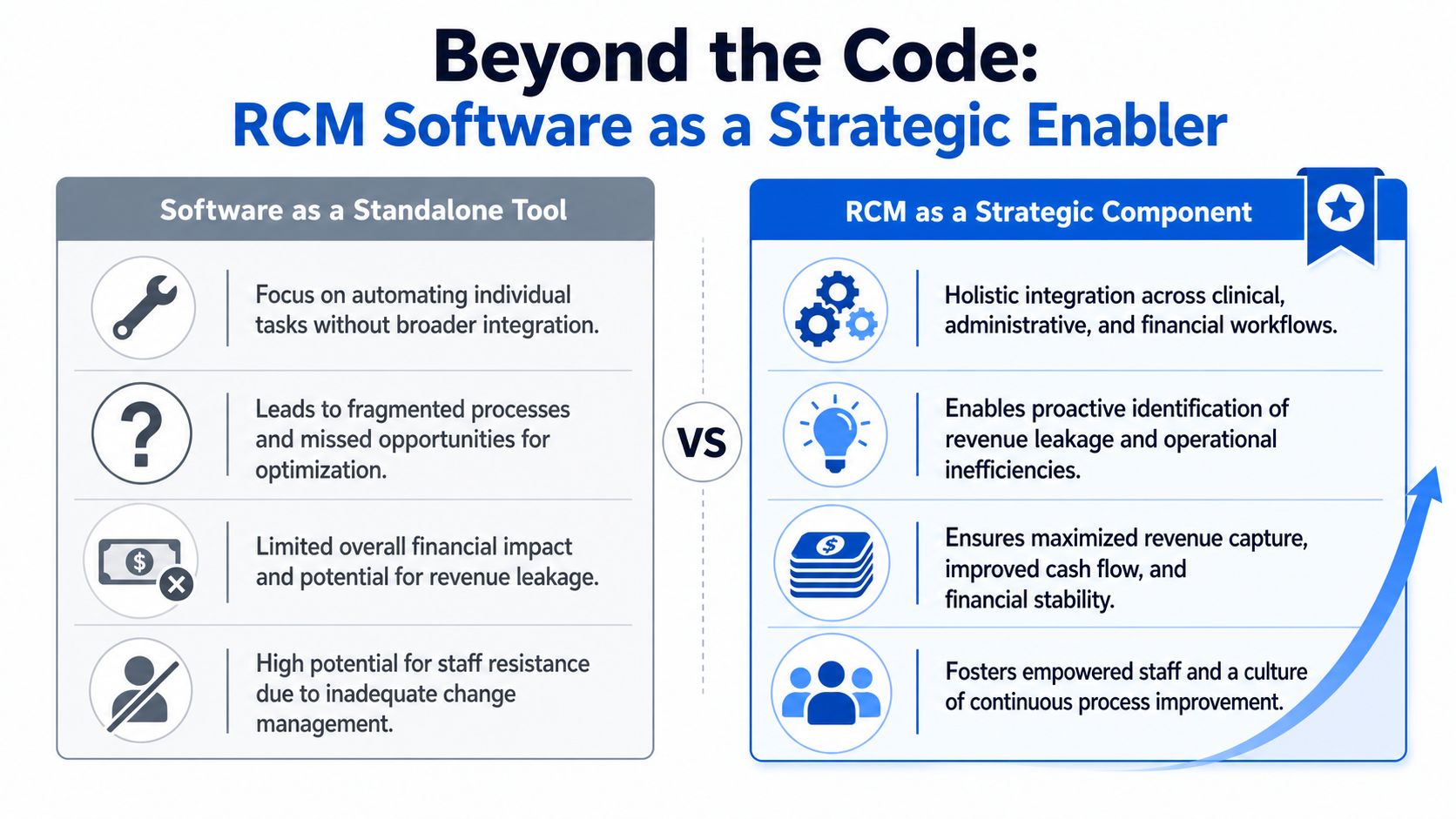
The hidden issue is fragmentation inside the workflow itself. AI-driven features only work when the data pipeline from registration to billing is integrated. Hospitals with fragmented RCM suites lose revenue through those breaks, and 25% of underpayments stem from human error in data migration and workflow configuration rather than the software's core logic, according to OmniMD's evaluation of revenue cycle management software.
Why fragmented suites still underperform
A hospital can buy strong registration software, capable coding tools, a respected claims engine, and solid analytics. If those systems hand off data poorly, the organization still ends up managing by exception.
That's where “broken handoffs” become expensive:
- Registration teams collect data that billing can't use cleanly
- Clinical activity reaches the EHR but not the charge capture workflow
- Payer responses sit in one system while denial teams work in another
- Configuration errors migrate unnoticed until underpayments surface later
The result isn't just technical inefficiency. It's operational drag. Managers spend time reconciling systems instead of improving process. Staff create workarounds to keep cash moving. Leadership gets reports, but not a reliable line of sight into the cause of leakage.
A hospital doesn't need more automation in isolation. It needs fewer points where accountability disappears.
Where full-service support changes the equation
This is why the most effective strategy isn't always software alone. Some hospitals have the internal depth to manage design, rules maintenance, exception routing, denial prevention, and process governance in-house. Others do better with a co-managed or full-service model that fills capability gaps.
A full-service partner can help in ways software by itself can't:
- Operational alignment: Finance, patient access, HIM, and billing work from one governed process instead of local workarounds.
- Configuration discipline: Rule logic, payer setup, and workflow routing are maintained continuously.
- Gap coverage: Teams don't need to hire for every specialized function at once.
- Sustained accountability: Someone owns the handoffs, not just the tool.
For hospitals considering that model, the key question isn't whether to choose software or services. It's how to combine tools and expertise so the revenue cycle functions as one connected system. That's the rationale behind working with an experienced revenue cycle management team when internal bandwidth, turnover, or fragmented workflows are limiting performance.
Software can enable discipline. It can't replace it. The hospitals that get the most from hospital revenue cycle management software are the ones that pair technology with clear ownership, strong operational design, and consistent follow-through.
If your organization is dealing with delayed cash, recurring denials, or too many manual handoffs between systems, Clarity can help you assess the gaps and build a revenue cycle approach that fits your operation. Whether you need end-to-end support or targeted help in areas like eligibility, payment posting, billing operations, or workflow setup, Clarity brings the operational expertise needed to turn software into financial performance.
No responses yet