

You're usually not staring at the charge description master when the problem starts. You're staring at a denial queue, a revenue report that misses expected charges, or a department manager asking why a new service line still isn't showing up on claims. The CDM sits underneath all of that, deciding whether a hospital's work gets translated into billable charges with the right code, the right price, and the right reimbursement path.
Table of Contents
- What a Charge Description Master Is
- Inside a CDM Line Item and How Charges Flow to Claims
- Why the CDM Is a Revenue Cycle Control, Not a Spreadsheet
- Governing the CDM Through People, Cadence, and Triggers
- List Prices, Transparency, and What the CDM Should Optimize For
- Common CDM Errors and Their Financial Impact
- A Practical CDM Self-Assessment and How an RCM Partner Helps
What a Charge Description Master Is
On a busy hospital week, a department opens a new infusion service, the coder adds documentation, and the claim still doesn't carry the charge. Nothing is wrong with the treatment itself. The break happened one layer down, where the hospital's billing logic depends on a missing line in the charge description master, or chargemaster. When that line isn't there, the charge may never flow cleanly into the claim, which can stall reimbursement and force staff into avoidable cleanup work.
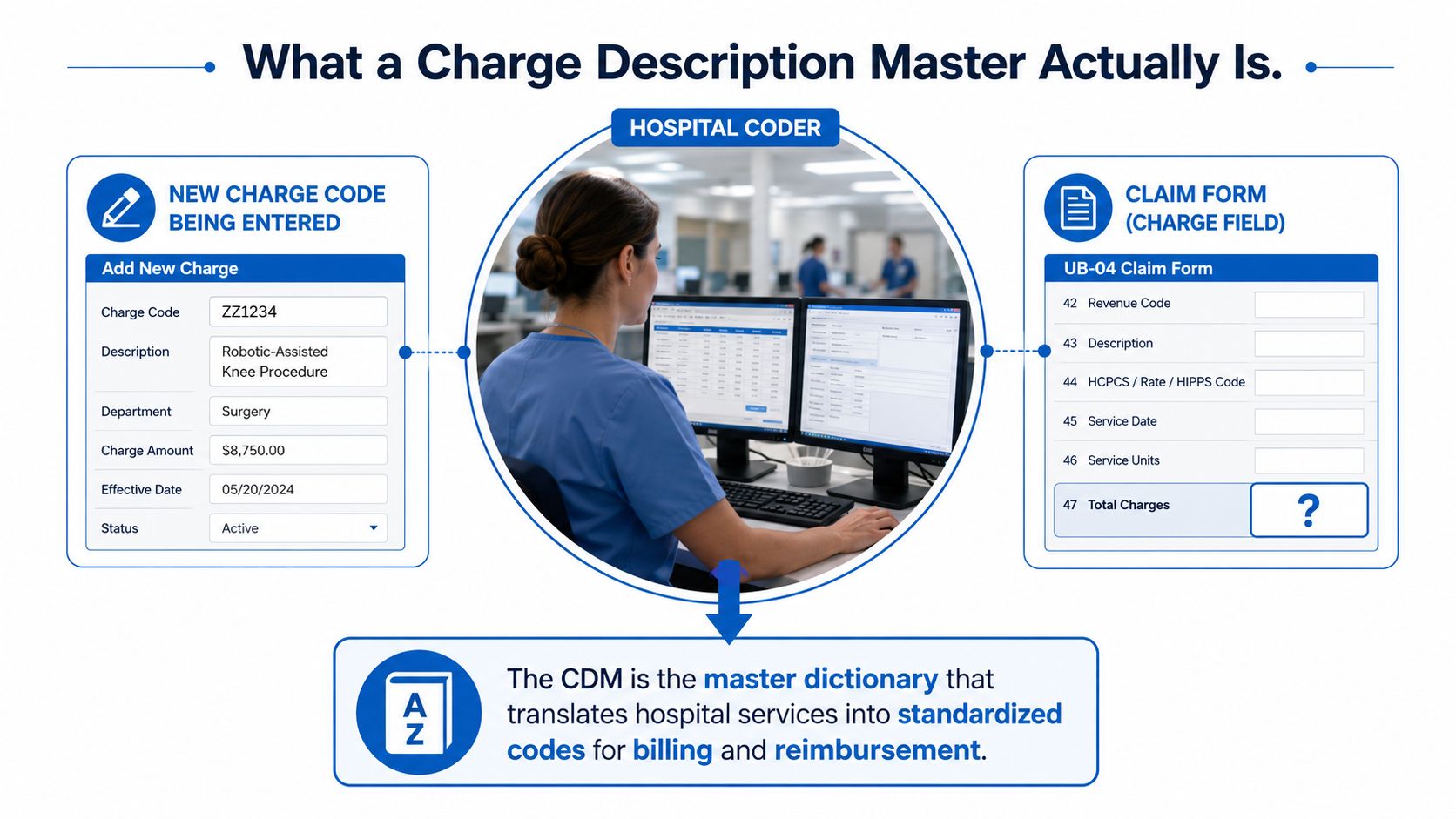
A useful plain-language definition is this, the CDM is the hospital's master file of billable items and services. It sits inside the hospital information system and supports charging, claims, and revenue reporting. In practice, it holds the codes and prices for the items used in patient care, including supplies, services, and drugs. That is why a single missing line item can ripple well beyond one visit, especially in outpatient reimbursement where the charge must be present and mapped correctly to reach the claim.
How the CDM works in practice
The CDM works like the hospital's internal dictionary for what can be billed. Each entry tells the system what the item is called, what code it uses, and what amount is assigned to it. If the service exists clinically but not in the CDM, billing has to improvise, and improvisation is where errors start.
The CDM is also more than internal paperwork. California requires hospitals to submit chargemaster files annually under Health and Safety Code Sections 1339.50 through 1339.59, with a July 1 deadline and the chargemaster as of June 1 each year, along with average charges for 25 common outpatient procedures and an estimate of the percentage change in gross revenue from price changes. That reporting context shows why this file matters outside the billing office, it is also a regulated transparency artifact in a major U.S. market.
Practical rule: if a service line changes and the CDM does not change with it, the hospital is risking broken charge capture.
For a broader primer on the coding side of this topic, navigating CDM in health data is a useful companion read. For a more operational lens on where charge capture breaks, the internal overview on charge capture basics fits well with the CDM concept.
Inside a CDM Line Item and How Charges Flow to Claims
A CDM row looks simple until you try to use it. Then each field starts doing a different job, and a weak link in any one field can stop the charge from becoming a payable claim. A good CDM isn't just a list of prices. It's a mapping structure that lets documentation move into billing with enough specificity to survive claim editing.
The fields that matter most
A strong CDM line item usually includes a facility-specific charge code, a description, a revenue code, a CPT or HCPCS linkage, a department, and a unit price. In many systems, the description has to be split into a more technical version and a more patient-readable version because character limits are tight. That's not cosmetic. It's a governance issue, because the hospital has to preserve coding specificity while still making the line understandable for billing staff and, when needed, patients.
Here's the logic in plain language. The charge code identifies the item inside the hospital. The revenue code places it in the right billing category. The CPT or HCPCS link anchors it to the procedure or service descriptor used in billing. The department ties it to the operational owner. The unit price is the dollar amount the hospital has assigned. If one of those fields is wrong, the row may still exist, but the claim may not behave the way finance expects.
How the charge becomes a claim
A clinician documents the service. The charge capture process translates that documentation into a charge. The CDM supplies the billing logic that tells the system how to represent the item on the institutional claim, including the UB-04/CMS workflow described in the PARA data requirements. If the mapping is right, the charge flows into the claim with the right coding and reimbursement classification. If it's off, the claim can land in the wrong bucket, underpay, or deny.
That flow is why reviewers need to read a CDM extract the way an analyst reads a balance sheet. Missing descriptions, odd revenue code pairings, or stale crosswalks are all clues that the claim may break later. If you want a useful external reference on how billing logic connects to claim handling, configure Claude billing settings is a reminder that structured billing inputs matter in every system, not just hospital billing.
A clean CDM row doesn't guarantee payment, but a messy one almost always guarantees extra work.
For the downstream claim side, the internal reference on claim adjudication basics helps connect the CDM to what happens after submission.
Why the CDM Is a Revenue Cycle Control, Not a Spreadsheet
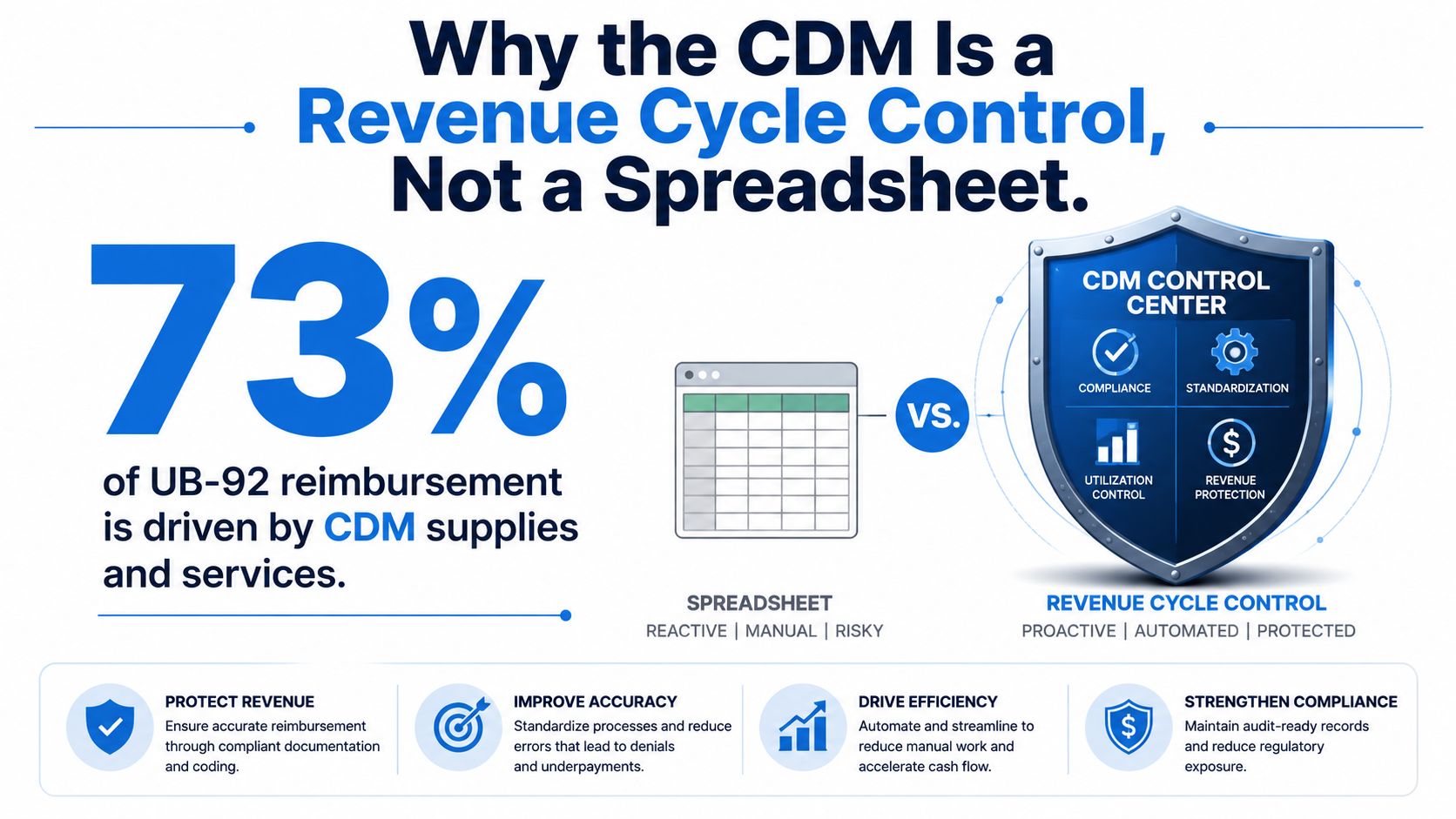
A spreadsheet is a document. A CDM is a control point. That difference matters because the hospital uses this file to protect charge capture, reimbursement, and reporting integrity, not just to organize prices. In the AHIMA material, the charge master is described as driving reimbursement for a large share of outpatient claims, which is why revenue teams do not treat CDM maintenance as clerical work.
What that means operationally
A missed high-volume charge rarely stays small. The same service pattern can repeat across outpatient encounters, so one missing row can echo through many claims. The AHIMA guidance also describes a material rate of inaccurate or missing chargemaster items in high-value areas such as supplies, pharmacy, operating room time, and room charges. Even without turning that into a forecast, the point is clear, a weak CDM can distort a large share of outpatient billing activity.
The financial logic is straightforward. A missing item undercaptures charges. A mispriced item can compress reimbursement or create contract friction. A mislabeled item can trigger audit exposure. Those outcomes do not show up as one dramatic failure. They show up as scattered underpayments, avoidable denials, and time spent fixing the same class of issue over and over.
A managed CDM is more like a control tower than a price list. It needs someone watching for changes in services, reviewing whether the charge logic still matches how care is delivered, and correcting problems before those problems reach claims. That is the difference between a list that sits in a folder and a live asset that supports payment.
Why the spreadsheet mindset fails
A spreadsheet invites passive ownership. Someone updates it when there is time. A revenue control needs a named owner, a review cadence, and trigger points for change. That is the difference between a file and a managed process.
Hospitals also get the governance question wrong when they treat the CDM as an IT artifact. IT can host the file. Revenue integrity has to own the logic because the logic changes when services change, contracts change, or departments change how they work. Without that ownership, the CDM becomes stale in the same way an old map fails after roads shift, it still looks organized, but it no longer matches the route people travel.
Bottom line: An inaccurate CDM creates both data problems and reimbursement problems.
For readers who want the operational context behind why charges show up the way they do, the internal discussion of medical coding issues belongs in a section focused on error patterns and claim fallout, not in the control discussion here.
Governing the CDM Through People, Cadence, and Triggers
The most common CDM mistake is assuming ownership belongs to IT alone. IT can host the file, but revenue integrity has to own the logic, because the logic changes when services change, contracts change, or departments start using a new workflow. A good governance model names one accountable owner, usually a revenue integrity lead or equivalent, then gives that owner access to coding, department operations, and finance input.
Ownership has to be cross-functional
HFMA-derived guidance in the brief points to review processes, departmental interviews, volume analysis, and chart audits. That combination matters because each source sees a different kind of error. Department leaders know when a service was added. Coders know when the description is too vague. Finance knows when charges drift away from contracts or fee schedules. No single team sees all of it.
Operational rule: unused codes should be removed, new services should be added quickly, and charge logic should be checked against contracts before the errors hit claims.
That means governance should run on a cadence, not on panic. Monthly department reviews catch new services and changed workflows. Quarterly cross-functional audits catch broader mapping issues. A full-file annual reconciliation gives the hospital a deep reset. That cadence is more practical than treating CDM maintenance as a one-time IT project because hospitals don't operate on annual cycles, they operate on constant change.
What should trigger an edit
Three triggers matter most. First, a new service line or workflow change. Second, unused or inactive codes that still sit in the file and create room for error. Third, a contract or fee schedule change that makes the current price logic stale. Revenue integrity consultants in the verified material specifically note that the CDM should stay current, unused codes create errors, and charges should align with contracts and fee schedules instead of being treated as a static list.
A simple governance checklist helps here:
- Defined owner: one person is accountable for the file's integrity.
- Regular reviews: meetings happen on a set schedule, not only after denials spike.
- Trigger-based edits: workflow, contract, and volume changes all prompt review.
- Audit trail: changes are documented so staff can trace why a row changed.
The hospital that does this well avoids the feeling that CDM updates are always behind. The file stays closer to the clinical operation, which is the only way it can keep up.
List Prices, Transparency, and What the CDM Should Optimize For
A lot of leaders still think the CDM's job is to set the highest possible list price. That view is too narrow. The CDM sits at the point where price transparency, payer scrutiny, and internal pricing logic all meet. California publishes hospital chargemaster data statewide, and CMS requires hospitals to post standard charges online, so the CDM is no longer tucked away inside the billing office. It has a public face now.
That public face changes the question entirely. Hospital chargemaster prices are often far above cost, which is why patients and regulators increasingly ask whether a price is defensible, not just present. A CFO should think about the CDM the way a board thinks about a risk policy, it has to hold up when it is reviewed from multiple angles. The central question is what the pricing philosophy should optimize for.
Defensible beats theatrical
HFMA-derived guidance in the brief says charges should be defendable, consistent, and logical. That is the right standard. A CDM built only to maximize list price can become hard to explain to patients, awkward in payer discussions, and brittle under transparency review. A CDM built around logical charge relationships is easier to maintain and easier to justify.
That does not mean hospitals ignore revenue. It means they stop confusing sticker price with strategy. The strongest pricing model is usually the one that can survive clinical review, financial review, and public review without requiring a separate story for each audience.
The CFO decision that matters
The CDM is already visible. The decision is what the pricing philosophy should support, negotiated revenue, public transparency, or internal defensibility. It has to support all three. A hospital that prices only for the loudest headline often ends up with a file that is hard to defend when a payer asks why one service sits so far from the rest of the schedule. A hospital that prices with service reality, contract logic, and transparency requirements in view has a cleaner path.
That is why the best approach is not to chase the highest possible list price. It is to align the charge structure with the actual service, the contract logic, and the disclosure rules that now surround the file. A price that looks aggressive but cannot be explained is a liability. A price that is consistent and rational is much easier to manage over time.
In practice, that means the CDM should be optimized for auditability, not theater. If the pricing logic cannot be explained to a payer, a patient, or a regulator, it probably needs work. For a closer look at how coding mistakes can affect that logic downstream, see this guide to medical coding errors.
Common CDM Errors and Their Financial Impact
The most expensive CDM problems are usually the ordinary ones. A new service is not added when it should be. A revenue code points to the wrong bucket. A price stays frozen after the fee schedule changes. An inactive code keeps moving through the charge workflow. Each issue looks minor at the row level, but each one can create a repeated revenue leak or a compliance problem that keeps showing up until someone owns it.
The error patterns to watch first
Missing codes for new services usually appear when a department grows faster than billing can update the file. The first sign is often a charge that never reaches the claim, or a trail of manual workarounds that staff start using because the clean path is not there. That is how a CDM begins to drift away from actual operations.
Wrong revenue codes create a different kind of trouble. They can send a service into the wrong reimbursement bucket, which often shows up as odd payment behavior or denials tied to claim structure. The service was delivered correctly, but the billing path no longer matches how the claim is built.
Stale prices are quieter, but they can still matter. They may not trigger a denial at all, yet they can create contract mismatch, underpayment risk, or awkward out-of-pocket estimates that are hard to explain to patients and payers. Duplicate entries create another layer of confusion because staff may not know which row is the active one. Inactive codes that still get used are a classic source of downstream errors, especially when staff are moving quickly and choose the wrong line from memory.
The coding layer often sits underneath those mistakes, so a closer look at medical coding errors can help connect the charge file to what happens later in claims.
High-Impact CDM Errors and Their Financial Consequences
| Error Category | Common Symptom | Financial or Compliance Impact |
|---|---|---|
| Missing code for a new service | Charge doesn't appear on the claim | Lost charges, delayed reimbursement, manual correction work |
| Wrong revenue code | Service lands in the wrong billing bucket | Underpayment risk, claim edits, classification problems |
| Stale price | Charge doesn't match current fee logic | Contract mismatch, pricing inconsistency, public transparency risk |
| Duplicate entry | Staff use the wrong active row | Double-billing risk, confusion in audits, cleanup time |
| Inactive code still used | Old line keeps showing up in claims | Denials, rework, and governance breakdown |
The table is not there to make the file look tidy. It is there to help a CFO decide where to start. High-volume services usually deserve first attention, especially if they carry repeated denials or tend to appear in audit findings. That order usually produces faster payoff than trying to clean the entire file at once, because the same small errors can keep repeating across many claims until the underlying row is fixed.
A Practical CDM Self-Assessment and How an RCM Partner Helps
A CDM review works best when it's specific. Don't ask whether the file is “up to date.” Ask whether the hospital can prove that the file is complete, mapped correctly, priced logically, and reviewed on a real cadence. If the answer is fuzzy in any of those areas, the CDM is probably functioning as a static list instead of a managed asset.
Quick self-assessment
Use this as a working checklist:
- Completeness: Are new services added promptly, or do departments wait for billing to catch up?
- Code mapping: Do charge codes, revenue codes, and procedure links line up cleanly?
- Price alignment: Are charges consistent with the hospital's current fee logic and contract structure?
- Governance cadence: Is there a named owner and a recurring review cycle?
- Audit history: Can the team show what was reviewed, changed, and why?
If one or two of those answers are uncertain, the next step is not a full redesign. It's a focused cleanup.
A realistic 30, 60, 90-day path
In the first 30 days, identify the top service lines, the newest services, and the highest-risk inactive codes. In the next 60 days, cross-check those rows against department workflows and fee schedules. By day 90, you should have a documented cadence, a change log, and a repeatable review process that doesn't depend on one person remembering to chase updates.
That's where a full-service revenue cycle partner can help without turning the CDM into a side project. Clarity's fee schedule and practice management setup can establish the billing foundation, billing operations support can keep day-to-day charge activity moving, insurance benefit verification can reduce avoidable denials, and claim status and payment posting can close the loop when a CDM issue shows up downstream. The useful part isn't just implementation, it's having a feedback system that keeps the file honest.
A good CDM program doesn't end when the file is updated. It ends when the claim path, payment posting, and denial patterns all start telling the same story.
If you're ready to turn your CDM into a managed revenue asset instead of a static price list, Clarity can review your current revenue cycle, identify where your charge structure is breaking down, and help you build a practical cleanup plan. Visit Clarity to schedule a complimentary consultation and get a path for your practice.
No responses yet