

A front-desk error doesn't stay at the front desk. A 2024 study in PMC found that 60% of claims denials originate from errors in patient demographics or insurance eligibility verification, yet most revenue cycle management steps are still presented as a tidy billing checklist instead of a financial control system (PMC study on denial origins).
That framing is too narrow for leadership. CFOs, CEOs, and physician owners don't need another generic workflow diagram. They need to know where cash slows down, where labor costs rise, and which process failures create preventable write-offs. In practice, the revenue cycle starts before care is delivered and keeps shaping margin long after the claim is submitted.
Table of Contents
- Moving Beyond the RCM Checklist
- Fortifying Your Front-End RCM Foundation
- Translating Clinical Services Into Clean Claims
- Mastering Back-End Processes to Secure Revenue
- Driving Performance With Analytics and Reconciliation
- Your RCM Implementation and Partnership Roadmap
Moving Beyond the RCM Checklist
Most articles treat revenue cycle management steps like a sequence of boxes. Schedule the patient. Verify benefits. Code the visit. Submit the claim. Post the payment. Work denials. Close the account.
That sequence is directionally right, but operationally incomplete. A practice doesn't lose revenue because it forgot the order of the steps. It loses revenue because a weak action early in the cycle forces expensive correction later. Front-end friction becomes back-end labor, delayed cash, patient confusion, and write-offs.
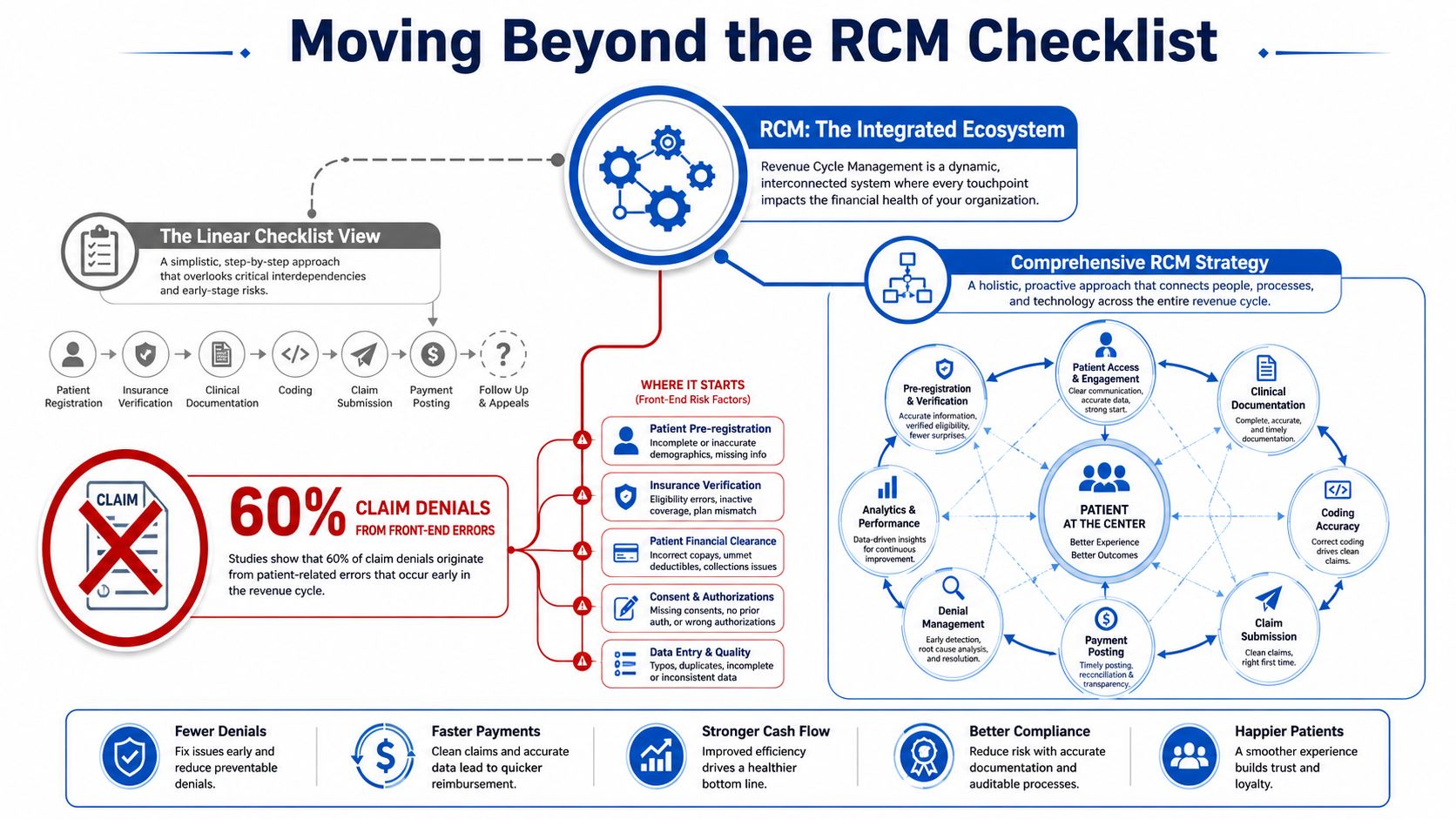
A better way to think about revenue cycle management steps is as an integrated operating model with three financial phases:
- Front-end controls: scheduling, pre-registration, eligibility, authorizations, and financial clearance
- Middle-cycle translation: documentation, coding, charge capture, and claim preparation
- Back-end recovery: payment posting, denial management, AR follow-up, reconciliation, and reporting
This is why leadership should stop treating RCM as a back-office utility. It's closer to a margin protection function. Every bad demographic field, missed authorization, unsupported modifier, unapplied contractual variance, or ignored aging bucket creates downstream work that someone must pay for.
Practical rule: If a task can be done before the visit, it's almost always cheaper to do it there than after a denial.
That's also why a visual process map matters. A detailed healthcare revenue cycle flowchart can reveal something a checklist hides. The work is interconnected. Registration quality affects coding confidence. Coding quality affects clean claim performance. Payment posting quality affects whether underpayments are ever seen. Analytics only help if the underlying workflow is controlled.
Fortifying Your Front-End RCM Foundation
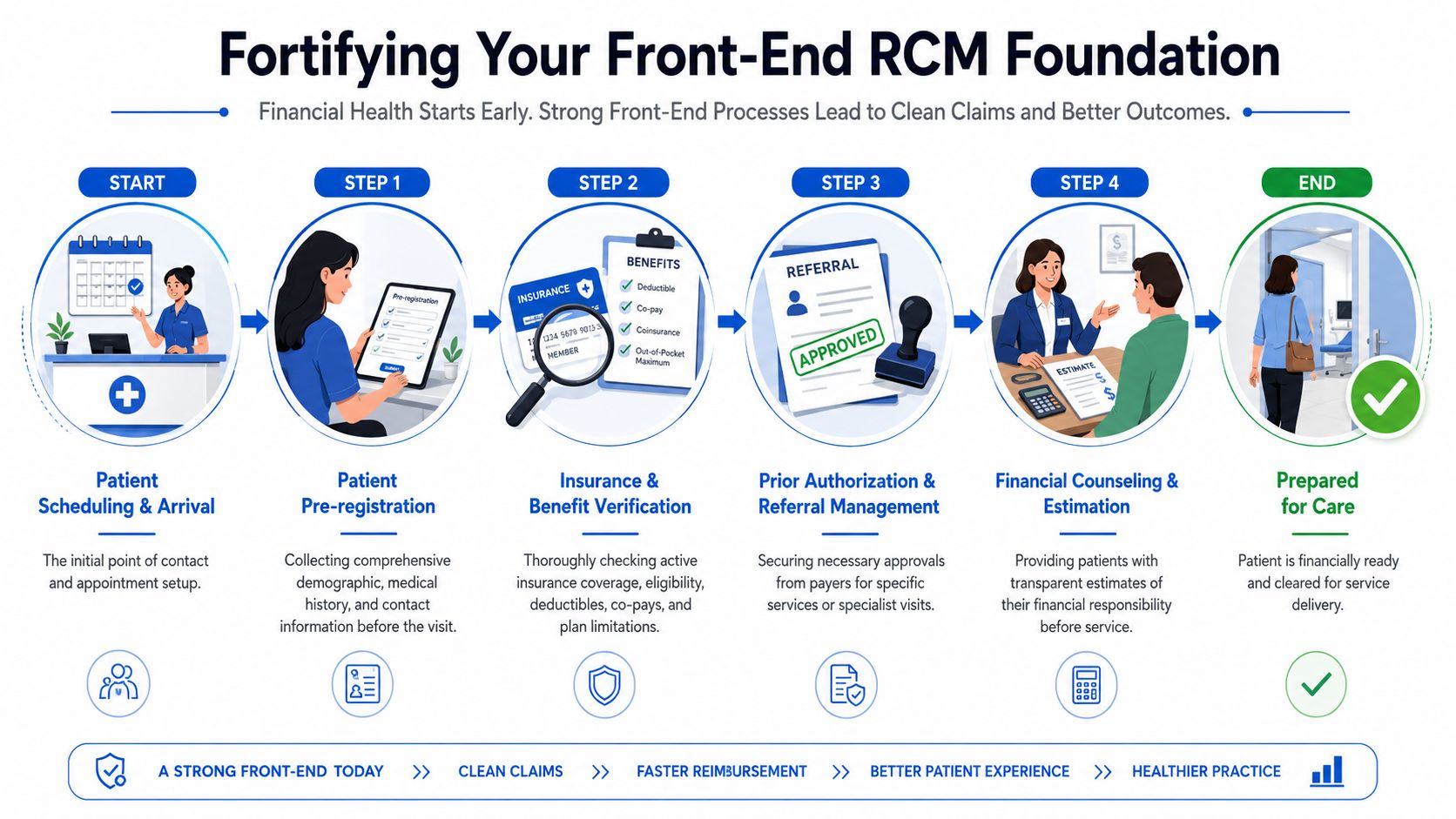
The most effective revenue cycle interventions usually happen before the encounter starts. The front end sets the conditions for clean billing, realistic patient estimates, and fewer avoidable denials.
Why the first touchpoint drives margin
The American Medical Association emphasizes that the integrity of pre-registration data, including verifying insurance coverage and identifying preauthorizations before service, is the cornerstone of a healthy revenue cycle and the most effective preventative measure against revenue loss (AMA guidance summarized by TruBridge).
That should change how leadership staffs and manages front-desk operations. Registration isn't clerical overhead. It's revenue protection. Teams that rush through intake, trust old insurance cards, or verify only for new patients create preventable denials that the billing office inherits later.
A common mistake is relying on static patient data. Returning patients change employers, plans terminate, secondary coverage shifts, and referral rules change. Front-end staff often assume familiarity equals accuracy. It doesn't. Real-time checks at scheduling and again before the visit are far more reliable than one-time verification.
Here's the other issue: fee schedule and practice management setup rarely get enough executive attention. If payer rules, plan mappings, or service-level financial expectations aren't set correctly, the staff member at check-in can't communicate clearly, and the billing team receives flawed data from the start.
A short training resource can help teams standardize the process before they touch workflows:
A practical front-end control list
For front-desk and pre-service teams, these are the controls that prevent trouble:
- Confirm demographics field by field: Don't ask, “Anything changed?” Ask the patient to confirm address, date of birth, phone, guarantor, and insurance details individually.
- Verify eligibility before every visit: New patient or established patient, it doesn't matter. Coverage changes faster than most practices think.
- Check authorization status before service: If the service requires preauthorization or referral, don't leave it to chance or memory.
- Document financial responsibility clearly: Staff should communicate copay, deductible exposure, and any known patient balance before the encounter.
- Use structured intake forms: Required fields should block submission when key information is missing.
- Escalate exceptions immediately: Out-of-network status, inactive coverage, missing referral, and mismatched subscriber data shouldn't sit in a generic queue.
What doesn't work is verbal reassurance without documentation, copied-forward insurance records, and “we'll fix it after the visit” thinking. Those habits feel efficient in the moment and expensive later.
Registration quality is one of the few RCM levers that improves denials, rework, patient collections, and staff workload at the same time.
Translating Clinical Services Into Clean Claims
A claim only gets paid if it tells a coherent financial story. The middle of the cycle is where clinical work becomes billable work, and small defects become expensive ones.
Charge capture is a revenue integrity issue
Missed charges don't announce themselves. They disappear. That's why charge capture deserves more attention from leadership than it typically gets. If the provider documentation, ancillary services, supplies, or time-based elements aren't translated into the billing workflow correctly, no amount of collections effort will recover revenue that was never billed.
Practices that tighten this stage usually focus on three things:
- Documentation discipline: The clinical note has to support what was performed.
- Coding review: CPT, ICD-10, and modifiers must align with payer requirements and the record.
- Charge reconciliation: Teams compare what happened clinically against what entered the claim stream.
For organizations reviewing workflow design, a focused guide to charge capture in healthcare is useful because it forces a basic question many groups skip: where exactly can billable activity fall out of the process?
Clean claims come from disciplined translation
The financial stakes here are straightforward. The industry average clean claim rate is approximately 85%, meaning 15% of claims require costly rework. A single denied claim can cost a provider between $25 and $100 in labor to resolve (clean claim benchmark and denial rework cost).
That changes the conversation around coding edits and claim scrubbing. This isn't about perfectionism. It's about labor economics. Every claim that leaves with a preventable error creates avoidable follow-up, delayed reimbursement, and more touches per account.
Teams with strong middle-cycle performance usually share a few habits:
- They scrub before submission: Clearinghouse edits, payer-specific rules, and NCCI-related checks should happen before the claim leaves.
- They resolve rejects daily: A rejected claim isn't pending revenue. It's a failed transmission until someone fixes it.
- They train coders and billers together: Coding and billing teams often work from different assumptions. Shared review sessions reduce that gap.
- They audit recurring failure types: If the same modifier, diagnosis pairing, or documentation gap keeps appearing, the fix belongs in process design, not in endless rework.
A bad operating model here looks familiar. Providers finish charts late. Charges drop in batches. Billers inherit incomplete documentation. Scrubbing catches only obvious errors. Denials rise, and everyone blames the payer. In reality, the claim often left the building weak.
Mastering Back-End Processes to Secure Revenue
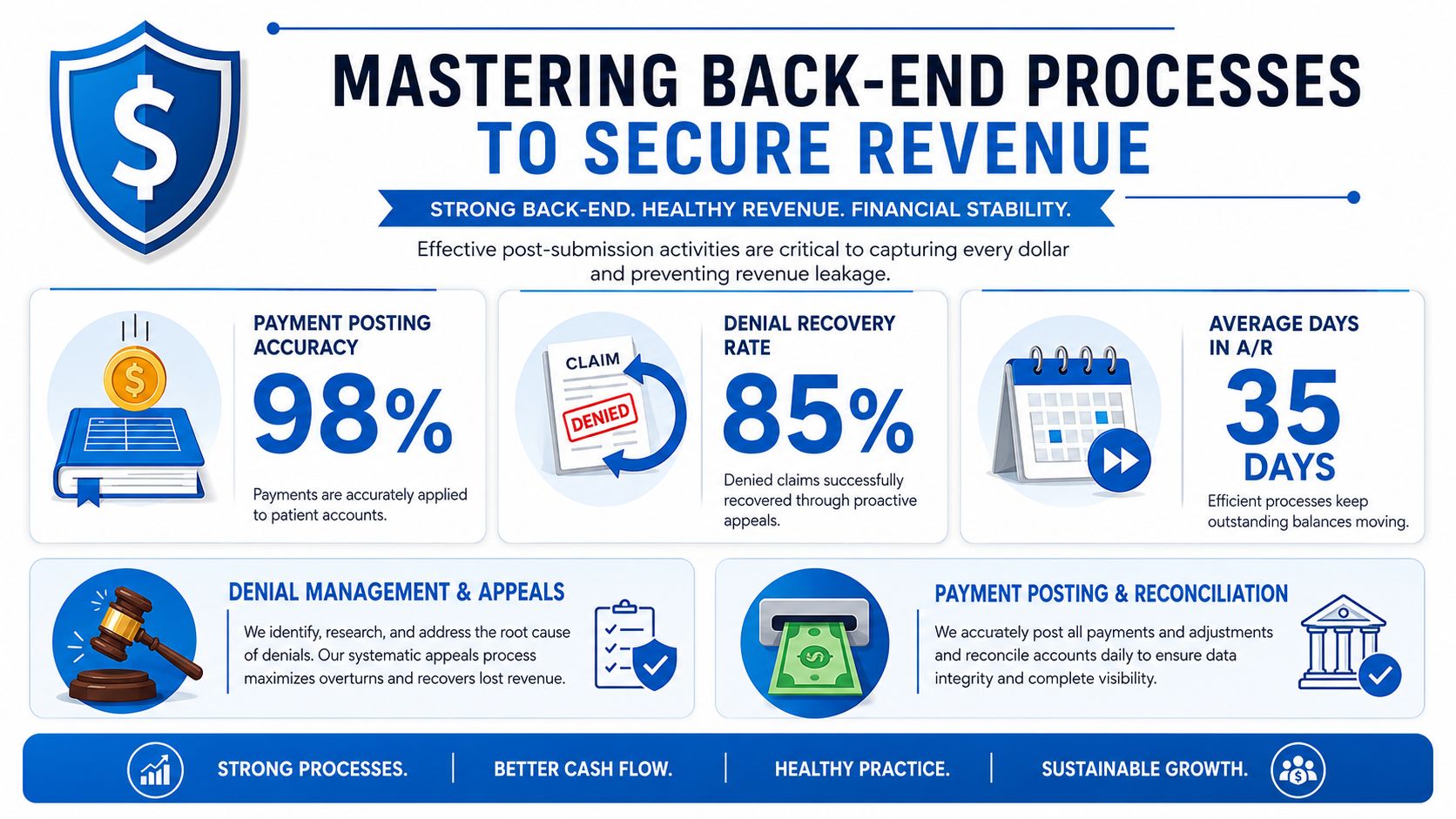
The back end decides whether earned revenue turns into collected revenue. Once the claim is out the door, the practice needs a system for interpreting payer behavior, spotting underpayments, and pursuing the right balances in the right order.
Payment posting is where underpayments first appear
Payment posting is often treated like bookkeeping. That's a mistake. It's the first place a practice can see whether a payer adjudicated the claim correctly, applied contractual adjustments properly, or paid less than expected.
When teams “post and move on,” they miss patterns. A payer may consistently underpay certain codes, process a category of claims incorrectly, or apply avoidable denials in a repeatable way. If no one is reconciling the remittance against expected reimbursement logic, the organization trains itself to accept leakage as normal.
Denials and AR need triage, not heroics
Two benchmarks matter here. The target benchmark for Days in Accounts Receivable is 30 to 35 days, and the top 3 denial reason codes typically represent 60% to 70% of all denials (Days in AR and denial concentration benchmark).
That tells you something important. Most denial work shouldn't be broad and reactive. It should be narrow and targeted. A team that knows its top denial categories can redesign process where it matters instead of chasing every account with the same urgency.
Strong back-end teams don't work the loudest accounts first. They work the accounts that are most collectible and most diagnostic of a broken process.
A useful operating rhythm looks like this:
- Segment AR by age: Review 0 to 30, 31 to 60, 61 to 90, and 90+ day buckets separately.
- Sort denials by root cause: Eligibility, coding, credentialing, authorization, timely filing, and payer processing errors need different owners.
- Prioritize appeals deliberately: Some denials justify appeal because the issue is fixable and the claim value supports the work. Others should feed prevention efforts instead.
- Create closed-loop feedback: If denial trends point to registration, coding, or payer setup problems, those teams need the data quickly.
The KPI set should stay simple enough to drive action. This table works well in leadership review:
| KPI (Key Performance Indicator) | Industry Benchmark | What It Measures |
|---|---|---|
| Clean Claim Rate | Approximately 85% baseline | The share of claims submitted without errors requiring rework |
| Days in Accounts Receivable | 30 to 35 days | How quickly the practice converts billed revenue into cash |
| Claim Denial Rate | Above 10% signals an unhealthy process | Whether preventable breakdowns are reaching the payer |
| Top 3 Denial Reason Codes | Typically represent 60% to 70% of denials | Where the highest-volume process failures are concentrated |
Driving Performance With Analytics and Reconciliation
Dashboards matter only if they change decisions. Many practices already have reports. Far fewer have analytics that tell leaders where revenue cycle management steps are failing, who owns the fix, and whether the correction held.
Reporting that changes behavior
A useful RCM dashboard doesn't drown leadership in columns. It tracks a small number of operational signals over time and ties each one to a process owner. Denial rate belongs to more than billing. Eligibility-related denials belong to front-end leadership. Coding-related denials belong to documentation and coding leadership. Credentialing-related denials belong to enrollment and payer management.
The warning threshold is clear. Industry benchmarks indicate that claim denial rates above 10% signal an unhealthy RCM process, with common root causes being failures in eligibility verification, coding errors, or credentialing issues (claim denial benchmark and root causes).
That's why a modern healthcare revenue cycle analytics approach should answer operational questions, not just produce month-end summaries:
- Which denial categories are rising
- Which payers are slowing payment
- Which locations or providers have recurring documentation problems
- Which queues are aging without action
- Which variances suggest underpayment or setup errors
Reconciliation closes the loop
Reconciliation is where RCM becomes a strategic financial function. Posted payments should be checked against contracted expectations, especially with major payers and frequently billed services. If a payer repeatedly reimburses below contract logic and no one reviews it, the practice accepts silent erosion.
This is also where executives should insist on accountability. If the dashboard shows a pattern, someone should own the remediation plan, the timeline, and the follow-up review. Reporting without accountability turns into a monthly ritual. Reporting with reconciliation and ownership turns into performance management.
If leadership only sees collections totals, leadership is already too late in the cycle.
Your RCM Implementation and Partnership Roadmap
Most organizations don't need more theory. They need a sequence for fixing what's broken without creating new confusion. The fastest improvement usually comes from stabilizing the front end, then tightening translation and follow-up, then building the reporting discipline to keep gains from slipping.
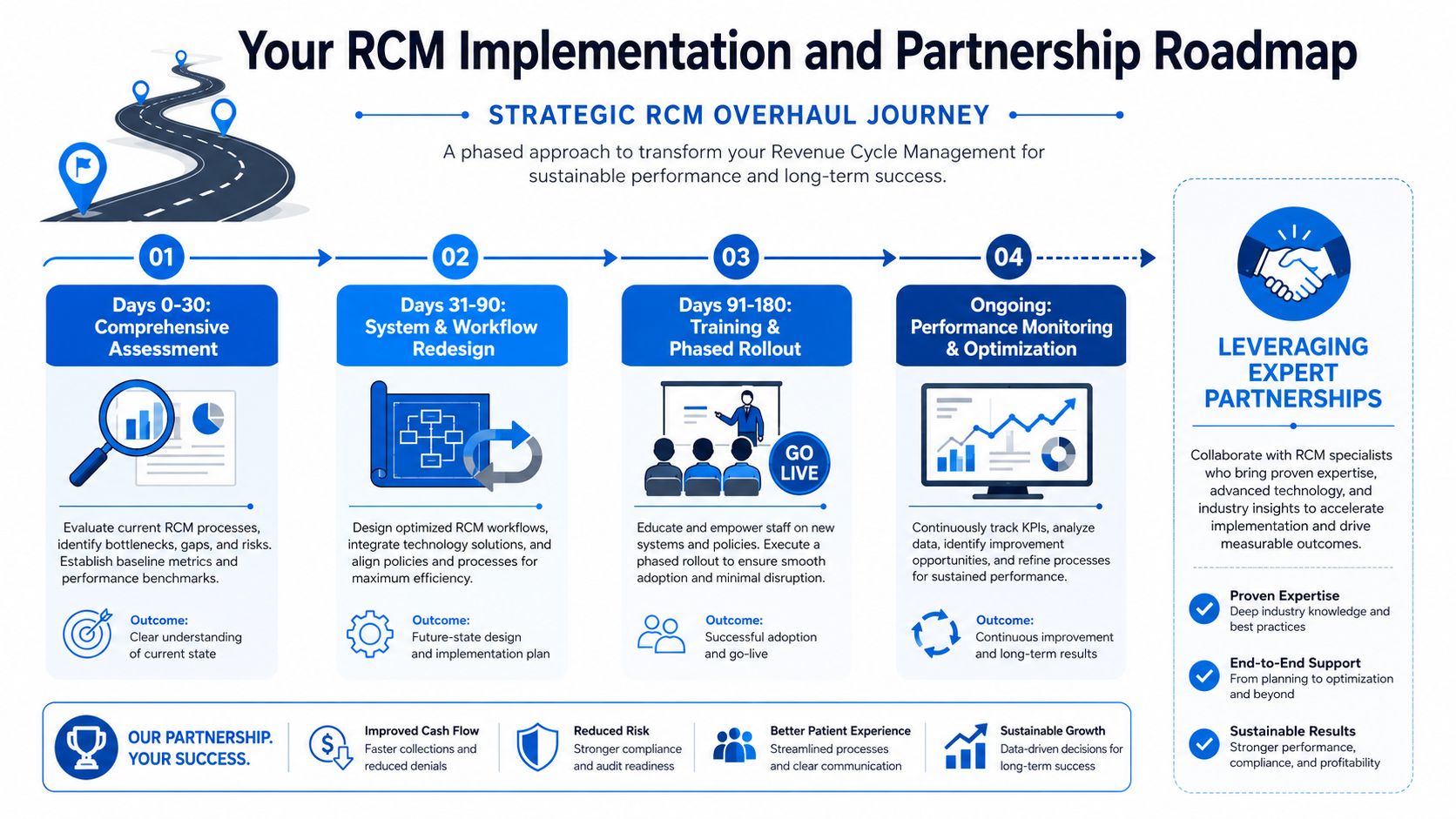
Days 0 to 30 stabilize the foundation
Start with an audit that follows the life of a claim from scheduling through payment. Don't begin by asking where the billing office is struggling. Begin by asking where bad data enters the system and where cash stops moving.
Review scheduling scripts, pre-registration fields, insurance verification workflow, authorization handling, fee schedule setup, claim edit work queues, payment posting logic, denial categories, and aging structure. Pull examples from each major payer and each major service line. Leadership needs to see the specific handoff points where revenue cycle management steps are breaking down.
In this first phase, the priority is control, not speed. Standardize intake requirements. Define who verifies coverage and when. Require exception handling for inactive insurance, authorization gaps, and mismatched subscriber data. Clean up basic build issues in the practice management system that force manual work later.
Days 31 to 90 redesign the work
Once the obvious leakage points are visible, redesign workflows around prevention and ownership. Many projects fail at this stage because practices try to fix everything at once.
A better pattern is to choose a short list of high-friction changes:
- Front-end redesign: Required-field intake, real-time verification, documented financial clearance, and tighter referral or authorization workflows
- Middle-cycle redesign: Clear charge entry rules, coder-biller review loops, and a daily process for claim rejection correction
- Back-end redesign: Denial category ownership, payer-specific follow-up queues, aging-based worklists, and underpayment review during posting
Training matters here, but generic training won't hold. Teams need role-based standards, examples of acceptable documentation, and escalation rules for exceptions. A registrar should know when to stop the workflow and who to involve. A biller should know when to appeal, when to correct and resubmit, and when to push a trend upstream.
Days 90 and beyond manage the cycle like a financial asset
At this stage, the organization should move from cleanup to managed performance. Monthly review should focus on trend lines, not anecdotes. If a denial category improves, confirm the fix stayed in place. If AR starts stretching again, look at queue ownership, payer changes, and staffing design before the problem gets normalized.
Executive sponsorship matters more than many groups expect. Operational changes in RCM don't stick if leaders tolerate exceptions, allow each location to use different standards, or treat billing issues as isolated staff problems. Consistency wins. So does transparency.
This is also where an external RCM partner can provide a real advantage. The value isn't just extra hands. It's specialized process ownership, payer experience, workflow discipline, and the ability to plug gaps without forcing the practice to build every capability internally. Some groups need end-to-end support. Others need focused help with insurance benefit verification, fee schedule setup, payment posting, or AR follow-up. The right model depends on where the cycle is weakest and how much internal management capacity exists.
The practical test is simple. If leadership can't clearly answer where denials start, where cash is aging, and who owns correction by category, the current operating model needs help.
Clarity is a full-service healthcare revenue cycle management partner that helps providers strengthen fee schedule and practice management setup, insurance benefit verification, billing operations, claim status follow-up, and payment posting. If your team needs a full RCM overhaul or targeted support in the parts of the cycle that are leaking revenue, Clarity offers a complimentary consultation to assess your current process and recommend a customized path to better accuracy, efficiency, and financial performance.
No responses yet