
Healthcare revenue cycle management has become a larger strategic buying decision as the RCM market continues to expand quickly over the next decade, according to Fortune Business Insights.
For CEOs, CFOs, and physician owners, the question is not which vendor has the broadest marketing claims. It is which healthcare RCM company fits your organization's size, payer mix, staffing model, and tolerance for operational change.
RCM now affects cash flow, labor cost, denial rates, patient collections, and reporting discipline across the full revenue cycle. Leaders who are still separating basic billing from broader revenue cycle strategy should review the difference between medical billing vs revenue cycle management before comparing partners.
This guide is built for selection, not browsing. Each company is framed by Best For context, followed by practical pros and cons, so you can compare hospital-scale outsourcing, platform-first models, and more flexible service approaches without losing sight of the trade-offs. Clarity is included in that same decision framework, with the rest of the list designed to help you choose a partner that improves revenue performance without creating avoidable operational drag.
Table of Contents
- 1. Clarity
- 2. R1 RCM
- 3. Optum
- 4. Ensemble Health Partners
- 6. athenahealth
- 6. athenahealth
- 7. GeBBS Healthcare Solutions
- Top 7 Healthcare RCM Companies Comparison
- How to Choose the Right RCM Partner for Your Practice
1. Clarity
Best for leaders who want a consultative RCM partner instead of a one-size-fits-all outsourcing package.
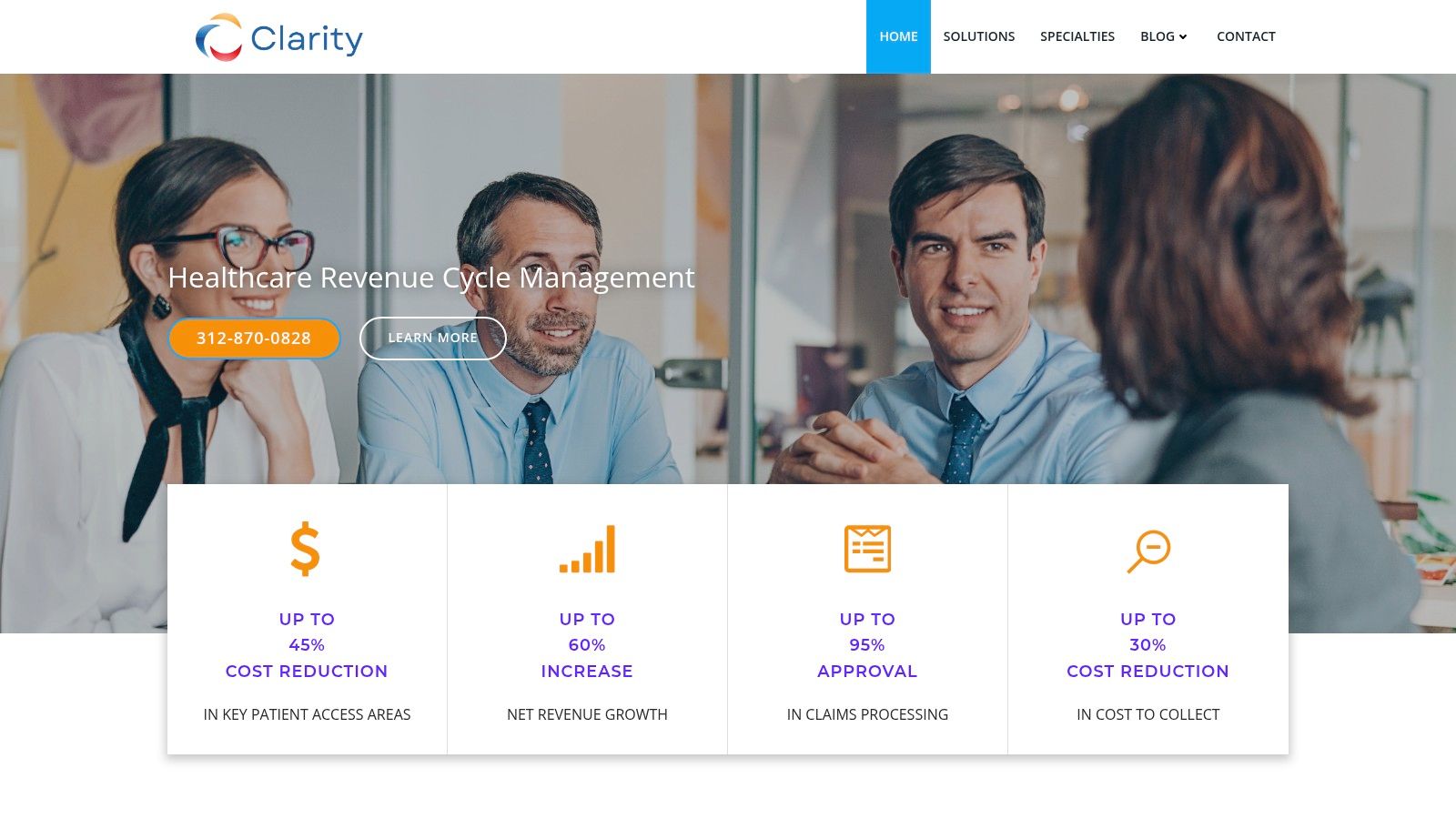
Clarity positions itself as a full-service healthcare RCM company built around practical operational support. That matters because many vendors are either software-first or enterprise-outsourcing-first. Clarity sits in the middle. It can take over the full revenue cycle, or step into specific weak points like insurance benefit verification, claim status follow-up, payment posting, billing operations support, and fee schedule or practice management setup.
For CEOs, CFOs, and physician owners, that flexibility is usually the deciding factor. If your internal team is strong in coding but weak in front-end eligibility, you don't need to replace the whole system. If your practice has broader leakage across intake, billing, and collections, a fuller engagement makes more sense. Clarity's operating model gives you both options, and that's more useful than a rigid outsourcing scope.
Why Clarity stands out
Clarity starts with a complimentary revenue-cycle consultation and builds a specific improvement plan before pricing. That's the right sequence. In practice, providers often confuse medical billing with true end-to-end revenue cycle management, even though front-end and mid-cycle errors are what often trigger downstream denials. This is why the distinction between medical billing and revenue cycle management matters when evaluating vendors.
The company also presents a strong credibility profile through the organizations it has supported, including Rush University Medical Center, Northwestern Faculty Foundation, University Transplant, Children's Memorial ED, Saint Anthony Hospital, Trinity Hospital, and Access Community Health Centers.
Practical rule: If a vendor can't clearly explain what they own before claim submission, not just after denial, they're probably a billing shop, not a real RCM partner.
Pros and cons in practice
What works well with Clarity is the service range and the consultative posture. The team can support foundational setup work, daily billing operations, eligibility verification, claim follow-up, and payment posting without forcing an all-or-nothing engagement. That's attractive for practices that need targeted help now but may want to expand scope later.
A few trade-offs are real:
- Flexible scope: You can use Clarity for end-to-end support or targeted gap coverage.
- Operational breadth: The service menu spans front-end, mid-cycle, and back-end work.
- Consultative start: The complimentary review helps define likely savings and priorities before contract discussions.
The main downside is straightforward. Public pricing isn't listed, so leaders need to go through the consultation process before they get exact numbers and contract structure. Results will also depend on how clean your underlying workflows and data are at the start. That's true of every RCM engagement, but it matters most when a vendor is trying to fix root causes instead of just working queues.
You can review Clarity directly at Clarity Health RCM.
2. R1 RCM
Best for hospital systems and enterprise physician organizations that need scale.
R1 RCM is one of the better-known names among healthcare RCM companies for large provider organizations. Its appeal is scale and breadth. R1 covers patient access, coding, billing, denials, collections, and analytics, with the operational maturity that large hospitals usually require.
The market context supports why vendors like R1 keep gaining traction. The broader global RCM market reached USD 102.16 billion in 2024 and is forecast to expand to USD 291.19 billion by 2033, while cloud-based RCM platforms generated USD 55 billion in 2024, according to Datam Intelligence's market release via PR Newswire. That trend favors enterprise partners that can combine service delivery with centralized technology.
Best for hospital-scale outsourcing
R1 makes sense when the job is bigger than isolated billing optimization. If a health system needs broad workflow redesign across patient access, charge capture, and A/R, R1 is built for that kind of transition. It also offers ambulatory RCM support, which matters for systems trying to standardize across employed physician networks and hospital operations.
For leaders comparing vendor-led services to internal platforms, it's also worth understanding how healthcare RCM software differs from outsourced operational execution. Software visibility alone won't fix broken workflows.
Where the trade-off shows up
R1 is rarely the best fit for groups that want a light-touch engagement. Large transitions demand governance, executive sponsorship, process discipline, and time. If your organization isn't ready for structured change management, the implementation burden can become the problem.
Large vendors help most when leadership has already decided to standardize process, not when it still wants every site to keep its own exceptions.
You can evaluate the platform and services at R1 RCM.
3. Optum
Best for large organizations looking to consolidate operations, analytics, and automation under a major healthcare enterprise partner.
Optum's revenue cycle offering is broad by design. It spans patient access, coding, clinical documentation integrity, billing, denials, and analytics across ambulatory and acute settings. For health systems already trying to reduce platform sprawl, that integrated positioning is a real advantage.
The strongest case for Optum is when leadership wants more than labor replacement. Optum is usually part of a larger operating model discussion that includes workflow redesign, automation, and data visibility.
Best for platform consolidation
The AI-enabled RCM market is projected to grow from USD 21.49 billion in 2026 to USD 71.27 billion by 2031 at a 27.10% CAGR, and claims and denial management captured 43.13% of total spending in 2025, according to Mordor Intelligence's AI in revenue cycle management market analysis. That aligns with Optum's positioning. The company is strongest when clients want automation in coding, denials, and workflow orchestration, not just outsourced billing headcount.
For groups considering outsourced support without fully replacing their current stack, medical billing services can sometimes be the cleaner path than a broad consolidation project.
What leaders should watch
Optum is usually better suited to larger organizations than smaller independent groups. The upside is depth, scale, and a large resource base. The downside is complexity. Existing systems, governance models, and local workflow preferences can slow integration.
In plain terms, Optum works best when your organization wants one strategic operating partner and is prepared to behave like an enterprise buyer. If you mainly need faster A/R follow-up or cleaner front-end eligibility, this can be more infrastructure than you need.
You can review its offering at Optum Revenue Cycle Management.
4. Ensemble Health Partners
Best for large health systems that want an operator-led RCM partner with proven hospital outsourcing depth.
Ensemble Health Partners is one of the names hospital executives often shortlist when they want end-to-end outsourcing with operational rigor. The company's positioning is not just about staffing claims and billing functions. It emphasizes embedded best practices, analytics, and sustained performance management across patient access, mid-cycle work, and back-end collections.
That model has visible scale. Ensemble provides end-to-end RCM services for 35 health systems, manages $46 billion in net patient revenue, and processes more than 80 million claims annually, according to the PubMed Central review on revenue cycle management and KPIs.
Best for large health systems that want operational depth
This is the kind of vendor you consider when your issue isn't one broken department. It's systemic variation across registration, coding, denials, and follow-up. Ensemble's appeal is that it can operate across the full cycle while keeping attention on measurable discipline, not just queue coverage.
The same review notes that well-implemented RCM addresses major inefficiencies in healthcare and that claim denials cost hospitals approximately $262 billion per year globally. That context makes denial prevention and process reliability more than a back-office concern.
Why Ensemble gets attention
Ensemble tends to fit organizations that value a high-touch operating relationship. That can be a strength. It also means the partnership requires governance. Executive leaders need to stay engaged on KPIs, accountability, and local adoption.
- Strong hospital orientation: Best suited for health systems and larger provider organizations.
- End-to-end model: Useful when fragmentation is the actual problem.
- Analytics plus operations: More credible than outsourcing models that only promise labor relief.
A smaller physician group may find Ensemble too large for what it needs. But for hospitals trying to standardize revenue operations, that scale is often the point.
You can review the company at Ensemble Health Partners.
6. athenahealth
Best for ambulatory groups that want one vendor for EHR, practice management, and revenue cycle services.
A large share of revenue cycle waste in physician practices comes from handoffs between systems, teams, and vendors. athenahealth appeals to leaders who want fewer of those handoffs by putting clinical workflow, scheduling, practice management, and billing support in the same operating environment.
That design choice matters most in ambulatory care. Independent groups, multispecialty practices, and regional platforms often do not need a hospital-scale outsourcing arrangement. They need cleaner workflow, tighter staff coordination, and faster issue resolution when front-office mistakes turn into back-end delays.
Best for ambulatory groups that want software and services together
athenahealth tends to fit organizations that prefer one vendor accountable for both the technology stack and day-to-day RCM support. Eligibility checks, authorizations, charge capture, coding support, denial follow-up, and payment posting all sit closer to the source workflow. For many practices, that reduces rework more than adding another niche vendor would.
The trade-off is straightforward. An integrated model can improve consistency, but it also asks leadership to accept the operating limits of a single platform. If your physicians want highly customized workflows or your finance team already has a strong best-of-breed stack, athenahealth can feel constraining.
Pros and cons leaders should weigh
Pros
- Tighter workflow alignment: Front-desk, clinical, and billing teams work from the same core system.
- Good fit for lean teams: Practices with limited internal IT and revenue cycle management often benefit from fewer vendor relationships.
- Clear ambulatory focus: The model lines up well with physician groups that want practical operational support, not enterprise transformation.
Cons
- Less flexibility than a modular stack: Organizations with specialized tools or unusual workflow needs may run into platform limits.
- Not ideal for every care setting: Large hospitals and complex health systems often need a different operating model.
- Vendor concentration risk: One partner handling software and services can simplify oversight, but it also raises switching costs.
For CEOs and CFOs, the question is not whether integrated RCM sounds efficient. The question is whether your main problem is fragmentation. If it is, athenahealth deserves serious consideration. If the underlying issue is payer contracting, denial strategy, or specialty-specific complexity, a more consultative partner may be the better fit.
6. athenahealth
Best for ambulatory groups that want one vendor for EHR, practice management, and revenue cycle services.
athenahealth is a practical choice when an ambulatory organization wants fewer handoffs between software and services. Its value proposition is straightforward. The platform combines EHR, practice management, and RCM support in one environment, which can simplify eligibility checks, authorization workflows, coding support, denial work, and payment posting.
That simplification is often more valuable than feature depth. Many physician groups don't need a massive outsourcing partner. They need a system that reduces operational friction enough for a lean internal team to stay on top of the cycle.
Best for ambulatory groups that want software and services together
athenahealth tends to work best for small-to-midsize groups, multisite ambulatory practices, and organizations already inclined toward a single-vendor operating model. If leadership wants one partner accountable for both workflow tooling and billing support, athenahealth deserves a close look.
That said, integrated RCM isn't just a convenience trend. Integrated solutions currently hold the largest market share in revenue cycle management because they address the entire process from patient registration to final payment collection, as noted in the Fortune Business Insights market report referenced earlier.
Where athenahealth fits and where it doesn't
The upside is simplicity. The trade-off is control. A tightly integrated platform can make standardization easier, but some specialties still need close oversight for nuanced coding, payer policy interpretation, and denial escalation. Groups with unusual workflows may find the single-vendor model less flexible than it first appears.
In practice, athenahealth is strongest when a group values operational consistency over bespoke process design.
You can review the offering at athenahealth Revenue Cycle Services.
7. GeBBS Healthcare Solutions
Best for flexible staffing models, blended delivery, and organizations trying to control cost without giving up workflow coverage.
GeBBS Healthcare Solutions is often considered when provider organizations want end-to-end RCM support with more delivery flexibility than traditional enterprise outsourcers provide. The company offers billing, coding, A/R follow-up, risk adjustment, and point solutions, backed by onshore, nearshore, and offshore resources.
For many finance leaders, that's the main attraction. GeBBS can flex staffing and throughput without forcing the organization into one rigid service structure.
Best for flexible staffing and blended delivery
GeBBS is particularly relevant when leadership wants cost efficiency and rapid scale-up across coding, work queues, or back-end follow-up. It also fits organizations that are comfortable managing a vendor against defined KPIs and governance standards rather than expecting a significantly embedded strategic transformation partner.
There is another angle many lists miss. Rural facilities often need RCM help that accounts for lower patient volumes, higher uninsured rates, and a more complex payer mix. Becker's notes a strategic gap here, including that rural hospitals lost $8.9 billion in net revenue in 2023 due to reimbursement lags and denials in this underserved segment, as described in Becker's review of revenue cycle management companies to know. Flexible delivery models can help, but only if the vendor understands the operating realities of those facilities.
What to lock down before go-live
GeBBS can be a strong option, but only when the client defines workflows tightly and manages governance seriously.
- Set KPI ownership early: Define who owns denials, turnaround standards, escalation paths, and payer follow-up logic.
- Review security and compliance: Blended delivery requires disciplined controls and clear oversight.
- Map integration points: Results improve when EMR and PM handoffs are explicit before work moves offshore or nearshore.
You can assess the company at GeBBS Healthcare Solutions.
Top 7 Healthcare RCM Companies Comparison
Denials, aging A/R, and labor cost rarely come from one weak workflow. They come from a partner mismatch. The comparison below is built to help practice and health system leaders assess fit by operating model, resource demand, and likely business impact, not just brand recognition.
| Provider | Implementation 🔄 | Resource requirements ⚡ | Expected outcomes 📊 | Best for 💡 | Key advantages ⭐ |
|---|---|---|---|---|---|
| Clarity | Moderate. Flexible full-cycle or a la carte onboarding | Variable. Requires data access, workflow visibility, and staff input early | Revenue improvement, denial reduction, and lower cost-to-collect when priorities are clearly defined | Hospitals and practices that want specific ROI-focused improvements instead of a one-size-fits-all outsourcing model | Flexible scope, outcome-focused engagement, experience with complex revenue cycle problems |
| R1 RCM | High. Enterprise migration and change management are usually substantial | High. Requires strong internal leadership, integration support, and governance | Faster collections and stronger performance visibility through scale, analytics, and automation | Large hospitals, health systems, and multisite ambulatory platforms that need enterprise-level operating discipline | National scale, operational depth, EHR-agnostic ambulatory RCM capabilities |
| Optum (Optum RCM) | High. Consolidation and integration work can be extensive | Very large. Best suited to organizations prepared for major platform and process investment | Better coding, billing accuracy, and process efficiency through analytics and automation | Large health systems pursuing broad RCM standardization across multiple functions | Significant technology investment, broad scalability, integrated platform breadth |
| Ensemble Health Partners | High. High-touch implementation with ongoing governance expectations | Significant. Works best when leadership wants an embedded long-term partner | Stronger financial performance and better denial prevention over time | Hospitals and systems seeking a deeply involved outsourced RCM operating partner | Operator-led delivery, sustained process discipline, strong hospital focus |
| Conifer Health Solutions | High. Broader solution scope can lengthen implementation | Broad. Requires alignment across HIM, coding, finance, and operational teams | Better revenue integrity, coding performance, and support for value-based initiatives | Health systems that need RCM support tied closely to HIM and population health priorities | HIM and coding depth, value-based care support, large-system experience |
| athenahealth (athenaOne) | Moderate. Combined EHR and RCM can shorten deployment for ambulatory groups | Moderate. Requires platform adoption and operational alignment with its model | Efficient billing and collections, with operational gains for ambulatory practices | Small-to-midsize medical groups that want one vendor for EHR, PM, and RCM | Platform simplicity, built-in automation, scalable support for physician groups |
| GeBBS Healthcare Solutions | Variable. Can scale quickly, but governance matters more in blended delivery models | Flexible. Supports cost control through onshore, nearshore, and offshore staffing options | Lower operating cost and scalable execution, especially in defined workflow areas | Organizations that need rapid staffing support or cost-optimized RCM services | Flexible delivery model, scalable staffing, workflow technology support |
A useful way to read this table is by management burden. Clarity and athenahealth usually fit organizations that want faster operational traction without committing to a full enterprise transformation. R1, Optum, Ensemble, and Conifer make more sense when leadership is prepared for heavier implementation, formal governance, and broader process change. GeBBS can fit either camp, depending on scope and oversight.
The trade-off is straightforward. Larger platforms can bring more scale, analytics, and process standardization, but they often require more internal time, more stakeholder alignment, and more tolerance for a longer ramp. More flexible partners can address specific leakage points faster, but results depend on how well the scope matches the actual revenue problem.
For CEOs, CFOs, and physician owners, the key question is not which company looks strongest on paper. It is which partner fits your current breakpoints, internal capacity, and financial goals. That is the difference between buying RCM support and getting measurable performance improvement.
How to Choose the Right RCM Partner for Your Practice
Selecting among healthcare RCM companies isn't really a vendor selection exercise. It's an operating model decision. The wrong partner can add meetings, dashboards, and contract complexity without fixing denials, cash acceleration, or cost-to-collect. The right one improves the daily mechanics that determine whether revenue lands.
Start with diagnosis. Look at where the cycle is breaking. Is the damage happening before the claim goes out, in coding quality, in authorization gaps, or in back-end follow-up? That answer determines whether you need full outsourcing or targeted support. It also keeps you from overbuying.
Then evaluate fit and proof. Ask whether the vendor has real experience with your care setting, specialty mix, and current systems. Claims and denial management accounted for 43.13% of AI-enabled RCM spending in 2025, while patient access and eligibility tools are the fastest-growing segment, according to the Mordor Intelligence analysis cited earlier. That should shape your questions. Don't just ask whether a vendor uses AI. Ask where it applies automation, what workflows remain human-led, and how it handles front-end denial prevention versus back-end recovery.
Finally, prioritize consultative behavior. The best partners don't rush to a generic proposal. They want to review your workflows, identify where leakage occurs, and define the right scope before they talk contracts. That's one reason firms like Clarity stand out. A complimentary revenue cycle consultation is more than a sales tactic when it's done well. It gives leadership a practical view of what needs fixing, what can wait, and whether the expected return justifies the change.
If you're a CFO or CEO, keep the final standard simple. Choose the partner that can explain, in operational terms, how it will improve reimbursement reliability, reduce avoidable work, and fit the way your organization runs. Everything else is presentation.
If you're evaluating healthcare RCM companies and want a practical second opinion before committing to a vendor, Clarity is a strong place to start. Their team offers a complimentary revenue-cycle consultation that helps identify where your process is leaking revenue, whether you need full-service support or targeted help, and what a realistic improvement plan looks like for your practice.
No responses yet